
BuddhistCatholicContemplativeEvangelicalGeneral ChristianHinduJewishLatter-day SaintMuslimNew VisionsProgressive Christian
Beliefs
- Buddhist
- Catholic
- Contemplative
- Evangelical
- General Christian
- Hindu
- Jewish
- Latter-day Saint
- More Voices
- Muslim
- New Visions
- Pagan
- Progressive Christian
Topics
- Religion News
- Food and Religion
- Sports and Religion
- Religious Art
- Religious Music and Entertainment
- Religious Events
- History and Religion
- Style and Religion
- Politics and Religion
- Women in Religion
- Recreation Outdoors and Religion
- Business Finance and Religion
- Careers Workplace and Religion
- Education and Religion
- Family Parenting and Religion
- Health Fitness and Religion
- Home and Religion
- Relationships and Religion
- Technology and Religion
- Travel and Religion
Columnists
- Buddhist Columnists
- Business Finance and Religion Columnists
- Careers Workplace and Religion Columnists
- Catholic Columnists
- Contemplative Columnists
- Education and Religion Columnists
- Evangelists Columnists
- Family Parenting and Religion Columnists
- General Christian Columnists
- Health Fitness and Religion Columnists
- Hindu Columnists
- History and Religion Columnists
- Home and Religion Columnists
- Jewish Columnists
- More Voices Columnists
- Latter Day Columnists
- Muslim Columnists
- New Visions Columnists
- Nonreligious Columnists
- Pagan Columnists
- Politics and Religion Columnists
- Progressive Columnists
- Recreation Outdoors and Religion Columnists
- Relationships and Religion Columnists
- Religion News Columnists
- Religious Art Columnists
- Religious Events Columnists
- Religious Music and Entertainment Columnists
- Sports and Religion Columnists
- Style and Religion Columnists
- Technology and Religion Columnists
- Travel and Religion Columnists
- Women in Religion Columnists
Resource Library
- 2026 Calendar
- Library of World Religions
- The 100 Most Holy Places on Earth
- Patheos Answers
- Podcasts
- Videos
- Faith Leaders Database
- Anglican Episcopalian
- Bahai
- Baptist
- Buddhism
- Christianity
- Confucianism
- Eastern Orthodoxy
- Hinduism
- Holiness and Pentecostal
- ISKCON
- Islam
- Judaism
- Lutheran
- Methodist
- The Church of Jesus Christ of Latter-day Saints
- New Age
- Paganism
- Presbytarian and Reformed
- Protestantism
- Religion Behind the Scenes
- Roman Catholic
- Scientology
- Shia Islam
- Sikhism
- Sufism
- Sunni Islam
- Taoism
- Zen
- See all religions
Research Tools
 Ad-Free & Subscriber Log-In Subscription Support
Ad-Free & Subscriber Log-In Subscription Support
Follow Patheos 

- Trending:
- Forgiveness
- |
- Marriage
- |
- Consciousness
- |
- Death Penalty
- |
- Election
- |
- Halloween

- Home
- Latter-day Saint
- Travel and Religion
- Hope, Faith, Suffering, Ugliness, and Seeming Indifference
Hope, Faith, Suffering, Ugliness, and Seeming Indifference
Last updated on: June 21, 2026 at 8:34 pm by Dan Peterson
Hope, Faith, Suffering, Ugliness, and Seeming Indifference 2026-06-21T20:34:49-06:00 Dan Peterson
Patheos Explore the world's faith through different perspectives on religion and spirituality! Patheos has the views of the prevalent religions and spiritualities of the world.

In my former missionary tracting area, Lauterbrunnen in the Berner Oberland of Switzerland — perhaps, in my judgment, the most beautiful landscape on Planet Earth. (Wikimedia Commons public domain image)
At the beginning of my ward’s sacrament meeting this morning, we sang words that have evidently been included in the various hymnals of the Church of Jesus Christ of Latter-day Saints since the very first one was compiled by Emma Smith, the wife of the Prophet Joseph. These words were penned by Thomas R. Taylor (1807-1835), an English clergyman who died tragically young, at the age of only twenty-seven:
Earth, with her ten thousand flow’rs,
Air, with all its beams and show’rs,
Heaven’s infinite expanse,
Sea’s resplendent countenance—
All around and all above
Bear this record: God is love.
Sounds among the vales and hills,
In the woods and by the rills,,
Of the breeze and of the bird,
By the gentle murmur stirred—
Sacred songs, beneath, above,
Have one chorus: God is love.
All the hopes that sweetly start
From the fountain of the heart,
All the bliss that ever comes
To our earthly human homes,
All the voices from above
Sweetly whisper: God is love.
It’s certainly possible, in many places and in particular moods, to resonate with the sentiment that Rev. Taylor was expressing in his lyrics. (See, for example, this rendition of the hymn by the Tabernacle Choir and the images that accompany it online.) But, as his own sadly brief life suggests, it’s also easy to view the world quite differently.
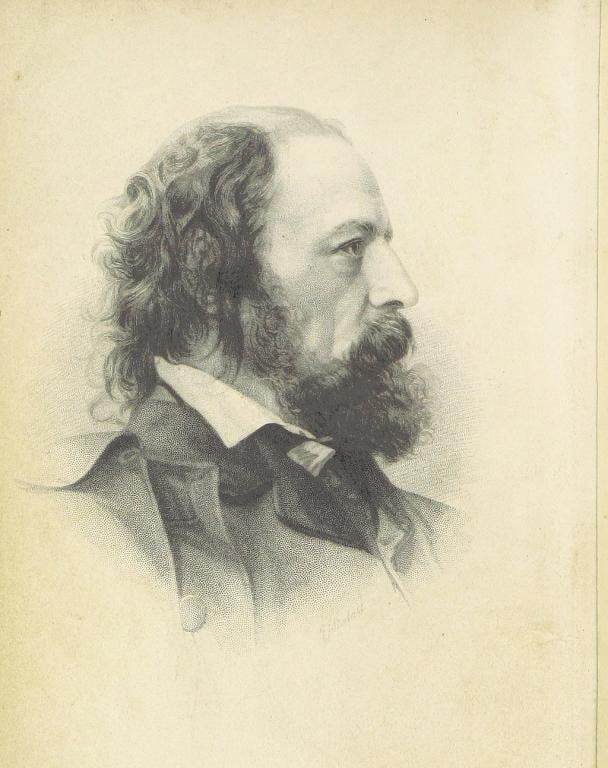
Alfred, Lord Tennyson (1809-1892), poet laureate of England
(Wikimedia Commons public domain image)
In 1850, Alfred, Lord Tennyson, published a lengthy elegy entitled In Memoriam A.H.H. (1850) for Arthur Henry Hallam, a friend from his student days at Cambridge University who had died suddenly from a cerebral haemorrhage in Vienna in 1833, at the age of only twenty-two years. In the poem, Lord Tennyson reflects not only on Hallam’s death but more broadly on the seemingly random cruelty of nature as seen from the conflicting perspectives of Christian faith, which was already declining in early Victorian Britain, and of increasingly materialist science. (Charles Darwin’s classic On the Origin of Species would be published just nine years later, in 1859). Accordingly, as has been observed, In Memoriam A.H.H. is not only an elegy for a friend but a kind of requiem or dirge for an earlier time and worldview.
At one point in his elegy, Lord Tennyson asks,
Are God and Nature then at strife,
That Nature lends such evil dreams?
So careful of the type she seems,
So careless of the single life;
Here, Lord Tennyson writes of nature’s seeming indifference to “single lives” (e.g., that of Arthur Hallam) as contrasted with its concern for species or “types.” Where is divine providence in all of this? Where is any sign of a concern for individual human lives?
That I, considering everywhere
Her secret meaning in her deeds,
And finding that of fifty seeds
She often brings but one to bear,I falter where I firmly trod,
And falling with my weight of cares
Upon the great world’s altar-stairs
That slope thro’ darkness up to God,I stretch lame hands of faith, and grope,
And gather dust and chaff, and call
To what I feel is Lord of all,
And faintly trust the larger hope.
And yet, as Charles Darwin’s unjustly neglected co-discoverer of evolution, Alfred Russel Wallace, evidently also did but as Darwin apparently could not, Tennyson continues to assert his (rather wan) hope against what nature seems to show.
Tennyson was aware of the fossil evidence that had begun to be systematically noticed and studied in the British Isles and on the continent of Europe — paleontological finds in France and Switzerland’s Jura Mountains give us the Jurassic Period; the Cambrian Period comes from Cambria, a Latin name for Wales; ancient Celtic tribes (the Ordovices and the Silures) that once inhabited Wales give us the Ordovician and Silurian periods; the Devonian Period is named after the county of Devon — and he knew that nature hasn’t even really concerned itself with “types” or species:
So careful of the type?” but no.
From scarped cliff and quarried stone
She cries, “A thousand types are gone:
I care for nothing, all shall go.“Thou makest thine appeal to me:
I bring to life, I bring to death:
The spirit does but mean the breath:
I know no more.” And he, shall he,Man, her last work, who seem’d so fair,
Such splendid purpose in his eyes,
Who roll’d the psalm to wintry skies,
Who built him fanes of fruitless prayer,Who trusted God was love indeed
And love Creation’s final law —
Tho’ Nature, red in tooth and claw
With ravine, shriek’d against his creed —Who loved, who suffer’d countless ills,
Who battled for the True, the Just,
Be blown about the desert dust,
Or seal’d within the iron hills?
Will humans, too, end up as nothing more than scattered fossils? Lord Tennyson seems almost to be replaying directly to Thomas Taylor. (By the way, the word ravine, above, is not to be understood in the sense of a small and narrow valley but, rather, in connection with terms like ravenous and ravening — as, e.g., of a wolf.) Pretty plainly, Darwin and Wallace were drawing for their formulation of the idea of natural selection (and, eventually, Herbert Spencer’s notion of “the survival of the fittest”) on ideas that were already common to the culture of their time. In a very real sense, Tennyson had already been there before they published their much more elaborate and more scientific works.
Through all of this, though, Lord Tennyson asserts his faith, because of what he has “felt,” and he yearns for God’s voice, for revelation, though he recognizes that final answer aren’t likely to come until after death:
O life as futile, then, as frail!
O for thy voice to soothe and bless!
What hope of answer, or redress?
Behind the veil, behind the veil. . . .
If e’er when faith had fallen asleep,
I hear a voice ‘believe no more’
And heard an ever-breaking shore
That tumbled in the Godless deep;A warmth within the breast would melt
The freezing reason’s colder part,
And like a man in wrath the heart
Stood up and answer’d ‘I have felt.’No, like a child in doubt and fear:
But that blind clamour made me wise;
Then was I as a child that cries,
But, crying knows his father near.
It must be remembered that this is how his poem opens:
Strong Son of God, immortal Love,
Whom we, that have not seen thy face,
By faith, and faith alone, embrace,
Believing where we cannot prove;Thine are these orbs of light and shade;
Thou madest Life in man and brute;
Thou madest Death; and lo, thy foot
Is on the skull which thou hast made.Thou wilt not leave us in the dust:
Thou madest man, he knows not why,
He thinks he was not made to die;
And thou hast made him: thou art just.Thou seemest human and divine,
The highest, holiest manhood, thou.
Our wills are ours, we know not how;
Our wills are ours, to make them thine.Our little systems have their day;
They have their day and cease to be:
They are but broken lights of thee,
And thou, O Lord, art more than they.We have but faith: we cannot know;
For knowledge is of things we see
And yet we trust it comes from thee,
A beam in darkness: let it grow.Let knowledge grow from more to more,
But more of reverence in us dwell;
That mind and soul, according well,
May make one music as before,
And, thinking here of his friend Arthur Hallam and, no doubt, of others whom he had lost before and since, Lord Tennyson concludes his lengthy poem with these famous lines:
I hold it true, whate’er befall;
I feel it, when I sorrow most;
’Tis better to have loved and lost
Than never to have loved at all.
Alfred, Lord Tennyson, wrote at the beginning of the melancholy period (famously described in Matthew Arnold’s great poem Dover Beach) when Europe’s religious faith began to crumble. I can’t help but think that he would have been heartened to see what I regard as the return of scientific arguments for design, which we’re beginning to see in such areas as the cosmic anthropic principle, apparent cosmic fine tuning, irreducible complexity, the astonishing intricacy of the cell, and the like.

The iconic view of the Jungfrau in the Berner Oberland of Switzerland. (Public domain image from Wikimedia Commons.) Having served in Interlaken for seven months of my mission and having visited the area more times than I can count during the years since, I came to love this mountain and this view of it.
Finally, rather irrelevantly but with complete sincerity, I wish everybody out there a slightly late Happy Father’s Day!
Travel and Religion
History and Religion
Previous Post
June 20, 2026
Belatedly, for Juneteenth
Next Post
June 22, 2026 Of violence and a violent storm
Recent Comments
"I have cpnsidered in my mond if the 4 volume Saints could be made into ..."
From Serbia’s “White City,” Belgrade
"DP: “But Mr. Sutherland worries about the fact that our time, when we can communicate ..."
Learning more about a region of ..."
"Another class of memories are of individuals who previously lived. Some of these remembered individuals ..."
"Sutherland's lecture sounds interesting. He seems to restate the Washington consensus that trade brings peace ..."
Learning more about a region of ..."
Browse Our Archives
Select a Category Uncategorized
Select a Month October 2026 September 2026 August 2026 July 2026 June 2026 May 2026 April 2026 March 2026 February 2026 January 2026 December 2025 November 2025 October 2025 September 2025 August 2025 July 2025 June 2025 May 2025 April 2025 March 2025 February 2025 January 2025 December 2024 November 2024 October 2024 September 2024 August 2024 July 2024 June 2024 May 2024 April 2024 March 2024 February 2024 January 2024 December 2023 November 2023 October 2023 September 2023 August 2023 July 2023 June 2023 May 2023 April 2023 March 2023 February 2023 January 2023 December 2022 November 2022 October 2022 September 2022 August 2022 July 2022 June 2022 May 2022 April 2022 March 2022 February 2022 January 2022 December 2021 November 2021 October 2021 September 2021 August 2021 July 2021 June 2021 May 2021 April 2021 March 2021 February 2021 January 2021 December 2020 November 2020 October 2020 September 2020 August 2020 July 2020 June 2020 May 2020 April 2020 March 2020 February 2020 January 2020 December 2019 November 2019 October 2019 September 2019 August 2019 July 2019 June 2019 May 2019 April 2019 March 2019 February 2019 January 2019 December 2018 November 2018 October 2018 September 2018 August 2018 July 2018 June 2018 May 2018 April 2018 March 2018 February 2018 January 2018 December 2017 November 2017 October 2017 September 2017 August 2017 July 2017 June 2017 May 2017 April 2017 March 2017 February 2017 January 2017 December 2016 November 2016 October 2016 September 2016 August 2016 July 2016 June 2016 May 2016 April 2016 March 2016 February 2016 January 2016 December 2015 November 2015 October 2015 September 2015 August 2015 July 2015 June 2015 May 2015 April 2015 March 2015 February 2015 January 2015 December 2014 November 2014 March 2014 August 2013 February 2012
Follow Us!
TAKE THE
Religious Wisdom Quiz
What color is the first horse in Revelation 6?
Select your answer to see how you score.
Black Pale White Red
Related posts from Sic et Non
"Proven quality and solidarity"
The Passing of a Pope, and of a...
'Twas the night before Christmas
TRENDING AT PATHEOS Latter-day Saint

Methodist Central Hall and Westminster Abbey
Situated on the same square is Methodist Central Hall and Westminster Abbey. ...

57th Dove Awards Honor Dolly Parton, Crown New...
On gospel music’s biggest night, the 57th annual GMA Dove Awards honored...

The First Eucharistic Controversy: Christ’s Real Presence
For Catholics, the Eucharist is the source and summit of the Christian...

What a Stop Sign Can Teach Us About...
How to Make a Decision When You Can't Hear God Main point:...

Archdiocese Hosts Military Marriage Retreat in Germany
RASTATT, Germany — The transient military lifestyle, with its frequent deployments and...

Nearly every morning, I make the drive to Detroit with my high-school-age...
view all Latter-day Saint blogs
What Are Your Thoughts?leave a comment
Ad-Free & Subscriber Log-In Subscription Support
- About Us
- 2026 Calendar
- Videos
- Podcasts
- Library of World Religions
- Faith In Media Tracker
- Advertise With Us
- Write for Us
- Privacy Policy
- Terms of Service
- Do Not Sell My Data
- Contact Us
- Radiant Digital
- Manage Newsletter Subscriptions
- Unsubscribe From Notifications
- Sitemap
Copyright 2008-2026, Patheos. All rights reserved.
Subscription Support Ad-Free & Subscriber Log-In
Follow Patheos