
BuddhistCatholicContemplativeEvangelicalGeneral ChristianHinduJewishLatter-day SaintMuslimNew VisionsProgressive Christian
Beliefs
- Buddhist
- Catholic
- Contemplative
- Evangelical
- General Christian
- Hindu
- Jewish
- Latter-day Saint
- More Voices
- Muslim
- New Visions
- Pagan
- Progressive Christian
Topics
- Religion News
- Food and Religion
- Sports and Religion
- Religious Art
- Religious Music and Entertainment
- Religious Events
- History and Religion
- Style and Religion
- Politics and Religion
- Women in Religion
- Recreation Outdoors and Religion
- Business Finance and Religion
- Careers Workplace and Religion
- Education and Religion
- Family Parenting and Religion
- Health Fitness and Religion
- Home and Religion
- Relationships and Religion
- Technology and Religion
- Travel and Religion
Columnists
- Buddhist Columnists
- Business Finance and Religion Columnists
- Careers Workplace and Religion Columnists
- Catholic Columnists
- Contemplative Columnists
- Education and Religion Columnists
- Evangelists Columnists
- Family Parenting and Religion Columnists
- General Christian Columnists
- Health Fitness and Religion Columnists
- Hindu Columnists
- History and Religion Columnists
- Home and Religion Columnists
- Jewish Columnists
- More Voices Columnists
- Latter Day Columnists
- Muslim Columnists
- New Visions Columnists
- Nonreligious Columnists
- Pagan Columnists
- Politics and Religion Columnists
- Progressive Columnists
- Recreation Outdoors and Religion Columnists
- Relationships and Religion Columnists
- Religion News Columnists
- Religious Art Columnists
- Religious Events Columnists
- Religious Music and Entertainment Columnists
- Sports and Religion Columnists
- Style and Religion Columnists
- Technology and Religion Columnists
- Travel and Religion Columnists
- Women in Religion Columnists
Resource Library
- 2026 Calendar
- Library of World Religions
- The 100 Most Holy Places on Earth
- Patheos Answers
- Podcasts
- Videos
- Faith Leaders Database
- Anglican Episcopalian
- Bahai
- Baptist
- Buddhism
- Christianity
- Confucianism
- Eastern Orthodoxy
- Hinduism
- Holiness and Pentecostal
- ISKCON
- Islam
- Judaism
- Lutheran
- Methodist
- The Church of Jesus Christ of Latter-day Saints
- New Age
- Paganism
- Presbytarian and Reformed
- Protestantism
- Religion Behind the Scenes
- Roman Catholic
- Scientology
- Shia Islam
- Sikhism
- Sufism
- Sunni Islam
- Taoism
- Zen
- See all religions
Research Tools
 Ad-Free & Subscriber Log-In Subscription Support
Ad-Free & Subscriber Log-In Subscription Support
Follow Patheos 

- Trending:
- Forgiveness
- |
- Marriage
- |
- Consciousness
- |
- Death Penalty
- |
- Election
- |
- Halloween

- Home
- Latter-day Saint
- History and Religion
- Two abbeys, a cathedral, and a seventh-century English poet
Two abbeys, a cathedral, and a seventh-century English poet
Last updated on: May 10, 2026 at 4:44 pm by Dan Peterson
Two abbeys, a cathedral, and a seventh-century English poet 2026-05-10T16:44:02-06:00 Dan Peterson
Patheos Explore the world's faith through different perspectives on religion and spirituality! Patheos has the views of the prevalent religions and spiritualities of the world.
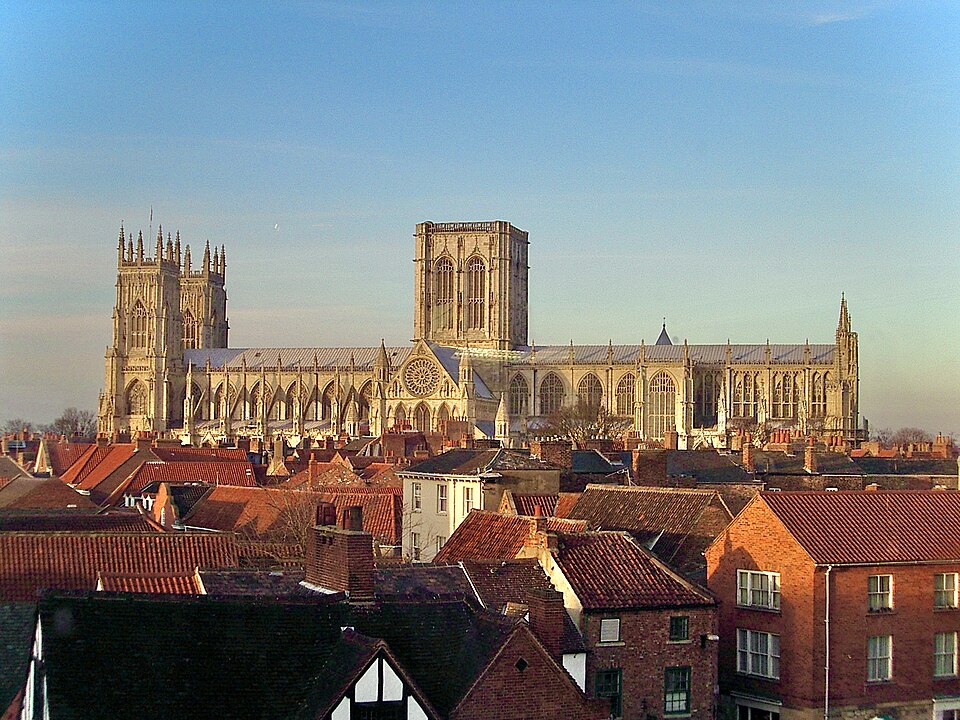
A 2003 Wikimedia Commons public domain photograph of the York Minster or Cathedral of York
We began the day by walking (through the Shambles, no less) to the magnificent York Minster, the Cathedral of York (or, officially, the Cathedral and Metropolitan Church of Saint Peter in York), for a Sunday morning service. The congregation wasn’t very large — our group made up at least a third of it, I would guess — and by far most of those in it were pretty plainly tourists (judging from the fact that they were clearly struggling, as we were, to follow the liturgy). The choral singing was exquisitely done.
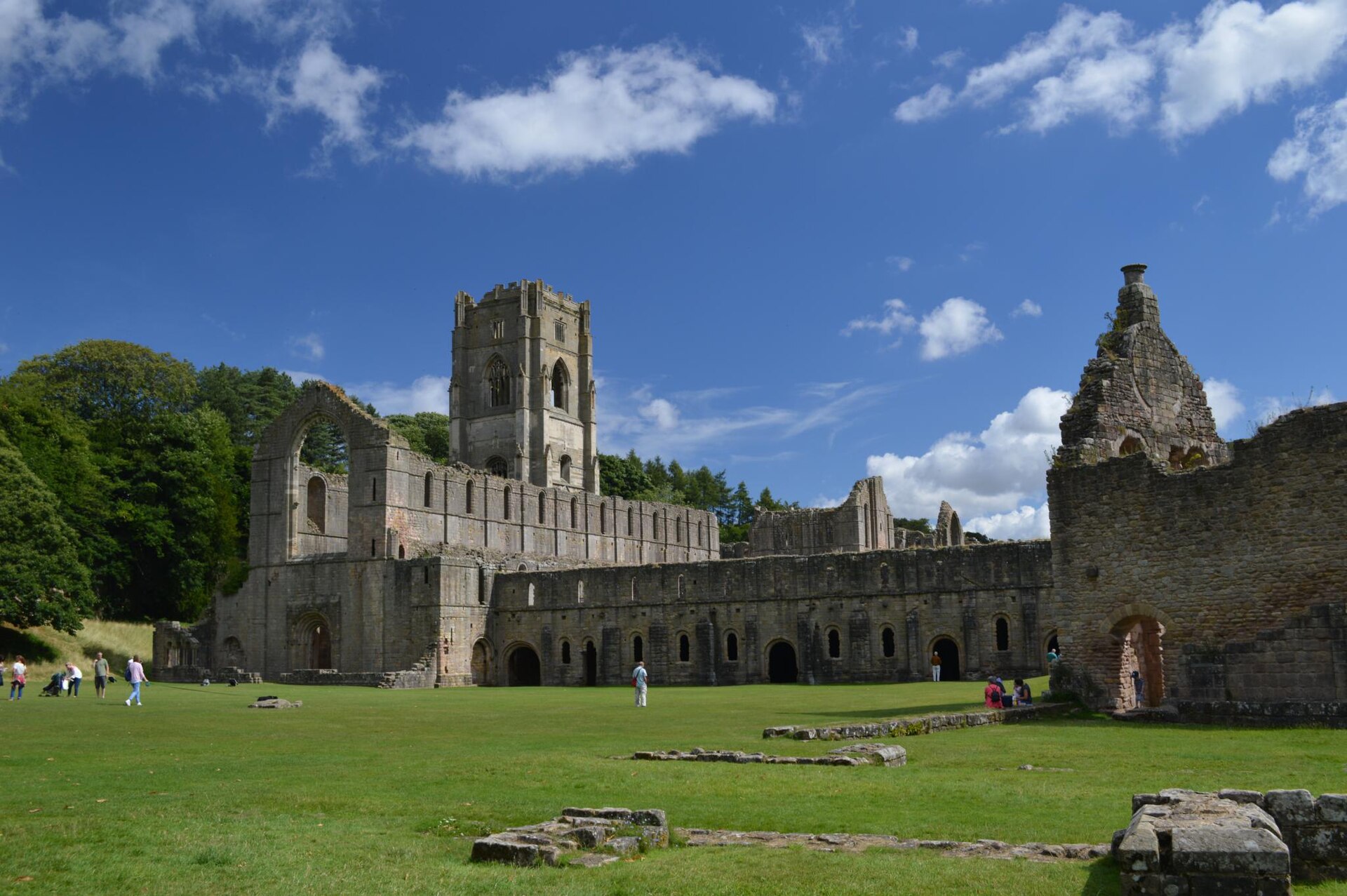
Fountains Abbey (Wikimedia Commons public domain photograph), on a beautiful day much like today
From the city, we drove to Fountains Abbey, a ruined Cistercian monastery near Ripon in North Yorkshire. Founded in the first half of the twelfth century, it eventually became the “mother abbey” to a dozen subordinate “daughter abbeys” and one of the wealthiest monasteries in England. Its diverse landholdings, we were told, extended from the North Sea all the way over to the Lake District.
The Abbey was abandoned and pillaged in 1539 as part of Henry VIII’s brutal and rapacious “Dissolution of the Monasteries.” Today, though, it’s widely considered to be the best preserved of all English abbeys as well as one of the country’s most picturesque ruins. It’s a favorite of our English Latter-day Saint guide, Peter Fagg, and it was at his suggestion that we included it in this tour’s itinerary; my wife and I had never been to it before.
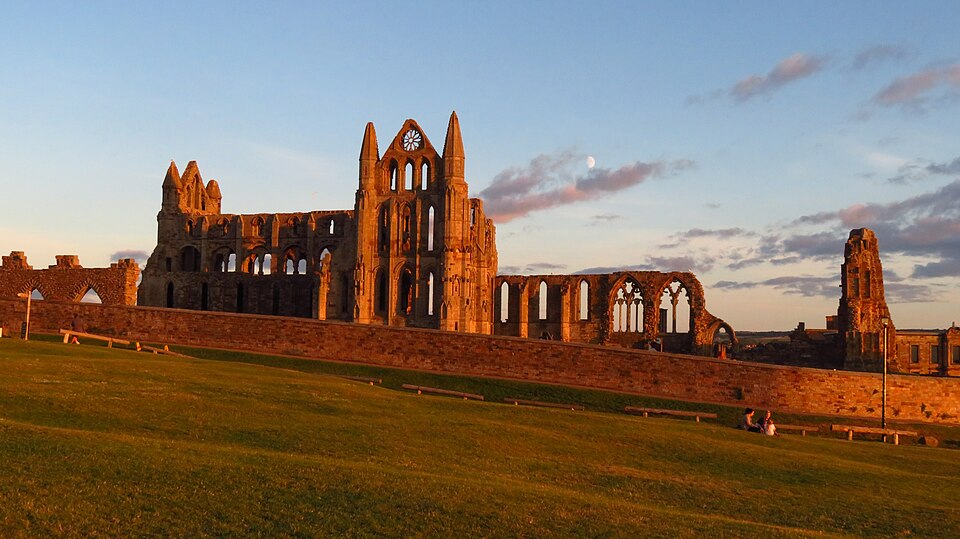
Evening sunlight on the ruins of Whitby Abbey, by Colin Park
Today was definitely a day for cathedrals and abbeys. Our final visit of the day, prior to having dinner in the town of Whitby below it, was to the ruined Whitby Abbey, which stands atop a cliff overlooking the North Sea. My wife and I first visited it several years ago; we loved not only the ruins themselves but their picturesque location.
Founded in AD 657, as a Benedictine institution, the Abbey hosted the Synod of Whitby in AD 664, which decided the question of whether the Christians of Northumbria would follow the Easter dating of Iona (which followed an 84-year cycle) or the new nineteen-year cycle that had recently been adopted at Rome. The synod also determined what kind of tonsure clergy and monks should use.
The proper dating of Easter was a surprisingly big and divisive issue during the first several centuries of post-biblical, post-apostolic Christianity, and not just in England. (The “proper” tonsure seems to me a triviality from any perspective; perhaps it’s because of my own naturally constrained hairstyle, but I simply don’t care and can’t imagine ever caring about such a topic.). But the real (and much more fundamental) question at the Synod of Whitby was whether the English Christian church would accept the leadership of Rome, and its decision to do so was pivotal for the course of Christianity in Britain.
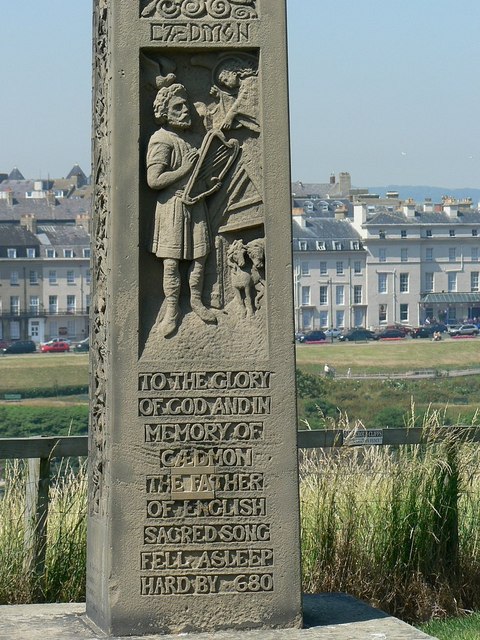
A portion of “Caedmon’s Cross,” a memorial at Whitby’s St. Mary’s Church. (Wikimedia Commons public domain image)
Still, I have to confess that what interests me most about Whitby Abbey (apart from the beauty of its ruins and its location) is its association with the Anglo-Saxon poet Cædmon. According to the Northumbrian monk-historian the Venerable Bede (d. 735) , Cædmon was an illiterate and unmusical cowherd, a lay brother at what would become Whitby Abbey, who cared for the monks’ flocks and herds.
As the story goes, while the monks were feasting, singing, and playing a harp one evening, Cædmon fell asleep among the animals. In a dream, “someone” (quidam) came to him and directed him to sing principium creaturarum, “the beginning of created things.” At first, presumably aware of his musical and literary inadequacy, he refused to sing. (Which reminds me of Muhammad’s initial refusal to “recite” at the command of the angel Gabriel, though he soon began to dictate the Qur’an.) Shortly thereafter, though, Cædmon produced a short poem in praise of God, the Creator of heaven and earth. “Caedmon’s Hymn,” as it’s known, is the poet’s only surviving composition, but it seems to be the oldest securely dated specimen of Old English — that is, of recognizably English — verse that has survived. Here it is, in its original form. There are numerous textual variants, but this will do the job:
Nū scylun hergan hefaenrīcaes Uard,
metudæs maecti end his mōdgidanc,
uerc Uuldurfadur, suē hē uundra gihuaes,
ēci dryctin ōr āstelidæ
hē ǣrist scōp aelda barnum
heben til hrōfe, hāleg scepen.
Thā middungeard moncynnæs Uard,
eci Dryctin, æfter tīadæ
fīrum foldu, Frēa allmectig.
Here is a fairly literal translation of the poem, from Wikipedia:
Now [we] shall honour / heaven-kingdom’s guardian,
the measurer’s might / and his mind’s plan,
the work of the father of glory / as he of each wonder,
eternal lord, / the origin established;
he first created / for the children of men
heaven for a roof, / holy creator.
Then Middle-earth / mankind’s guardian,
eternal Lord, / after bestowed
the lands to men, / Lord almighty.
Here is another rendition into modern English, this one done by Roy A. Liuzza:
Now let us praise Heaven-Kingdom’s guardian,
the Maker’s might and his mind’s thoughts,
the work of the glory-father—of every wonder,
eternal Lord. He established a beginning.
He first shaped for men’s sons
Heaven as a roof, the holy Creator;
then middle-earth mankind’s guardian,
eternal Lord, afterwards prepared
the earth for men, the Lord almighty.
The monastery at Whitby was laid waste by Danish Vikings in multiple raids between 867 and 870 and lay in ruins for about two centuries thereafter. Its splendor and its prominent location overlooking the North Sea seem to have been an insuperable temptation to my ancestors. (My paternal grandfather was Danish.) Meanwhile, others of my ancestors were living not terribly far away to the south-southwest, near York (aka Jorvik, the Viking capital of the Danelaw), where the family of my maternal grandfather lived.
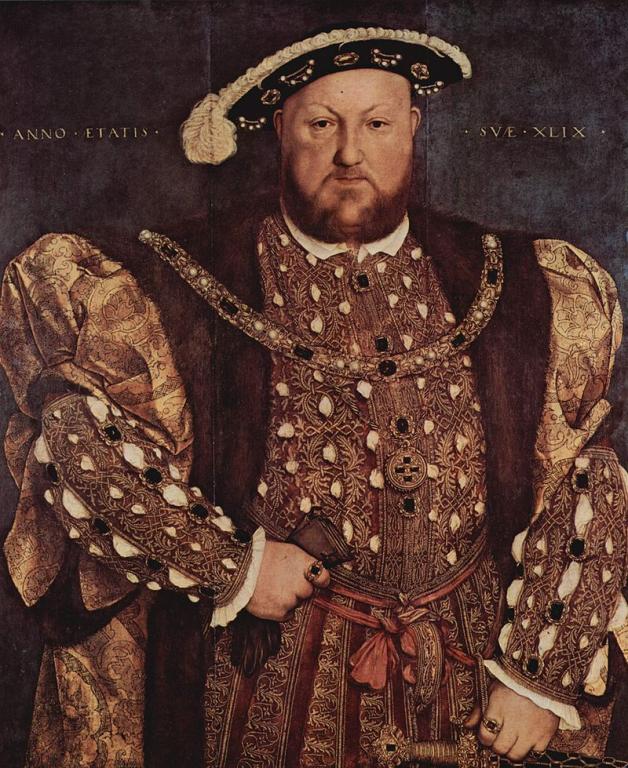
Henry VIII, ca. 1539-1540 (portrait by Hans Holbein the Younger). I confess that I’ve never completely warmed up to him, despite our obvious similarities in character and personality. (Wikimedia Commons public domain image)
Whitby Abbey lay in ruins for about two centuries after the catastrophic Viking raids but was rebuilt in the 1220s — significantly, after the close of the so-called “Viking Age” — on a grander scale than previously, and it flourished for slightly more than three centuries as a center of scholarship. But then, once again, Henry VIII came along. In 1540, as part of his “Dissolution of the Monasteries,” he turned his kindly attentions toward Whitby, and you can admire the results of his work in the photograph above. Of course, it didn’t help much that, in December 1914, two German battlecruisers shelled the Abbey for about ten minutes, and did considerable damage to it, as part of the early festivities of the First World War.
Posted from York, England
History and Religion
Travel and Religion
Previous Post
May 9, 2026
The first Boston, and Lincoln
Next Post
May 11, 2026 To the cradle of the Restoration in England
Recent Comments
"Another class of memories are of individuals who previously lived. Some of these remembered individuals ..."
"Sutherland's lecture sounds interesting. He seems to restate the Washington consensus that trade brings peace ..."
Learning more about a region of ..."
"In a meeting today, I learned another important reason why accurate (or at least as ..."
From Serbia’s “White City,” Belgrade
"I've been watching a lot of video interviews of NDErs and researchers. I think in ..."
Browse Our Archives
Select a Category Uncategorized
Select a Month October 2026 September 2026 August 2026 July 2026 June 2026 May 2026 April 2026 March 2026 February 2026 January 2026 December 2025 November 2025 October 2025 September 2025 August 2025 July 2025 June 2025 May 2025 April 2025 March 2025 February 2025 January 2025 December 2024 November 2024 October 2024 September 2024 August 2024 July 2024 June 2024 May 2024 April 2024 March 2024 February 2024 January 2024 December 2023 November 2023 October 2023 September 2023 August 2023 July 2023 June 2023 May 2023 April 2023 March 2023 February 2023 January 2023 December 2022 November 2022 October 2022 September 2022 August 2022 July 2022 June 2022 May 2022 April 2022 March 2022 February 2022 January 2022 December 2021 November 2021 October 2021 September 2021 August 2021 July 2021 June 2021 May 2021 April 2021 March 2021 February 2021 January 2021 December 2020 November 2020 October 2020 September 2020 August 2020 July 2020 June 2020 May 2020 April 2020 March 2020 February 2020 January 2020 December 2019 November 2019 October 2019 September 2019 August 2019 July 2019 June 2019 May 2019 April 2019 March 2019 February 2019 January 2019 December 2018 November 2018 October 2018 September 2018 August 2018 July 2018 June 2018 May 2018 April 2018 March 2018 February 2018 January 2018 December 2017 November 2017 October 2017 September 2017 August 2017 July 2017 June 2017 May 2017 April 2017 March 2017 February 2017 January 2017 December 2016 November 2016 October 2016 September 2016 August 2016 July 2016 June 2016 May 2016 April 2016 March 2016 February 2016 January 2016 December 2015 November 2015 October 2015 September 2015 August 2015 July 2015 June 2015 May 2015 April 2015 March 2015 February 2015 January 2015 December 2014 November 2014 March 2014 August 2013 February 2012
Follow Us!
TAKE THE
Religious Wisdom Quiz
What kind of bird did Noah send out second from the ark?
Select your answer to see how you score.
Owl Eagle Dove Pidgeon
Related posts from Sic et Non

A Global Effort on Behalf of Women and...
"Generational Curses and Inheritance in the Book of...
Paying our respects to St. André and St....
TRENDING AT PATHEOS Latter-day Saint

The Sermon on the Mount, Part I: Matthew...
The Sermon on the Mount, Part I (Matthew 4:12-5:12) St. Matthew moves...

What's up from Crossway: Reviewing some of their latest A few weeks...

Janie Learns the Way of the Cross: A...
Teaching children about Jesus' Passion can be challenging. Many parents and educators...

Looking For Good Catholic Writing - October 2026
He alone extends the heavens, and he walks upon the waves of...

In "Irreplaceable," our book on vocation and technology, Trevor Sutton and I...

I was strolling through the top floor of the brand new Parthenon...
view all Latter-day Saint blogs
What Are Your Thoughts?leave a comment
Ad-Free & Subscriber Log-In Subscription Support
- About Us
- 2026 Calendar
- Videos
- Podcasts
- Library of World Religions
- Faith In Media Tracker
- Advertise With Us
- Write for Us
- Privacy Policy
- Terms of Service
- Do Not Sell My Data
- Contact Us
- Radiant Digital
- Manage Newsletter Subscriptions
- Unsubscribe From Notifications
- Sitemap
Copyright 2008-2026, Patheos. All rights reserved.
Subscription Support Ad-Free & Subscriber Log-In
Follow Patheos