
BuddhistCatholicContemplativeEvangelicalGeneral ChristianHinduJewishLatter-day SaintMuslimNew VisionsProgressive Christian
Beliefs
- Buddhist
- Catholic
- Contemplative
- Evangelical
- General Christian
- Hindu
- Jewish
- Latter-day Saint
- More Voices
- Muslim
- New Visions
- Pagan
- Progressive Christian
Topics
- Religion News
- Food and Religion
- Sports and Religion
- Religious Art
- Religious Music and Entertainment
- Religious Events
- History and Religion
- Style and Religion
- Politics and Religion
- Women in Religion
- Recreation Outdoors and Religion
- Business Finance and Religion
- Careers Workplace and Religion
- Education and Religion
- Family Parenting and Religion
- Health Fitness and Religion
- Home and Religion
- Relationships and Religion
- Technology and Religion
- Travel and Religion
Columnists
- Buddhist Columnists
- Business Finance and Religion Columnists
- Careers Workplace and Religion Columnists
- Catholic Columnists
- Contemplative Columnists
- Education and Religion Columnists
- Evangelists Columnists
- Family Parenting and Religion Columnists
- General Christian Columnists
- Health Fitness and Religion Columnists
- Hindu Columnists
- History and Religion Columnists
- Home and Religion Columnists
- Jewish Columnists
- More Voices Columnists
- Latter Day Columnists
- Muslim Columnists
- New Visions Columnists
- Nonreligious Columnists
- Pagan Columnists
- Politics and Religion Columnists
- Progressive Columnists
- Recreation Outdoors and Religion Columnists
- Relationships and Religion Columnists
- Religion News Columnists
- Religious Art Columnists
- Religious Events Columnists
- Religious Music and Entertainment Columnists
- Sports and Religion Columnists
- Style and Religion Columnists
- Technology and Religion Columnists
- Travel and Religion Columnists
- Women in Religion Columnists
Resource Library
- 2026 Calendar
- Library of World Religions
- The 100 Most Holy Places on Earth
- Patheos Answers
- Podcasts
- Videos
- Faith Leaders Database
- Anglican Episcopalian
- Bahai
- Baptist
- Buddhism
- Christianity
- Confucianism
- Eastern Orthodoxy
- Hinduism
- Holiness and Pentecostal
- ISKCON
- Islam
- Judaism
- Lutheran
- Methodist
- The Church of Jesus Christ of Latter-day Saints
- New Age
- Paganism
- Presbytarian and Reformed
- Protestantism
- Religion Behind the Scenes
- Roman Catholic
- Scientology
- Shia Islam
- Sikhism
- Sufism
- Sunni Islam
- Taoism
- Zen
- See all religions
Research Tools
 Ad-Free & Subscriber Log-In Subscription Support
Ad-Free & Subscriber Log-In Subscription Support
Follow Patheos 

- Trending:
- Forgiveness
- |
- Marriage
- |
- Consciousness
- |
- Death Penalty
- |
- Election
- |
- Halloween

- Home
- Latter-day Saint
- History and Religion
- The first Boston, and Lincoln
The first Boston, and Lincoln
Last updated on: May 9, 2026 at 5:16 pm by Dan Peterson
The first Boston, and Lincoln 2026-05-09T17:16:41-06:00 Dan Peterson
Patheos Explore the world's faith through different perspectives on religion and spirituality! Patheos has the views of the prevalent religions and spiritualities of the world.
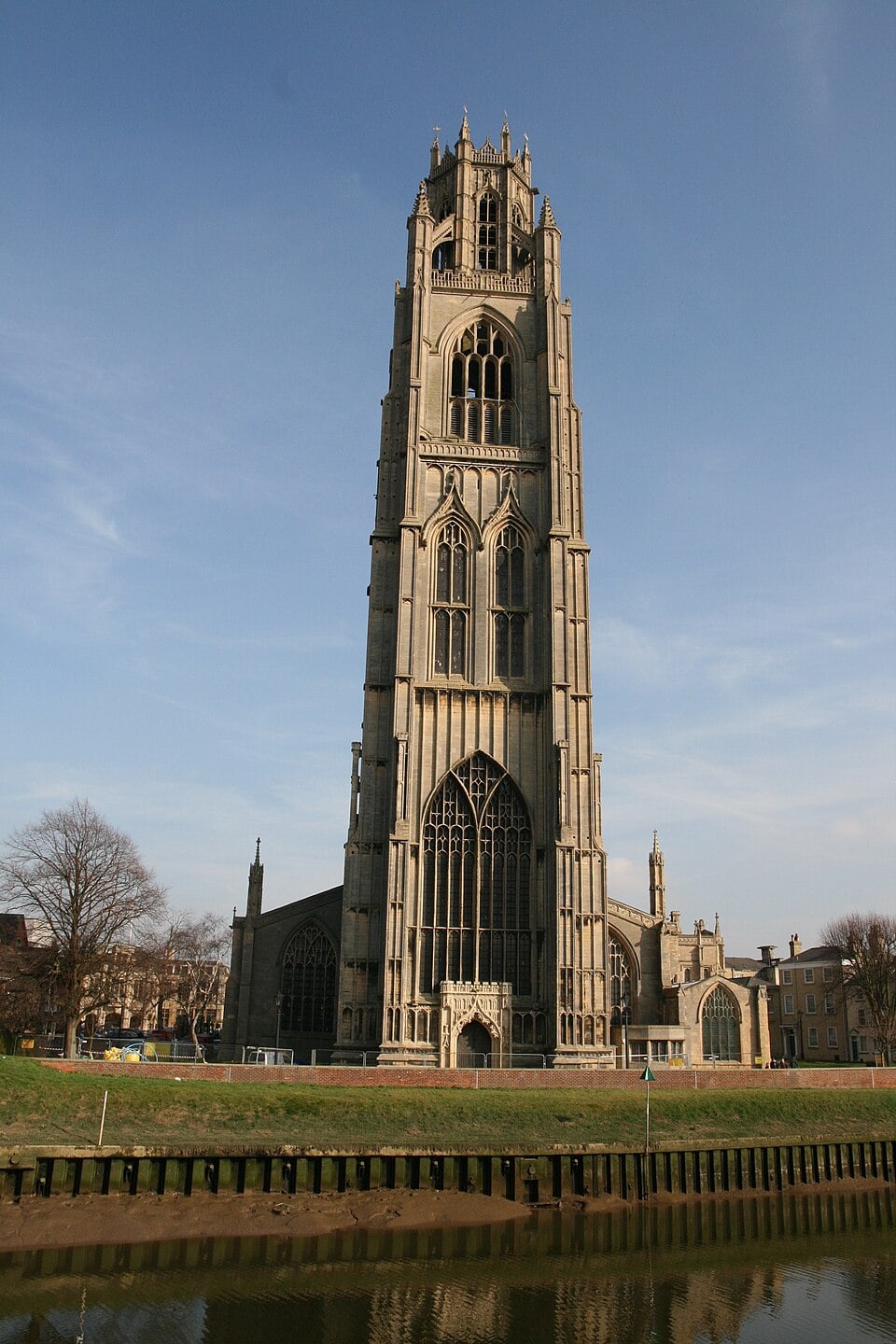
The tower of St. Botolph’s Church, Boston, Lincolnshire, England (Wikimedia Commons public domain photograph)
We began the morning by driving to Boston, a market town and inland port in the English county of Lincolnshire. The name Boston is said to be a contraction of “Saint Botolph’s town” — named after a seventh-century Saxon abbot — with tun being an Old English, Old Norse, and modern Norwegian term for a “hamlet” or a “farm.” In Latin, Boston was known as villa Sancti Botulfi “St. Botulf’s village,” and the name Botulfeston appears in 1460.
By the beginning of the thirteenth century, Boston had become a significant place for trade with the European Continent, a port of the Hanseatic League. In fact, before the rise of Liverpool, it was probably the second port in the entire country, after only London. It became wealthy from trade in wool, grain, and lead, and for the importation of salt from the coast of Holland. Unfortunately, in the latter part of the fifteenth century an international trade dispute and the silting up of its harbor led to a massive and fairly sudden decline in the town’s economic prospects.
However, its prior trade connections with the Continent of Europe had made Boston a conduit for intellectual influences, as well — eventually including the teachings of the Protestant Reformer John Calvin. In 1607, a group of pilgrims from the area, led by William Brewster and William Bradford, attempted to escape religious persecution by emigrating via Boston to the more tolerant Netherlands. However, unauthorized emigration was illegal at the time, and they were arrested, brought to trial in Boston’s Guildhall., and, for a time, imprisoned there. We visited the Guildhall, and some of us even climbed into their prison cells. The following year, in 1608, the pilgrims set sail for the Netherlands, settling in Leiden. Thereafter, in 1620, several of them sailed to New England aboard the Mayflower.
In 1612, John Cotton — a graduate, by the way, of Trinity College, Cambridge, and of Emmanuel College, Cambridge — was appointed Vicar of St Botolph’s Church, which remains Boston’s most prominent landmark still today. Popularly (but, I think, oddly) known as “The Stump,” it’s the largest parish church in England. It’s also the burial place of the composer John Taverner (d. 1545).
At St. Botolph’s, John Cotton’s nonconformist preaching became very popular. He encouraged those who felt religiously oppressed in England to join the Massachusetts Bay Company and, in 1633, he himself left for the New World. There, his grandson Cotton Mather (1663-1728), a graduate of Harvard College (in Cambridge, Massachusetts) became not only a Puritan clergyman but a major intellectual figure in Colonial America. According to a plaque on an interior wall of the church, no fewer than five colonial governors of Massachusetts came from St. Botolph’s Church in Boston, England.
“Boston,” by Henry Wadsworth Longfellow
St. Botolph’s Town! Hither across the plains
And fens of Lincolnshire, in garb austere,
There came a Saxon monk, and founded here
A Priory, pillaged by marauding Danes,
So that thereof no vestige now remains;
Only a name, that, spoken loud and clear,
And echoed in another hemisphere,
Survives the sculptured walls and painted panes.
St. Botolph’s Town! Far over leagues of land
And leagues of sea looks forth its noble tower,
And far around the chiming bells are heard;
So may that sacred name forever stand
A landmark, and a symbol of the power,
That lies concentred in a single word.
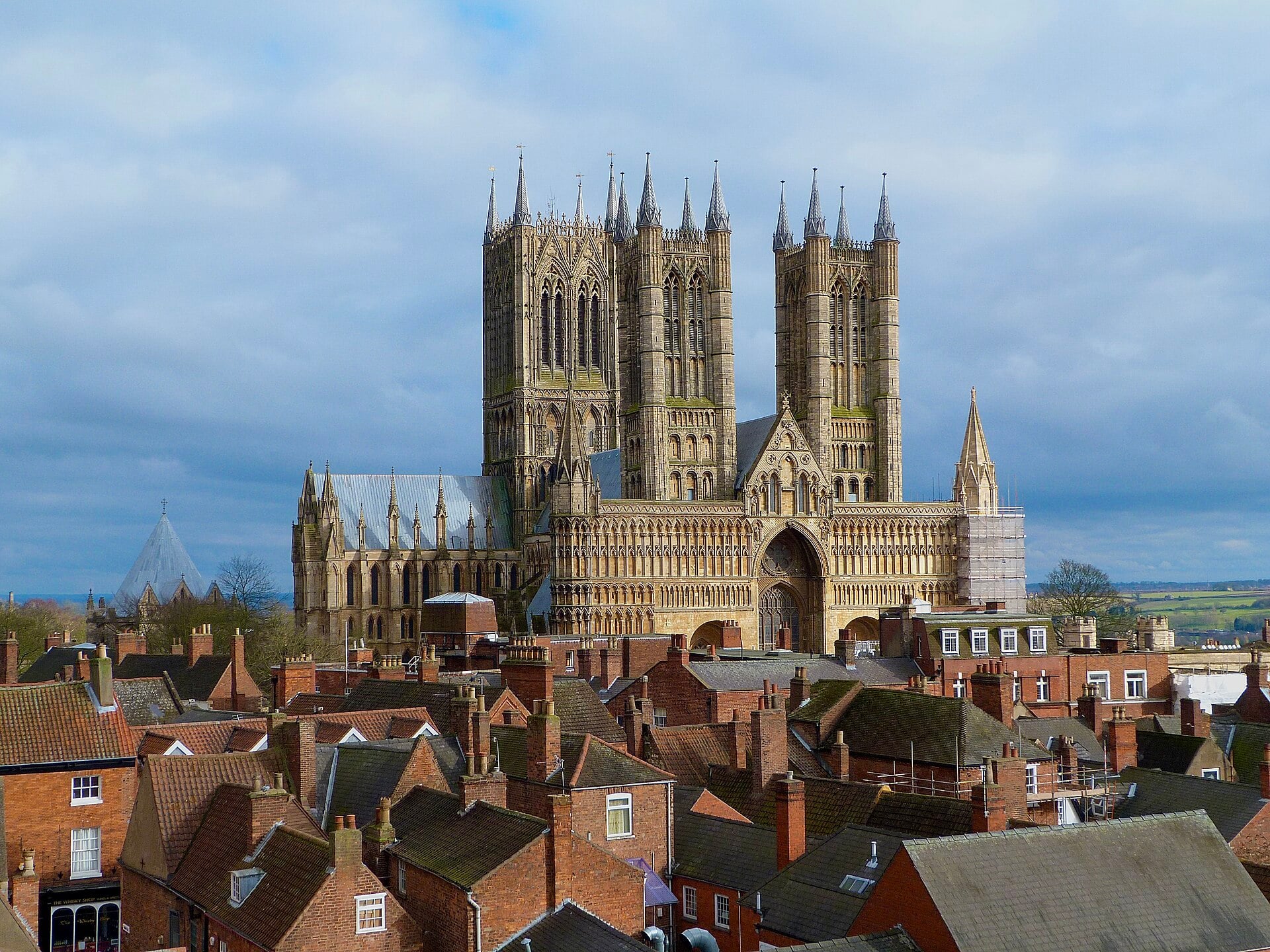
A 2013 view of Lincoln Cathedral from Lincoln Castle (Wikimedia Commons public domain photograph)
We then drove to Lincoln, where we found ourselves in the midst of some sort of celebration of the local football team. We walked by and in front of the massive and magnificent Lincoln Cathedral, proceeding over to Lincoln Castle, where one of the four surviving originals of the Magna Carta has been kept since its signing by King John and the barons at Runnymede, near Windsor, on 15 June 1215. A justly famous document at the very foundation of, among others, the English and American legal systems, Magna Carta established the principle that even sovereign monarchs should be subject to the rule of law.
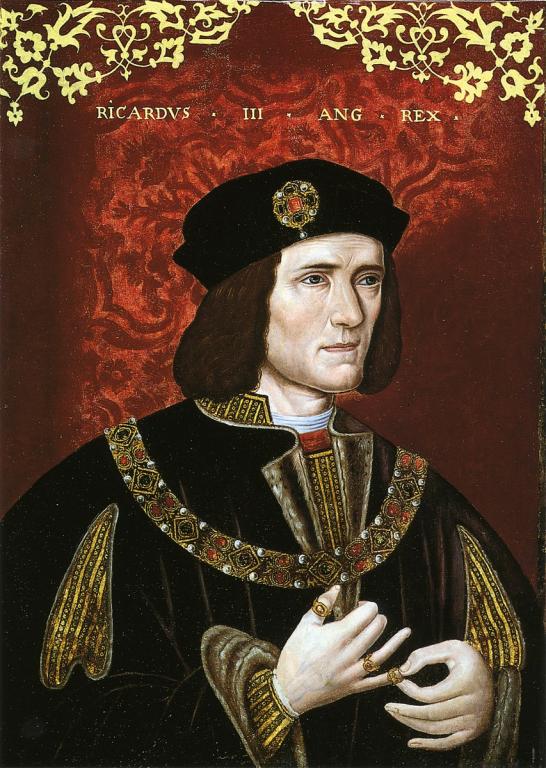
“Now is the winter of our discontent Made glorious summer by this sun of York.” A late-sixteenth-century image of King Richard III of England, the last monarch from the House of York and the last of the Plantagenet dynasty, from the National Portrait Gallery (Wikimedia Commons public domain image). Although his famous portrayal by William Shakespeare lacks my mean-spirited and gratuitous cruelty, I see in him an obvious kindred spirit. It’s nice to remember him here in his hometown, where, before his assumption of the kingship, he was the Duke of York.
A week or two ago, I posted here some extracts from a book by Reggie Anderson, written with the assistance of Jennifer Schuchmann. The book is entitled Appointments with Heaven: The True Story of a Country Doctor’s Healing Encounters With the Hereafter (Carol Stream, IL: Tyndale Momentum, 2013). I want to mention here another passage that caught my attention, partially at least because I’ve had a couple of roughly similar experiences myself.
The book tells a story about a boy who was brought in by his mother one night while Dr. Anderson was working the overnight shift in the emergency room. The boy had bumped his head. It didn’t seem very serious at first, but then the boy began vomiting and the mother grew worried. Dr. Anderson examined him and concluded that there was nothing to be concerned about. He was intending to give her a sheet of information on head injuries and then send the two of them home.
“”Well, his scan looks good,” he heard himself say, “but I think we should send him to Vanderbilt Children’s Hospital to get a CT scan of his head.”
“I had no idea why I said that. I wasn’t intending to say it, but the words slipped out of my mouth. I looked at the nurse. She stared back at me like I was a lunatic. Even the mother looked a bit confused.”
Out of the room, the nurse questioned him. The boy seemed healthy, after all. Now, they would need to find a neurosurgeon in the middle of the night, make arrangements at the Vanderbilt University hospital, order an ambulance to transport the boy and his mother to Nashville, and so forth. They would need to do lots of paperwork.
All Dr. Anderson could respond was “God just told me to send him.” To this day, he writes, he doesn’t know what prompted him to do what he did. He expected the neurosurgeon to call and say that the boy was fine.
When the neurosurgeon did call, though, four hours later, he asked why Dr. Anderson had sent the boy. Anderson responded that he didn’t know.
“Well, I’m glad you did,” the neurosurgeon said. “I just got out of surgery. We evacuated a hematoma from his brain. If you hadn’t gotten him here in time, he would have died.”
The story struck me because, on at least two occasions, one of them a particularly clear case, I’ve heard words come out of my mouth during priesthood healing blessings that I had not intended to say and that seemed decidedly imprudent and unrealistic given the realities involved . . . and that were fulfilled. I know what it’s like.
Posted from York, England
History and Religion
Travel and Religion
Previous Post
May 8, 2026
Multiple Degrees within the Kingdoms
Next Post

May 10, 2026 Two abbeys, a cathedral, and a seventh-century English poet
Recent Comments
"I have cpnsidered in my mond if the 4 volume Saints could be made into ..."
From Serbia’s “White City,” Belgrade
"DP: “But Mr. Sutherland worries about the fact that our time, when we can communicate ..."
Learning more about a region of ..."
"Another class of memories are of individuals who previously lived. Some of these remembered individuals ..."
"Sutherland's lecture sounds interesting. He seems to restate the Washington consensus that trade brings peace ..."
Learning more about a region of ..."
Browse Our Archives
Select a Category Uncategorized
Select a Month October 2026 September 2026 August 2026 July 2026 June 2026 May 2026 April 2026 March 2026 February 2026 January 2026 December 2025 November 2025 October 2025 September 2025 August 2025 July 2025 June 2025 May 2025 April 2025 March 2025 February 2025 January 2025 December 2024 November 2024 October 2024 September 2024 August 2024 July 2024 June 2024 May 2024 April 2024 March 2024 February 2024 January 2024 December 2023 November 2023 October 2023 September 2023 August 2023 July 2023 June 2023 May 2023 April 2023 March 2023 February 2023 January 2023 December 2022 November 2022 October 2022 September 2022 August 2022 July 2022 June 2022 May 2022 April 2022 March 2022 February 2022 January 2022 December 2021 November 2021 October 2021 September 2021 August 2021 July 2021 June 2021 May 2021 April 2021 March 2021 February 2021 January 2021 December 2020 November 2020 October 2020 September 2020 August 2020 July 2020 June 2020 May 2020 April 2020 March 2020 February 2020 January 2020 December 2019 November 2019 October 2019 September 2019 August 2019 July 2019 June 2019 May 2019 April 2019 March 2019 February 2019 January 2019 December 2018 November 2018 October 2018 September 2018 August 2018 July 2018 June 2018 May 2018 April 2018 March 2018 February 2018 January 2018 December 2017 November 2017 October 2017 September 2017 August 2017 July 2017 June 2017 May 2017 April 2017 March 2017 February 2017 January 2017 December 2016 November 2016 October 2016 September 2016 August 2016 July 2016 June 2016 May 2016 April 2016 March 2016 February 2016 January 2016 December 2015 November 2015 October 2015 September 2015 August 2015 July 2015 June 2015 May 2015 April 2015 March 2015 February 2015 January 2015 December 2014 November 2014 March 2014 August 2013 February 2012
Follow Us!
TAKE THE
Religious Wisdom Quiz
How did Saul die?
Select your answer to see how you score.
Killed by Philistines Fell on his own sword Stoned by Israelites Died of old age
Related posts from Sic et Non


“Once more unto the breach, dear friends, once...
TRENDING AT PATHEOS Latter-day Saint

Methodist Central Hall and Westminster Abbey
Situated on the same square is Methodist Central Hall and Westminster Abbey. ...

57th Dove Awards Honor Dolly Parton, Crown New...
On gospel music’s biggest night, the 57th annual GMA Dove Awards honored...

The First Eucharistic Controversy: Christ’s Real Presence
For Catholics, the Eucharist is the source and summit of the Christian...

What a Stop Sign Can Teach Us About...
How to Make a Decision When You Can't Hear God Main point:...

Archdiocese Hosts Military Marriage Retreat in Germany
RASTATT, Germany — The transient military lifestyle, with its frequent deployments and...

Nearly every morning, I make the drive to Detroit with my high-school-age...
view all Latter-day Saint blogs
What Are Your Thoughts?leave a comment
Ad-Free & Subscriber Log-In Subscription Support
- About Us
- 2026 Calendar
- Videos
- Podcasts
- Library of World Religions
- Faith In Media Tracker
- Advertise With Us
- Write for Us
- Privacy Policy
- Terms of Service
- Do Not Sell My Data
- Contact Us
- Radiant Digital
- Manage Newsletter Subscriptions
- Unsubscribe From Notifications
- Sitemap
Copyright 2008-2026, Patheos. All rights reserved.
Subscription Support Ad-Free & Subscriber Log-In
Follow Patheos