
BuddhistCatholicContemplativeEvangelicalGeneral ChristianHinduJewishLatter-day SaintMuslimNew VisionsProgressive Christian
Beliefs
- Buddhist
- Catholic
- Contemplative
- Evangelical
- General Christian
- Hindu
- Jewish
- Latter-day Saint
- More Voices
- Muslim
- New Visions
- Pagan
- Progressive Christian
Topics
- Religion News
- Food and Religion
- Sports and Religion
- Religious Art
- Religious Music and Entertainment
- Religious Events
- History and Religion
- Style and Religion
- Politics and Religion
- Women in Religion
- Recreation Outdoors and Religion
- Business Finance and Religion
- Careers Workplace and Religion
- Education and Religion
- Family Parenting and Religion
- Health Fitness and Religion
- Home and Religion
- Relationships and Religion
- Technology and Religion
- Travel and Religion
Columnists
- Buddhist Columnists
- Business Finance and Religion Columnists
- Careers Workplace and Religion Columnists
- Catholic Columnists
- Contemplative Columnists
- Education and Religion Columnists
- Evangelists Columnists
- Family Parenting and Religion Columnists
- General Christian Columnists
- Health Fitness and Religion Columnists
- Hindu Columnists
- History and Religion Columnists
- Home and Religion Columnists
- Jewish Columnists
- More Voices Columnists
- Latter Day Columnists
- Muslim Columnists
- New Visions Columnists
- Nonreligious Columnists
- Pagan Columnists
- Politics and Religion Columnists
- Progressive Columnists
- Recreation Outdoors and Religion Columnists
- Relationships and Religion Columnists
- Religion News Columnists
- Religious Art Columnists
- Religious Events Columnists
- Religious Music and Entertainment Columnists
- Sports and Religion Columnists
- Style and Religion Columnists
- Technology and Religion Columnists
- Travel and Religion Columnists
- Women in Religion Columnists
Resource Library
- 2026 Calendar
- Library of World Religions
- The 100 Most Holy Places on Earth
- Patheos Answers
- Podcasts
- Videos
- Faith Leaders Database
- Anglican Episcopalian
- Bahai
- Baptist
- Buddhism
- Christianity
- Confucianism
- Eastern Orthodoxy
- Hinduism
- Holiness and Pentecostal
- ISKCON
- Islam
- Judaism
- Lutheran
- Methodist
- The Church of Jesus Christ of Latter-day Saints
- New Age
- Paganism
- Presbytarian and Reformed
- Protestantism
- Religion Behind the Scenes
- Roman Catholic
- Scientology
- Shia Islam
- Sikhism
- Sufism
- Sunni Islam
- Taoism
- Zen
- See all religions
Research Tools
 Ad-Free & Subscriber Log-In Subscription Support
Ad-Free & Subscriber Log-In Subscription Support
Follow Patheos 

- Trending:
- Forgiveness
- |
- Marriage
- |
- Consciousness
- |
- Death Penalty
- |
- Election
- |
- Halloween

- Home
- Latter-day Saint
- History and Religion
- “Murder in the Cathedral”
“Murder in the Cathedral”
Last updated on: May 7, 2026 at 5:57 pm by Dan Peterson
“Murder in the Cathedral” 2026-05-07T17:57:17-06:00 Dan Peterson
Patheos Explore the world's faith through different perspectives on religion and spirituality! Patheos has the views of the prevalent religions and spiritualities of the world.
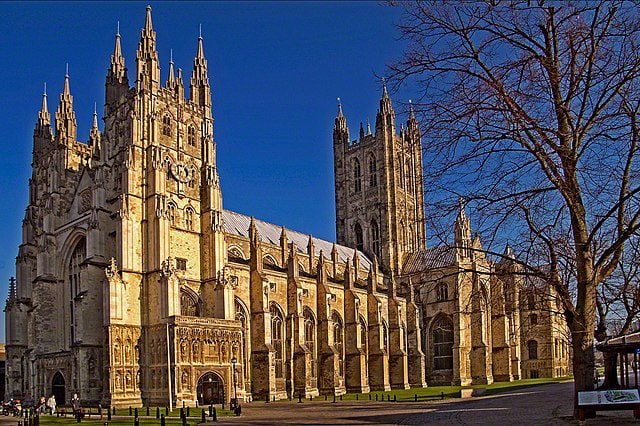
Canterbury Cathedral, shown here in a 2006 Wikimedia Commons public domain photograph by Antony McCallum, who is the uploader, photographer, full copyright owner, and proprietor of WyrdLight.com, is currently undergoing an exterior cleaning and renovation that has already made its twin towers gleam as if they had been completed just a few days ago.
Whan that Aprille with his shoures soote,
The droghte of March hath perced to the roote,
And bathed every veyne in swich licóur
Of which vertú engendred is the flour;
Whan Zephirus eek with his swete breeth
Inspired hath in every holt and heeth
The tendre croppes, and the yonge sonne
Hath in the Ram his halfe cours y-ronne,
And smale foweles maken melodye,
That slepen al the nyght with open ye,
So priketh hem Natúre in hir corages,
Thanne longen folk to goon on pilgrimages,
And palmeres for to seken straunge strondes,
To ferne halwes, kowthe in sondry londes;
And specially, from every shires ende
Of Engelond, to Caunterbury they wende,
The hooly blisful martir for to seke,
That hem hath holpen whan that they were seeke.
So run the first eighteen lines of The Canterbury Tales in their original Middle English, as they were written by Geoffrey Chaucer between 1387 and 1400. And here they are as one modern translator has rendered them:
When April with its sweet-smelling showers
Has pierced the drought of March to the root,
And bathed every vein (of the plants) in such liquid
By which power the flower is created;
When the West Wind also with its sweet breath,
In every wood and field has breathed life into
The tender new leaves, and the young sun
Has run half its course in Aries,
And small fowls make melody,
Those that sleep all the night with open eyes
(So Nature incites them in their hearts),
Then folk long to go on pilgrimages,
And professional pilgrims to seek foreign shores,
To distant shrines, known in various lands;
And specially from every shire’s end
Of England to Canterbury they travel,
To seek the holy blessed martyr,
Who helped them when they were sick.
Our tour began today. We drove out of London, which is a very slow and complicated process, and over to Canterbury. Our first stop there was at the Church of St Martin, which is believed to be the oldest church in the English-speaking world, as well as the oldest English church building that is still in active ecclesiastical use. With the nearby Canterbury Cathedral and St Augustine’s Abbey, it forms a collective UNESCO World Heritage Site. It also happens to be the place where the parents of our British Latter-day Saint guide, Peter Fagg, were married. They later joined the Church of Jesus Christ of Latter-day Saints and eventually served as the president and matron of the London England Temple.
We then walked over to St. Augustine’s Abbey, which was founded in AD 598 by the monk and missionary St. Augustine of Canterbury — not to be confused with the philosopher and theologian Augustine of Hippo — who was sent by Pope Gregory I to convert the Anglo-Saxons and who became the first Archbishop of Canterbury — which is still the title of the head of the Church of England and of the world-wide Anglican communion.
From the Abbey we walked over to Canterbury Cathedral, which we visited after lunch. This is where St. Anselm of Canterbury, an Italian Benedictine abbot, philosopher and theologian, served as Archbishop of Canterbury from 1093 until his death in 1109. He is often considered the founder of medieval scholasticism and is very likely the originator of the famous “ontological argument” for the existence of God.
Most famously, it was within the Cathedral that St. Thomas Becket, formerly the close friend of King Henry II and Lord Chancellor of England from 1155 until his very reluctant acceptance of the office of Archbishop of Canterbury in 1162 was assassinated by four of the king’s knights on 29 December 1170. He was canonized as a saint roughly two years later, and his tomb became a major object of pilgrimage.
I first read T. S. Eliot’s verse play Murder in the Cathedral back when I was in high school — though whether I did so as a class assignment or on my own initiative I cannot now recall. It impressed me deeply. Written at the invitation of George Bell, the Bishop of Chichester, and first performed in the Cathedral’s Chapter House for the 1935 Canterbury Festival, the play is a remarkable piece of literature and has occupied a special place in my heart and mind since my initial encounter with it.
After decades have passed, I still remember a passage that struck me powerfully then. It occurs when the second of four “tempters” comes to Thomas, offering him a return to the worldly power and wealth that he had previously enjoyed as Lord Chancellor of England and the king’s friend if we will only accede to the demands that Henry II is making of the Church. Thomas responds:
Thomas: No! shall I, who keep the keys
Of heaven and hell, supreme alone in England,
Who bind and loose, with power from the
Pope,
Descend to desire a punier power?
Delegate to deal the doom of damnation,
To condemn kings, not serve among their
servants, Is my open office. No! Go.
Tempter: Then I leave you to your fate.
I freely admit to having been much impressed, too, by the 1964 film Becket, which is based upon a play by Jean Anouilh and which stars Richard Burton as Thomas Becket and Peter O’Toole as Henry II. I fact, I think that I need to watch it again. It’s been years since I’ve seen it.
A martyrdom is always the design of God, for His love of men, to warn them and to lead them, to bring them back to His ways. It is never the design of man; for the true martyr is he who has become the instrument of God, who has lost his will in the will of God, and who no longer desires anything for himself, not even the glory of being a martyr. (T. S. Eliot, Murder in the Cathedral)
Posted from Cambridge, England
History and Religion
Travel and Religion
Previous Post
May 6, 2026
"Hadestown"
Next Post

May 8, 2026 Multiple Degrees within the Kingdoms
Recent Comments
"I have cpnsidered in my mond if the 4 volume Saints could be made into ..."
From Serbia’s “White City,” Belgrade
"DP: “But Mr. Sutherland worries about the fact that our time, when we can communicate ..."
Learning more about a region of ..."
"Another class of memories are of individuals who previously lived. Some of these remembered individuals ..."
"Sutherland's lecture sounds interesting. He seems to restate the Washington consensus that trade brings peace ..."
Learning more about a region of ..."
Browse Our Archives
Select a Category Uncategorized
Select a Month October 2026 September 2026 August 2026 July 2026 June 2026 May 2026 April 2026 March 2026 February 2026 January 2026 December 2025 November 2025 October 2025 September 2025 August 2025 July 2025 June 2025 May 2025 April 2025 March 2025 February 2025 January 2025 December 2024 November 2024 October 2024 September 2024 August 2024 July 2024 June 2024 May 2024 April 2024 March 2024 February 2024 January 2024 December 2023 November 2023 October 2023 September 2023 August 2023 July 2023 June 2023 May 2023 April 2023 March 2023 February 2023 January 2023 December 2022 November 2022 October 2022 September 2022 August 2022 July 2022 June 2022 May 2022 April 2022 March 2022 February 2022 January 2022 December 2021 November 2021 October 2021 September 2021 August 2021 July 2021 June 2021 May 2021 April 2021 March 2021 February 2021 January 2021 December 2020 November 2020 October 2020 September 2020 August 2020 July 2020 June 2020 May 2020 April 2020 March 2020 February 2020 January 2020 December 2019 November 2019 October 2019 September 2019 August 2019 July 2019 June 2019 May 2019 April 2019 March 2019 February 2019 January 2019 December 2018 November 2018 October 2018 September 2018 August 2018 July 2018 June 2018 May 2018 April 2018 March 2018 February 2018 January 2018 December 2017 November 2017 October 2017 September 2017 August 2017 July 2017 June 2017 May 2017 April 2017 March 2017 February 2017 January 2017 December 2016 November 2016 October 2016 September 2016 August 2016 July 2016 June 2016 May 2016 April 2016 March 2016 February 2016 January 2016 December 2015 November 2015 October 2015 September 2015 August 2015 July 2015 June 2015 May 2015 April 2015 March 2015 February 2015 January 2015 December 2014 November 2014 March 2014 August 2013 February 2012
Follow Us!
TAKE THE
Religious Wisdom Quiz
True or False: Romans teaches that we are justified by works of the law.
Select your answer to see how you score.
FALSE TRUE
Related posts from Sic et Non
Margaret Barker’s Master Classes on the Hebrew Scriptures

Thinking, from Dover back to Amsterdam
TRENDING AT PATHEOS Latter-day Saint

57th Dove Awards Honor Dolly Parton, Crown New...
On gospel music’s biggest night, the 57th annual GMA Dove Awards honored...

The First Eucharistic Controversy: Christ’s Real Presence
For Catholics, the Eucharist is the source and summit of the Christian...

What a Stop Sign Can Teach Us About...
How to Make a Decision When You Can't Hear God Main point:...

Archdiocese Hosts Military Marriage Retreat in Germany
RASTATT, Germany — The transient military lifestyle, with its frequent deployments and...

Nearly every morning, I make the drive to Detroit with my high-school-age...

The Real AI Story Is Adoption Without Trust
Artificial intelligence has crossed a political threshold. It is no longer a...
view all Latter-day Saint blogs
What Are Your Thoughts?leave a comment
Ad-Free & Subscriber Log-In Subscription Support
- About Us
- 2026 Calendar
- Videos
- Podcasts
- Library of World Religions
- Faith In Media Tracker
- Advertise With Us
- Write for Us
- Privacy Policy
- Terms of Service
- Do Not Sell My Data
- Contact Us
- Radiant Digital
- Manage Newsletter Subscriptions
- Unsubscribe From Notifications
- Sitemap
Copyright 2008-2026, Patheos. All rights reserved.
Subscription Support Ad-Free & Subscriber Log-In
Follow Patheos