
BuddhistCatholicContemplativeEvangelicalGeneral ChristianHinduJewishLatter-day SaintMuslimNew VisionsProgressive Christian
Beliefs
- Buddhist
- Catholic
- Contemplative
- Evangelical
- General Christian
- Hindu
- Jewish
- Latter-day Saint
- More Voices
- Muslim
- New Visions
- Pagan
- Progressive Christian
Topics
- Religion News
- Food and Religion
- Sports and Religion
- Religious Art
- Religious Music and Entertainment
- Religious Events
- History and Religion
- Style and Religion
- Politics and Religion
- Women in Religion
- Recreation Outdoors and Religion
- Business Finance and Religion
- Careers Workplace and Religion
- Education and Religion
- Family Parenting and Religion
- Health Fitness and Religion
- Home and Religion
- Relationships and Religion
- Technology and Religion
- Travel and Religion
Columnists
- Buddhist Columnists
- Business Finance and Religion Columnists
- Careers Workplace and Religion Columnists
- Catholic Columnists
- Contemplative Columnists
- Education and Religion Columnists
- Evangelists Columnists
- Family Parenting and Religion Columnists
- General Christian Columnists
- Health Fitness and Religion Columnists
- Hindu Columnists
- History and Religion Columnists
- Home and Religion Columnists
- Jewish Columnists
- More Voices Columnists
- Latter Day Columnists
- Muslim Columnists
- New Visions Columnists
- Nonreligious Columnists
- Pagan Columnists
- Politics and Religion Columnists
- Progressive Columnists
- Recreation Outdoors and Religion Columnists
- Relationships and Religion Columnists
- Religion News Columnists
- Religious Art Columnists
- Religious Events Columnists
- Religious Music and Entertainment Columnists
- Sports and Religion Columnists
- Style and Religion Columnists
- Technology and Religion Columnists
- Travel and Religion Columnists
- Women in Religion Columnists
Resource Library
- 2026 Calendar
- Library of World Religions
- The 100 Most Holy Places on Earth
- Patheos Answers
- Podcasts
- Videos
- Faith Leaders Database
- Anglican Episcopalian
- Bahai
- Baptist
- Buddhism
- Christianity
- Confucianism
- Eastern Orthodoxy
- Hinduism
- Holiness and Pentecostal
- ISKCON
- Islam
- Judaism
- Lutheran
- Methodist
- The Church of Jesus Christ of Latter-day Saints
- New Age
- Paganism
- Presbytarian and Reformed
- Protestantism
- Religion Behind the Scenes
- Roman Catholic
- Scientology
- Shia Islam
- Sikhism
- Sufism
- Sunni Islam
- Taoism
- Zen
- See all religions
Research Tools
 Ad-Free & Subscriber Log-In Subscription Support
Ad-Free & Subscriber Log-In Subscription Support
Follow Patheos 

- Trending:
- Forgiveness
- |
- Marriage
- |
- Consciousness
- |
- Death Penalty
- |
- Election
- |
- Halloween

- Home
- Latter-day Saint
- History and Religion
- Multiple Degrees within the Kingdoms
Multiple Degrees within the Kingdoms
Last updated on: May 8, 2026 at 4:42 pm by Dan Peterson
Multiple Degrees within the Kingdoms 2026-05-08T16:42:58-06:00 Dan Peterson
Patheos Explore the world's faith through different perspectives on religion and spirituality! Patheos has the views of the prevalent religions and spiritualities of the world.
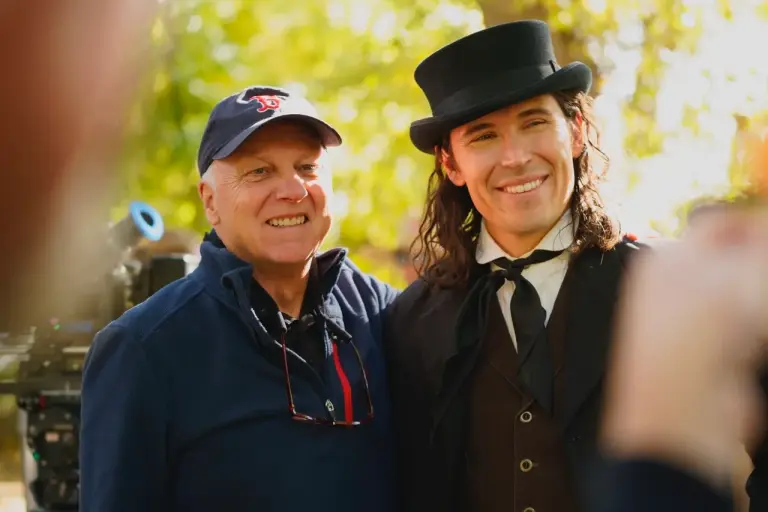
A clearly unsuspecting director, Mark Goodman, with David Martinez
They’re all here. Every single one of the currently-available episodes of Becoming Brigham. And every future installment of the series will appear here, as well: https://becomingbrigham.com. And the 37-second teaser for Episode 16 (“Sweeter than Honey”) is also now up. Watch them!
And don’t miss the newest article to appear on the never-changing website of the Interpreter Foundation. This one (“Multiple Degrees within the Celestial, Terrestrial, and Telestial Kingdoms”) is published in Interpreter: A Journal of Latter-day Saint Faith and Scholarship 68 [2026]: 443-490) and was written by David W. Smith:
Abstract: Based on Doctrine and Covenants 131:1, The Church of Jesus Christ of Latter-day Saints teaches that there are three degrees within the celestial kingdom. There has been a proposal that this teaching is incorrect and instead this scripture should be interpreted as a reference to the three kingdoms described in Doctrine and Covenants 76 (celestial, terrestrial, and telestial). This proposition is based on two claims. First, the word celestial, in Joseph Smith’s day, meant heavenly or belonging to heaven, so Doctrine and Covenants 131:1 should be interpreted to mean “in heaven there are three degrees.” The second claim is that interpreting Doctrine and Covenants 131:1 as referring to three degrees in the celestial kingdom is a twentieth-century innovation based on one sermon by one Apostle, with almost no other apostolic support before or after that sermon. This article shows that the first claim is very likely incorrect and the second is demonstrably false. The article then briefly addresses the question of degrees in the terrestrial and telestial kingdoms.
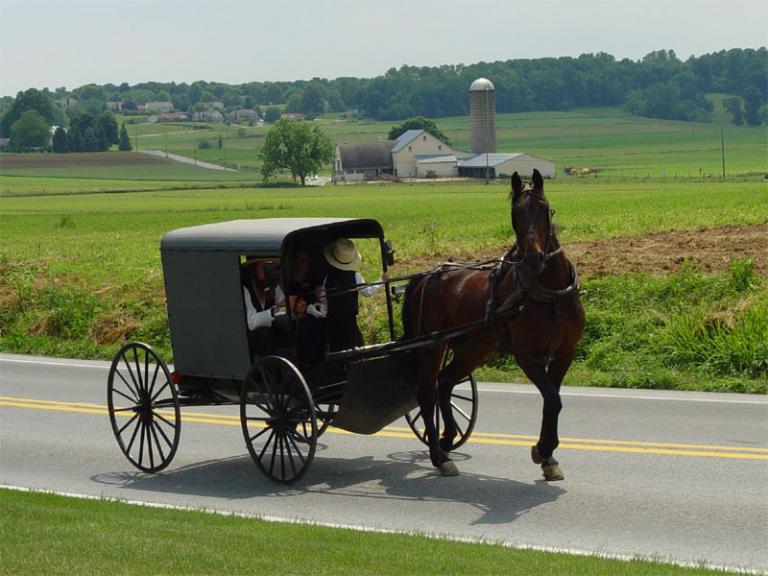
Contrary to apparently common assumptions, this isn’t a photograph of a Latter-day Saint vehicle in downtown Salt Lake City. Rather, it’s a scene in modern Lancaster County, Pennsylvania. And still not Latter-day Saint. (Wikimedia Commons public domain photograph)
I ran across this little gem a few days before departing from North America this time around. I cannot now recall where I saw it, so I apologize for not crediting my source. But I wanted to share it:
A man was being tailgated by a woman on Foothill Boulevard in Salt Lake City. Suddenly, the light turned yellow just in front of him. He did the right thing by stopping at the crosswalk, even though he could have beaten the red light by accelerating through the intersection. The tailgating woman slammed on her brakes and leaned on her horn. She opened her window, stuck her hand out, and made a certain gesture, all the while screaming in frustration because she’d missed her chance to get through the intersection with him. As she was still in mid-rant, she heard a tap on her window and looked up into the face of a very serious-looking police officer.
The officer ordered her to exit the car with her hands up. He next took her to the police station, where she was searched, fingerprinted, photographed, and placed in a cell. After a couple of hours, a policeman approached the cell and opened the door. She was escorted back to the booking desk where the arresting officer was waiting with her personal effects. “I’m very sorry for this mistake,” he said. “You see, I pulled up behind your car while you were blowing your horn, flipping the guy off in front of you, and cussing a blue streak at him. I noticed the “Choose the Right” license plate holder, the “Families are Forever” bumper sticker, the “Follow Me to Sunday School” bumper sticker, and the chrome-plated Angel Moroni emblem on the trunk.
“Naturally, I assumed that you had stolen the car.”
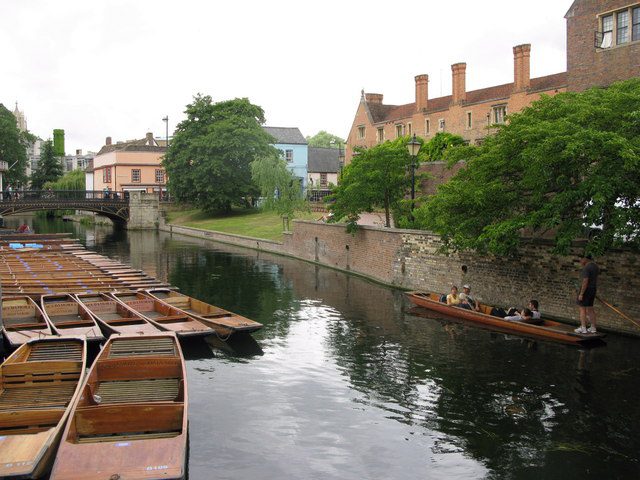
Magdalene Bridge and College, University of Cambridge, United Kingdom (Wikimedia Commons photograph by Simon Palmer). Relatively late in his teaching career, C. S. Lewis left Oxford and took a professorship in this Cambridge college.
Our group went punting on the River Cam this morning. Then we walked past the site of the former White Horse Tavern or White Horse Inn and over to St. Edward’s Church (strictly speaking, to the Church of St. Edward King and Martyr). It’s dedicated to Edward the Martyr, who reigned as King of England from 975 until his murder (under thoroughly unclear circumstances) in 978.
More importantly, it was at midnight mass on Christmas Eve 1525 — just slightly more than five hundred years ago — a man named Robert Barnes delivered what is generally regarded as the first openly evangelical sermon in English history, accusing the Catholic Church of heresy. Over the next decade or so many of the great English reformers preached at St Edward’s, including the future Bishop of Worcester and Oxford Martyr Hugh Latimer, whom I’ll have more to say about in a few days, who was a regular preacher in the church until he left Cambridge in 1531. For this reason, St Edward’s is sometimes called the “Cradle of the (English) Reformation.”
According to Foxe’s Book of Martyrs, although the claim has been strongly disputed both in detail and altogether, such figures as Robert Barnes, Hugh Latimer, William Tyndale, Miles Coverdale, and the future Archbishop of Canterbury Thomas Cranmer had been meeting frequently in the White Horse Tavern (in a group sometimes called “Little Germany”) to discuss the ideas of Martin Luther, which were beginning to arrive from the European continent
We were given a fine twenty-five minute introduction to St. Edward’s and its history and significance by the church’s wonderful old treasurer, who left little doubt as to his feelings toward the Roman Catholic Church and what might be termed Romanizing tendencies within his own Church of England.
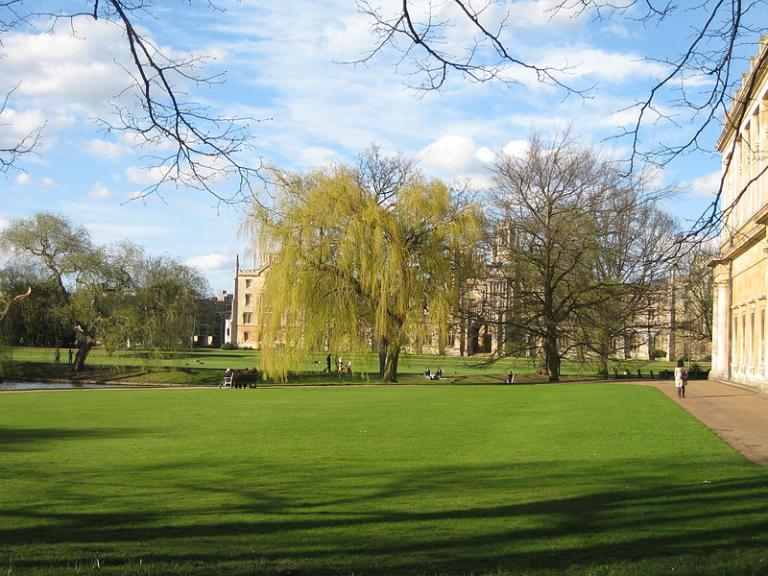
Another scene in Cambridge. (Wikimedia Commons public domain image)
From St. Edward’s, we walked around the legendary original Cavendish Laboratory, past multiple Cambridge colleges (including Trinity, where a descendant of Sir Isaac Newton’s famous gravity-related apple tree stands below his former window), and over to the Round Church, which has been turned into a very helpful visitor’s center that’s dedicated to the Christian history and heritage of this beautiful and fascinating city.

King’s College Chapel, Cambridge, as viewed from Great St. Mary’s Church by Jean-Christophe Benoist (Wikimedia Commons public domain photograph)
In the evening, after I had substantially reduced my descendants’ hopes for an inheritance by buying a couple of Ancient Greek texts at the main Cambridge University Press bookstore, we attended a service of Evensong in the magnificent King’s College Chapel, which is one of my very favorite buildings not only in England but in all the world. The visual surroundings were, of course, stunning, but so was the music. English choral singing can have an absolutely unearthly beauty, and this evening’s music was of that ethereal quality.
Posted from Cambridge, England
History and Religion
Travel and Religion
Previous Post
May 7, 2026
"Murder in the Cathedral"
Next Post
May 9, 2026 The first Boston, and Lincoln
Recent Comments
"I have cpnsidered in my mond if the 4 volume Saints could be made into ..."
From Serbia’s “White City,” Belgrade
"DP: “But Mr. Sutherland worries about the fact that our time, when we can communicate ..."
Learning more about a region of ..."
"Another class of memories are of individuals who previously lived. Some of these remembered individuals ..."
"Sutherland's lecture sounds interesting. He seems to restate the Washington consensus that trade brings peace ..."
Learning more about a region of ..."
Browse Our Archives
Select a Category Uncategorized
Select a Month October 2026 September 2026 August 2026 July 2026 June 2026 May 2026 April 2026 March 2026 February 2026 January 2026 December 2025 November 2025 October 2025 September 2025 August 2025 July 2025 June 2025 May 2025 April 2025 March 2025 February 2025 January 2025 December 2024 November 2024 October 2024 September 2024 August 2024 July 2024 June 2024 May 2024 April 2024 March 2024 February 2024 January 2024 December 2023 November 2023 October 2023 September 2023 August 2023 July 2023 June 2023 May 2023 April 2023 March 2023 February 2023 January 2023 December 2022 November 2022 October 2022 September 2022 August 2022 July 2022 June 2022 May 2022 April 2022 March 2022 February 2022 January 2022 December 2021 November 2021 October 2021 September 2021 August 2021 July 2021 June 2021 May 2021 April 2021 March 2021 February 2021 January 2021 December 2020 November 2020 October 2020 September 2020 August 2020 July 2020 June 2020 May 2020 April 2020 March 2020 February 2020 January 2020 December 2019 November 2019 October 2019 September 2019 August 2019 July 2019 June 2019 May 2019 April 2019 March 2019 February 2019 January 2019 December 2018 November 2018 October 2018 September 2018 August 2018 July 2018 June 2018 May 2018 April 2018 March 2018 February 2018 January 2018 December 2017 November 2017 October 2017 September 2017 August 2017 July 2017 June 2017 May 2017 April 2017 March 2017 February 2017 January 2017 December 2016 November 2016 October 2016 September 2016 August 2016 July 2016 June 2016 May 2016 April 2016 March 2016 February 2016 January 2016 December 2015 November 2015 October 2015 September 2015 August 2015 July 2015 June 2015 May 2015 April 2015 March 2015 February 2015 January 2015 December 2014 November 2014 March 2014 August 2013 February 2012
Follow Us!
TAKE THE
Religious Wisdom Quiz
What was the occupation of Lydia, Paul's first convert in Philippi?
Select your answer to see how you score.
Tentmaker Dealer in purple cloth Tax collector Fisherman
Related posts from Sic et Non

Created or Discovered? (Part Two)
Created or Discovered? (Part One)
One of the greatest of all logicians on...
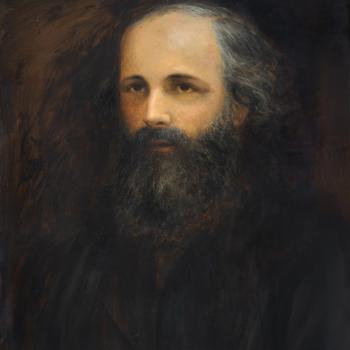
Science and Religion: A Great Scottish Example
TRENDING AT PATHEOS Latter-day Saint

Letters on Living the Faith by C.S. Lewis
Most of us met C.S. Lewis as a public intellectual. Mere Christianity....

When Halloween Unmasks Married Hearts
Written by Dr. David K. Ewen from Eternal Truth Bible College Behind...

Aristotle. He’s been called the father of logic, the father of the...

Methodist Central Hall and Westminster Abbey
Situated on the same square is Methodist Central Hall and Westminster Abbey. ...

57th Dove Awards Honor Dolly Parton, Crown New...
On gospel music’s biggest night, the 57th annual GMA Dove Awards honored...

The First Eucharistic Controversy: Christ’s Real Presence
For Catholics, the Eucharist is the source and summit of the Christian...
view all Latter-day Saint blogs
What Are Your Thoughts?leave a comment
Ad-Free & Subscriber Log-In Subscription Support
- About Us
- 2026 Calendar
- Videos
- Podcasts
- Library of World Religions
- Faith In Media Tracker
- Advertise With Us
- Write for Us
- Privacy Policy
- Terms of Service
- Do Not Sell My Data
- Contact Us
- Radiant Digital
- Manage Newsletter Subscriptions
- Unsubscribe From Notifications
- Sitemap
Copyright 2008-2026, Patheos. All rights reserved.
Subscription Support Ad-Free & Subscriber Log-In
Follow Patheos