
BuddhistCatholicContemplativeEvangelicalGeneral ChristianHinduJewishLatter-day SaintMuslimNew VisionsProgressive Christian
Beliefs
- Buddhist
- Catholic
- Contemplative
- Evangelical
- General Christian
- Hindu
- Jewish
- Latter-day Saint
- More Voices
- Muslim
- New Visions
- Pagan
- Progressive Christian
Topics
- Religion News
- Food and Religion
- Sports and Religion
- Religious Art
- Religious Music and Entertainment
- Religious Events
- History and Religion
- Style and Religion
- Politics and Religion
- Women in Religion
- Recreation Outdoors and Religion
- Business Finance and Religion
- Careers Workplace and Religion
- Education and Religion
- Family Parenting and Religion
- Health Fitness and Religion
- Home and Religion
- Relationships and Religion
- Technology and Religion
- Travel and Religion
Columnists
- Buddhist Columnists
- Business Finance and Religion Columnists
- Careers Workplace and Religion Columnists
- Catholic Columnists
- Contemplative Columnists
- Education and Religion Columnists
- Evangelists Columnists
- Family Parenting and Religion Columnists
- General Christian Columnists
- Health Fitness and Religion Columnists
- Hindu Columnists
- History and Religion Columnists
- Home and Religion Columnists
- Jewish Columnists
- More Voices Columnists
- Latter Day Columnists
- Muslim Columnists
- New Visions Columnists
- Nonreligious Columnists
- Pagan Columnists
- Politics and Religion Columnists
- Progressive Columnists
- Recreation Outdoors and Religion Columnists
- Relationships and Religion Columnists
- Religion News Columnists
- Religious Art Columnists
- Religious Events Columnists
- Religious Music and Entertainment Columnists
- Sports and Religion Columnists
- Style and Religion Columnists
- Technology and Religion Columnists
- Travel and Religion Columnists
- Women in Religion Columnists
Resource Library
- 2026 Calendar
- Library of World Religions
- The 100 Most Holy Places on Earth
- Patheos Answers
- Podcasts
- Videos
- Faith Leaders Database
- Anglican Episcopalian
- Bahai
- Baptist
- Buddhism
- Christianity
- Confucianism
- Eastern Orthodoxy
- Hinduism
- Holiness and Pentecostal
- ISKCON
- Islam
- Judaism
- Lutheran
- Methodist
- The Church of Jesus Christ of Latter-day Saints
- New Age
- Paganism
- Presbytarian and Reformed
- Protestantism
- Religion Behind the Scenes
- Roman Catholic
- Scientology
- Shia Islam
- Sikhism
- Sufism
- Sunni Islam
- Taoism
- Zen
- See all religions
Research Tools
 Ad-Free & Subscriber Log-In Subscription Support
Ad-Free & Subscriber Log-In Subscription Support
Follow Patheos 

- Trending:
- Forgiveness
- |
- Marriage
- |
- Consciousness
- |
- Death Penalty
- |
- Election
- |
- Halloween

- Home
- Latter-day Saint
- Travel and Religion
- “God’s Equation”
“God’s Equation”
Last updated on: April 30, 2026 at 2:56 pm by Dan Peterson
“God’s Equation” 2026-04-30T14:56:20-06:00 Dan Peterson
Patheos Explore the world's faith through different perspectives on religion and spirituality! Patheos has the views of the prevalent religions and spiritualities of the world.

A NASA/NOAA photo of the Nile River and the Nile Delta — the ORIGINAL “delta” — from approximately 512 miles above the surface of the planet. The exceptionally bright glow of Cairo at the southern end of the Delta is plainly visible, as is the long narrow strip along the Mediterranean coast on western side of the Delta that is Alexandria. Moving westward, after the sparsely populated moonscape of the Sinai Peninsula, the very populous nations of Israel and Lebanon and coastal Syria are unmistakable. The Nile Valley and the Delta, taken together, resemble an Egyptian lotus flower and its stem. Far to the east of the Mediterranean, across a vast desert in the upper right corner of the photograph, you can see the populous centers of Mesopotamia (Iraq), that are watered by the Tigris and Euphrates rivers.
A new article of mine appeared early this morning in Meridian Magazine. Whether it does its job or not, my hope for it is that it might help at least a little bit in understanding some of the narratives of the Old Testament: “Why the Fertile Crescent Matters: A Map That Unlocks the Bible’s Geography and History”
And please don’t forget to watch and rewatch and recommend Becoming Brigham. All of its episodes are and will continue to be posted at becomingbrigham.com.
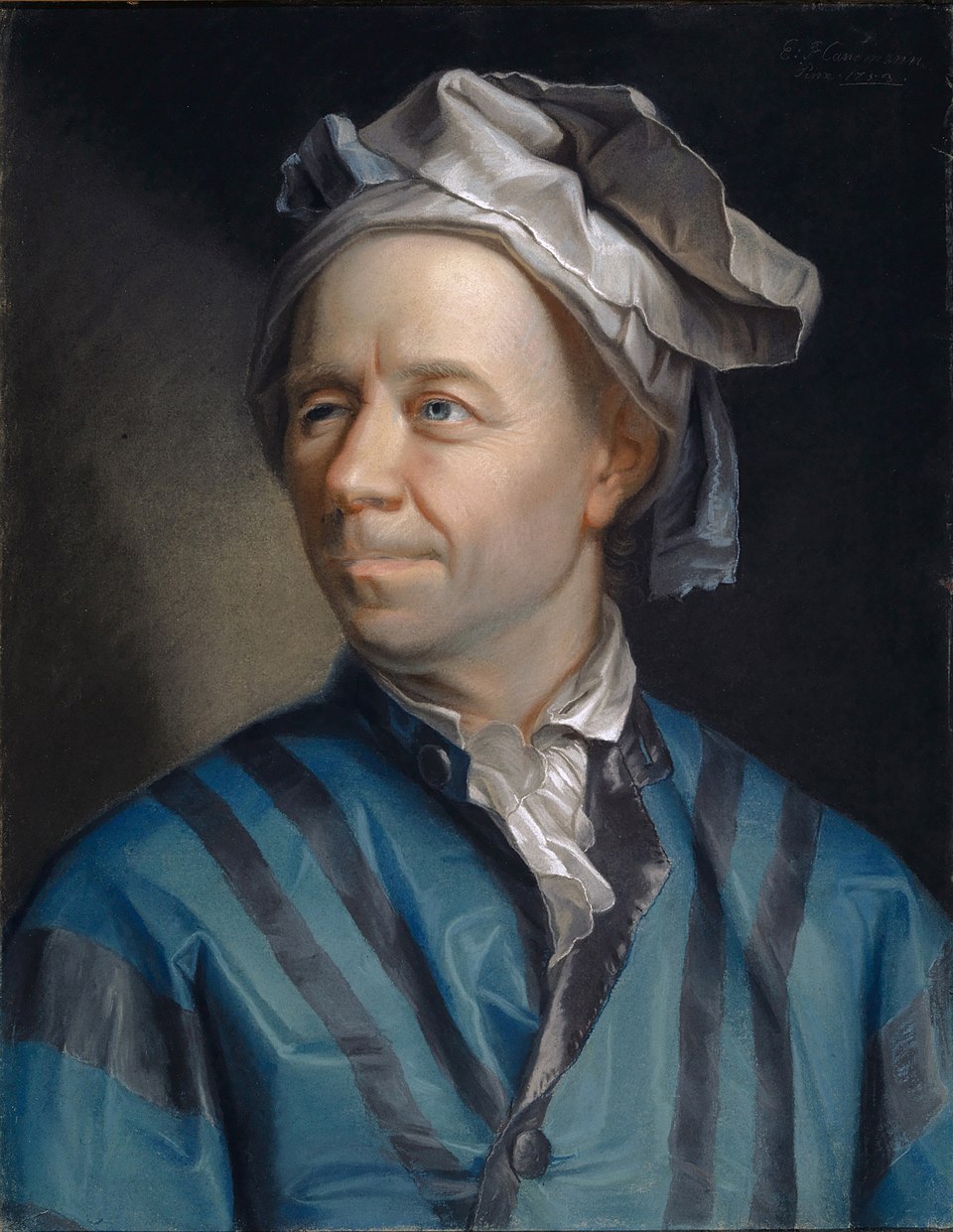
A 1753 portrait of Leonhard Euler (Wikimedia Commons public domain image)
On one of my bedroom bookshelves, I have
a small volume by the science writer David Stipp entitled A Most Elegant Equation: Euler’s Formula and the Beauty of Mathematics (New York: Basic Books, 2017)
Euler’s formula — the pronunciation of his surname is roughly the same as that of the English noun oiler — states that, for any real number x,

When x = π, Euler’s formula can be rewritten as eiπ = −1 or eiπ + 1 = 0, which is then known as “Euler’s identity.”
I know, I know. Don’t worry. And don’t be frightened off. It’s not essential, it’s not even particularly important or relevant, that you or I really understand the equation or its implications. I readily admit that I don’t — which I deeply regret. (In the next life, I hope to devote serious attention to mathematics. Really, I do.) But my point is a different one. It’s not, as such, even really mathematical.
Nearly two and a half centuries after the death of the great Swiss mathematician Leonhard Euler (1707-1783) his formula shows up all over the place — not only in mathematics, but in physics (e.g., quantum theory, the analysis of waves and oscillations and alternating currents), chemistry, and engineering (e.g., signal analysis, communications theory, and control systems). The late great Nobel laureate physicist Richard Feynman, of the California Institute of Technology, called the equation “our jewel” and “the most remarkable formula in mathematics.” (See Richard Feynman. “Chapter 22: Algebra,” in The Feynman Lectures on Physics [1970] 1:10.)
“Euler’s identity,” which is sometimes labeled “God’s equation,” includes just five numbers. But these are five core constants and, thus, it represents an astonishing revelation of hidden connections. It ties together everything from basic arithmetic to compound interest, the circumference of a circle, trigonometry, calculus, and even infinity.
Permit me to share a few passages that I marked in just the first few pages of A Most Elegant Equation:
Who can resist lists of all the ten best this or that? Not me. So a few years ago when I ran across a ranking by math experts of the most beautiful theorems, I tuned in. I decided to treat it as a pop quiz: How many of them could I dredge up from my distant undergraduate days as a math major? Alas, I’m afraid I flunked. Still, I was consoled by being able to recall nine of the top 10 (of two dozen). But the No. 1 beauty, an equation known as Euler’s formula, bothered me — I’d seen it before, yet couldn’t remember going over it in school (1).
Stipp points out that Euler is sometimes called “the Mozart of mathematics” (1).
And as the formula started playing through my head like a tune whose provenance maddeningly eluded me, I discovered via Google that a number of authorities on math have considered it not only beautiful, but also one of the most remarkable results in the history of mathematics. (2)
In my limited experience with them, mathematicians (and those who are seriously involved with the use of higher mathematics) are prone to describe certain formulae as “elegant” and “beautiful.” I’m pretty sure that I don’t fully grasp their appreciation — my mastery of the discipline was never great and is, now, much less than it once was — but such sentiments do raise the question of why mathematics should ever be considered a matter of aesthetics. And, yet, it often is.
Also, the formula isn’t just a math version of abstract art. Long after Euler’s era, scientists and engineers realized that the general equation mentioned above (the conceptual parent of eiπ + 1 = 0) is immensely useful for mathematically modeling phenomena, such as the rhythmic flow of alternating current. Thus, Euler’s brilliant pure math discovery is now effectively embedded in electrical devices all around us. I’d call that scary cool, too, if I hadn’t already used up my weekly allotment of that epithet.
The formula’s timelessness also appealed to me. As electrical engineer Paul Nahin nicely put it in a book he wrote about the equation for people who’ve taken college math: “Unlike the physics or chemistry or engineering of today, which will almost surely appear archaic to technicians of the far future, Euler’s formula will still appear, to the arbitrarily advanced mathematicians ten thousand years hence, to be beautiful and stunning and untarnished by time.” (5)
But, for me (and, I know, for others) such comments raise other really important and difficult questions. Why is it that developments in pure mathematics have so often found application, down the line, to previously unforeseen areas in the empirical sciences? Are such developments discoveries, or are they inventions? And, especially if the universe is thought to be fundamentally mindless and ultimately pointless, why is the mathematics that describes it and makes sense of it (as in the case of Euler’s formula)so often regarded by those who understand it,as “beautiful” and “elegant”?
His book, Stipp writes,
isn’t intended to increase quantitative skills or impart a thorough grounding in the math that it covers — its sole mission is to bring home that great mathematics is as provocative, beautiful, and deep as great art or literature (5).
Bertrand Russell (1872-1970), third Earl Russell, the prominent and prolific English philosopher, logician, mathematician, public intellectual, and Nobel laureate in Literature, put it this way in his 1910 collection of philosophical writings Mysticism and Logic and Other Essays:
Mathematics, rightly viewed, possesses not only truth, but supreme beauty— a beauty cold and austere, like that of sculpture, without appeal to any part of our weaker nature, without the gorgeous trappings of painting or music, yet sublimely pure, and capable of a stern perfection such as only the greatest art can show. The true spirit of delight, the exaltation, the sense of being more than Man, which is the touchstone of the highest excellence, is to be found in mathematics as surely as poetry.
I find that extremely interesting, and I’m not alone in doing so.
Travel and Religion
History and Religion
Previous Post

April 29, 2026
Panel Perspectives on the Book of Abraham, and Other Fun
Next Post

May 1, 2026 "Color in the Book of Mormon"
Recent Comments
"Sutherland's lecture sounds interesting. He seems to restate the Washington consensus that trade brings peace ..."
Learning more about a region of ..."
"In a meeting today, I learned another important reason why accurate (or at least as ..."
From Serbia’s “White City,” Belgrade
"I've been watching a lot of video interviews of NDErs and researchers. I think in ..."
"PL: "Let's hope he doesn't have your address..."I have to frankly confess that a few ..."
From Serbia’s “White City,” Belgrade
Browse Our Archives
Select a Category Uncategorized
Select a Month October 2026 September 2026 August 2026 July 2026 June 2026 May 2026 April 2026 March 2026 February 2026 January 2026 December 2025 November 2025 October 2025 September 2025 August 2025 July 2025 June 2025 May 2025 April 2025 March 2025 February 2025 January 2025 December 2024 November 2024 October 2024 September 2024 August 2024 July 2024 June 2024 May 2024 April 2024 March 2024 February 2024 January 2024 December 2023 November 2023 October 2023 September 2023 August 2023 July 2023 June 2023 May 2023 April 2023 March 2023 February 2023 January 2023 December 2022 November 2022 October 2022 September 2022 August 2022 July 2022 June 2022 May 2022 April 2022 March 2022 February 2022 January 2022 December 2021 November 2021 October 2021 September 2021 August 2021 July 2021 June 2021 May 2021 April 2021 March 2021 February 2021 January 2021 December 2020 November 2020 October 2020 September 2020 August 2020 July 2020 June 2020 May 2020 April 2020 March 2020 February 2020 January 2020 December 2019 November 2019 October 2019 September 2019 August 2019 July 2019 June 2019 May 2019 April 2019 March 2019 February 2019 January 2019 December 2018 November 2018 October 2018 September 2018 August 2018 July 2018 June 2018 May 2018 April 2018 March 2018 February 2018 January 2018 December 2017 November 2017 October 2017 September 2017 August 2017 July 2017 June 2017 May 2017 April 2017 March 2017 February 2017 January 2017 December 2016 November 2016 October 2016 September 2016 August 2016 July 2016 June 2016 May 2016 April 2016 March 2016 February 2016 January 2016 December 2015 November 2015 October 2015 September 2015 August 2015 July 2015 June 2015 May 2015 April 2015 March 2015 February 2015 January 2015 December 2014 November 2014 March 2014 August 2013 February 2012
Follow Us!
TAKE THE
Religious Wisdom Quiz
Who alone went up the mountain with Moses to meet God?
Select your answer to see how you score.
Miriam Hur Joshua Aaron
Related posts from Sic et Non
Once more unto the breach, dear friends, once...
Created or Discovered? (Part Two)
Created or Discovered? (Part One)

TRENDING AT PATHEOS Latter-day Saint

Janie Learns the Way of the Cross: A...
Teaching children about Jesus' Passion can be challenging. Many parents and educators...

Looking For Good Catholic Writing - October 2026
He alone extends the heavens, and he walks upon the waves of...

In "Irreplaceable," our book on vocation and technology, Trevor Sutton and I...

I was strolling through the top floor of the brand new Parthenon...

What Does Gêvâh Mean For Kimberley Guifoyle &...
This week, a lot of the news is focused on Kimberly Guilfoyle....

INNER CIRCLE: Profound Mystery (Of Christ In All...
Ephesians 5:31-32 “For this reason, a man will leave his father and...
view all Latter-day Saint blogs
What Are Your Thoughts?leave a comment
Ad-Free & Subscriber Log-In Subscription Support
- About Us
- 2026 Calendar
- Videos
- Podcasts
- Library of World Religions
- Faith In Media Tracker
- Advertise With Us
- Write for Us
- Privacy Policy
- Terms of Service
- Do Not Sell My Data
- Contact Us
- Radiant Digital
- Manage Newsletter Subscriptions
- Unsubscribe From Notifications
- Sitemap
Copyright 2008-2026, Patheos. All rights reserved.
Subscription Support Ad-Free & Subscriber Log-In
Follow Patheos