
BuddhistCatholicContemplativeEvangelicalGeneral ChristianHinduJewishLatter-day SaintMuslimNew VisionsProgressive Christian
Beliefs
- Buddhist
- Catholic
- Contemplative
- Evangelical
- General Christian
- Hindu
- Jewish
- Latter-day Saint
- More Voices
- Muslim
- New Visions
- Pagan
- Progressive Christian
Topics
- Religion News
- Food and Religion
- Sports and Religion
- Religious Art
- Religious Music and Entertainment
- Religious Events
- History and Religion
- Style and Religion
- Politics and Religion
- Women in Religion
- Recreation Outdoors and Religion
- Business Finance and Religion
- Careers Workplace and Religion
- Education and Religion
- Family Parenting and Religion
- Health Fitness and Religion
- Home and Religion
- Relationships and Religion
- Technology and Religion
- Travel and Religion
Columnists
- Buddhist Columnists
- Business Finance and Religion Columnists
- Careers Workplace and Religion Columnists
- Catholic Columnists
- Contemplative Columnists
- Education and Religion Columnists
- Evangelists Columnists
- Family Parenting and Religion Columnists
- General Christian Columnists
- Health Fitness and Religion Columnists
- Hindu Columnists
- History and Religion Columnists
- Home and Religion Columnists
- Jewish Columnists
- More Voices Columnists
- Latter Day Columnists
- Muslim Columnists
- New Visions Columnists
- Nonreligious Columnists
- Pagan Columnists
- Politics and Religion Columnists
- Progressive Columnists
- Recreation Outdoors and Religion Columnists
- Relationships and Religion Columnists
- Religion News Columnists
- Religious Art Columnists
- Religious Events Columnists
- Religious Music and Entertainment Columnists
- Sports and Religion Columnists
- Style and Religion Columnists
- Technology and Religion Columnists
- Travel and Religion Columnists
- Women in Religion Columnists
Resource Library
- 2026 Calendar
- Library of World Religions
- The 100 Most Holy Places on Earth
- Patheos Answers
- Podcasts
- Videos
- Faith Leaders Database
- Anglican Episcopalian
- Bahai
- Baptist
- Buddhism
- Christianity
- Confucianism
- Eastern Orthodoxy
- Hinduism
- Holiness and Pentecostal
- ISKCON
- Islam
- Judaism
- Lutheran
- Methodist
- The Church of Jesus Christ of Latter-day Saints
- New Age
- Paganism
- Presbytarian and Reformed
- Protestantism
- Religion Behind the Scenes
- Roman Catholic
- Scientology
- Shia Islam
- Sikhism
- Sufism
- Sunni Islam
- Taoism
- Zen
- See all religions
Research Tools
 Ad-Free & Subscriber Log-In Subscription Support
Ad-Free & Subscriber Log-In Subscription Support
Follow Patheos 

- Trending:
- Forgiveness
- |
- Marriage
- |
- Consciousness
- |
- Death Penalty
- |
- Election
- |
- Halloween

- Home
- Latter-day Saint
- History and Religion
- From the sublime to the monstrous
From the sublime to the monstrous
Last updated on: April 17, 2026 at 3:06 pm by Dan Peterson
From the sublime to the monstrous 2026-04-17T15:06:49-06:00 Dan Peterson
Patheos Explore the world's faith through different perspectives on religion and spirituality! Patheos has the views of the prevalent religions and spiritualities of the world.
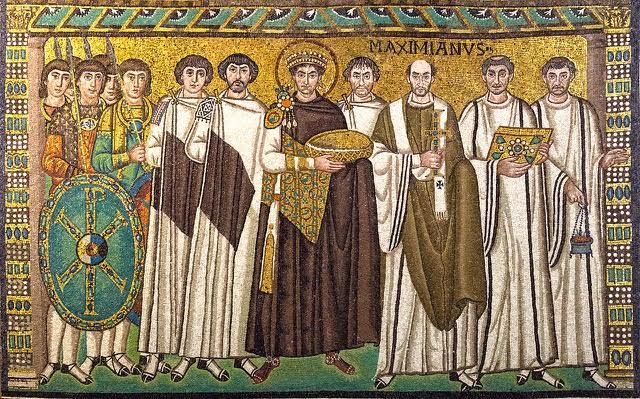
The Byzantine Emperor Justinan I (“the Great”) in the Basilica of San Vitale in Ravenna. He is shown with some of his clergy, including Maximian, the balding and bearded archbishop of Ravenna, and his courtiers. (Wikimedia Commons public domain image)
A new article, written by Janet Ewell, went up today on the ne’er-changing website of the Interpreter Foundation: “Gamma Marks: Recent Works Relevant to Their Study” (Interpreter: A Journal of Latter-day Saint Faith and Scholarship 68 [2026]: 311-370):
Abstract: Many are familiar with the so-called gamma marks as they are portrayed on early medieval mosaics in Ravenna and Rome. They appear as right-angle marks, usually with toothed ends, or in a shape like a capital H on the corners of angels’ and worthies’ robes or mosaics depicting textiles such as altar cloths and hangings. The marks defy easy explanation, in part because they are also portrayed in multiple cultural contexts, well beyond Italy, and because they take other forms. This paper surveys publications from Maciej Szymaszek, one of three scholars whose recent works significantly increase our knowledge of the marks’ geographic spread, their frequency of use, and their persistence across time.
It was accompanied on the Interpreter Foundation’s moribund webpage by Interpreting Interpreter: “Ancient Ritual Marks,” written by Kyler Rasmussen:
This post is a summary of the article “Gamma Marks: Recent Works Relevant to Their Study” by Janet Ewell in Volume 68 of Interpreter: A Journal of Latter-day Saint Faith and Scholarship. All of the Interpreting Interpreter articles may be seen at https://interpreterfoundation.org/category/summaries/. An introduction to the Interpreting Interpreter series is available at https:/interpreterfoundation.org/interpreting-interpreter-on-abstracting-thought/.
A video introduction to this Interpreter article is now available on all of our social media channels, including on YouTube at https://youtube.com/shorts/C-_V4jZvtM0.
The Takeaway: Ewell outlines recent research on gamma marks—right-angled marks that appear on ancient textiles and medieval artistic renderings—noting their association with early Christian funeral and initiation rites and their connection to temple-oriented spaces.

I visited the former Nazi concentration camp at Buchenwald for the first time in the summer of 2015. A naturalistic materialist can oppose such things, of course. She can point out that they cause pain, harm society, and so forth. But can she pronounce them objectively, absolutely, non-metaphorically evil? If so, on what basis? (Wikimedia Commons public domain image)
I found Chapter 7 of Hyrum Lewis’s There is a God — entitled “The Good Delusion” — particularly stimulating, and I intend to share the notes that I’ve taken from it. A few today and quite a few more in blog entries yet to come:
“The ‘God delusion’ necessarily implies the ‘good delusion,'” he says on page 107, and he spends the rest of the chapter fleshing out what he intends when he says that.
Some atheists, he notes — and I’ve observed the same phenomenon — become rather indignant at the proposition that morality depends upon God. God, they say, doesn’t exist. And, anyway, we can derive morality quite nicely, thank you, from science.
But many of them will also say that you can really know only what you can see — or feel, or measure, or, in some sense, empirically perceive. That’s one of their strong reasons for denying the existence of God, who is, whether in principle, by definition, or at least in fact or common experience.
But morality can’t be seen. “The good” can’t be measured, or perceived by any of our five senses. Nor, if you want to push it, detected by any instrument or device.
So doesn’t it indicate something of a double standard to dismiss God as mere imagined superstition while insisting on the reality of “good” and “evil,” which seem to be equally invisible?
It seems unlikely that any scientist, puzzled about a moral dilemma, has ever consulted astrophysical data or performed a biochemical laboratory experiment in order to resolve it. Science deals in empirical data, and moral questions are beyond its purview. They aren’t empirical.
Nor is morality material.
It is neither moral nor immoral for grains of sand to scatter, for air molecules to blow eastward, for a comet to follow a particular orbit, or for a cat to chase a mouse. There is no right or wrong among atoms, molecules, dirt, rocks, comets, planets, or galaxies, so how can it be any different for those purely material entities we call humans? Material is neither good nor evil; it just is.
Let’s use the case of murder to illustrate. If humans are mere material, then a murderer is only rearranging matter (the assemblage of atoms we call a human body) in space. The molecules that make up a hill of sound rearrange without moral implication, so why can’t the molecules that make up a human body rearrange (what we call death) without moral implications as well? (109)
We naturally and intuitively feel that murder is wrong, and that it’s something much more serious than a mere rearrangement of matter. Instead, we feel that there is some higher value associated with the body than can be found merely in the chemical substances of which it’s composed. (One source that I consulted puts the monetary value of the human body, viewed in those terms, at no more than about $160 in 2026 US currency: oxygen and hydrogen have negligible market value, carbon is pretty cheap, and a few trace minerals round out the sum.)
We would probably laugh if someone said it was morally right that oceans consist of saltwater or that a continental plate rearranges matter by drifting northward, yet atheists say it is morally right that other materials (humans) are arranged in a random way and that it’s immoral to rearrange them. Materialists can only have morality if they sneak immaterialism in through the back door. (109)
Earlier atheists understood this well enough. Lewis cites the late great logician and philosopher Bertrand Russell, who spent much of the last half of his campaigning for nuclear disarmament and for various other causes that might today be labeled “progressive.” In his Autobiography, Russell admitted that, given his atheism, he had no real way to justify or ground his moral preferences. “I cannot . . . prove that my view of the good life is right,” he wrote in Why I Am Not a Christian (New York: Touchstone, 1957), 56.
Friedrich Nietzsche was straightforward about the matter, too. If God is “dead,” as he argued, traditional concepts of morality appear to be dead, as well, “implying a radical transvaluation of values and movement beyond good and evil” (110).
History and Religion
Travel and Religion
Previous Post

April 16, 2026
Thoughts from the "Information Age"
Next Post

April 18, 2026 Tomorrow, Out of Africa
Recent Comments
"DP: “But Mr. Sutherland worries about the fact that our time, when we can communicate ..."
Learning more about a region of ..."
"Sutherland's lecture sounds interesting. He seems to restate the Washington consensus that trade brings peace ..."
Learning more about a region of ..."
"In a meeting today, I learned another important reason why accurate (or at least as ..."
From Serbia’s “White City,” Belgrade
"I've been watching a lot of video interviews of NDErs and researchers. I think in ..."
Browse Our Archives
Select a Category Uncategorized
Select a Month October 2026 September 2026 August 2026 July 2026 June 2026 May 2026 April 2026 March 2026 February 2026 January 2026 December 2025 November 2025 October 2025 September 2025 August 2025 July 2025 June 2025 May 2025 April 2025 March 2025 February 2025 January 2025 December 2024 November 2024 October 2024 September 2024 August 2024 July 2024 June 2024 May 2024 April 2024 March 2024 February 2024 January 2024 December 2023 November 2023 October 2023 September 2023 August 2023 July 2023 June 2023 May 2023 April 2023 March 2023 February 2023 January 2023 December 2022 November 2022 October 2022 September 2022 August 2022 July 2022 June 2022 May 2022 April 2022 March 2022 February 2022 January 2022 December 2021 November 2021 October 2021 September 2021 August 2021 July 2021 June 2021 May 2021 April 2021 March 2021 February 2021 January 2021 December 2020 November 2020 October 2020 September 2020 August 2020 July 2020 June 2020 May 2020 April 2020 March 2020 February 2020 January 2020 December 2019 November 2019 October 2019 September 2019 August 2019 July 2019 June 2019 May 2019 April 2019 March 2019 February 2019 January 2019 December 2018 November 2018 October 2018 September 2018 August 2018 July 2018 June 2018 May 2018 April 2018 March 2018 February 2018 January 2018 December 2017 November 2017 October 2017 September 2017 August 2017 July 2017 June 2017 May 2017 April 2017 March 2017 February 2017 January 2017 December 2016 November 2016 October 2016 September 2016 August 2016 July 2016 June 2016 May 2016 April 2016 March 2016 February 2016 January 2016 December 2015 November 2015 October 2015 September 2015 August 2015 July 2015 June 2015 May 2015 April 2015 March 2015 February 2015 January 2015 December 2014 November 2014 March 2014 August 2013 February 2012
Follow Us!
TAKE THE
Religious Wisdom Quiz
Who was the prophet that confronted King David about his sin with Bathsheba?
Select your answer to see how you score.
Samuel Elijah Nathan Isaiah
Related posts from Sic et Non


Notes on Women, Priesthood, and General Conference

"The Book of Moses as a Temple Text"

TRENDING AT PATHEOS Latter-day Saint

The Sermon on the Mount, Part I: Matthew...
The Sermon on the Mount, Part I (Matthew 4:12-5:12) St. Matthew moves...

What's up from Crossway: Reviewing some of their latest A few weeks...

Janie Learns the Way of the Cross: A...
Teaching children about Jesus' Passion can be challenging. Many parents and educators...

Looking For Good Catholic Writing - October 2026
He alone extends the heavens, and he walks upon the waves of...

In "Irreplaceable," our book on vocation and technology, Trevor Sutton and I...

I was strolling through the top floor of the brand new Parthenon...
view all Latter-day Saint blogs
What Are Your Thoughts?leave a comment
Ad-Free & Subscriber Log-In Subscription Support
- About Us
- 2026 Calendar
- Videos
- Podcasts
- Library of World Religions
- Faith In Media Tracker
- Advertise With Us
- Write for Us
- Privacy Policy
- Terms of Service
- Do Not Sell My Data
- Contact Us
- Radiant Digital
- Manage Newsletter Subscriptions
- Unsubscribe From Notifications
- Sitemap
Copyright 2008-2026, Patheos. All rights reserved.
Subscription Support Ad-Free & Subscriber Log-In
Follow Patheos