
BuddhistCatholicContemplativeEvangelicalGeneral ChristianHinduJewishLatter-day SaintMuslimNew VisionsProgressive Christian
Beliefs
- Buddhist
- Catholic
- Contemplative
- Evangelical
- General Christian
- Hindu
- Jewish
- Latter-day Saint
- More Voices
- Muslim
- New Visions
- Pagan
- Progressive Christian
Topics
- Religion News
- Food and Religion
- Sports and Religion
- Religious Art
- Religious Music and Entertainment
- Religious Events
- History and Religion
- Style and Religion
- Politics and Religion
- Women in Religion
- Recreation Outdoors and Religion
- Business Finance and Religion
- Careers Workplace and Religion
- Education and Religion
- Family Parenting and Religion
- Health Fitness and Religion
- Home and Religion
- Relationships and Religion
- Technology and Religion
- Travel and Religion
Columnists
- Buddhist Columnists
- Business Finance and Religion Columnists
- Careers Workplace and Religion Columnists
- Catholic Columnists
- Contemplative Columnists
- Education and Religion Columnists
- Evangelists Columnists
- Family Parenting and Religion Columnists
- General Christian Columnists
- Health Fitness and Religion Columnists
- Hindu Columnists
- History and Religion Columnists
- Home and Religion Columnists
- Jewish Columnists
- More Voices Columnists
- Latter Day Columnists
- Muslim Columnists
- New Visions Columnists
- Nonreligious Columnists
- Pagan Columnists
- Politics and Religion Columnists
- Progressive Columnists
- Recreation Outdoors and Religion Columnists
- Relationships and Religion Columnists
- Religion News Columnists
- Religious Art Columnists
- Religious Events Columnists
- Religious Music and Entertainment Columnists
- Sports and Religion Columnists
- Style and Religion Columnists
- Technology and Religion Columnists
- Travel and Religion Columnists
- Women in Religion Columnists
Resource Library
- 2026 Calendar
- Library of World Religions
- The 100 Most Holy Places on Earth
- Patheos Answers
- Podcasts
- Videos
- Faith Leaders Database
- Anglican Episcopalian
- Bahai
- Baptist
- Buddhism
- Christianity
- Confucianism
- Eastern Orthodoxy
- Hinduism
- Holiness and Pentecostal
- ISKCON
- Islam
- Judaism
- Lutheran
- Methodist
- The Church of Jesus Christ of Latter-day Saints
- New Age
- Paganism
- Presbytarian and Reformed
- Protestantism
- Religion Behind the Scenes
- Roman Catholic
- Scientology
- Shia Islam
- Sikhism
- Sufism
- Sunni Islam
- Taoism
- Zen
- See all religions
Research Tools
 Ad-Free & Subscriber Log-In Subscription Support
Ad-Free & Subscriber Log-In Subscription Support
Follow Patheos 

- Trending:
- Forgiveness
- |
- Marriage
- |
- Consciousness
- |
- Death Penalty
- |
- Election
- |
- Halloween

- Home
- Latter-day Saint
- Travel and Religion
- Another glimpse of my glamorous life as an apologist
Another glimpse of my glamorous life as an apologist
Last updated on: April 21, 2026 at 12:10 am by Dan Peterson
Another glimpse of my glamorous life as an apologist 2026-04-21T00:10:48-06:00 Dan Peterson
Patheos Explore the world's faith through different perspectives on religion and spirituality! Patheos has the views of the prevalent religions and spiritualities of the world.
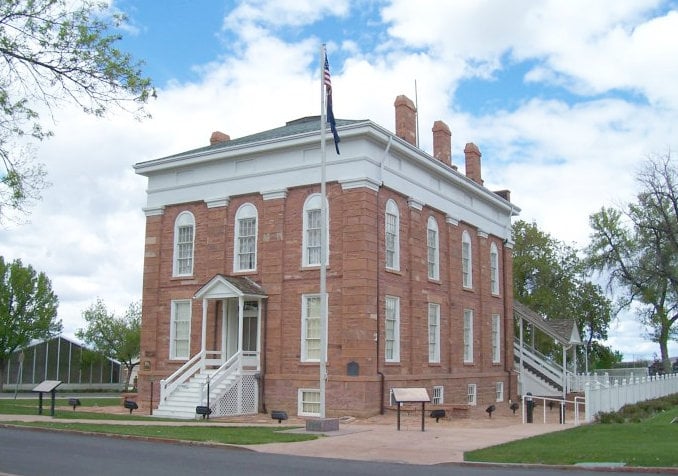
The Territorial Statehouse in Fillmore, Utah (Wikimedia Commons public domain image)
A few of my online critics like to claim that my involvement in apologetics and with the Interpreter Foundation has afforded me a lifestyle of exotic travel and extravagant dining out. And, of course, they’re right: Today is the first of five days devoted to another bout of precisely such fine dining and adventurous sightseeing.
With John Donovan Wilson and Camrey Bagley Fox, as well as James Jordan and Russ Richins and Mark Goodman of Redbrick Filmworks — unfortunately, my wife could not come along — I spent much of the day involved in filming in and around the old Territorial Statehouse in Fillmore, Utah, for our ongoing Becoming Brigham series.
For Peterson Obsession Board investigators who are keeping track of these important things, yes, I ate today. Yet again. Clearly, unlike normal people, my life absolutely revolves around food. I eat every day, even while traveling.
Here are the disturbing details: Before leaving my house in the morning, I enjoyed a glass of chocolate Carnation Breakfast Essentials. For lunch, once we had driven south and after some filming at the Statehouse, I had a mushroom-and-Swiss burger at The Eatery in downtown Fillmore (2020 population roughly 2592), accompanied by onion rings that I happily shared with the others and washed down with a very cold plastic “glass” of ice water. In the evening, after we had completed our day’s shooting, we went to the Iceberg Drive Inn at the southern end of town. I wasn’t overly hungry, but I did have a mini-size chocolate milkshake. We’re spending the night here in Fillmore at the Best Western Paradise Inn.
I will try to keep my monitors at the POB informed as to the specifics of my eating and my lodging during this Redbrick Filmworks/Interpreter Foundation filming trip. I know that these things matter to them.
Our focus for today’s filming was on Brigham Young, Joseph Smith, slavery, and race. We’re in Fillmore because, from 1851 to 1856, Fillmore was at least nominally the capital of Utah Territory –although the territorial legislature met in the town during only one term, in 1855. The Statehouse here (which is only one wing of the large building that was originally envisioned) is the oldest government building in Utah. Among other things, we’re treating the important 1852 “Act in Relation to Service” that was passed by Utah’s territorial legislature and signed by the federally appointed territorial governor, Brigham Young. I spoke about the Act at last year’s FAIR conference (see “Brigham Young and Slavery”).
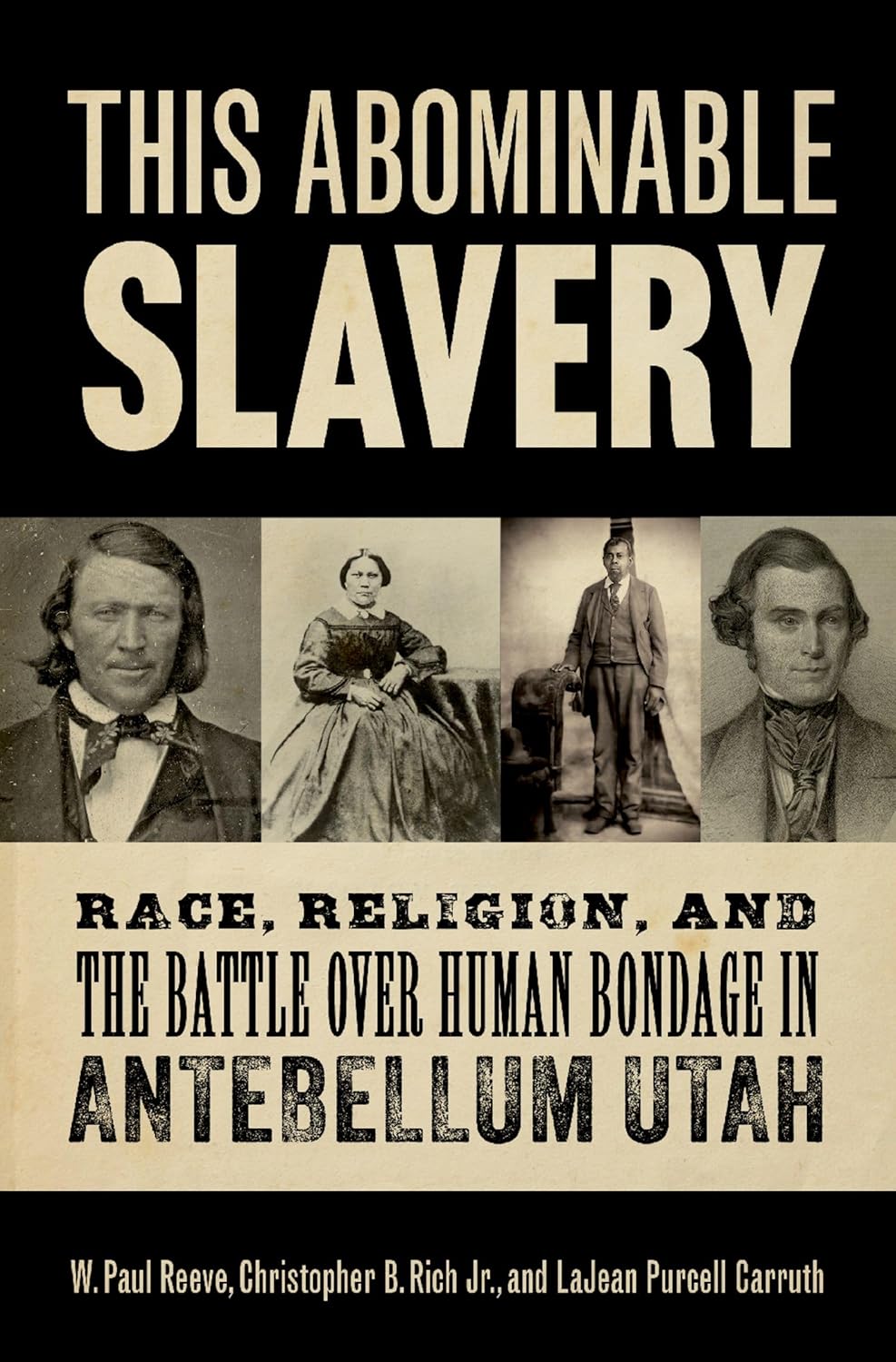
This book corrected what I had thought that I knew about the topic of slavery in Utah Territory.
Here are my notes (with a few contributions of my own) from Hyrum Lewis, There Is a God, 110-112:
If morality can’t be deduced or derived from matter and only matter is truly real, can another source for it be identified?
Lewis cites the example of the vocal “New Atheist” Sam Harris and his book The Moral Landscape. In that book, Harris contends that we can get morality from science.
Now, at first glance, such a claim seems pretty obviously silly. Compassion can’t be proven good in a cyclotron or a chemistry lab. Does botany tell us anything about whether slavery is wrong? Can a microscope demonstrate that torturing animals or abusing small children is immoral? Don’t we already know that murder is evil before we enroll in a course on evolutionary biology? Has any scientist ever engaged in laboratory or field research for the sake of constructing (or falsifying) a moral system? (You may recall Sir Karl Popper’s contention that “falsifiability” is a requirement for a scientific theory to be meaningful.)
But Harris’s argument isn’t that obviously ridiculous. In The Moral Landscape, he contends that we can base our morality on science by determining, scientifically, what promotes “well-being” and then deciding, on that basis, what we ought to do. For example, living in community makes us happier than living in isolation, thus contributing to our well-being, so the promotion of community and living in community are moral goods. Donating to charity also enhances human well-being, so it is also demonstrably moral. There is no need to invoke God here, he says. All we need is science.
Where, though, does Harris get his principle that we should pursue happiness, or well-being? Where does that should come from? Isn’t that already a value-laden or moral judgment? And, if it is, was it scientifically derived? Was it deduced from counting lichen spores or finding exoplanets? Is it falsifiable? And why couldn’t someone, instead, declare that we should pursue domination, or power, or pleasure? Or control? Or enlightenment? Or growth or experience or “fulfillment”? Or expanded Lebensraum for the Aryan race? How can one distinguish between those goals “scientifically”? Evolutionarily or biologically, couldn’t someone make the case that the true moral imperative is the maximum spread of his genes? Why not? How does one determine “scientifically” that happiness or well-being is the one proper moral goal? Isn’t that a nonempirical leap of faith?
Lewis cites Bertrand Russell’s Autobiography (161-162) as saying that his work in philosophy “brought moments of delight, but these [were] outweighed by years of effort and depression.” Still, even though his own personal unhappiness was often the result of his effort, he continued, as he saw it, to “pursue truth.”
And can science really determine what brings happiness or well-being? Will expanding the welfare state maximize happiness? Many think so. But many others argue that increased dependence on government welfare will, in the long run, reduce human happiness. Does the prosperity that results from free trade outweigh the jobs that it sometimes destroys? Marital fidelity has been shown to be a contributor to human happiness, but not a few people have found happiness, as they imagine, through promiscuity.
John C. Calhoun evidently contended that African-Americans were happier as slaves than they would have been as free men. Assuming for a moment that he was right, would that have morally justified slavery? Enslaving others may well have increased the happiness of the enslavers. If eliminating a subset of society could make the remainder of the populace happier, would that be morally justifiable? (Imagine that the genocide could be accomplished painlessly, perhaps even without inducing anxiety. Would that make a difference?) Is there a calculus for determining how large a number of people might ethically be eliminated?
If happiness or well-being is the criterion, cases can surely be imagined in which enslaving others or committing murder or genocide would increase well-being or happiness for at least some portion, larger or smaller, of the population. But all normal people know, without needing to research it or think deeply about it, that even painless murder is morally wrong. How do we know this? On the basis of what do we know it?
Posted from Fillmore, Millard County, Utah
Travel and Religion
History and Religion
Previous Post

April 19, 2026
How are we doing?
Next Post

April 21, 2026 "Protecting the Symbols of Christ’s Church"
Recent Comments
"Sutherland's lecture sounds interesting. He seems to restate the Washington consensus that trade brings peace ..."
Learning more about a region of ..."
"In a meeting today, I learned another important reason why accurate (or at least as ..."
From Serbia’s “White City,” Belgrade
"I've been watching a lot of video interviews of NDErs and researchers. I think in ..."
"PL: "Let's hope he doesn't have your address..."I have to frankly confess that a few ..."
From Serbia’s “White City,” Belgrade
Browse Our Archives
Select a Category Uncategorized
Select a Month October 2026 September 2026 August 2026 July 2026 June 2026 May 2026 April 2026 March 2026 February 2026 January 2026 December 2025 November 2025 October 2025 September 2025 August 2025 July 2025 June 2025 May 2025 April 2025 March 2025 February 2025 January 2025 December 2024 November 2024 October 2024 September 2024 August 2024 July 2024 June 2024 May 2024 April 2024 March 2024 February 2024 January 2024 December 2023 November 2023 October 2023 September 2023 August 2023 July 2023 June 2023 May 2023 April 2023 March 2023 February 2023 January 2023 December 2022 November 2022 October 2022 September 2022 August 2022 July 2022 June 2022 May 2022 April 2022 March 2022 February 2022 January 2022 December 2021 November 2021 October 2021 September 2021 August 2021 July 2021 June 2021 May 2021 April 2021 March 2021 February 2021 January 2021 December 2020 November 2020 October 2020 September 2020 August 2020 July 2020 June 2020 May 2020 April 2020 March 2020 February 2020 January 2020 December 2019 November 2019 October 2019 September 2019 August 2019 July 2019 June 2019 May 2019 April 2019 March 2019 February 2019 January 2019 December 2018 November 2018 October 2018 September 2018 August 2018 July 2018 June 2018 May 2018 April 2018 March 2018 February 2018 January 2018 December 2017 November 2017 October 2017 September 2017 August 2017 July 2017 June 2017 May 2017 April 2017 March 2017 February 2017 January 2017 December 2016 November 2016 October 2016 September 2016 August 2016 July 2016 June 2016 May 2016 April 2016 March 2016 February 2016 January 2016 December 2015 November 2015 October 2015 September 2015 August 2015 July 2015 June 2015 May 2015 April 2015 March 2015 February 2015 January 2015 December 2014 November 2014 March 2014 August 2013 February 2012
Follow Us!
TAKE THE
Religious Wisdom Quiz
Who killed Goliath?
Select your answer to see how you score.
Samson Jonathan Saul David
Related posts from Sic et Non

"America's Most Neighborly City"? It's not in Switzerland

“Once more unto the breach, dear friends, once...


How many divine beings appeared in Joseph's First...
TRENDING AT PATHEOS Latter-day Saint

Janie Learns the Way of the Cross: A...
Teaching children about Jesus' Passion can be challenging. Many parents and educators...

Looking For Good Catholic Writing - October 2026
He alone extends the heavens, and he walks upon the waves of...

In "Irreplaceable," our book on vocation and technology, Trevor Sutton and I...

I was strolling through the top floor of the brand new Parthenon...

What Does Gêvâh Mean For Kimberley Guifoyle &...
This week, a lot of the news is focused on Kimberly Guilfoyle....

INNER CIRCLE: Profound Mystery (Of Christ In All...
Ephesians 5:31-32 “For this reason, a man will leave his father and...
view all Latter-day Saint blogs
What Are Your Thoughts?leave a comment
Ad-Free & Subscriber Log-In Subscription Support
- About Us
- 2026 Calendar
- Videos
- Podcasts
- Library of World Religions
- Faith In Media Tracker
- Advertise With Us
- Write for Us
- Privacy Policy
- Terms of Service
- Do Not Sell My Data
- Contact Us
- Radiant Digital
- Manage Newsletter Subscriptions
- Unsubscribe From Notifications
- Sitemap
Copyright 2008-2026, Patheos. All rights reserved.
Subscription Support Ad-Free & Subscriber Log-In
Follow Patheos