
BuddhistCatholicContemplativeEvangelicalGeneral ChristianHinduJewishLatter-day SaintMuslimNew VisionsProgressive Christian
Beliefs
- Buddhist
- Catholic
- Contemplative
- Evangelical
- General Christian
- Hindu
- Jewish
- Latter-day Saint
- More Voices
- Muslim
- New Visions
- Pagan
- Progressive Christian
Topics
- Religion News
- Food and Religion
- Sports and Religion
- Religious Art
- Religious Music and Entertainment
- Religious Events
- History and Religion
- Style and Religion
- Politics and Religion
- Women in Religion
- Recreation Outdoors and Religion
- Business Finance and Religion
- Careers Workplace and Religion
- Education and Religion
- Family Parenting and Religion
- Health Fitness and Religion
- Home and Religion
- Relationships and Religion
- Technology and Religion
- Travel and Religion
Columnists
- Buddhist Columnists
- Business Finance and Religion Columnists
- Careers Workplace and Religion Columnists
- Catholic Columnists
- Contemplative Columnists
- Education and Religion Columnists
- Evangelists Columnists
- Family Parenting and Religion Columnists
- General Christian Columnists
- Health Fitness and Religion Columnists
- Hindu Columnists
- History and Religion Columnists
- Home and Religion Columnists
- Jewish Columnists
- More Voices Columnists
- Latter Day Columnists
- Muslim Columnists
- New Visions Columnists
- Nonreligious Columnists
- Pagan Columnists
- Politics and Religion Columnists
- Progressive Columnists
- Recreation Outdoors and Religion Columnists
- Relationships and Religion Columnists
- Religion News Columnists
- Religious Art Columnists
- Religious Events Columnists
- Religious Music and Entertainment Columnists
- Sports and Religion Columnists
- Style and Religion Columnists
- Technology and Religion Columnists
- Travel and Religion Columnists
- Women in Religion Columnists
Resource Library
- 2026 Calendar
- Library of World Religions
- The 100 Most Holy Places on Earth
- Patheos Answers
- Podcasts
- Videos
- Faith Leaders Database
- Anglican Episcopalian
- Bahai
- Baptist
- Buddhism
- Christianity
- Confucianism
- Eastern Orthodoxy
- Hinduism
- Holiness and Pentecostal
- ISKCON
- Islam
- Judaism
- Lutheran
- Methodist
- The Church of Jesus Christ of Latter-day Saints
- New Age
- Paganism
- Presbytarian and Reformed
- Protestantism
- Religion Behind the Scenes
- Roman Catholic
- Scientology
- Shia Islam
- Sikhism
- Sufism
- Sunni Islam
- Taoism
- Zen
- See all religions
Research Tools
 Ad-Free & Subscriber Log-In Subscription Support
Ad-Free & Subscriber Log-In Subscription Support
Follow Patheos 

- Trending:
- Forgiveness
- |
- Marriage
- |
- Consciousness
- |
- Death Penalty
- |
- Election
- |
- Halloween

- Home
- Latter-day Saint
- Travel and Religion
- “A whole civilization will die tonight”
“A whole civilization will die tonight”
Last updated on: April 7, 2026 at 2:25 pm by Dan Peterson
“A whole civilization will die tonight” 2026-04-07T14:25:17-06:00 Dan Peterson
Patheos Explore the world's faith through different perspectives on religion and spirituality! Patheos has the views of the prevalent religions and spiritualities of the world.

A detail of the main entrance to the Masjid-e Shah, in Isfahan, Iran (Wikimedia Commons public domain image)
“A whole civilization will die tonight, never to be brought back again,” President Donald J. Trump declared on Truth Social. “I don’t want that to happen, but it probably will.” He has set a deadline for the leaders of Iran to reach a settlement with the United States by 8 PM, eastern time, this evening.
As someone who taught elements of Persian history, art, architecture, literature, and philosophy throughout my career, I have to admit that I very much disapprove of what Mr. Trump said. I don’t believe that United States military forces are capable of killing Persian civilization, but I still dislike the sentiment and the tone. (If, though I think not, the intention really is to annihilate a civilization, it is bound to fail. But I also think of the sin of what the ancient Greeks called hubris — and of the punishing disaster that, in the ancient Greek tragedies, commonly follows such hubris.)
Seeking to destroy Hitler’s Third Reich was about ending that particular political evil, not about erasing the entire culture that had been created by Goethe, Luther, Grünewald, Leibnitz, Bach, Planck, Schiller, Gauss, Hölderlin, Kepler, Beethoven, Dürer, Kant, Meister Eckhart, Holbein, Lessing, Einstein, and Mendelssohn. We were not seeking to destroy Cologne Cathedral or the castle at Neuschwanstein — and we didn’t (just as, in Japan, we explicitly removed Kyoto from the list of possible targets for our atomic bombs because of its enormous importance to the history, culture, and religious heritage of Japan).
Likewise, while the elimination of Iran’s current theocratic tyranny would certainly be a major step forward for the peace and welfare of humankind, we’re not at war with Ferdowsi, Avicenna (Ibn Rushd), Nizami Ganjavi, Rumi, Sadegh Hedayat, al-Biruni, Hafez, Nasir al-Din Tusi, Saadi Shirazi, Omar Khayyam, al-Razi, Attar of Nishapur, al-Khwarizmi, Jabbir b. Hayyan, or Forugh Farrokhzad. And we surely aren’t — are we? — intending to destroy Persepolis or the Masjid-e Shah.
Talk about killing a “whole civilization” is wildly inappropriate. Moreover, as a purely practical matter, it’s hardly calculated to win the support of Iranians who may hate the regime that oppresses them but, as patriots, intensely love their nation and the great historical civilization that it has fostered. I know many such Iranians, and I wish them well.
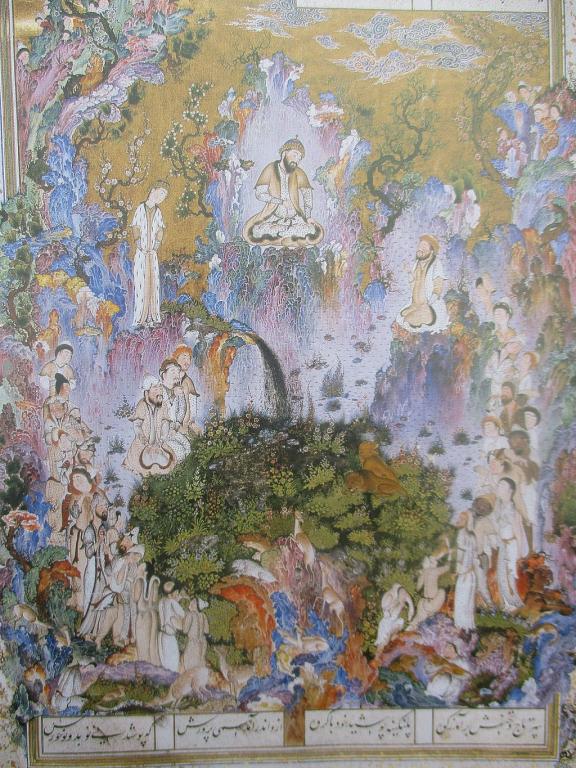
The court of King Kayumars, described in the 10th-11th-century Shahnameh (“Book of Kings”) of Firdawsi. in a miniature painting from the Shahnameh of Shah Tahmasp I — also known as the “Houghton Shahnameh” — which was created somewhere in the period between 1520 and 1540. (Wikimedia Commons public domain image)
On this, the first full day of my status as an official, Obsession Board-certified “cruel and sadistic bully,” I feel moved upon to prophesy: I predict that my Malevolent Stalker, who announced my new designation in a recent post at his online home and who is now well into his third decade of anonymous online attacks on me, won’t cease posting this sort of thing until he dies. I doubt that my own death (which, just to forestall speculation, isn’t yet clearly on the horizon) will slow him down even slightly. And I have precedent on my side: Thus far, over the past quarter of a century, nothing has slowed him down.
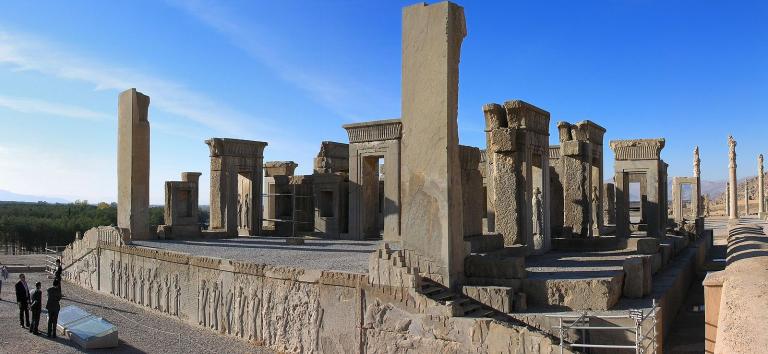
The ruins of ancient Persepolis, in Iran — the ceremonial capital of the Achaemenid Empire between about BC 550 and BC 330 — is one of the most impressive archaeological sites I’ve ever visited. (Wikimedia Commons public domain photograph)
I think that I’ll offer a brief historical note here: Cyrus II of Persia (ca. 600–530 BC), who is commonly known as Cyrus the Great, was the founder of the Achaemenid Empire. He emerged from the area known as Persis, which roughly corresponds to the modern Iranian province of Fars. Persia takes its name from Persis, much as the modern Persian term for the Persian language, Farsi, derives its name from Fars., which is, as you’ve probably guessed, cognate with Persis and Persia. (Following the lead of one of my professors in graduate school, himself an Iranian, I don’t refer to the language as Farsi but, rather, as Persian — for the same reason that, when speaking English, I don’t typically refer to Deutsch, Español, Nederlands, Français, al-ʿarabiyya, or Nihongo, but, rather, to German, Spanish, Dutch, French, Arabic, and Japanese.)
Cyrus the Great (who reigned ca. 559–530 BC) defeated the Median Empire — aka the Medes — and eventually brought all of the ancient Near East under the control of the Achaemenid dynasty, expanding across most of West Asia and much of Central Asia to create what, at the time, would became the largest empire in history. He was the Persian emperor who not only allowed the Jewish people to return to Jerusalem and to rebuild their temple (see Ezra 1-6), thus marking the end of the Babylonian captivity, but ordered the return of sacred temple vessels taken by Nebuchadnezzar and provided state funds for the rebuilding:
Now in the first year of Cyrus king of Persia, that the word of the Lord by the mouth of Jeremiah might be fulfilled, the Lord stirred up the spirit of Cyrus king of Persia, that he made a proclamation throughout all his kingdom, and put it also in writing, saying,
Thus saith Cyrus king of Persia, The Lord God of heaven hath given me all the kingdoms of the earth; and he hath charged me to build him an house at Jerusalem, which is in Judah.
Who is there among you of all his people? his God be with him, and let him go up to Jerusalem, which is in Judah, and build the house of the Lord God of Israel, (he is the God,) which is in Jerusalem.
And whosoever remaineth in any place where he sojourneth, let the men of his place help him with silver, and with gold, and with goods, and with beasts, beside the freewill offering for the house of God that is in Jerusalem. (Ezra 1:1-4; compare 2 Chronicles 36:22-23))
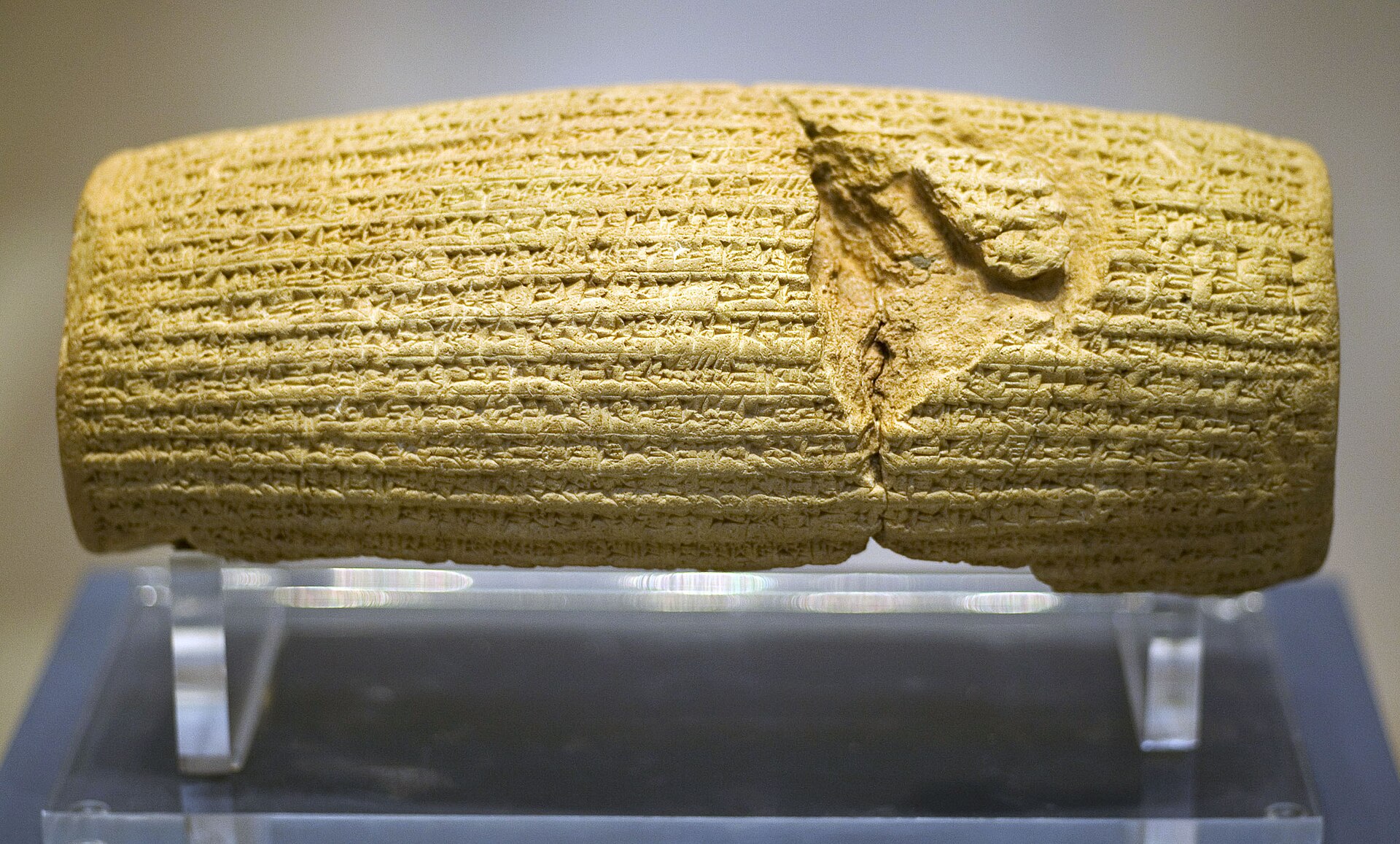
The Cyrus Cylinder, which is currently located in Room 52 of the British Library in London, is a clay artifact from the sixth-century BC that contains a Babylonian cuneiform inscription recording King Cyrus the Great’s conquest of Babylon (539 BC) as well as his restoration of religious shrines (one of which would be the Jewish temple at Jerusalem) and the repatriation of previously-deported peoples. It has been described as the “first charter of human rights” in human history and it illustrates Cyrus’s policies of religious tolerance and humanitarian treatment of conquered populations.
Isaiah 44-45 has much to say about Cyrus, including this remarkable passage:
Thus saith the Lord to his anointed (לִמְשִׁיחוֹ֮, “to his messiah”), to Cyrus, whose right hand I have holden, to subdue nations before him; and I will loose the loins of kings, to open before him the two leaved gates; and the gates shall not be shut;
I will go before thee, and make the crooked places straight: I will break in pieces the gates of brass, and cut in sunder the bars of iron:
And I will give thee the treasures of darkness, and hidden riches of secret places, that thou mayest know that I, the Lord, which call thee by thy name, am the God of Israel.
For Jacob my servant’s sake, and Israel mine elect, I have even called thee by thy name: I have surnamed thee, though thou hast not known me.
I am the Lord, and there is none else, there is no God beside me: I girded thee, though thou hast not known me:
That they may know from the rising of the sun, and from the west, that there is none beside me. I am the Lord, and there is none else.
I form the light, and create darkness: I make peace, and create evil: I the Lord do all these things. (Isaiah 45:1-7)
The Achaemenid Empire’s greatest territorial extent was achieved later, under Darius (the Great) of Persia, whose rule stretched from southeastern Europe and northeastern Africa in the west all the way over to the Indus Valley in the east. He is mentioned in the biblical books of Ezra, Haggai, and Zechariah. Among other things (see Ezra 6), he confirmed Cyrus’s earlier decree to rebuild the temple of Jerusalem.
I can’t know, as I write, exactly what Mr. Trump has in mind for Iran. But I hope and expect that his talk of the “death” of “a whole civilization” is simply yet another instance of his exaggerations and his often intemperate language. If it isn’t, I mourn for Iran. And I mourn for America.
Travel and Religion
History and Religion
whole civilization will die tonight
Previous Post

April 6, 2026
There is a God
Next Post

April 8, 2026 "To boldly go where no man has gone before"
Recent Comments
"DP: “But Mr. Sutherland worries about the fact that our time, when we can communicate ..."
Learning more about a region of ..."
"Another class of memories are of individuals who previously lived. Some of these remembered individuals ..."
"Sutherland's lecture sounds interesting. He seems to restate the Washington consensus that trade brings peace ..."
Learning more about a region of ..."
"In a meeting today, I learned another important reason why accurate (or at least as ..."
From Serbia’s “White City,” Belgrade
Browse Our Archives
Select a Category Uncategorized
Select a Month October 2026 September 2026 August 2026 July 2026 June 2026 May 2026 April 2026 March 2026 February 2026 January 2026 December 2025 November 2025 October 2025 September 2025 August 2025 July 2025 June 2025 May 2025 April 2025 March 2025 February 2025 January 2025 December 2024 November 2024 October 2024 September 2024 August 2024 July 2024 June 2024 May 2024 April 2024 March 2024 February 2024 January 2024 December 2023 November 2023 October 2023 September 2023 August 2023 July 2023 June 2023 May 2023 April 2023 March 2023 February 2023 January 2023 December 2022 November 2022 October 2022 September 2022 August 2022 July 2022 June 2022 May 2022 April 2022 March 2022 February 2022 January 2022 December 2021 November 2021 October 2021 September 2021 August 2021 July 2021 June 2021 May 2021 April 2021 March 2021 February 2021 January 2021 December 2020 November 2020 October 2020 September 2020 August 2020 July 2020 June 2020 May 2020 April 2020 March 2020 February 2020 January 2020 December 2019 November 2019 October 2019 September 2019 August 2019 July 2019 June 2019 May 2019 April 2019 March 2019 February 2019 January 2019 December 2018 November 2018 October 2018 September 2018 August 2018 July 2018 June 2018 May 2018 April 2018 March 2018 February 2018 January 2018 December 2017 November 2017 October 2017 September 2017 August 2017 July 2017 June 2017 May 2017 April 2017 March 2017 February 2017 January 2017 December 2016 November 2016 October 2016 September 2016 August 2016 July 2016 June 2016 May 2016 April 2016 March 2016 February 2016 January 2016 December 2015 November 2015 October 2015 September 2015 August 2015 July 2015 June 2015 May 2015 April 2015 March 2015 February 2015 January 2015 December 2014 November 2014 March 2014 August 2013 February 2012
Follow Us!
TAKE THE
Religious Wisdom Quiz
For all have _____ and come short of the glory of God.
Select your answer to see how you score.
Tried Believed Sinned Prayed
Related posts from Sic et Non

Notes on Women, Priesthood, and General Conference

"The Book of Moses as a Temple Text"


Finally, a political blog entry like the ones...
TRENDING AT PATHEOS Latter-day Saint

The First Eucharistic Controversy: Christ’s Real Presence
For Catholics, the Eucharist is the source and summit of the Christian...

How to Make a Decision When You Can't...
Main point: It’s much more valuable to stay close to God so...

Archdiocese Hosts Military Marriage Retreat in Germany
RASTATT, Germany — The transient military lifestyle, with its frequent deployments and...

Nearly every morning, I make the drive to Detroit with my high-school-age...

The Real AI Story Is Adoption Without Trust
Artificial intelligence has crossed a political threshold. It is no longer a...

A new article, written by Jeff Lindsay and Gale L. Pooley,...
view all Latter-day Saint blogs
What Are Your Thoughts?leave a comment
Ad-Free & Subscriber Log-In Subscription Support
- About Us
- 2026 Calendar
- Videos
- Podcasts
- Library of World Religions
- Faith In Media Tracker
- Advertise With Us
- Write for Us
- Privacy Policy
- Terms of Service
- Do Not Sell My Data
- Contact Us
- Radiant Digital
- Manage Newsletter Subscriptions
- Unsubscribe From Notifications
- Sitemap
Copyright 2008-2026, Patheos. All rights reserved.
Subscription Support Ad-Free & Subscriber Log-In
Follow Patheos