
BuddhistCatholicContemplativeEvangelicalGeneral ChristianHinduJewishLatter-day SaintMuslimNew VisionsProgressive Christian
Beliefs
- Buddhist
- Catholic
- Contemplative
- Evangelical
- General Christian
- Hindu
- Jewish
- Latter-day Saint
- More Voices
- Muslim
- New Visions
- Pagan
- Progressive Christian
Topics
- Religion News
- Food and Religion
- Sports and Religion
- Religious Art
- Religious Music and Entertainment
- Religious Events
- History and Religion
- Style and Religion
- Politics and Religion
- Women in Religion
- Recreation Outdoors and Religion
- Business Finance and Religion
- Careers Workplace and Religion
- Education and Religion
- Family Parenting and Religion
- Health Fitness and Religion
- Home and Religion
- Relationships and Religion
- Technology and Religion
- Travel and Religion
Columnists
- Buddhist Columnists
- Business Finance and Religion Columnists
- Careers Workplace and Religion Columnists
- Catholic Columnists
- Contemplative Columnists
- Education and Religion Columnists
- Evangelists Columnists
- Family Parenting and Religion Columnists
- General Christian Columnists
- Health Fitness and Religion Columnists
- Hindu Columnists
- History and Religion Columnists
- Home and Religion Columnists
- Jewish Columnists
- More Voices Columnists
- Latter Day Columnists
- Muslim Columnists
- New Visions Columnists
- Nonreligious Columnists
- Pagan Columnists
- Politics and Religion Columnists
- Progressive Columnists
- Recreation Outdoors and Religion Columnists
- Relationships and Religion Columnists
- Religion News Columnists
- Religious Art Columnists
- Religious Events Columnists
- Religious Music and Entertainment Columnists
- Sports and Religion Columnists
- Style and Religion Columnists
- Technology and Religion Columnists
- Travel and Religion Columnists
- Women in Religion Columnists
Resource Library
- 2026 Calendar
- Library of World Religions
- The 100 Most Holy Places on Earth
- Patheos Answers
- Podcasts
- Videos
- Faith Leaders Database
- Anglican Episcopalian
- Bahai
- Baptist
- Buddhism
- Christianity
- Confucianism
- Eastern Orthodoxy
- Hinduism
- Holiness and Pentecostal
- ISKCON
- Islam
- Judaism
- Lutheran
- Methodist
- The Church of Jesus Christ of Latter-day Saints
- New Age
- Paganism
- Presbytarian and Reformed
- Protestantism
- Religion Behind the Scenes
- Roman Catholic
- Scientology
- Shia Islam
- Sikhism
- Sufism
- Sunni Islam
- Taoism
- Zen
- See all religions
Research Tools
 Ad-Free & Subscriber Log-In Subscription Support
Ad-Free & Subscriber Log-In Subscription Support
Follow Patheos 

- Trending:
- Forgiveness
- |
- Marriage
- |
- Consciousness
- |
- Death Penalty
- |
- Election
- |
- Halloween

- Home
- Latter-day Saint
- History and Religion
- Causal Constructions and Food for Thought
Causal Constructions and Food for Thought
Last updated on: March 27, 2026 at 4:09 pm by Dan Peterson
Causal Constructions and Food for Thought 2026-03-27T16:09:15-06:00 Dan Peterson
Patheos Explore the world's faith through different perspectives on religion and spirituality! Patheos has the views of the prevalent religions and spiritualities of the world.

This is the logo of the Interpreter Foundation. Look for it on cars, cans of tuna fish, bars of soap, and imported Swiss chocolate. I’m not saying that you’ll find it, of course. I’m merely suggesting that you look for it. There’s no harm in looking, after all.
The Interpreter Foundation continues to give revolutionary new meaning to terms like moribund, stagnant, dead, comatose, and unchanging:
For instance, a new article went up today in the Interpreter Foundation’s regular peer-reviewed journal: “A Comparative View of Causative Constructions in the Book of Mormon,” Interpreter: A Journal of Latter-day Saint Faith and Scholarship 68 (2026): 223-242, written by Stanford Carmack:
Abstract: One type of English frequently found in the Book of Mormon is the finite causative construction. For example, “they caused that he should be bound” (Alma 30:29). There are 136 finite instances after the verb cause*. Twenty-five pseudo-archaic texts do not have any finite causatives. The King James Bible has only three in more than 300 contexts. A subtype of the finite causative is the ditransitive causative. The King James Bible does not have any. The Book of Mormon has twelve. The most found in another text is four. This usage was obsolete around the year 1725. John Bunyan employed one ditransitive causative in about forty writings. Neither that nor his limited finite causative usage prompted pseudo-archaic imitation. In many ways, it is clear that there was no Bunyanesque influence on Book of Mormon English. The comparative evidence indicates that the Book of Mormon’s causative complex did not originate with Joseph Smith.*
At the Interpreter Foundation’s website, Dr. Carmack’s article was accompanied by Interpreting Interpreter: “Causal Constructions,” written by Kyler Rasmussen:
This post is a summary of the article “A Comparative View of Causative Constructions in the Book of Mormon” by Stanford Carmack in Volume 68 of Interpreter: A Journal of Latter-day Saint Faith and Scholarship. All of the Interpreting Interpreter articles may be seen at https://interpreterfoundation.org/category/summaries/. An introduction to the Interpreting Interpreter series is available at https:/interpreterfoundation.org/interpreting-interpreter-on-abstracting-thought/.
A video introduction to this Interpreter article is now available on all of our social media channels, including on YouTube at https://youtube.com/shorts/zJK36_FaPLs.
The Takeaway: Carmack examines how causal constructions (e.g., “they caused that. . . ”; “I will make that”) are used in the Book of Mormon, showing how they align with archaic usage, and fail to follow patterns from the nineteenth century, from the Bible, and from claimed archaic influences on Joseph Smith (i.e., John Bunyan).
Which was preceded yesterday by The Interpreter Insights Podcast — March 26, 2026: “Nephi Wanted to Be a Prophet Like Moses, Not a King Like David,” by Taylor Halverson, and Various Theories on the Deuteronomist School in LDS Letters, with Kevin Christensen:
In the 26 March 2026 episode of The Interpreter Insights Podcast, our host Terry Hutchinson and his guest Kevin Christensen discuss Taylor Halverson’s 2023 Interpreter article about Nephi emulating Moses and not David (https://interpreterfoundation.org/journal/nephi-wanted-to-be-a-prophet-like-moses-not-a-king-like-david) and the various theories on the Deuteronomist school in LDS letters.
And, to top it all off, a short trailer (thirty-six seconds, to be exact) is now up for Episode 10 of Becoming Brigham (“Gifts and Prophecies”). And you can watch all of the prior installments in this Interpreter Foundation video series here, at Becoming Brigham, All Episodes.
Stay tuned for the next developments from the never-changing Interpreter Foundation!
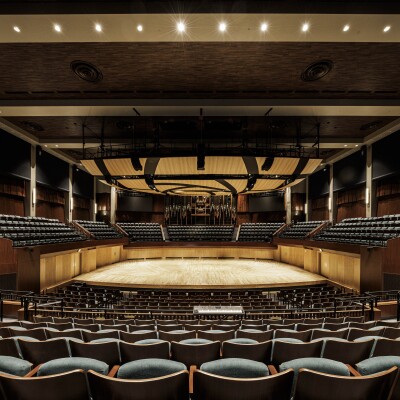
The main concert hall in Brigham Young University’s Music Building. (BYU website)
My wife and I attended an unusually good concert last night at BYU’s Music Building. It featured the Utah Symphony, with guest conductor David Danzmayr. The program included
- a suite from Der Rosenkavalier, op. 59, by Richard Strauss (1864-1949)
- the Concerto for Cello and Orchestra in C, op. 37, by Erich Wolfgang Korngold (1897-1957), for which the orchestra was joined by Pablo Ferrández, on the 1689 Stradivarius “Archinto” instrument.
- the Variations on a Rococo Theme, op. 33, by Pyotr Ilyich Tchaikovsky (1840-1893), for which Pablo Ferrández also joined in
- and I pini di Roma (“The Pines of Rome”) by Ottorino Respighi (1879-1936)
I noticed one commonality between three of the four composers (excepting Richard Strauss, who lived to a respectable eight-five years of age): Their lives were all relatively short: Erich Wolfgang Korngold lived to be just sixty. Ottorino Respighi died at fifty-six. Tchaikovsky reached only fifty-three.
These aren’t the shortest lives among major classical composers — Mozart and Mendelssohn, for instance, had much shorter lives and musical careers — but, to my mind, they vividly illustrate once again the fact that many of our greatest artists, writers, and composers have died long before reaching their full potential, that many great works (presumably) remained for them to complete. This is just one of many reasons for the hope of a continued life beyond death, though (of course) it isn’t proof that such a life actually exists.
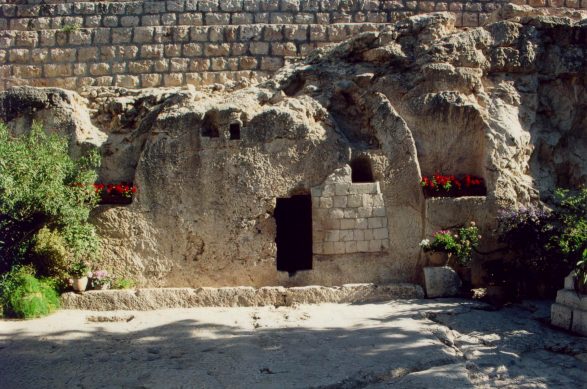
The Garden Tomb is one of the two most popular proposed locations for the burial and resurrection of Jesus. Photograph by Phillip Benshmuel (2008), Wikimedia Commons public domain image
It’s that time again. It’s time to post one of my favorite poems, which is especially well-suited to this season of the year. It’s the late poet and novelist John Updike’s “Seven Stanzas at Easter.” Updike (1932-2009) was a two-time winner of the National Book Award and a two-time winner of the Pulitzer Prize for fiction.
In order to understand the poem — and especially its conclusion — completely, you need to know the noun remonstrance (re-MON-strance), which denotes “a forcefully reproachful protest”:
Make no mistake: if he rose at all
It was as His body;
If the cell’s dissolution did not reverse, the molecule reknit,
The amino acids rekindle,
The Church will fall.It was not as the flowers,
Each soft spring recurrent;
It was not as His Spirit in the mouths and fuddled eyes of the
Eleven apostles;
It was as His flesh; ours.The same hinged thumbs and toes
The same valved heart
That—pierced—died, withered, paused, and then regathered
Out of enduring Might
New strength to enclose.Let us not mock God with metaphor,
Analogy, sidestepping, transcendence,
Making of the event a parable, a sign painted in the faded
Credulity of earlier ages:
Let us walk through the door.The stone is rolled back, not papier-mache,
Not a stone in a story,
But the vast rock of materiality that in the slow grinding of
Time will eclipse for each of us
The wide light of day.And if we have an angel at the tomb,
Make it a real angel,
Weighty with Max Planck’s quanta, vivid with hair, opaque in
The dawn light, robed in real linen
Spun on a definite loom.Let us not seek to make it less monstrous,
For our own convenience, our own sense of beauty,
Lest, awakened in one unthinkable hour, we are embarrassed
By the miracle,
And crushed by remonstrance.
I’m hoping that, someday, some Latter-day Saint other than myself might quote this poem in an Easter-related sacrament meeting sermon. I like it that much.
History and Religion
Travel and Religion
Previous Post
March 26, 2026
Will we welcome a shameful blot on the State of Utah?
Next Post
March 28, 2026 "Nephi and Isaiah on the Nations"
Recent Comments
"Sutherland's lecture sounds interesting. He seems to restate the Washington consensus that trade brings peace ..."
Learning more about a region of ..."
"In a meeting today, I learned another important reason why accurate (or at least as ..."
From Serbia’s “White City,” Belgrade
"I've been watching a lot of video interviews of NDErs and researchers. I think in ..."
"PL: "Let's hope he doesn't have your address..."I have to frankly confess that a few ..."
From Serbia’s “White City,” Belgrade
Browse Our Archives
Select a Category Uncategorized
Select a Month October 2026 September 2026 August 2026 July 2026 June 2026 May 2026 April 2026 March 2026 February 2026 January 2026 December 2025 November 2025 October 2025 September 2025 August 2025 July 2025 June 2025 May 2025 April 2025 March 2025 February 2025 January 2025 December 2024 November 2024 October 2024 September 2024 August 2024 July 2024 June 2024 May 2024 April 2024 March 2024 February 2024 January 2024 December 2023 November 2023 October 2023 September 2023 August 2023 July 2023 June 2023 May 2023 April 2023 March 2023 February 2023 January 2023 December 2022 November 2022 October 2022 September 2022 August 2022 July 2022 June 2022 May 2022 April 2022 March 2022 February 2022 January 2022 December 2021 November 2021 October 2021 September 2021 August 2021 July 2021 June 2021 May 2021 April 2021 March 2021 February 2021 January 2021 December 2020 November 2020 October 2020 September 2020 August 2020 July 2020 June 2020 May 2020 April 2020 March 2020 February 2020 January 2020 December 2019 November 2019 October 2019 September 2019 August 2019 July 2019 June 2019 May 2019 April 2019 March 2019 February 2019 January 2019 December 2018 November 2018 October 2018 September 2018 August 2018 July 2018 June 2018 May 2018 April 2018 March 2018 February 2018 January 2018 December 2017 November 2017 October 2017 September 2017 August 2017 July 2017 June 2017 May 2017 April 2017 March 2017 February 2017 January 2017 December 2016 November 2016 October 2016 September 2016 August 2016 July 2016 June 2016 May 2016 April 2016 March 2016 February 2016 January 2016 December 2015 November 2015 October 2015 September 2015 August 2015 July 2015 June 2015 May 2015 April 2015 March 2015 February 2015 January 2015 December 2014 November 2014 March 2014 August 2013 February 2012
Follow Us!
TAKE THE
Religious Wisdom Quiz
What did God use to guide the Israelites by night in the wilderness?
Select your answer to see how you score.
A cloud The moon A pillar of fire A torch
Related posts from Sic et Non


Notes on Women, Priesthood, and General Conference

"The Book of Moses as a Temple Text"

TRENDING AT PATHEOS Latter-day Saint

Janie Learns the Way of the Cross: A...
Teaching children about Jesus' Passion can be challenging. Many parents and educators...

Looking For Good Catholic Writing - October 2026
He alone extends the heavens, and he walks upon the waves of...

In "Irreplaceable," our book on vocation and technology, Trevor Sutton and I...

I was strolling through the top floor of the brand new Parthenon...

What Does Gêvâh Mean For Kimberley Guifoyle &...
This week, a lot of the news is focused on Kimberly Guilfoyle....

INNER CIRCLE: Profound Mystery (Of Christ In All...
Ephesians 5:31-32 “For this reason, a man will leave his father and...
view all Latter-day Saint blogs
What Are Your Thoughts?leave a comment
Ad-Free & Subscriber Log-In Subscription Support
- About Us
- 2026 Calendar
- Videos
- Podcasts
- Library of World Religions
- Faith In Media Tracker
- Advertise With Us
- Write for Us
- Privacy Policy
- Terms of Service
- Do Not Sell My Data
- Contact Us
- Radiant Digital
- Manage Newsletter Subscriptions
- Unsubscribe From Notifications
- Sitemap
Copyright 2008-2026, Patheos. All rights reserved.
Subscription Support Ad-Free & Subscriber Log-In
Follow Patheos