
BuddhistCatholicContemplativeEvangelicalGeneral ChristianHinduJewishLatter-day SaintMuslimNew VisionsProgressive Christian
Beliefs
- Buddhist
- Catholic
- Contemplative
- Evangelical
- General Christian
- Hindu
- Jewish
- Latter-day Saint
- More Voices
- Muslim
- New Visions
- Pagan
- Progressive Christian
Topics
- Religion News
- Food and Religion
- Sports and Religion
- Religious Art
- Religious Music and Entertainment
- Religious Events
- History and Religion
- Style and Religion
- Politics and Religion
- Women in Religion
- Recreation Outdoors and Religion
- Business Finance and Religion
- Careers Workplace and Religion
- Education and Religion
- Family Parenting and Religion
- Health Fitness and Religion
- Home and Religion
- Relationships and Religion
- Technology and Religion
- Travel and Religion
Columnists
- Buddhist Columnists
- Business Finance and Religion Columnists
- Careers Workplace and Religion Columnists
- Catholic Columnists
- Contemplative Columnists
- Education and Religion Columnists
- Evangelists Columnists
- Family Parenting and Religion Columnists
- General Christian Columnists
- Health Fitness and Religion Columnists
- Hindu Columnists
- History and Religion Columnists
- Home and Religion Columnists
- Jewish Columnists
- More Voices Columnists
- Latter Day Columnists
- Muslim Columnists
- New Visions Columnists
- Nonreligious Columnists
- Pagan Columnists
- Politics and Religion Columnists
- Progressive Columnists
- Recreation Outdoors and Religion Columnists
- Relationships and Religion Columnists
- Religion News Columnists
- Religious Art Columnists
- Religious Events Columnists
- Religious Music and Entertainment Columnists
- Sports and Religion Columnists
- Style and Religion Columnists
- Technology and Religion Columnists
- Travel and Religion Columnists
- Women in Religion Columnists
Resource Library
- 2026 Calendar
- Library of World Religions
- The 100 Most Holy Places on Earth
- Patheos Answers
- Podcasts
- Videos
- Faith Leaders Database
- Anglican Episcopalian
- Bahai
- Baptist
- Buddhism
- Christianity
- Confucianism
- Eastern Orthodoxy
- Hinduism
- Holiness and Pentecostal
- ISKCON
- Islam
- Judaism
- Lutheran
- Methodist
- The Church of Jesus Christ of Latter-day Saints
- New Age
- Paganism
- Presbytarian and Reformed
- Protestantism
- Religion Behind the Scenes
- Roman Catholic
- Scientology
- Shia Islam
- Sikhism
- Sufism
- Sunni Islam
- Taoism
- Zen
- See all religions
Research Tools
 Ad-Free & Subscriber Log-In Subscription Support
Ad-Free & Subscriber Log-In Subscription Support
Follow Patheos 

- Trending:
- Forgiveness
- |
- Marriage
- |
- Consciousness
- |
- Death Penalty
- |
- Election
- |
- Halloween

- Home
- Latter-day Saint
- Travel and Religion
- Brigham Young, Karl Marx, and Friedrich Engels
Brigham Young, Karl Marx, and Friedrich Engels
Last updated on: February 25, 2026 at 3:42 pm by Dan Peterson
Brigham Young, Karl Marx, and Friedrich Engels 2026-02-25T15:42:19-07:00 Dan Peterson
Patheos Explore the world's faith through different perspectives on religion and spirituality! Patheos has the views of the prevalent religions and spiritualities of the world.
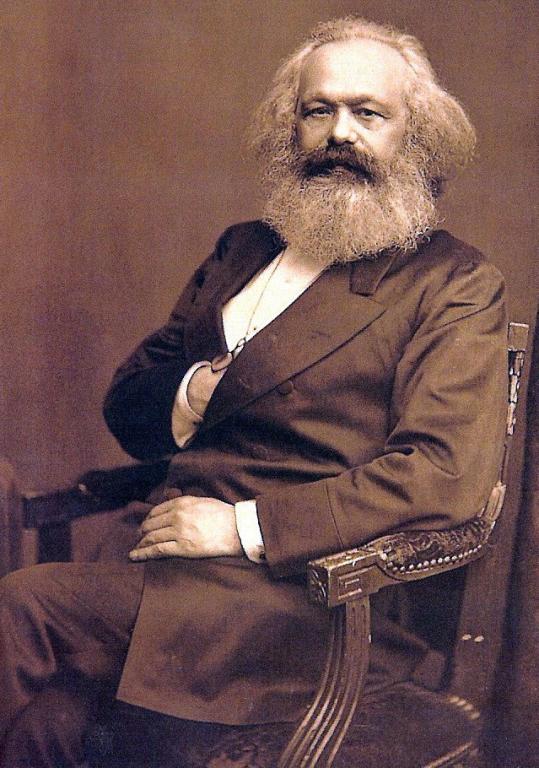
The great man himself, not Brigham Young but Karl Marx (1875), in an unusually jovial and kindly mood (Wikimedia Commons public domain image)
The second part of our discussion with Matt Grow, the Managing Director of the Church History Department in Salt Lake City, is now up: “Why Brigham Young, An Introduction,” Part Two. All of the five currently-available episodes (along with some other supporting materials) are accessible at becomingbrigham.com.
I wanted to add a comment to something that he said in this second part of our discussion: He mentioned Brigham Young’s encounter with the social and economic conditions of the middle and lower classes during the tumultuous days of the Industrial Revolution in England, and the impact that encounter had upon him. This was the period when the Latter-day Saint missionaries first arrived in the British Isles, in the late 1830s and early 1840s. Things were very difficult, which probably played a role in the remarkable success of those early emissaries of the Gospel: They brought a message of hope, and, not unimportantly, the idea of emigrating had likely become unusually attractive.
These were the social conditions described by Dickens (in such notable stories as A Christmas Carol) and by other Victorian novelists, as Professor Jamie Horrocks told us last year in a video lecture that remains available on the website of the Interpreter Foundation and that I heartily recommend, especially for those who might be coming with us on our tour of England in May of this year: “Truth Will Prevail!: Victorian Britain in the First Missionary Moment.”
They were also the conditions that, unfortunately, gave rise to Marxism. I’m thinking particularly of the German philosopher, social and political theorist, journalist, businessman, and revolutionary socialist Friedrich Engels (born in 1820; died in London in 1895), who was a lifelong collaborator with his fellow-German Karl Marx, who eventually moved to England in 1850 but with whom Engels had already co-authored The Communist Manifesto (1848). After Marx’s death in London in 1883, Engels served as the editor of his works, completing (among other things) the second and third volumes of Das Kapital.
Although Engels was German, his father had sent him to Manchester, England, in 1842 to work in a cotton mill in which the family had an investment. Manchester is commonly considered to have been the world’s first industrial city, transforming itself from a small town into a global hub of cotton manufacturing and trade in the late eighteenth and early nineteenth centuries. Sometimes known as “Cottonopolis,” it pioneered huge factory systems, steam power, and infrastructure like canals and railways — the Liverpool and Manchester Railway (1830), connecting the mills of Manchester with Liverpool’s port, was the world’s first modern inter-city railroad system — driven by technological innovation and its helpful proximity to coalfields.
Friedrich Engels’s experiences with the industrial working class there in Manchester in his early to mid-twenties impelled him to write his first significant work, The Condition of the Working Class in England (1845). Although the diagnosis that was eventually offered by Marx and Engels was seriously flawed, and despite the fact that their recommended cure, Communism, has proven not only deeply wrong in theory but economically catastrophic and massively lethal in practice, their observations on the actual plight of the English working classes were not dissimilar to some of the observations made by Brigham Young and the other apostles, who were shocked by what they saw. Marx and Engels and the apostles diverged widely, but, to some degree, they shared indignation.
Brigham Young’s passion for building Zion was certainly not lessened by what he saw in England. William Blake’s famous 18o4 poem, which has now become a find of unofficial national anthem for England, expresses a similar dream:
And did those feet in ancient time
Walk upon Englands mountains green:
And was the holy Lamb of God,
On Englands pleasant pastures seen!And did the Countenance Divine,
Shine forth upon our clouded hills?
And was Jerusalem builded here,
Among these dark Satanic Mills?Bring me my Bow of burning gold:
Bring me my arrows of desire:
Bring me my Spear: O clouds unfold!
Bring me my Chariot of fire!I will not cease from Mental Fight,
Nor shall my sword sleep in my hand:
Till we have built Jerusalem,
In Englands green & pleasant Land.
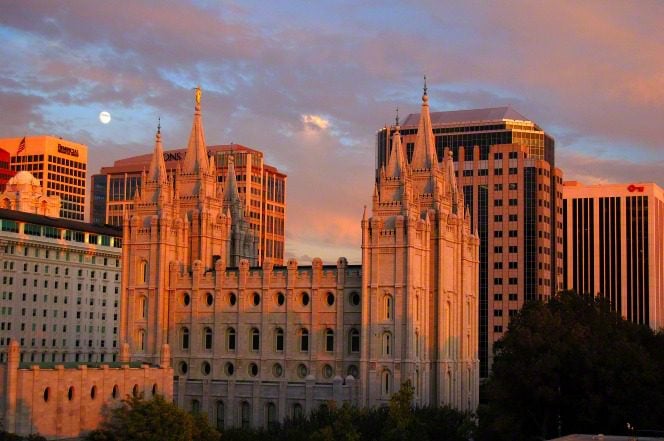
The 1978 Revelation on Priesthood was received in the Salt Lake City Utah Temple
(LDS.org)
In the comments section of this blog, a reader raises an important issue: “In the discussion with Matt Grow about the Priesthood ban on those of Black African descent,” he writes, “it seems that the assumption was that B[r]other Brigham made a mistake.”
That’s certainly a possibility, but I don’t think that we actually said that and it’s not necessarily my position.
He goes on to observe that “Brigham served for another 26 years after his announcement, and there was nine Church Presidents after Brigham who did not correct it. This was a serious and important issue which I doubt the Lord would have permitted if He hadn’t ordered it.”
I’m inclined to agree. Somewhat. It certainly seems to me that the Lord permitted the policy to continue, whether he originally ordered it or didn’t. I set forth a major reason for my view in a blog entry that I posted here back on 5 September 2018 under the title “Why I Can’t Simply Dismiss The Pre-1978 Priesthood Ban As A Mistake.”
I really meant what I said in that conversation with Matt Grow, that it’s important to say what we know (about this issue and others) and to acknowledge what we don’t know. And I simply don’t know — nor, so far as I’m aware, does anybody else know — what changed Brigham Young’s mind about Blacks and the priesthood between the end of the 1840s and the debates about slavery, servitude, and race in Utah Territory at the beginning of the 1850s. Something changed, but we don’t have anything yet to tell us what it was.
I do want to make one thing very clear, though — despite the fact that I’ll be accused (I’ve already been accused) of lying about it: I’m absolutely delighted that the Black priesthood ban is in our past. (President Spencer W. Kimball’s revelation on priesthood came nearly half a century ago.) The day that I heard the news of the revelation was one of the greatest and one of the happiest days of my entire life. I almost felt like dancing for a week or two thereafter . . . and that’s saying quite a bit, because I don’t dance.
Travel and Religion
History and Religion
Previous Post
February 23, 2026
"This is your daughter, Virginia."
Next Post
February 25, 2026 Politics, Commandments, Opposition, and Abrahamic Tests
Recent Comments
"In a meeting today, I learned another important reason why accurate (or at least as ..."
From Serbia’s “White City,” Belgrade
"PL: "Let's hope he doesn't have your address..."I have to frankly confess that a few ..."
From Serbia’s “White City,” Belgrade
"Let's hope he doesn't have your address..."
From Serbia’s “White City,” Belgrade
"PL: "The layers are peeling back."He appears to be suffering under an odd but powerful ..."
From Serbia’s “White City,” Belgrade
Browse Our Archives
Select a Category Uncategorized
Select a Month October 2026 September 2026 August 2026 July 2026 June 2026 May 2026 April 2026 March 2026 February 2026 January 2026 December 2025 November 2025 October 2025 September 2025 August 2025 July 2025 June 2025 May 2025 April 2025 March 2025 February 2025 January 2025 December 2024 November 2024 October 2024 September 2024 August 2024 July 2024 June 2024 May 2024 April 2024 March 2024 February 2024 January 2024 December 2023 November 2023 October 2023 September 2023 August 2023 July 2023 June 2023 May 2023 April 2023 March 2023 February 2023 January 2023 December 2022 November 2022 October 2022 September 2022 August 2022 July 2022 June 2022 May 2022 April 2022 March 2022 February 2022 January 2022 December 2021 November 2021 October 2021 September 2021 August 2021 July 2021 June 2021 May 2021 April 2021 March 2021 February 2021 January 2021 December 2020 November 2020 October 2020 September 2020 August 2020 July 2020 June 2020 May 2020 April 2020 March 2020 February 2020 January 2020 December 2019 November 2019 October 2019 September 2019 August 2019 July 2019 June 2019 May 2019 April 2019 March 2019 February 2019 January 2019 December 2018 November 2018 October 2018 September 2018 August 2018 July 2018 June 2018 May 2018 April 2018 March 2018 February 2018 January 2018 December 2017 November 2017 October 2017 September 2017 August 2017 July 2017 June 2017 May 2017 April 2017 March 2017 February 2017 January 2017 December 2016 November 2016 October 2016 September 2016 August 2016 July 2016 June 2016 May 2016 April 2016 March 2016 February 2016 January 2016 December 2015 November 2015 October 2015 September 2015 August 2015 July 2015 June 2015 May 2015 April 2015 March 2015 February 2015 January 2015 December 2014 November 2014 March 2014 August 2013 February 2012
Follow Us!
TAKE THE
Religious Wisdom Quiz
What does "Jezebel" mean in Hebrew?
Select your answer to see how you score.
Daughter of Baal The Lord reigns Unexalted Queen of the people
Related posts from Sic et Non


Notes on Women, Priesthood, and General Conference

"The Book of Moses as a Temple Text"

TRENDING AT PATHEOS Latter-day Saint

The Sermon on the Mount, Part I: Matthew...
The Sermon on the Mount, Part I (Matthew 4:12-5:12) St. Matthew moves...

What's up from Crossway: Reviewing some of their latest A few weeks...

Janie Learns the Way of the Cross: A...
Teaching children about Jesus' Passion can be challenging. Many parents and educators...

Looking For Good Catholic Writing - October 2026
He alone extends the heavens, and he walks upon the waves of...

In "Irreplaceable," our book on vocation and technology, Trevor Sutton and I...

I was strolling through the top floor of the brand new Parthenon...
view all Latter-day Saint blogs
What Are Your Thoughts?leave a comment
Ad-Free & Subscriber Log-In Subscription Support
- About Us
- 2026 Calendar
- Videos
- Podcasts
- Library of World Religions
- Faith In Media Tracker
- Advertise With Us
- Write for Us
- Privacy Policy
- Terms of Service
- Do Not Sell My Data
- Contact Us
- Radiant Digital
- Manage Newsletter Subscriptions
- Unsubscribe From Notifications
- Sitemap
Copyright 2008-2026, Patheos. All rights reserved.
Subscription Support Ad-Free & Subscriber Log-In
Follow Patheos