
BuddhistCatholicContemplativeEvangelicalGeneral ChristianHinduJewishLatter-day SaintMuslimNew VisionsProgressive Christian
Beliefs
- Buddhist
- Catholic
- Contemplative
- Evangelical
- General Christian
- Hindu
- Jewish
- Latter-day Saint
- More Voices
- Muslim
- New Visions
- Pagan
- Progressive Christian
Topics
- Religion News
- Food and Religion
- Sports and Religion
- Religious Art
- Religious Music and Entertainment
- Religious Events
- History and Religion
- Style and Religion
- Politics and Religion
- Women in Religion
- Recreation Outdoors and Religion
- Business Finance and Religion
- Careers Workplace and Religion
- Education and Religion
- Family Parenting and Religion
- Health Fitness and Religion
- Home and Religion
- Relationships and Religion
- Technology and Religion
- Travel and Religion
Columnists
- Buddhist Columnists
- Business Finance and Religion Columnists
- Careers Workplace and Religion Columnists
- Catholic Columnists
- Contemplative Columnists
- Education and Religion Columnists
- Evangelists Columnists
- Family Parenting and Religion Columnists
- General Christian Columnists
- Health Fitness and Religion Columnists
- Hindu Columnists
- History and Religion Columnists
- Home and Religion Columnists
- Jewish Columnists
- More Voices Columnists
- Latter Day Columnists
- Muslim Columnists
- New Visions Columnists
- Nonreligious Columnists
- Pagan Columnists
- Politics and Religion Columnists
- Progressive Columnists
- Recreation Outdoors and Religion Columnists
- Relationships and Religion Columnists
- Religion News Columnists
- Religious Art Columnists
- Religious Events Columnists
- Religious Music and Entertainment Columnists
- Sports and Religion Columnists
- Style and Religion Columnists
- Technology and Religion Columnists
- Travel and Religion Columnists
- Women in Religion Columnists
Resource Library
- 2026 Calendar
- Library of World Religions
- The 100 Most Holy Places on Earth
- Patheos Answers
- Podcasts
- Videos
- Faith Leaders Database
- Anglican Episcopalian
- Bahai
- Baptist
- Buddhism
- Christianity
- Confucianism
- Eastern Orthodoxy
- Hinduism
- Holiness and Pentecostal
- ISKCON
- Islam
- Judaism
- Lutheran
- Methodist
- The Church of Jesus Christ of Latter-day Saints
- New Age
- Paganism
- Presbytarian and Reformed
- Protestantism
- Religion Behind the Scenes
- Roman Catholic
- Scientology
- Shia Islam
- Sikhism
- Sufism
- Sunni Islam
- Taoism
- Zen
- See all religions
Research Tools
 Ad-Free & Subscriber Log-In Subscription Support
Ad-Free & Subscriber Log-In Subscription Support
Follow Patheos 

- Trending:
- Forgiveness
- |
- Marriage
- |
- Consciousness
- |
- Death Penalty
- |
- Election
- |
- Halloween

- Home
- Latter-day Saint
- History and Religion
- An interesting criticism of “Becoming Brigham”
An interesting criticism of “Becoming Brigham”
Last updated on: February 3, 2026 at 1:35 pm by Dan Peterson
An interesting criticism of “Becoming Brigham” 2026-02-03T13:35:56-07:00 Dan Peterson
Patheos Explore the world's faith through different perspectives on religion and spirituality! Patheos has the views of the prevalent religions and spiritualities of the world.

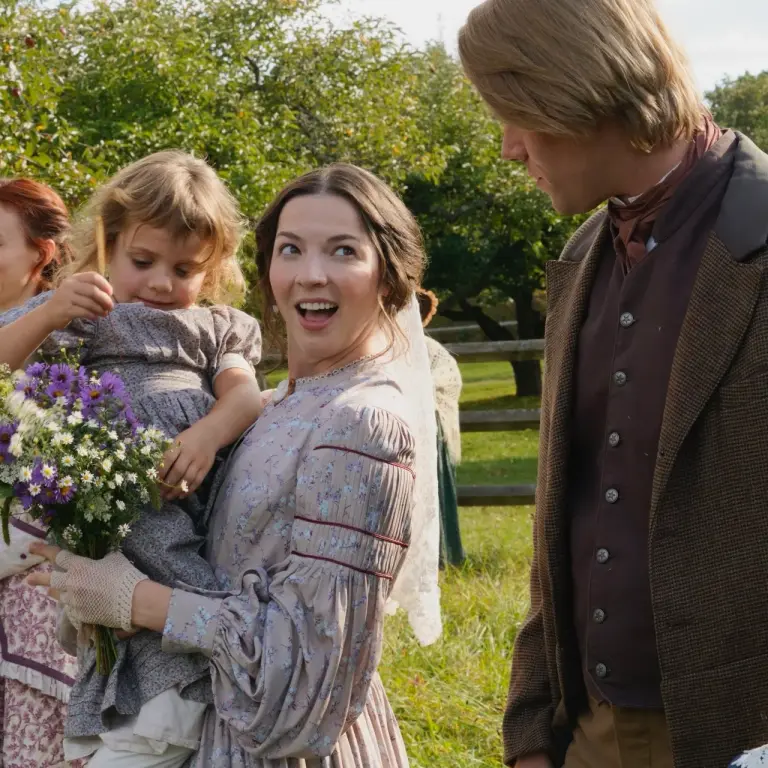
Miriam Works Young (portrayed by Jana Dahmer) and Brigham Young (John Donovan Wilson), following the baptism of Vilate Kimball. Miriam died of “consumption” (tuberculosis) only about three or four months after her own baptism, at the age of twenty-six. This is a scene from the 2024 Interpreter Foundation film Six Days in August.
We posted our second episode in the Becoming Brigham series yesterday (see “Becoming Brigham, Episode 2—Shorthand & Bloodstains, Part One”) and our first episode is still available for you delinquents who haven’t yet watched it. I hope that you will watch it and that, if you feel able to do so, you will commend it to others. And, by the way, Episode 2 may be of special interest to those out there who played with secret decoder rings and/or guns as children .
Becoming Brigham has even received some coverage — and relatively positive coverage — in the Salt Lake Tribune! “New docuseries tackles the ‘hard questions’ about LDS leader Brigham Young: “A lot of his harder edges,” historian says, “developed in the wake of Joseph Smith’s murder.””
The comments following the article, however, are quite another matter. Plainly, the very idea of the series massively irritates some, and it appears that I’m not universally beloved.
Amusingly, at least a couple of the commenters seem to blame me and the others involved in Becoming Brigham for the idea — which I don’t actually share — that Brigham Young’s “harder edges” resulted from the trauma that he allegedly suffered from the murder of Joseph Smith. (“You can see,” says one of the letter-writers, “they’ve thought up a “heart wrenching” excuse for all the horror of Brigham Youngs life.”) But it’s John Turner who says that in the article, and John Turner is a Virginia-based non-Latter-day Saint historian and biographer of Brigham Young (and of Joseph Smith) who has been quite critical of Brigham and of Latter-day Saint claims and who has absolutely no connection with Becoming Brigham.
Brigham Young (John Donovan Wilson), Mary Ann Angell Young (Twyla Wilson), and an up and coming younger actor in a scene from Six Days in August
In the study of logic, the term begging the question has a very specific meaning — which refers to a fallacy of assuming the conclusion, or circular reasoning. The fallacy occurs when an argument’s premises assume the truth of its conclusion, rather than independently supporting it. In this sense, it’s often called by the Latin name petītiō principiī. Here is a trio of examples:
- “There is a God because the Bible says so, and the Bible is true because God inspired it.”
- “Opium puts people to sleep because it has sleep-inducing properties.”
- “Freedom of speech is important because it’s important that people be able to speak freely.”
Unfortunately, many people misuse the term to mean merely “raising the question.” One of the complaints leveled against Becoming Brigham at both the Tribune and elsewhere, though, seems to me a nice, neat case of “begging the question” in the accurate meaning of the term:
Why, the complainers ask, are we seeking to defend this odious man? Doesn’t defending a morally contemptible person suggest that the defender himself is odious and morally contemptible? (For present purposes, let’s ignore my personal involvement in Becoming Brigham. The fact that I am, in fact, odious and morally contemptible merely clouds the issue by complicating the logic of the matter.) But whether Brigham Young is odious and morally contemptible is precisely one of the questions in dispute. (With others, I deny it.) Simply assuming him to be such cannot reasonably be used as an argument against inquiring about whether he is or isn’t.
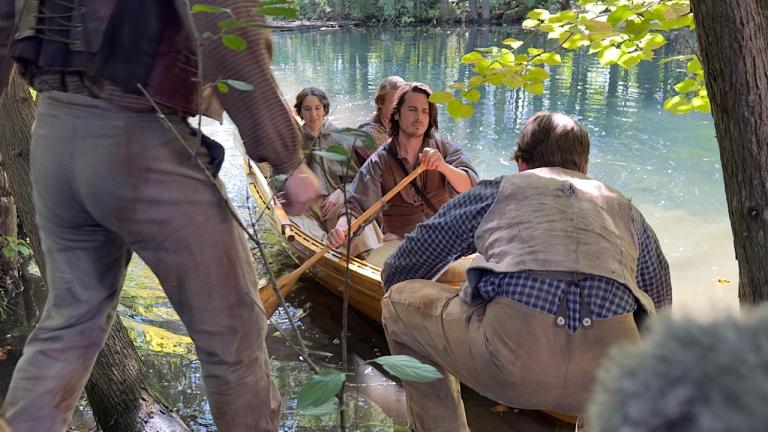
Joseph and Hyrum Smith, who have been in hiding, welcome the arrival of Emma Smith and Brigham Young in a scene from the Interpreter Foundation’s 2024 film Six Days in August. George A. Smith is at the oar.
I commented yesterday that my remarks at the August 2025 FAIR Conference appeared not to have been posted. Happily, though, an alert reader pointed out that I was wrong. (Which is, of course, a first for me. I’m still reeling from the realization and needing to process the unfamiliar concept of being mistaken.) Here is a link to my talk, on a subject that I consider quite important:
Dan Peterson examines Brigham Young’s views and actions regarding slavery, servitude, and race in the 19th century, pushing back against modern assumptions that frame the issue only in terms of absolute slavery or freedom. He emphasizes that Brigham Young should not be judged by oversimplified modern categories but understood within his historical context.
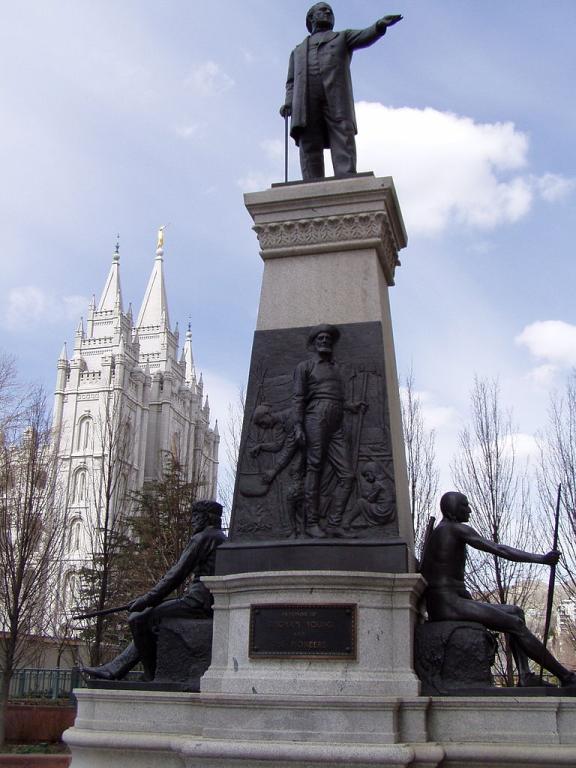
Cyrus Dallin’s 1897 statue of Brigham Young, near Temple Square in Salt Lake City
(Wikimedia Commons public domain image)
An academic with whom I’m acquainted who is deeply critical of the Church of Jesus Christ of Latter-day Saints, formerly active in the Church and now, sadly, quite alienated from it but, on many occasions, far more balanced, fair, intelligent, and lucid than those who surround him where he posts, has raised an interesting objection to Becoming Brigham. I know his identity in real life, but I’ll call him Alex:
Alex is inclined to fault Becoming Brigham as an instance of “hero worship” and a manifestation of the “cult of personality” that he regards as a negative characteristic of the culture of the Church. He writes, he observes, about such historical figures as Julius Caesar and Constantine, but he feels no need to defend them as honest, or nice, or good. He has nothing invested in them. He simply follows where the historical evidence leads.
I will grant that there are sometimes elements of undue hero worship in the Church (as elsewhere). While I’m not especially offended by them, I also don’t advocate such attitudes. Still, I do believe that there are real heroes, in the Church and beyond it.
But I think that, in this regard, Alex seriously misconceives what we’re doing with Becoming Brigham and what we did with Six Days in August. These are not ventures in “hero worship.” But they are attempts to tell an accurate story, to paint an accurate portrait as we see it. And to correct inaccurate perceptions where they occur.
Why does this matter? Because Brigham Young (and Joseph Smith and the Witnesses to the Book of Mormon) occupy a distinctly different place in Latter-day Saint historical self-understanding than Julius Caesar, Constantine, Napoleon, and Attila the Hun occupy in historical understanding more generally. Nobody orients his or her daily personal life according to a conception of Julius Caesar — though, I will confess, some current public figures begin to remind me of Attila the Hun. But the claims of Joseph Smith, the Witnesses, and Brigham Young do have life-orientational implications for those who accept them — and, for that matter, for those who reject them.
Moreover, to put it perhaps another way: Joseph and Brigham and other such pivotal figures in the story of the Restoration aren’t merely historical figures. They are witnesses, the value of whose testimony rests upon their credibility and moral character. Thus, as in a courtroom, defending (or questioning) their credibility and their character makes perfect sense and is actually quite important.
Reading Alex’s objection to Becoming Brigham, I immediately thought of a passage from a letter written by Oliver Cowdery to Phineas Young, on 23 March 1846. Oliver was negotiating his return to the Church, and he had some strong requests, even demands, to make before his rebaptism. During the turbulent and unpleasant time of his departure from the Church, in 1838, some very grave and intemperate accusations had been leveled against him and his character. The accusations were untrue, and he wanted explicit clarification that they were untrue. His reasons are of interest and of relevance here:
I have cherished a hope, and that one of my fondest, that I might leave such a character, as those who might believe in my testimony, after I should be called hence, might do so, not only for the sake of the truth, but might not blush for the private character of the man who bore that testimony. I have been sensitive on this subject, I admit; but I ought to be so—you would be, under the circumstances, had you stood in the presence of John, with our departed Brother Joseph, to receive the Lesser Priesthood—and in the presence of Peter, to receive the Greater, and looked down through time, and witnessed the effects these two must produce,—you would feel what you have never felt, were wicked men conspiring to lessen the effects of your testimony on man, after you should have gone to your long sought rest.
I have nothing invested in arguing for the perfection of Joseph Smith or Brigham Young or the Book of Mormon Witnesses. But a great deal rides for me (and for millions of others) on their credibility and on their having been morally adequate to the stewardships that I believe God assigned to them. Fortunately, I believe the historical evidence to be on my side, and on theirs.
History and Religion
Travel and Religion
Previous Post

February 2, 2026
"Shorthand and Bloodstains"
Next Post

February 4, 2026 Getting the Word Out
Recent Comments
"In a meeting today, I learned another important reason why accurate (or at least as ..."
From Serbia’s “White City,” Belgrade
"I've been watching a lot of video interviews of NDErs and researchers. I think in ..."
"PL: "Let's hope he doesn't have your address..."I have to frankly confess that a few ..."
From Serbia’s “White City,” Belgrade
"Let's hope he doesn't have your address..."
From Serbia’s “White City,” Belgrade
Browse Our Archives
Select a Category Uncategorized
Select a Month October 2026 September 2026 August 2026 July 2026 June 2026 May 2026 April 2026 March 2026 February 2026 January 2026 December 2025 November 2025 October 2025 September 2025 August 2025 July 2025 June 2025 May 2025 April 2025 March 2025 February 2025 January 2025 December 2024 November 2024 October 2024 September 2024 August 2024 July 2024 June 2024 May 2024 April 2024 March 2024 February 2024 January 2024 December 2023 November 2023 October 2023 September 2023 August 2023 July 2023 June 2023 May 2023 April 2023 March 2023 February 2023 January 2023 December 2022 November 2022 October 2022 September 2022 August 2022 July 2022 June 2022 May 2022 April 2022 March 2022 February 2022 January 2022 December 2021 November 2021 October 2021 September 2021 August 2021 July 2021 June 2021 May 2021 April 2021 March 2021 February 2021 January 2021 December 2020 November 2020 October 2020 September 2020 August 2020 July 2020 June 2020 May 2020 April 2020 March 2020 February 2020 January 2020 December 2019 November 2019 October 2019 September 2019 August 2019 July 2019 June 2019 May 2019 April 2019 March 2019 February 2019 January 2019 December 2018 November 2018 October 2018 September 2018 August 2018 July 2018 June 2018 May 2018 April 2018 March 2018 February 2018 January 2018 December 2017 November 2017 October 2017 September 2017 August 2017 July 2017 June 2017 May 2017 April 2017 March 2017 February 2017 January 2017 December 2016 November 2016 October 2016 September 2016 August 2016 July 2016 June 2016 May 2016 April 2016 March 2016 February 2016 January 2016 December 2015 November 2015 October 2015 September 2015 August 2015 July 2015 June 2015 May 2015 April 2015 March 2015 February 2015 January 2015 December 2014 November 2014 March 2014 August 2013 February 2012
Follow Us!
TAKE THE
Religious Wisdom Quiz
What is the main Christian group in Ethiopia called?
Select your answer to see how you score.
Ethiopian Orthodox Tewahedo Church Baptist Pentecostal Assemblies of God
Related posts from Sic et Non


Notes on Women, Priesthood, and General Conference

"The Book of Moses as a Temple Text"

TRENDING AT PATHEOS Latter-day Saint

Janie Learns the Way of the Cross: A...
Teaching children about Jesus' Passion can be challenging. Many parents and educators...

Looking For Good Catholic Writing - October 2026
He alone extends the heavens, and he walks upon the waves of...

In "Irreplaceable," our book on vocation and technology, Trevor Sutton and I...

I was strolling through the top floor of the brand new Parthenon...

What Does Gêvâh Mean For Kimberley Guifoyle &...
This week, a lot of the news is focused on Kimberly Guilfoyle....

INNER CIRCLE: Profound Mystery (Of Christ In All...
Ephesians 5:31-32 “For this reason, a man will leave his father and...
view all Latter-day Saint blogs
What Are Your Thoughts?leave a comment
Ad-Free & Subscriber Log-In Subscription Support
- About Us
- 2026 Calendar
- Videos
- Podcasts
- Library of World Religions
- Faith In Media Tracker
- Advertise With Us
- Write for Us
- Privacy Policy
- Terms of Service
- Do Not Sell My Data
- Contact Us
- Radiant Digital
- Manage Newsletter Subscriptions
- Unsubscribe From Notifications
- Sitemap
Copyright 2008-2026, Patheos. All rights reserved.
Subscription Support Ad-Free & Subscriber Log-In
Follow Patheos