
BuddhistCatholicContemplativeEvangelicalGeneral ChristianHinduJewishLatter-day SaintMuslimNew VisionsProgressive Christian
Beliefs
- Buddhist
- Catholic
- Contemplative
- Evangelical
- General Christian
- Hindu
- Jewish
- Latter-day Saint
- More Voices
- Muslim
- New Visions
- Pagan
- Progressive Christian
Topics
- Religion News
- Food and Religion
- Sports and Religion
- Religious Art
- Religious Music and Entertainment
- Religious Events
- History and Religion
- Style and Religion
- Politics and Religion
- Women in Religion
- Recreation Outdoors and Religion
- Business Finance and Religion
- Careers Workplace and Religion
- Education and Religion
- Family Parenting and Religion
- Health Fitness and Religion
- Home and Religion
- Relationships and Religion
- Technology and Religion
- Travel and Religion
Columnists
- Buddhist Columnists
- Business Finance and Religion Columnists
- Careers Workplace and Religion Columnists
- Catholic Columnists
- Contemplative Columnists
- Education and Religion Columnists
- Evangelists Columnists
- Family Parenting and Religion Columnists
- General Christian Columnists
- Health Fitness and Religion Columnists
- Hindu Columnists
- History and Religion Columnists
- Home and Religion Columnists
- Jewish Columnists
- More Voices Columnists
- Latter Day Columnists
- Muslim Columnists
- New Visions Columnists
- Nonreligious Columnists
- Pagan Columnists
- Politics and Religion Columnists
- Progressive Columnists
- Recreation Outdoors and Religion Columnists
- Relationships and Religion Columnists
- Religion News Columnists
- Religious Art Columnists
- Religious Events Columnists
- Religious Music and Entertainment Columnists
- Sports and Religion Columnists
- Style and Religion Columnists
- Technology and Religion Columnists
- Travel and Religion Columnists
- Women in Religion Columnists
Resource Library
- 2026 Calendar
- Library of World Religions
- The 100 Most Holy Places on Earth
- Patheos Answers
- Podcasts
- Videos
- Faith Leaders Database
- Anglican Episcopalian
- Bahai
- Baptist
- Buddhism
- Christianity
- Confucianism
- Eastern Orthodoxy
- Hinduism
- Holiness and Pentecostal
- ISKCON
- Islam
- Judaism
- Lutheran
- Methodist
- The Church of Jesus Christ of Latter-day Saints
- New Age
- Paganism
- Presbytarian and Reformed
- Protestantism
- Religion Behind the Scenes
- Roman Catholic
- Scientology
- Shia Islam
- Sikhism
- Sufism
- Sunni Islam
- Taoism
- Zen
- See all religions
Research Tools
 Ad-Free & Subscriber Log-In Subscription Support
Ad-Free & Subscriber Log-In Subscription Support
Follow Patheos 

- Trending:
- Forgiveness
- |
- Marriage
- |
- Consciousness
- |
- Death Penalty
- |
- Election
- |
- Halloween

- Home
- Latter-day Saint
- History and Religion
- Unsurprised by Hieronymus Bosch?
Unsurprised by Hieronymus Bosch?
Last updated on: January 3, 2026 at 9:56 pm by Dan Peterson
Unsurprised by Hieronymus Bosch? 2026-01-03T21:56:01-07:00 Dan Peterson
Patheos Explore the world's faith through different perspectives on religion and spirituality! Patheos has the views of the prevalent religions and spiritualities of the world.

Remarkably near to downtown St. George, in a Wikimedia Commons public domain photo by Murray Foubister
At the end of another long day of driving, I’m going to content myself with offering a few highlighted passages from my recent reading of Sam Parnia’s still relatively-new book Lucid Dying: The New Science Revolutionizing How We Understand Life and Death (New York: Grand Central Publishing, 2024). I’m just too tired to do much more.
You may perhaps recall that Dr. Parnia, M.D., Ph.D., is an associate professor of medicine at New York University’s Langone Medical Center, where he is also director of research into cardiopulmonary resuscitation. In the United Kingdom — born in London, he is a British subject — he is director of the Human Consciousness Project at the University of Southampton. He received his medical degree in 1995 from Guy’s and St. Thomas’ Medical School (that is, from the Medical School of King’s College London) and then earned a doctorate in cell biology from the University of Southhampton in 2007, followed by fellowship training in Pulmonary and Critical Care Medicine at the University of London and the Weill Cornell Medical College in New York City.
Dr. Parnia has described himself, by the way, as not at all religious. That self-description may help in understanding what he has to say in the first quoted passage:
[W]hat if death itself is not the end we have thought and assumed? What if who we are—our very consciousness and selfhood—is not annihilated with death? And what if science can prove it? What will that mean for us, for society, for religion, for philosophy, for how we live our lives?
Many scientists consider what happens after death as mere philosophical or theological speculation. I don’t agree with this position and thankfully, today this no longer needs to be the case. Using sophisticated brain technology, we can peer inside the brains of people as they approach and then transition beyond death by recording and analyzing their brain waves. Advances in mathematics, artificial intelligence (AI) technology, and computing power are allowing us to objectively analyze realities about life and death that we never could have until recently. And this research is giving us the first real-time ability to study what happens to the brain and consciousness in people as they cross from life beyond the boundary of death.
He claims that his position with respect to death and dying, and to what lies beyond them, rests upon science rather than upon received dogma:
There is much more to be discovered, but science does, at a minimum, suggest that our consciousness and selfhood are not annihilated when we cross over into death and into the great unknown. (8)
As so many others do who have worked in the area of what are often — though, he thinks, erroneously (see below) — referred to as “near-death experiences,” he sees overwhelming evidence for what he describes as “a unique hyperconscious lucid mental state” that accompanies dying, and he believes that it points to the survival of the human mind or personality beyond death (8).
His reading, his research, and his own interactions with experiencers have impressed him, among other things, with the commonalities that he sees across cultures:
These people, having had a recalled experience of death (or RED), return with a uniform, standardized series of experiences. It doesn’t matter that they’ve never met or communicated with each other, or that they died in Mexico, Iran, Thailand, America, Denmark, or the United Kingdom. No matter how varied their lives, their encounters with death have a startling narrative unity. (9)
For several years, this blog was graced with the presence of a resident atheist commentator who called himself “gemli.” His principal objection to the concept of “near-death experiences” — he never really managed to get beyond it — was that, by definition, a “near-death” experience was not, could not be, an experience of death. Nearly dead, he told us over and over again, is not the same thing as dead. I think that it’s partly (but not solely) for that reason that Dr. Parnia rejects the term near-death experience, substituting in its place recalled experience of death.
Often, people, including many scientists and doctors, say if your heart has stopped and you are alive again, then you could not have died because “death” is irreversible and permanent by definition. People have even created terms, such as clinical death, to distinguish between people who have traversed death and returned from people with “real” death, in their own minds. However, this is just a play with words. It has nothing to do with biological and scientific reality. (45)
One of Dr. Parnia’s major contentions in the study of death and resuscitation is the concept that “the liminal grey zone beyond death is vastly more expansive than recognized in the past” (19). Life and death are not simple dichotomous terms. They are not a black and white matter. He explains that
the process of cell damage and death in the body, including in the brain, generally starts after a person has died and does not become absolute for many hours or even possibly days after death. The transition from life to what we call death, like everything else in biology, follows a continuum. (45)
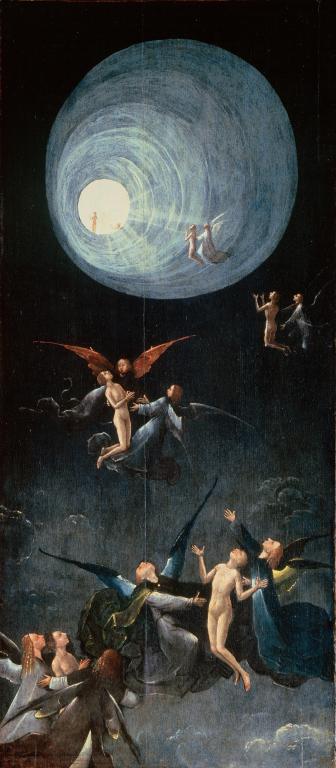
Hieronymus Bosch (d. 1516), “Ascent of the Blest” or “Ascent to the Empyrean”. (Wikimedia Commons public domain image)
I’ve called attention on several prior occasions, here on this blog, to the early sixteenth-century painting by Hieronymus Bosch that is shown above. (The original hangs in the Gallerie dell’Accademia in Venice, Italy.) I find the image remarkable, as does Dr. Parnia. Here is what he has to say about it:
As much as I like this painting, nothing about it particularly surprised me the first time I saw it. It was first shown to me by a patient who had been successfully resuscitated. He was struggling to describe the experience he claimed to have had while his heart had stopped. Eventually, he gave up and simply relied on this image. Bosch was painting something I’d heard described many times, both as a doctor and a researcher focused on understanding the experience of people who’ve died and been resuscitated. Over the years I’ve met countless survivors who’ve described a recalled experience of death. They are of all ages, beliefs, and backgrounds, yet there is a uniformity to their experiences. They all describe some variation of the scene depicted in this painting. (50)
Posted from St. George, Utah
History and Religion
Travel and Religion
Previous Post

January 2, 2026
Palm Springs, Prophetic Parallels, and the Passing Scene
Next Post

January 4, 2026 Some reflections on the U.S. operation in Venezuela
Recent Comments
Browse Our Archives
Select a Category Uncategorized
Select a Month October 2026 September 2026 August 2026 July 2026 June 2026 May 2026 April 2026 March 2026 February 2026 January 2026 December 2025 November 2025 October 2025 September 2025 August 2025 July 2025 June 2025 May 2025 April 2025 March 2025 February 2025 January 2025 December 2024 November 2024 October 2024 September 2024 August 2024 July 2024 June 2024 May 2024 April 2024 March 2024 February 2024 January 2024 December 2023 November 2023 October 2023 September 2023 August 2023 July 2023 June 2023 May 2023 April 2023 March 2023 February 2023 January 2023 December 2022 November 2022 October 2022 September 2022 August 2022 July 2022 June 2022 May 2022 April 2022 March 2022 February 2022 January 2022 December 2021 November 2021 October 2021 September 2021 August 2021 July 2021 June 2021 May 2021 April 2021 March 2021 February 2021 January 2021 December 2020 November 2020 October 2020 September 2020 August 2020 July 2020 June 2020 May 2020 April 2020 March 2020 February 2020 January 2020 December 2019 November 2019 October 2019 September 2019 August 2019 July 2019 June 2019 May 2019 April 2019 March 2019 February 2019 January 2019 December 2018 November 2018 October 2018 September 2018 August 2018 July 2018 June 2018 May 2018 April 2018 March 2018 February 2018 January 2018 December 2017 November 2017 October 2017 September 2017 August 2017 July 2017 June 2017 May 2017 April 2017 March 2017 February 2017 January 2017 December 2016 November 2016 October 2016 September 2016 August 2016 July 2016 June 2016 May 2016 April 2016 March 2016 February 2016 January 2016 December 2015 November 2015 October 2015 September 2015 August 2015 July 2015 June 2015 May 2015 April 2015 March 2015 February 2015 January 2015 December 2014 November 2014 March 2014 August 2013 February 2012
Follow Us!
TAKE THE
Religious Wisdom Quiz
What king sought Isaiah's prayers when facing Assyrian invasion?
Select your answer to see how you score.
Rehoboam Josiah Manasseh Hezekiah
Related posts from Sic et Non




Comments from two near-death experiencers
TRENDING AT PATHEOS Latter-day Saint

Pope Leo Celebrates Mass for Nurses & Docs...
I don't have any idea how he did it, but Pope Leo...

The Sermon on the Mount, Part I: Matthew...
The Sermon on the Mount, Part I (Matthew 4:12-5:12) St. Matthew moves...

What's up from Crossway: Reviewing some of their latest A few weeks...

Janie Learns the Way of the Cross: A...
Teaching children about Jesus' Passion can be challenging. Many parents and educators...

Looking For Good Catholic Writing - October 2026
He alone extends the heavens, and he walks upon the waves of...

In "Irreplaceable," our book on vocation and technology, Trevor Sutton and I...
view all Latter-day Saint blogs
What Are Your Thoughts?leave a comment
Ad-Free & Subscriber Log-In Subscription Support
- About Us
- 2026 Calendar
- Videos
- Podcasts
- Library of World Religions
- Faith In Media Tracker
- Advertise With Us
- Write for Us
- Privacy Policy
- Terms of Service
- Do Not Sell My Data
- Contact Us
- Radiant Digital
- Manage Newsletter Subscriptions
- Unsubscribe From Notifications
- Sitemap
Copyright 2008-2026, Patheos. All rights reserved.
Subscription Support Ad-Free & Subscriber Log-In
Follow Patheos