
BuddhistCatholicContemplativeEvangelicalGeneral ChristianHinduJewishLatter-day SaintMuslimNew VisionsProgressive Christian
Beliefs
- Buddhist
- Catholic
- Contemplative
- Evangelical
- General Christian
- Hindu
- Jewish
- Latter-day Saint
- More Voices
- Muslim
- New Visions
- Pagan
- Progressive Christian
Topics
- Religion News
- Food and Religion
- Sports and Religion
- Religious Art
- Religious Music and Entertainment
- Religious Events
- History and Religion
- Style and Religion
- Politics and Religion
- Women in Religion
- Recreation Outdoors and Religion
- Business Finance and Religion
- Careers Workplace and Religion
- Education and Religion
- Family Parenting and Religion
- Health Fitness and Religion
- Home and Religion
- Relationships and Religion
- Technology and Religion
- Travel and Religion
Columnists
- Buddhist Columnists
- Business Finance and Religion Columnists
- Careers Workplace and Religion Columnists
- Catholic Columnists
- Contemplative Columnists
- Education and Religion Columnists
- Evangelists Columnists
- Family Parenting and Religion Columnists
- General Christian Columnists
- Health Fitness and Religion Columnists
- Hindu Columnists
- History and Religion Columnists
- Home and Religion Columnists
- Jewish Columnists
- More Voices Columnists
- Latter Day Columnists
- Muslim Columnists
- New Visions Columnists
- Nonreligious Columnists
- Pagan Columnists
- Politics and Religion Columnists
- Progressive Columnists
- Recreation Outdoors and Religion Columnists
- Relationships and Religion Columnists
- Religion News Columnists
- Religious Art Columnists
- Religious Events Columnists
- Religious Music and Entertainment Columnists
- Sports and Religion Columnists
- Style and Religion Columnists
- Technology and Religion Columnists
- Travel and Religion Columnists
- Women in Religion Columnists
Resource Library
- 2026 Calendar
- Library of World Religions
- The 100 Most Holy Places on Earth
- Patheos Answers
- Podcasts
- Videos
- Faith Leaders Database
- Anglican Episcopalian
- Bahai
- Baptist
- Buddhism
- Christianity
- Confucianism
- Eastern Orthodoxy
- Hinduism
- Holiness and Pentecostal
- ISKCON
- Islam
- Judaism
- Lutheran
- Methodist
- The Church of Jesus Christ of Latter-day Saints
- New Age
- Paganism
- Presbytarian and Reformed
- Protestantism
- Religion Behind the Scenes
- Roman Catholic
- Scientology
- Shia Islam
- Sikhism
- Sufism
- Sunni Islam
- Taoism
- Zen
- See all religions
Research Tools
 Ad-Free & Subscriber Log-In Subscription Support
Ad-Free & Subscriber Log-In Subscription Support
Follow Patheos 

- Trending:
- Forgiveness
- |
- Marriage
- |
- Consciousness
- |
- Death Penalty
- |
- Election
- |
- Halloween

- Home
- Latter-day Saint
- History and Religion
- Unexpectedly, you could have met me today in St. Louis
Unexpectedly, you could have met me today in St. Louis
Last updated on: January 17, 2026 at 5:15 am by Dan Peterson
Unexpectedly, you could have met me today in St. Louis 2026-01-17T05:15:57-07:00 Dan Peterson
Patheos Explore the world's faith through different perspectives on religion and spirituality! Patheos has the views of the prevalent religions and spiritualities of the world.
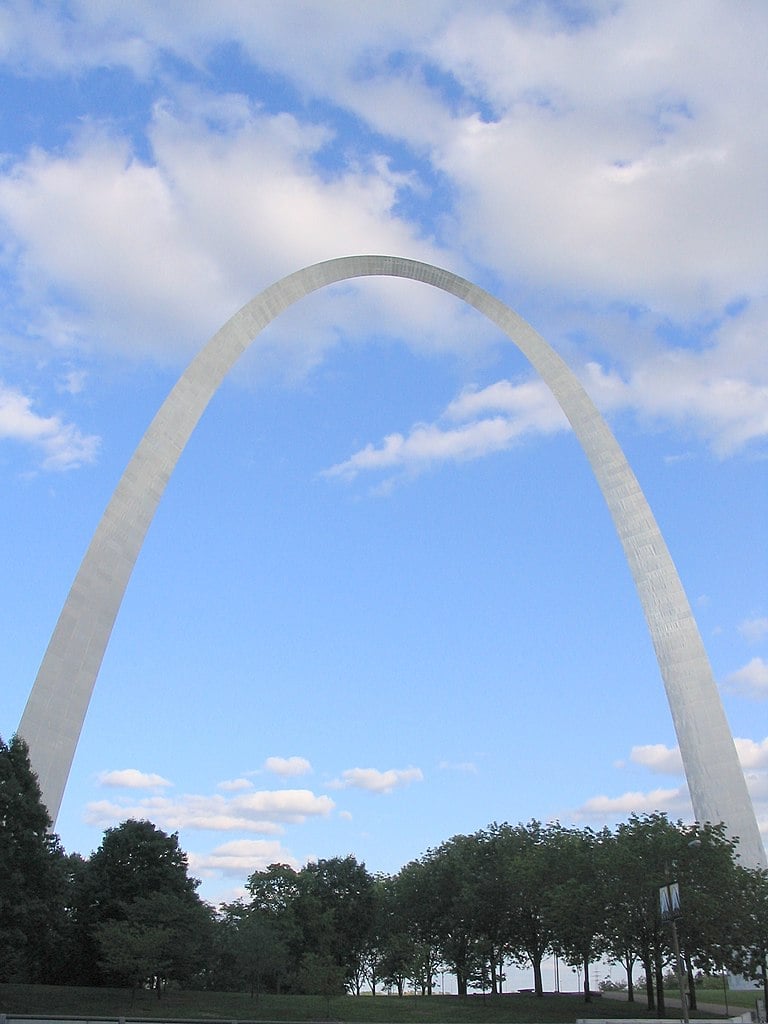
The Gateway Arch in St. Louis — officially known as the Jefferson National Expansion Memorial — was designed by the Finnish-American architect Eero Saarinen (1910-1961). This is a Wikimedia Commons public domain image.
Well, thanks to a mechanical problem with one of the aircraft in the Delta Airlines fleet, we were able to add an extra day to our filming expedition, spending an unplanned Friday night in St. Louis. In the, umm, spirit of St. Louis, here is Judy Garland’s “Meet Me in St. Louis.” Please ponder its timelessly immortal lyrics.
St. Louis served as a vital “city of refuge” and as a way station for many of the Latter-day Saint refugees who were fleeing persecution in Illinois. An estimated 22,000 of them passed through the city between 1846 and 1857. Because of its location — it was a key port, a logistical hub, on the Mississippi River where pioneers would transition from riverboats to land travel, organizing into companies for the overland journey westward — it became a crucial gathering point both for those displaced from Nauvoo and for immigrants who were arriving from Europe via New Orleans and the Mississippi, allowing them to work, to earn money, and to organize and equip themselves for the arduous trek ahead of them. (George Cannon, the father of the British-born George Q. Cannon who later became a counselor to four presidents of the Church, went off to work in St. Louis as a carpenter and joiner, but unexpectedly died there.) The pioneers’ route typically took them to the Latter-day Saint settlement of Kanesville, Iowa (modern-day Council Bluffs), or other outfitting posts, and then further on across the Great Plains and over the Rocky Mountains.
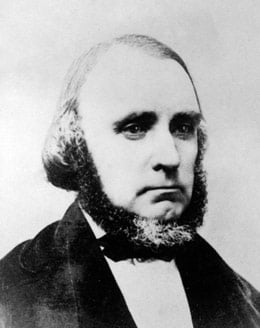
William H. Clayton (1814-1879), in a Wikimedia Commons public domain image
Here’s an important story: William Clayton, one of the earliest British converts to the Church of Jesus Christ of Latter-day Saints, was a member of the original pioneer company that, having left Nauvoo in February 1846, entered the Valley of the Great Salt Lake in the summer of 1847. Before that, while crossing Iowa in April 1846, he composed the beloved pioneer hymn Come, Come, Ye Saints:
1. Come, come, ye Saints, no toil nor labor fear;
But with joy wend your way.
Though hard to you this journey may appear,
Grace shall be as your day.
’Tis better far for us to strive
Our useless cares from us to drive;
Do this, and joy your hearts will swell—
All is well! All is well!
2. Why should we mourn or think our lot is hard?’
Tis not so; all is right.
Why should we think to earn a great reward
If we now shun the fight?
Gird up your loins; fresh courage take.
Our God will never us forsake;
And soon we’ll have this tale to tell—
All is well! All is well!
3. We’ll find the place which God for us prepared,
Far away in the West,
Where none shall come to hurt or make afraid;
There the Saints will be blessed.
We’ll make the air with music ring,
Shout praises to our God and King;
Above the rest these words we’ll tell—
All is well! All is well!
4. And should we die before our journey’s through,
Happy day! All is well!
We then are free from toil and sorrow, too;
With the just we shall dwell!
But if our lives are spared again
To see the Saints their rest obtain,
Oh, how we’ll make this chorus swell—
All is well! All is well!
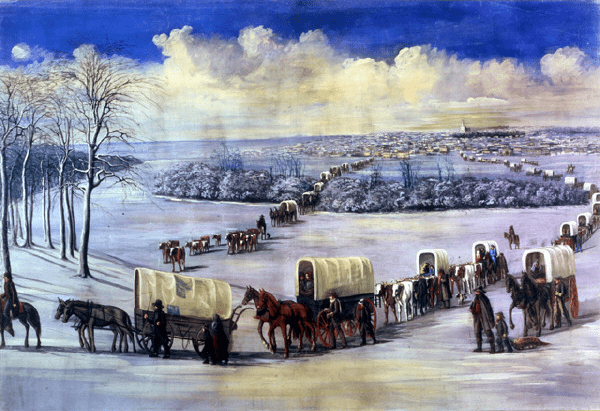
C.C.A. Christensen, “Crossing the Mississippi on the Ice” (created ca. 1878), depicting the mid-winter commencement of the enforced Mormon exodus from Nauvoo, Illinois, abandoning their temple and their city, toward the Great Basin West. (Wikimedia Commons public domain image)
I’ve just watched a beautifully illustrated performance of Come, Come Ye Saints by the Tabernacle Choir. Perhaps I’ve been more affected than I realized by spending the past several days in Nauvoo, in and around the surviving homes of those who abandoned them (and their temple, and the graves of their martyred Prophet and Patriarch, for exile in the west, but I found myself actually tearing up as I watched the accompanying video. It’s just five minutes in length.
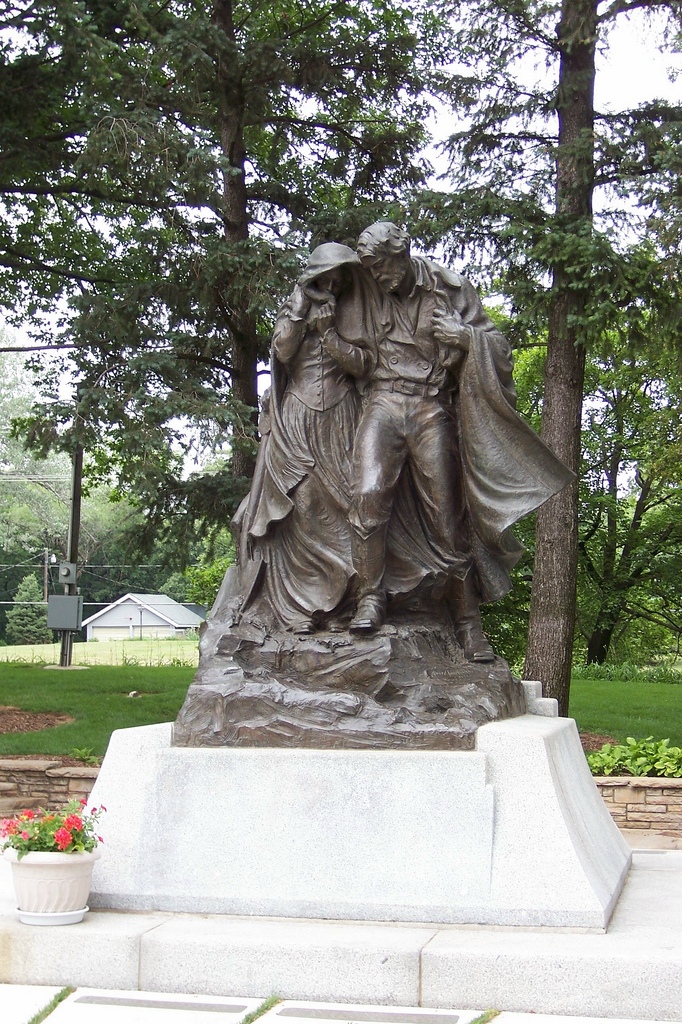
“Tragedy at Winter Quarters,” by Avard Fairbanks (1897-1987), depicts a Latter-day Saint mother and father grieving at the still-open grave of their small child.
After staying in the Valley for a short while in 1847, William Clayton returned to Winter Quarters in the fall and compiled a book from the detailed entries that he had made in his diary during the journey. His entries included data from a device that Elder Orson Pratt of the Quorum of the Twelve had designed and that Appleton Harmon had constructed during their 1847 expedition. They called it a “roadometer.” Like a modern odometer for measuring mileage, it was mounted on a wagon wheel.
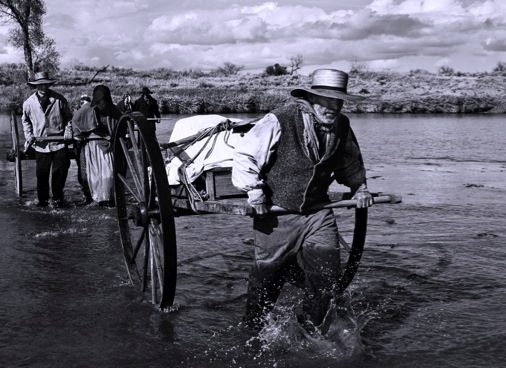
Latter-day Saint pioneers cross the Platte River en route to the Great Basin. A reenactment from the PBS film “Sweetwater Rescue,” on which my colleagues here also worked. (Wikimedia Commons public domain image)
Clayton was assigned to help organize efforts in St. Louis, where he was aided by the city’s relative tolerance and cosmopolitanism. While there, in order to aid the pioneers, he supervised the printing of The Latter-Day Saints’ Emigrants’ Guide: Being a Table of Distances, Showing all the Springs, Creeks, Rivers, Hills, Mountains, Camping Places, and all Other Notable Places, From Council Bluffs, to the Valley of the Great Salt Lake . . . . The Whole Route Having Been Carefully Measured by a Roadometer, and Distance from Point to Point, in English Miles, Accurately Shown (St. Louis: Mo. Republican Steam Power Press, Chambers & Knapp, 1848).
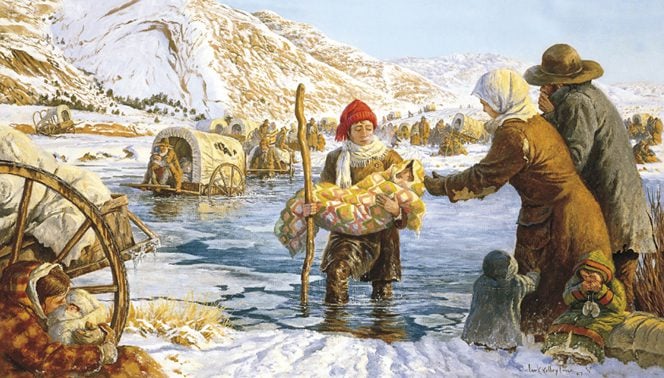
Gathering to Zion: “Helping the Martin Handcart Company across the Sweetwater River,” by Clark Kelley Price (LDS Media Library)
The book lists the names and occasional locations (giving latitudes in degrees, minutes, and seconds, in figures provided by Orson Pratt) of prominent points, the distances in miles between the points listed, the distance from Winter Quarters, and the distances from Great Salt Lake City. Thus, an emigrant reading the guide always knew how far he had come, how far he needed to travel to the next camp site, and how great a distance remained to the Valley of the Great Salt Lake. Sometimes, it even provides altitudes that had been calculated by Elder Pratt.

Today’s St. Louis Missouri Temple (LDS.org)
Posted from St. Louis, Missouri
History and Religion
Travel and Religion
Previous Post

January 16, 2026
One set of plates? Or TWO?
Next Post

January 18, 2026 Mark Your Calendar!
Recent Comments
"DP: “But Mr. Sutherland worries about the fact that our time, when we can communicate ..."
Learning more about a region of ..."
"Another class of memories are of individuals who previously lived. Some of these remembered individuals ..."
"Sutherland's lecture sounds interesting. He seems to restate the Washington consensus that trade brings peace ..."
Learning more about a region of ..."
"In a meeting today, I learned another important reason why accurate (or at least as ..."
From Serbia’s “White City,” Belgrade
Browse Our Archives
Select a Category Uncategorized
Select a Month October 2026 September 2026 August 2026 July 2026 June 2026 May 2026 April 2026 March 2026 February 2026 January 2026 December 2025 November 2025 October 2025 September 2025 August 2025 July 2025 June 2025 May 2025 April 2025 March 2025 February 2025 January 2025 December 2024 November 2024 October 2024 September 2024 August 2024 July 2024 June 2024 May 2024 April 2024 March 2024 February 2024 January 2024 December 2023 November 2023 October 2023 September 2023 August 2023 July 2023 June 2023 May 2023 April 2023 March 2023 February 2023 January 2023 December 2022 November 2022 October 2022 September 2022 August 2022 July 2022 June 2022 May 2022 April 2022 March 2022 February 2022 January 2022 December 2021 November 2021 October 2021 September 2021 August 2021 July 2021 June 2021 May 2021 April 2021 March 2021 February 2021 January 2021 December 2020 November 2020 October 2020 September 2020 August 2020 July 2020 June 2020 May 2020 April 2020 March 2020 February 2020 January 2020 December 2019 November 2019 October 2019 September 2019 August 2019 July 2019 June 2019 May 2019 April 2019 March 2019 February 2019 January 2019 December 2018 November 2018 October 2018 September 2018 August 2018 July 2018 June 2018 May 2018 April 2018 March 2018 February 2018 January 2018 December 2017 November 2017 October 2017 September 2017 August 2017 July 2017 June 2017 May 2017 April 2017 March 2017 February 2017 January 2017 December 2016 November 2016 October 2016 September 2016 August 2016 July 2016 June 2016 May 2016 April 2016 March 2016 February 2016 January 2016 December 2015 November 2015 October 2015 September 2015 August 2015 July 2015 June 2015 May 2015 April 2015 March 2015 February 2015 January 2015 December 2014 November 2014 March 2014 August 2013 February 2012
Follow Us!
TAKE THE
Religious Wisdom Quiz
How many years did Solomon reign?
Select your answer to see how you score.
30 years 50 years 40 years 35 years
Related posts from Sic et Non


Notes on Women, Priesthood, and General Conference

"The Book of Moses as a Temple Text"

TRENDING AT PATHEOS Latter-day Saint

Nearly every morning, I make the drive to Detroit with my high-school-age...

The Real AI Story Is Adoption Without Trust
Artificial intelligence has crossed a political threshold. It is no longer a...

A new article, written by Jeff Lindsay and Gale L. Pooley,...

Swimfan: Forgotten Aughts Pleasures
This is a recovery effort. In 2002, My Big Fat Greek Wedding...

Top Three Anti-Catholic Lies About Catholicism
This is my initial transcript for the video, "THE 3 WORST...

Pope Leo Celebrates Mass for Nurses & Docs...
I don't have any idea how he did it, but Pope Leo...
view all Latter-day Saint blogs
What Are Your Thoughts?leave a comment
Ad-Free & Subscriber Log-In Subscription Support
- About Us
- 2026 Calendar
- Videos
- Podcasts
- Library of World Religions
- Faith In Media Tracker
- Advertise With Us
- Write for Us
- Privacy Policy
- Terms of Service
- Do Not Sell My Data
- Contact Us
- Radiant Digital
- Manage Newsletter Subscriptions
- Unsubscribe From Notifications
- Sitemap
Copyright 2008-2026, Patheos. All rights reserved.
Subscription Support Ad-Free & Subscriber Log-In
Follow Patheos