
BuddhistCatholicContemplativeEvangelicalGeneral ChristianHinduJewishLatter-day SaintMuslimNew VisionsProgressive Christian
Beliefs
- Buddhist
- Catholic
- Contemplative
- Evangelical
- General Christian
- Hindu
- Jewish
- Latter-day Saint
- More Voices
- Muslim
- New Visions
- Pagan
- Progressive Christian
Topics
- Religion News
- Food and Religion
- Sports and Religion
- Religious Art
- Religious Music and Entertainment
- Religious Events
- History and Religion
- Style and Religion
- Politics and Religion
- Women in Religion
- Recreation Outdoors and Religion
- Business Finance and Religion
- Careers Workplace and Religion
- Education and Religion
- Family Parenting and Religion
- Health Fitness and Religion
- Home and Religion
- Relationships and Religion
- Technology and Religion
- Travel and Religion
Columnists
- Buddhist Columnists
- Business Finance and Religion Columnists
- Careers Workplace and Religion Columnists
- Catholic Columnists
- Contemplative Columnists
- Education and Religion Columnists
- Evangelists Columnists
- Family Parenting and Religion Columnists
- General Christian Columnists
- Health Fitness and Religion Columnists
- Hindu Columnists
- History and Religion Columnists
- Home and Religion Columnists
- Jewish Columnists
- More Voices Columnists
- Latter Day Columnists
- Muslim Columnists
- New Visions Columnists
- Nonreligious Columnists
- Pagan Columnists
- Politics and Religion Columnists
- Progressive Columnists
- Recreation Outdoors and Religion Columnists
- Relationships and Religion Columnists
- Religion News Columnists
- Religious Art Columnists
- Religious Events Columnists
- Religious Music and Entertainment Columnists
- Sports and Religion Columnists
- Style and Religion Columnists
- Technology and Religion Columnists
- Travel and Religion Columnists
- Women in Religion Columnists
Resource Library
- 2026 Calendar
- Library of World Religions
- The 100 Most Holy Places on Earth
- Patheos Answers
- Podcasts
- Videos
- Faith Leaders Database
- Anglican Episcopalian
- Bahai
- Baptist
- Buddhism
- Christianity
- Confucianism
- Eastern Orthodoxy
- Hinduism
- Holiness and Pentecostal
- ISKCON
- Islam
- Judaism
- Lutheran
- Methodist
- The Church of Jesus Christ of Latter-day Saints
- New Age
- Paganism
- Presbytarian and Reformed
- Protestantism
- Religion Behind the Scenes
- Roman Catholic
- Scientology
- Shia Islam
- Sikhism
- Sufism
- Sunni Islam
- Taoism
- Zen
- See all religions
Research Tools
 Ad-Free & Subscriber Log-In Subscription Support
Follow Patheos 

- Trending:
- Advent
- |
- Forgiveness
- |
- Thanksgiving
- |
- Election
- |
- Seasonal Holidays
- |
- Marriage

- Home
- Latter-day Saint
- History and Religion
- The Book of Mormon on the composition of scripture
The Book of Mormon on the composition of scripture
Last updated on: January 21, 2026 at 10:32 pm by Dan Peterson
The Book of Mormon on the composition of scripture 2026-01-21T22:32:58-07:00 Dan Peterson
Patheos Explore the world's faith through different perspectives on religion and spirituality! Patheos has the views of the prevalent religions and spiritualities of the world.

The “key art” poster for our new “Becoming Brigham” mini-documentary
Newly posted today on the never-changing website of the essentally moribund Interpreter Foundation: Steadfast in Defense of Faith: “God, Humankind, and Eternal Progression: Brigham Young and Church Doctrine,” written by Thomas G. Alexander. Part of our book chapter reprint series, this article originally appeared in Steadfast in Defense of Faith: Essays in Honor of Daniel C. Peterson, edited by Shirley Ricks, Stephen D. Ricks, and Louis Midgley. For more information, go to https://interpreterfoundation.org/books/steadfast-in-defense-of-faith/.
“To understand Brigham Young’s views of the doctrine of The Church of Jesus Christ of Latter-day Saints, it is important to recognize that he spread his ideas to the Latter-day Saint people and the world at large through sermons rather than through writing.”
And here, by the way, is the official site for Becoming Brigham: https://becomingbrigham.com/
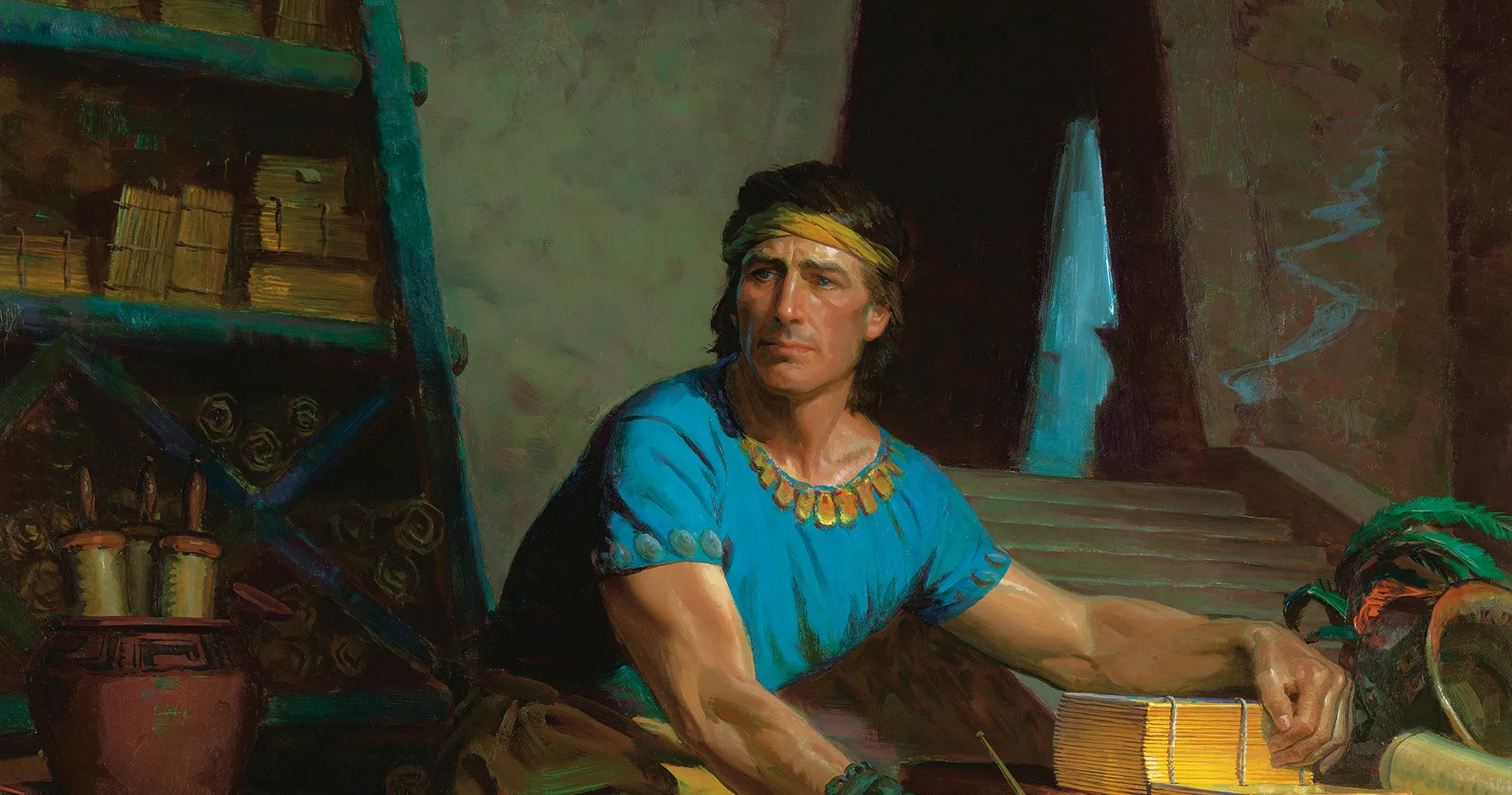
The prophet Mormon abridging the plates, by Tom Lovell (LDS Media Library)
The two lengthy passages below, from Richard Lyman Bushman, Joseph Smith’s Gold Plates: A Cultural History (New York: Oxford University Press, 2023) make a really significant point. It’s one that I had considered myself, but Professor Bushman put it into writing:
The Book of Mormon’s candor about its own making is at odds with the prevailing sense of how scriptures came to be. Most Christians in 1830 thought that the Bible, which the Book of Mormon devotedly emulates, had been composed by pure inspiration. They assumed that words came to prophets in the manner described by the ancient Jewish philosopher Philo, who believed that prophets “proffer nothing of their own, but matter altogether foreign to themselves, and communicated to them internally by the operation of God. So long as the state of a prophet be rapture, he knows nothing of himself.” Scripture was purely God’s word, unsullied by human thought. The Book of Mormon was compiled in another way. Mormon selected and blended materials from various plates, making editorial decisions all along the line. Scripture emerged from his work as an editor, extracting the history from his sources, much like other historians. This unconventional view had relevance in 1830. This was a time when the problems of constructing the Bible were of growing interest to Christian scholars. In the century preceding the publication of the Book of Mormon, scrutiny of the Bible had made the text seem more like a history than the privileged word of God. This movement toward the historicization of biblical texts came primarily from Germany where scholars were emphasizing the human influences on the production of the scriptures. They argued that to understand the composition of biblical texts readers had to grasp the historical conditions under which they emerged, in the process humanizing scripture-making. American scholars were bringing back this new biblical scholarship just as Joseph Smith was translating the gold plates. (31)
And this:
Anxiety about fallible human influence on scripture-making was absent from the Book of Mormon. A book whose origins were enshrouded in miraculous events was surprisingly at ease with historical influences on the actual production of scripture. Although Joseph Smith had no known connections with German biblical scholarship, his translation depicted scripture as emerging from specific historical circumstances and consisting of texts stitched together by a later editor much as the German scholars envisioned the origins of the Bible. While the text of the Book of Mormon insists on its privileges as inspired writing, readers of the Book of Mormon are permitted to view the very human process by which the text came into existence. It was a conglomeration of texts just as the new critics claimed the Bible was. Mormon, the general editor, took pains to explain exactly where the various elements of his book came from, making clear that the Book of Mormon consisted of the writings of various prophets and leaders going back through time and recorded on various plates. The book does not even shy away from the possibility of human errors creeping into the text. The Book of Mormon’s title page warns that “if there be fault, it be the mistake of men,” pretty much summing up the Unitarian view of holy writ. The Book of Mormon and the higher criticism both returned scripture to history. The essence of the German critical approach was to imagine biblical authors as writers grounded in concrete cultural and historical circumstances. Eighteenth- and nineteenth-century Bible critics read the book as they would any historical document, discerning the influences of its times on its production. Book of Mormon writers followed the same pattern. In the book’s pages, the scriptures are a human production: minds writing under heavenly influence but in particular historical circumstances, diligently inscribing events and inspiration on plates made by human hands. Alike as humanistic scholarship and the Book of Mormon were, however, the two actually pointed in opposite directions. If the thrust of German scholarship was to turn holy scriptures into human history, the Book of Mormon did the reverse: it turned history into holy writ. The biblical critics said little about how texts edited, blended, and revised by human editors rose to be treated as the word of God. The Book of Mormon offers itself as an example of that elevation. It reveals how a record kept as a history was in time transmuted into scripture. (32-33)

A landscape near Davos, Switzerland (Wikimedia Commons public domain photograph)
I loved Mr. Trump’s explanation, there in Davos, Switzerland, that had it not been for the United States in World War II, they would all be speaking German today. Since I’m a former German-speaking missionary in Switzerland, his comment had a special personal meaning for me. Perhaps, instead of trying to communicate with the Swiss in German, I would have been more successful had I tried the actual local language. Whatever that was.

The Seoul Korea Temple of the Church of Jesus Christ of Latter-day Saints (LDS.org)
We try as hard as we can here to keep up with the firehose of dispiriting horrors that is the Christopher Hitchens Memorial “How Religion Poisons Everything” File™. But it’s really, really difficult. There’s just so much! And the stories are absolutely relentless. They keep coming, day in and day out, week after week, month after month, year after oppressive year. Here’s a small collection of representative specimens:
History and Religion
Travel and Religion
Previous Post

January 20, 2026
Media Matters
Next Post
January 22, 2026 The Interpreter Foundation loses a co-worker (for a time)
Recent Comments
"That may be, of course. But what these AI inquiries have provided for me in ..."
"Years ago, I did fall asleep listening to a conference session."
Demmed if it do and demmed ..."
"Again, AI summaries aren't always incorrect but miss important context. Hoyle would, later on, say ..."
"DP: "Again, for the sake of ease, I simply cite a description from AI:" https://caniphish.com/Supporting/Memes/AI/ai-liar-meme.jpg"

Browse Our Archives
Select a Category Uncategorized
Select a Month November 2026 October 2026 September 2026 August 2026 July 2026 June 2026 May 2026 April 2026 March 2026 February 2026 January 2026 December 2025 November 2025 October 2025 September 2025 August 2025 July 2025 June 2025 May 2025 April 2025 March 2025 February 2025 January 2025 December 2024 November 2024 October 2024 September 2024 August 2024 July 2024 June 2024 May 2024 April 2024 March 2024 February 2024 January 2024 December 2023 November 2023 October 2023 September 2023 August 2023 July 2023 June 2023 May 2023 April 2023 March 2023 February 2023 January 2023 December 2022 November 2022 October 2022 September 2022 August 2022 July 2022 June 2022 May 2022 April 2022 March 2022 February 2022 January 2022 December 2021 November 2021 October 2021 September 2021 August 2021 July 2021 June 2021 May 2021 April 2021 March 2021 February 2021 January 2021 December 2020 November 2020 October 2020 September 2020 August 2020 July 2020 June 2020 May 2020 April 2020 March 2020 February 2020 January 2020 December 2019 November 2019 October 2019 September 2019 August 2019 July 2019 June 2019 May 2019 April 2019 March 2019 February 2019 January 2019 December 2018 November 2018 October 2018 September 2018 August 2018 July 2018 June 2018 May 2018 April 2018 March 2018 February 2018 January 2018 December 2017 November 2017 October 2017 September 2017 August 2017 July 2017 June 2017 May 2017 April 2017 March 2017 February 2017 January 2017 December 2016 November 2016 October 2016 September 2016 August 2016 July 2016 June 2016 May 2016 April 2016 March 2016 February 2016 January 2016 December 2015 November 2015 October 2015 September 2015 August 2015 July 2015 June 2015 May 2015 April 2015 March 2015 February 2015 January 2015 December 2014 November 2014 March 2014 August 2013 February 2012
Follow Us!
TAKE THE
Religious Wisdom Quiz
Who was the Roman centurion who converted to Christianity in Acts 10?
Select your answer to see how you score.
Herod Nicodemus Cornelius Felix
Related posts from Sic et Non


We shouldn't act as if WE'RE in the...

TRENDING AT PATHEOS Latter-day Saint
"Three B's" of My Apologetics Ministry (+ VIDEO)
In early December 2026 (less than a week from the time...

James Ishmael Ford's books on Zen
James Ishmael Ford's Official Website provides the most complete annotated list of...

The Trouble with Taking Chesterton Literally
Guest writer: Pilgrim. On paradox, human nature and the art of seeing...

Somewhere right now, someone is sitting in a parked car with a...

Just as the emergence of leaves on the fig tree signals the...

Belief and Disbelief in Christ's Presence in Holy...
A study found that only 29% of Catholics believe that the bread...
view all Latter-day Saint blogs
What Are Your Thoughts?leave a comment
Ad-Free & Subscriber Log-In Subscription Support
- About Us
- 2026 Calendar
- Videos
- Podcasts
- Library of World Religions
- Faith In Media Tracker
- Advertise With Us
- Write for Us
- Privacy Policy
- Terms of Service
- Do Not Sell My Data
- Contact Us
- Radiant Digital
- Manage Newsletter Subscriptions
- Unsubscribe From Notifications
- Sitemap
Copyright 2008-2026, Patheos, part of the Radiant Digital network of media brands. All rights reserved.
Subscription Support Ad-Free & Subscriber Log-In
Follow Patheos