
BuddhistCatholicContemplativeEvangelicalGeneral ChristianHinduJewishLatter-day SaintMuslimNew VisionsProgressive Christian
Beliefs
- Buddhist
- Catholic
- Contemplative
- Evangelical
- General Christian
- Hindu
- Jewish
- Latter-day Saint
- More Voices
- Muslim
- New Visions
- Pagan
- Progressive Christian
Topics
- Religion News
- Food and Religion
- Sports and Religion
- Religious Art
- Religious Music and Entertainment
- Religious Events
- History and Religion
- Style and Religion
- Politics and Religion
- Women in Religion
- Recreation Outdoors and Religion
- Business Finance and Religion
- Careers Workplace and Religion
- Education and Religion
- Family Parenting and Religion
- Health Fitness and Religion
- Home and Religion
- Relationships and Religion
- Technology and Religion
- Travel and Religion
Columnists
- Buddhist Columnists
- Business Finance and Religion Columnists
- Careers Workplace and Religion Columnists
- Catholic Columnists
- Contemplative Columnists
- Education and Religion Columnists
- Evangelists Columnists
- Family Parenting and Religion Columnists
- General Christian Columnists
- Health Fitness and Religion Columnists
- Hindu Columnists
- History and Religion Columnists
- Home and Religion Columnists
- Jewish Columnists
- More Voices Columnists
- Latter Day Columnists
- Muslim Columnists
- New Visions Columnists
- Nonreligious Columnists
- Pagan Columnists
- Politics and Religion Columnists
- Progressive Columnists
- Recreation Outdoors and Religion Columnists
- Relationships and Religion Columnists
- Religion News Columnists
- Religious Art Columnists
- Religious Events Columnists
- Religious Music and Entertainment Columnists
- Sports and Religion Columnists
- Style and Religion Columnists
- Technology and Religion Columnists
- Travel and Religion Columnists
- Women in Religion Columnists
Resource Library
- 2026 Calendar
- Library of World Religions
- The 100 Most Holy Places on Earth
- Patheos Answers
- Podcasts
- Videos
- Faith Leaders Database
- Anglican Episcopalian
- Bahai
- Baptist
- Buddhism
- Christianity
- Confucianism
- Eastern Orthodoxy
- Hinduism
- Holiness and Pentecostal
- ISKCON
- Islam
- Judaism
- Lutheran
- Methodist
- The Church of Jesus Christ of Latter-day Saints
- New Age
- Paganism
- Presbytarian and Reformed
- Protestantism
- Religion Behind the Scenes
- Roman Catholic
- Scientology
- Shia Islam
- Sikhism
- Sufism
- Sunni Islam
- Taoism
- Zen
- See all religions
Research Tools
 Ad-Free & Subscriber Log-In Subscription Support
Ad-Free & Subscriber Log-In Subscription Support
Follow Patheos 

- Trending:
- Forgiveness
- |
- Marriage
- |
- Consciousness
- |
- Death Penalty
- |
- Election
- |
- Halloween

- Home
- Latter-day Saint
- Travel and Religion
- Of Potatoes, Ottomans, and the Irish
Of Potatoes, Ottomans, and the Irish
Last updated on: January 6, 2026 at 9:28 am by Dan Peterson
Of Potatoes, Ottomans, and the Irish 2026-01-06T09:28:13-07:00 Dan Peterson
Patheos Explore the world's faith through different perspectives on religion and spirituality! Patheos has the views of the prevalent religions and spiritualities of the world.
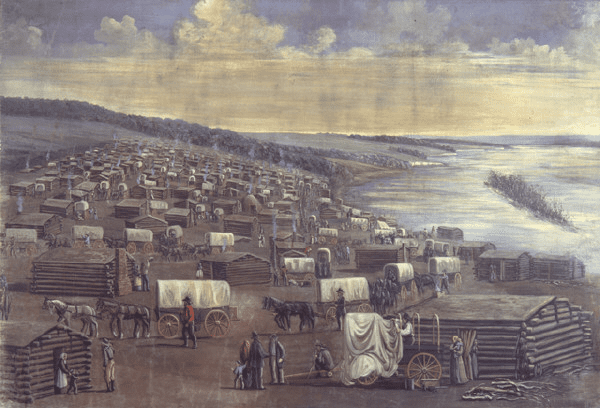
Winter Quarters, on the Missouri River in Nebraska territory, where Latter-day Saint refugees, led by Brigham Young and the Twelve, spent the winter of 1846-1847 (Wikimedia Commons public domain image))
My wife and I had a very useful meeting this morning with our friends at Red Brick Film Works with regard to the Interpreter Foundation’s forthcoming series of short Becoming Brigham docudramas. I’m very excited about this project. On Monday, 26 January, we will begin to release an online episode from it each and every week. Forty episodes are already pretty much complete. It’s possible that the number of episodes will eventually reach into the mid-70s — which means that the episodes will run for nearly a year and a half. We hope that you’ll enjoy Becoming Brigham, that you’ll profit from it — I’ve certainly learned quite a bit from the making of it, thus far — and that you’ll call the attention of other people to it. There will be no charge for watching it. More details are yet to come.

An engraving of Istanbul in 1856, just four years after the end of the “Irish Potato Famine”
(Wikimedia Commons public domain)
Potatoes came to Europe in the sixteenth century, brought by Spanish explorers from South America (Peru/Bolivia) after the conquest of the Inca Empire, with cultivation beginning in Spain around the 1570s and spreading to the British Isles shortly after, though widespread adoption took much longer. They had become a vital, nutritious staple by the eighteenth and nineteenth centuries owing to their ease of growth and their caloric value, which significantly impacted European diets and populations.
The Irish Potato Famine — also known as the Great Hunger or, simply, as the Famine — lasted from 1845 to 1852. It was a period of mass starvation and accompanying disease that had a major impact not only on Irish society and but on European and American history as a whole. The most severely affected areas were in the western and southern parts of Ireland, where the Irish language was dominant, which means that it had an indirect effect on the relative linguistic make-up of Ireland and on its literary culture.
The Irish potato crop in 1845 had seemed healthy enough, even robust, when it was first taken from the ground. Within a day or two of the harvest, however, rot set in. Potatoes that looked firm and edible turned black and then disintegrated into a stinking, liquid mess. And nobody knew why, nor how to remedy the situation.
Ireland’s population had surged from 3.2 million in 1750 to eight million or so within the space of about ninety years — at precisely the same time that the amount of land available for Irish tenants to farm had been falling sharply. Wealthy Protestant landowners were seizing and enclosing what had once been common land, thus reducing the acreage that was available to Catholic peasant farmers. (Have you ever wondered where the historically strong antipathy between Irish Protestants and Irish Catholics came from?) By 1845, at least a quarter of Irish families eked out their sustenance from tiny plots of five acres or less, which in turn obliged them to devote all of their land to the cultivation of the highest-yielding, most nutritious crop — which was the potato. By 1845, potatoes were not only the staple Irish foodstuff but, in many cases, the only food sustaining the Irish population.
On the eve of the Famine, that population was about 8.5 million; by 1901, it was just 4.4 million. During the Great Hunger, roughly one million people died and roughly 1.5 million more fled the country, which caused Ireland’s population to fall by nearly a quarter by 1871. Some towns were almost depopulated, with their numbers falling by as much as 67%. By 1855, at least 2.1 million people had left Ireland, perhaps the greatest exodus from a single island in human history. The population decline continued for a century, and the massive influx of Irish immigrants in places such as Boston and New York, which caused social strife in America, dates to this period. Even today, the entire combined population of the Republic of Ireland and Northern Ireland is somewhere just over seven million — substantially lower, in other words, than it was in 1845.
The direct cause of the Famine was the infection of potato crops throughout Europe and even, to some extent, in North America, by a “blight” that is now known to have been a fungus. Elsewhere in Europe, the infection caused 100,000 deaths and was a major factor in the popular unrest that culminated in the European Revolutions of 1848. But there were significant indirect causes, as well, including the system of absentee landlordism and over-dependence on a single-crop dependence. In the 1840s, Ireland seems to have been largely for the benefit of its elite landowning class.
Curiously, large amounts of food were exported from Ireland during the Great Hunger — which is one of the reasons why some historians refuse to call it a famine — and the refusal of the government in London to forbid such exports (they had been banned during previous food shortages) contributed mightily to anti-British sentiment and, eventually, to a successful campaign for Irish independence. Ireland wasn’t really isolated, dependent because of distance upon only its own failing resources. It was situated directly adjacent to the heart of the British Empire, which was at the time the richest and most powerful state on earth.
All of that, though, is a lead-up to the story that I will briefly mention here:
To this day, evidently, many Irish loathe the very name of Queen Victoria. (She is apparently still sometimes called “the Famine Queen.”) Why? Because, while the British government was doing essentially nothing to help, they believe that the immeasurably wealthy British monarch, in her capacity as a private citizen, contributed a mere £5 to Irish famine relief — at a time when, in the space of just two months, Irish emigrants in the slums of New York collected more than $326,000 (about £9 million today) to send home. Even the Choctaw tribe of Native Americans, ravaged by disease and restricted to a reservation in Oklahoma, donated $710. In one version of the tale, on the same day that the Queen made her miserly donation, she gave a substantially larger amount to an English home for dogs.
Enter now Sultan Abdülmecid I, ruler of the Ottoman Empire with its capital in Istanbul. (His name, equivalent to the Arabic ‘Abd al-Majid, is pronounced Abd al-MaJEED.)
It’s generally accepted that the sultan sent a personal donation of £1,000 to London — which is pretty generous in itself, considering that there were no real connections between Catholic Ireland and Muslim Turkey. Some accounts, however, suggest that he did — or tried to do — much more than that. In one version of the story, the sultan intended to give as much as £10,000 [£1 million now], but was advised that it would be diplomatically unwise were he to donate significantly more for Irish aid than Ireland’s own monarch, Queen Victoria, had given. In a variation on that account, Abdülmecid responded by lowering his gift to a more diplomatically acceptable sum – while surreptitiously sending additional help via several Turkish grain ships, which were quietly sent to unload badly needed foodstuffs at a port on the eastern Irish coast. Some even say that Abdülmecid’s sailors had to run a Royal Navy blockade in order to reach Irish land. As one of the characters in the Irish novelist James Joyce’s Ulysses puts it,
Even the Grand Turk sent us his piastres. But the Sassenach [Englishman] tried to starve the nation at home while the land was full of crops that the hyenas bought and sold in Rio de Janeiro.
There is much about this story of Ottoman aid (and of Victoria’s alleged miserliness) that is uncertain or unclear or contradicted in different accounts. For an additional retelling, see “An Irish Tale of Hunger and the Sultan,” in Aramco World (January/February 2015).
Travel and Religion
History and Religion
Previous Post

January 4, 2026
Some reflections on the U.S. operation in Venezuela
Next Post

January 6, 2026 Heavenly and Earthly
Recent Comments
"I have cpnsidered in my mond if the 4 volume Saints could be made into ..."
From Serbia’s “White City,” Belgrade
"DP: “But Mr. Sutherland worries about the fact that our time, when we can communicate ..."
Learning more about a region of ..."
"Another class of memories are of individuals who previously lived. Some of these remembered individuals ..."
"Sutherland's lecture sounds interesting. He seems to restate the Washington consensus that trade brings peace ..."
Learning more about a region of ..."
Browse Our Archives
Select a Category Uncategorized
Select a Month October 2026 September 2026 August 2026 July 2026 June 2026 May 2026 April 2026 March 2026 February 2026 January 2026 December 2025 November 2025 October 2025 September 2025 August 2025 July 2025 June 2025 May 2025 April 2025 March 2025 February 2025 January 2025 December 2024 November 2024 October 2024 September 2024 August 2024 July 2024 June 2024 May 2024 April 2024 March 2024 February 2024 January 2024 December 2023 November 2023 October 2023 September 2023 August 2023 July 2023 June 2023 May 2023 April 2023 March 2023 February 2023 January 2023 December 2022 November 2022 October 2022 September 2022 August 2022 July 2022 June 2022 May 2022 April 2022 March 2022 February 2022 January 2022 December 2021 November 2021 October 2021 September 2021 August 2021 July 2021 June 2021 May 2021 April 2021 March 2021 February 2021 January 2021 December 2020 November 2020 October 2020 September 2020 August 2020 July 2020 June 2020 May 2020 April 2020 March 2020 February 2020 January 2020 December 2019 November 2019 October 2019 September 2019 August 2019 July 2019 June 2019 May 2019 April 2019 March 2019 February 2019 January 2019 December 2018 November 2018 October 2018 September 2018 August 2018 July 2018 June 2018 May 2018 April 2018 March 2018 February 2018 January 2018 December 2017 November 2017 October 2017 September 2017 August 2017 July 2017 June 2017 May 2017 April 2017 March 2017 February 2017 January 2017 December 2016 November 2016 October 2016 September 2016 August 2016 July 2016 June 2016 May 2016 April 2016 March 2016 February 2016 January 2016 December 2015 November 2015 October 2015 September 2015 August 2015 July 2015 June 2015 May 2015 April 2015 March 2015 February 2015 January 2015 December 2014 November 2014 March 2014 August 2013 February 2012
Follow Us!
TAKE THE
Religious Wisdom Quiz
What language was the New Testament originally written in?
Select your answer to see how you score.
Aramaic Latin Greek Hebrew
Related posts from Sic et Non


"Whirr! whirr! all by wheels! — whiz! whiz!...

Responding to a terrestrial paradise

Near neighbours to the royal family
TRENDING AT PATHEOS Latter-day Saint

When Halloween Unmasks Married Hearts
Written by Dr. David K. Ewen from Eternal Truth Bible College Behind...

Aristotle. He’s been called the father of logic, the father of the...

Methodist Central Hall and Westminster Abbey
Situated on the same square is Methodist Central Hall and Westminster Abbey. ...

57th Dove Awards Honor Dolly Parton, Crown New...
On gospel music’s biggest night, the 57th annual GMA Dove Awards honored...

The First Eucharistic Controversy: Christ’s Real Presence
For Catholics, the Eucharist is the source and summit of the Christian...

What a Stop Sign Can Teach Us About...
How to Make a Decision When You Can't Hear God Main point:...
view all Latter-day Saint blogs
What Are Your Thoughts?leave a comment
Ad-Free & Subscriber Log-In Subscription Support
- About Us
- 2026 Calendar
- Videos
- Podcasts
- Library of World Religions
- Faith In Media Tracker
- Advertise With Us
- Write for Us
- Privacy Policy
- Terms of Service
- Do Not Sell My Data
- Contact Us
- Radiant Digital
- Manage Newsletter Subscriptions
- Unsubscribe From Notifications
- Sitemap
Copyright 2008-2026, Patheos. All rights reserved.
Subscription Support Ad-Free & Subscriber Log-In
Follow Patheos