
BuddhistCatholicContemplativeEvangelicalGeneral ChristianHinduJewishLatter-day SaintMuslimNew VisionsProgressive Christian
Beliefs
- Buddhist
- Catholic
- Contemplative
- Evangelical
- General Christian
- Hindu
- Jewish
- Latter-day Saint
- More Voices
- Muslim
- New Visions
- Pagan
- Progressive Christian
Topics
- Religion News
- Food and Religion
- Sports and Religion
- Religious Art
- Religious Music and Entertainment
- Religious Events
- History and Religion
- Style and Religion
- Politics and Religion
- Women in Religion
- Recreation Outdoors and Religion
- Business Finance and Religion
- Careers Workplace and Religion
- Education and Religion
- Family Parenting and Religion
- Health Fitness and Religion
- Home and Religion
- Relationships and Religion
- Technology and Religion
- Travel and Religion
Columnists
- Buddhist Columnists
- Business Finance and Religion Columnists
- Careers Workplace and Religion Columnists
- Catholic Columnists
- Contemplative Columnists
- Education and Religion Columnists
- Evangelists Columnists
- Family Parenting and Religion Columnists
- General Christian Columnists
- Health Fitness and Religion Columnists
- Hindu Columnists
- History and Religion Columnists
- Home and Religion Columnists
- Jewish Columnists
- More Voices Columnists
- Latter Day Columnists
- Muslim Columnists
- New Visions Columnists
- Nonreligious Columnists
- Pagan Columnists
- Politics and Religion Columnists
- Progressive Columnists
- Recreation Outdoors and Religion Columnists
- Relationships and Religion Columnists
- Religion News Columnists
- Religious Art Columnists
- Religious Events Columnists
- Religious Music and Entertainment Columnists
- Sports and Religion Columnists
- Style and Religion Columnists
- Technology and Religion Columnists
- Travel and Religion Columnists
- Women in Religion Columnists
Resource Library
- 2026 Calendar
- Library of World Religions
- The 100 Most Holy Places on Earth
- Patheos Answers
- Podcasts
- Videos
- Faith Leaders Database
- Anglican Episcopalian
- Bahai
- Baptist
- Buddhism
- Christianity
- Confucianism
- Eastern Orthodoxy
- Hinduism
- Holiness and Pentecostal
- ISKCON
- Islam
- Judaism
- Lutheran
- Methodist
- The Church of Jesus Christ of Latter-day Saints
- New Age
- Paganism
- Presbytarian and Reformed
- Protestantism
- Religion Behind the Scenes
- Roman Catholic
- Scientology
- Shia Islam
- Sikhism
- Sufism
- Sunni Islam
- Taoism
- Zen
- See all religions
Research Tools
 Ad-Free & Subscriber Log-In Subscription Support
Ad-Free & Subscriber Log-In Subscription Support
Follow Patheos 

- Trending:
- Forgiveness
- |
- Marriage
- |
- Consciousness
- |
- Death Penalty
- |
- Election
- |
- Halloween

- Home
- Latter-day Saint
- Mary, at Christmastime
Mary, at Christmastime
Last updated on: December 12, 2025 at 2:37 pm by Dan Peterson
Mary, at Christmastime 2025-12-12T14:37:10-07:00 Dan Peterson
Patheos Explore the world's faith through different perspectives on religion and spirituality! Patheos has the views of the prevalent religions and spiritualities of the world.
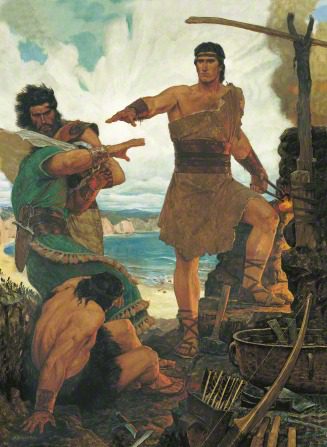
Very few photographs survive from the ancient world, so this one — of Nephi rebuking his brothers (in color, no less) — is exceptionally valuable.
(LDS.org)
This new article went up today in Interpreter: A Journal of Latter-day Saint Faith and Scholarship: “Irregular Kings and Precious Things: Viewing Nephi and Joseph Smith through the Lens of Ancient Near Eastern Kingship,” written by Noel Hudson:
Abstract: Political legitimacy is a key concept related to the exercise of political power. Legitimacy was especially critical for “irregular kings,” so named because they were not automatically legitimated by the existing political structure. There are many examples of apologetics from the literature of the Ancient Near East that sought to bolster the legitimacy of irregular kings. The Book of Mormon uses similar apologetics to legitimate its own irregular rulers. The most striking example is seen in the case of Nephi (son of Lehi). Nephi provides dozens of arguments that strengthen his status as a divinely sanctioned king within an Ancient Near Eastern framework. Startlingly, Nephi and other Book of Mormon prophets also seem to have viewed Joseph Smith, the future seer who would bring their words to light, in similar terms. Joseph appears to have been presented as the legitimate heir of the Nephite royal line. The prophecies of the Book of Mormon and Joseph’s receipt of the royal artifacts serve to bolster this claim.
And this one went up on the website, as well: Interpreting Interpreter: “A Legitimate Nephi (and Joseph),” written by Kyler Rasmussen:
This post is a summary of the article “Irregular Kings and Precious Things: Viewing Nephi and Joseph Smith through the Lens of Ancient Near Eastern Kingship” by Noel Hudson in Volume 67 of Interpreter: A Journal of Latter-day Saint Faith and Scholarship. All of the Interpreting Interpreter articles may be seen at https://interpreterfoundation.org/category/summaries/. An introduction to the Interpreting Interpreter series is available at https:/interpreterfoundation.org/interpreting-interpreter-on-abstracting-thought/.
A video introduction to this Interpreter article is now available on all of our social media channels, including on YouTube at https://youtube.com/shorts/P7CXJXViRpc.
The Takeaway: Hudson expands on the idea that Nephi wrote in part to strengthen his own legitimacy as ruler of the Nephites, based on common legitimization strategies in the Ancient Near East. He also theorizes that Joseph Smith was set up to inherit this kingly legitimacy through connections to Joseph of Egypt and his obtaining of royal artifacts.
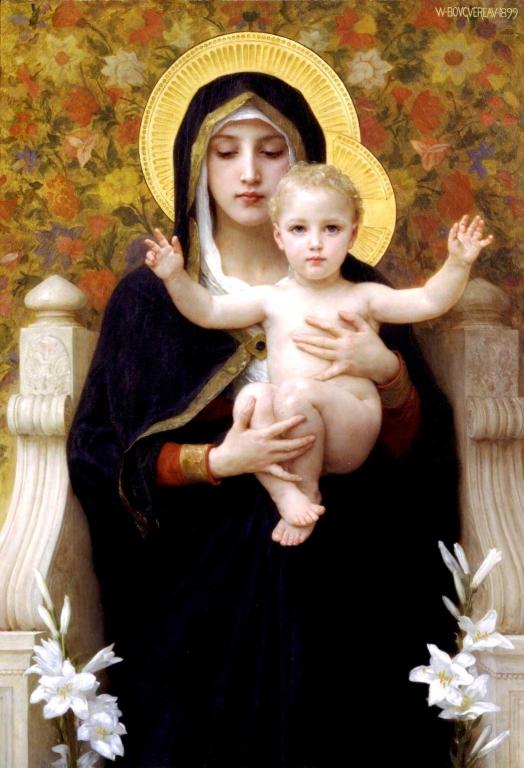
“The Virgin of the Lilies” (La Vierge au lys [1899]), by William-Adolphe Bouguereau
(Wikimedia Commons public domain image) I suspect that veneration of the Virgin Mary reflects a dimly perceived ancient theological truth.
From the Facebook page of Christopher Blythe:
You’ve never heard this beautiful Latter-day Saint ode to Mother Mary before this moment. It was written over a century ago, a dressmaker named Samantha Brimhall Foley wrote “Mary,” a poem that up to this point has never been put to music. Foley was herself a powerful songwriter, who is remembered for compiling the first Spanish hymnbook – a book that never received wide use. But, she was a visionary who on occasion would hear music performed by an invisible choir. We don’t know much about this song, but it is a moving representation of the Annunciation with an eye to Mary’s role in the pre-mortal realms. Why do we not have more of a discussion of Mary in Latter-day Saint thought, look forward to our Christmas episode of Angels and Seerstones.
If I’ve done this right, you should be able to listen to the song via this link. It’s really quite an amazing find. I had never heard of it before.
I share Professor Blythe’s feeling that we Latter-day Saints could and should profitably say more about Mary. Perhaps we’ve overcompensated because of the exaggerated veneration that some Christians bestow upon her. (Analogously, I also think that we’ve tended to overcorrect on the question of faith vs. works because of the extreme overcorrection of some Protestant Reformers against the previous extremes of pre-Reformation Catholicism.)

“Burgdorf” means “fortress village,” and this is the town’s castle (Wikimedia Commons public domain image)
I’ll illustrate my sense of overreaction with a story from my mission in Switzerland. My first assignment was to a largish town in the lowlands of Canton Bern called Burgdorf. My first senior companion — who died a number of years ago, much too young — was from Chicago, and (I think this relevant to the experience that I’ll relate) was a still relatively recent and still quite-Jewish convert from Judaism. One day, we “tracted out” a couple who were immigrants from somewhere in Eastern Europe. (I don’t recall which country they had come from. Maybe Poland.)
It was immediately obvious from the decor of their apartment that they were devoutly Catholic and, in particular, that they were exceptionally devoted to the Virgin Mary. Objects of Marian devotion were everywhere.
This plainly began to offend my companion, and eventually, to my astonishment, he commenced (not altogether subtly) to denigrate Mary. Whereupon, in their turn, they began to take offense, and, shortly thereafter, they asked us to leave. Quite understandably, I thought.
As soon as we were outside, I asked him what on earth he had been thinking. “Well,” he explained, still somewhat agitated, “they practically worship her!”
I remember saying to him that their excessive devotion in no way justified our cutting her down. After all, of the hundreds of millions of women who have ever lived, she was the one who was chosen to bear and to raise the atoning Son of God, to prepare him for his all-important mission. That makes her exceedingly special and, yes, worthy of our veneration.
With Mary in mind, I offer today’s piece of Christmas music: I never heard the song “Mary, Did You Know?” while growing up. And for good reason: The lyrics, by Mark Lowry, were only written in 1984 and they were only set to music seven years later, in 1991, by Buddy Greene — while my age, nowadays, is best measured in geological epochs. But the song has come to be one of my favorites, and here it is in a beautiful performance by the a cappella vocal group Pentatonix: “Mary, Did You Know?”
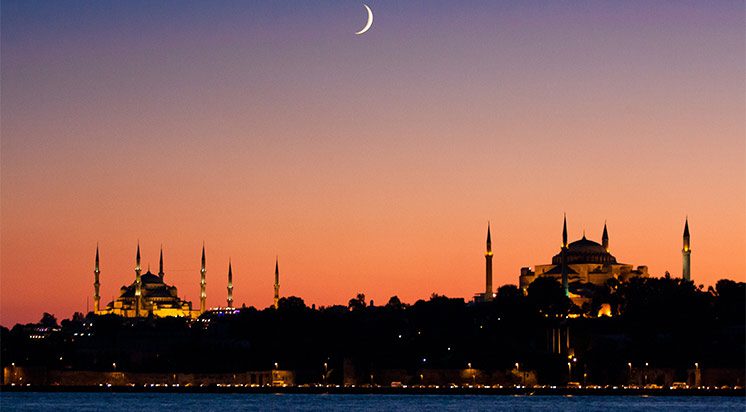
A view of the oldest part of Istanbul, which served as the capital of the Ottoman Empire until its collapse in the early twentieth century and, prior to that, under the name of “Constantinople,” as the capital of the Byzantine Empire. I regard it as one of the most fascinating places in the world. (Wikimedia Commons public domain photograph)
This is a story that I’ve somehow missed until now. But I think it worth sharing. Perhaps especially at Christmas. I received a Facebook item from the History Club that read as follows:
When coffins filled the ditches of Ireland and entire villages disappeared from starvation, an unexpected savior emerged from thousands of miles away. While Ireland’s own rulers turned their backs, a Muslim Sultan in Constantinople heard the cries of the dying and defied diplomatic protocol to send help. This is the story of how the Ottoman Empire secretly fed the Irish during their darkest hour, and why the Irish have never forgotten.
The full story gets even more remarkable. When Sultan Abdülmecid I learned of the mass starvation sweeping Ireland in 1847, he initially pledged £10,000 to help, an enormous sum at the time. But diplomatic pressure from London forced him to reduce the official donation to just £1,000, since Queen Victoria herself had only given £2,000 and no foreign ruler could be seen as more generous than the British Crown.
What happened next became legend. According to widespread accounts, the Sultan wasn’t satisfied with simply following protocol while people starved. He allegedly ordered several Ottoman ships loaded with grain, flour, and corn to sail from Constantinople across the Mediterranean, around Spain and Portugal, through the Atlantic, and up the Irish Sea to the port of Drogheda. These relief ships reportedly arrived with minimal fanfare, their precious cargo distributed to communities devastated by famine while their own government exported food.
Historical records confirm that Ottoman aid did reach Ireland during the Great Famine, with Irish newspapers from 1847 expressing gratitude to the “benevolent Sultan” for his compassion. The story has been passed down through generations in Ireland, and many point to the crescent and star symbols incorporated into Drogheda’s municipal coat of arms as a lasting tribute to this act of cross-continental solidarity.
For further reading, consult “The Great Irish Famine” edited by Cathal Póirtéir (1995), historical archives of the Freeman’s Journal from 1847, and Christine Kinealy’s work “This Great Calamity: The Irish Famine 1845-52.” The Drogheda Historical Society also maintains records related to the Ottoman connection.
And here is a nine-minute video about the story: Why the Ottoman Sultan Helped Ireland?
Posted from Salt Lake City, Utah
Previous Post
December 11, 2025
A year-end report and Christmas letter
Next Post
December 13, 2025 Friday with the Tabernacle Choir
Recent Comments
"I have cpnsidered in my mond if the 4 volume Saints could be made into ..."
From Serbia’s “White City,” Belgrade
"DP: “But Mr. Sutherland worries about the fact that our time, when we can communicate ..."
Learning more about a region of ..."
"Another class of memories are of individuals who previously lived. Some of these remembered individuals ..."
"Sutherland's lecture sounds interesting. He seems to restate the Washington consensus that trade brings peace ..."
Learning more about a region of ..."
Browse Our Archives
Select a Category Uncategorized
Select a Month October 2026 September 2026 August 2026 July 2026 June 2026 May 2026 April 2026 March 2026 February 2026 January 2026 December 2025 November 2025 October 2025 September 2025 August 2025 July 2025 June 2025 May 2025 April 2025 March 2025 February 2025 January 2025 December 2024 November 2024 October 2024 September 2024 August 2024 July 2024 June 2024 May 2024 April 2024 March 2024 February 2024 January 2024 December 2023 November 2023 October 2023 September 2023 August 2023 July 2023 June 2023 May 2023 April 2023 March 2023 February 2023 January 2023 December 2022 November 2022 October 2022 September 2022 August 2022 July 2022 June 2022 May 2022 April 2022 March 2022 February 2022 January 2022 December 2021 November 2021 October 2021 September 2021 August 2021 July 2021 June 2021 May 2021 April 2021 March 2021 February 2021 January 2021 December 2020 November 2020 October 2020 September 2020 August 2020 July 2020 June 2020 May 2020 April 2020 March 2020 February 2020 January 2020 December 2019 November 2019 October 2019 September 2019 August 2019 July 2019 June 2019 May 2019 April 2019 March 2019 February 2019 January 2019 December 2018 November 2018 October 2018 September 2018 August 2018 July 2018 June 2018 May 2018 April 2018 March 2018 February 2018 January 2018 December 2017 November 2017 October 2017 September 2017 August 2017 July 2017 June 2017 May 2017 April 2017 March 2017 February 2017 January 2017 December 2016 November 2016 October 2016 September 2016 August 2016 July 2016 June 2016 May 2016 April 2016 March 2016 February 2016 January 2016 December 2015 November 2015 October 2015 September 2015 August 2015 July 2015 June 2015 May 2015 April 2015 March 2015 February 2015 January 2015 December 2014 November 2014 March 2014 August 2013 February 2012
Follow Us!
TAKE THE
Religious Wisdom Quiz
How did Saul die?
Select your answer to see how you score.
Killed by Philistines Fell on his own sword Stoned by Israelites Died of old age
Related posts from Sic et Non


Learning more about a region of which I've...

From Serbia's "White City," Belgrade

TRENDING AT PATHEOS Latter-day Saint

Methodist Central Hall and Westminster Abbey
Situated on the same square is Methodist Central Hall and Westminster Abbey. ...

57th Dove Awards Honor Dolly Parton, Crown New...
On gospel music’s biggest night, the 57th annual GMA Dove Awards honored...

The First Eucharistic Controversy: Christ’s Real Presence
For Catholics, the Eucharist is the source and summit of the Christian...

What a Stop Sign Can Teach Us About...
How to Make a Decision When You Can't Hear God Main point:...

Archdiocese Hosts Military Marriage Retreat in Germany
RASTATT, Germany — The transient military lifestyle, with its frequent deployments and...

Nearly every morning, I make the drive to Detroit with my high-school-age...
view all Latter-day Saint blogs
What Are Your Thoughts?leave a comment
Ad-Free & Subscriber Log-In Subscription Support
- About Us
- 2026 Calendar
- Videos
- Podcasts
- Library of World Religions
- Faith In Media Tracker
- Advertise With Us
- Write for Us
- Privacy Policy
- Terms of Service
- Do Not Sell My Data
- Contact Us
- Radiant Digital
- Manage Newsletter Subscriptions
- Unsubscribe From Notifications
- Sitemap
Copyright 2008-2026, Patheos. All rights reserved.
Subscription Support Ad-Free & Subscriber Log-In
Follow Patheos