
BuddhistCatholicContemplativeEvangelicalGeneral ChristianHinduJewishLatter-day SaintMuslimNew VisionsProgressive Christian
Beliefs
- Buddhist
- Catholic
- Contemplative
- Evangelical
- General Christian
- Hindu
- Jewish
- Latter-day Saint
- More Voices
- Muslim
- New Visions
- Pagan
- Progressive Christian
Topics
- Religion News
- Food and Religion
- Sports and Religion
- Religious Art
- Religious Music and Entertainment
- Religious Events
- History and Religion
- Style and Religion
- Politics and Religion
- Women in Religion
- Recreation Outdoors and Religion
- Business Finance and Religion
- Careers Workplace and Religion
- Education and Religion
- Family Parenting and Religion
- Health Fitness and Religion
- Home and Religion
- Relationships and Religion
- Technology and Religion
- Travel and Religion
Columnists
- Buddhist Columnists
- Business Finance and Religion Columnists
- Careers Workplace and Religion Columnists
- Catholic Columnists
- Contemplative Columnists
- Education and Religion Columnists
- Evangelists Columnists
- Family Parenting and Religion Columnists
- General Christian Columnists
- Health Fitness and Religion Columnists
- Hindu Columnists
- History and Religion Columnists
- Home and Religion Columnists
- Jewish Columnists
- More Voices Columnists
- Latter Day Columnists
- Muslim Columnists
- New Visions Columnists
- Nonreligious Columnists
- Pagan Columnists
- Politics and Religion Columnists
- Progressive Columnists
- Recreation Outdoors and Religion Columnists
- Relationships and Religion Columnists
- Religion News Columnists
- Religious Art Columnists
- Religious Events Columnists
- Religious Music and Entertainment Columnists
- Sports and Religion Columnists
- Style and Religion Columnists
- Technology and Religion Columnists
- Travel and Religion Columnists
- Women in Religion Columnists
Resource Library
- 2026 Calendar
- Library of World Religions
- The 100 Most Holy Places on Earth
- Patheos Answers
- Podcasts
- Videos
- Faith Leaders Database
- Anglican Episcopalian
- Bahai
- Baptist
- Buddhism
- Christianity
- Confucianism
- Eastern Orthodoxy
- Hinduism
- Holiness and Pentecostal
- ISKCON
- Islam
- Judaism
- Lutheran
- Methodist
- The Church of Jesus Christ of Latter-day Saints
- New Age
- Paganism
- Presbytarian and Reformed
- Protestantism
- Religion Behind the Scenes
- Roman Catholic
- Scientology
- Shia Islam
- Sikhism
- Sufism
- Sunni Islam
- Taoism
- Zen
- See all religions
Research Tools
 Ad-Free & Subscriber Log-In Subscription Support
Follow Patheos 

- Trending:
- Advent
- |
- Forgiveness
- |
- Thanksgiving
- |
- Election
- |
- Seasonal Holidays
- |
- Marriage

- Home
- Latter-day Saint
- History and Religion
- Evidence and argument in thinking about the existence of God
Evidence and argument in thinking about the existence of God
Last updated on: December 7, 2025 at 7:55 pm by Dan Peterson
Evidence and argument in thinking about the existence of God 2025-12-07T19:55:52-07:00 Dan Peterson
Patheos Explore the world's faith through different perspectives on religion and spirituality! Patheos has the views of the prevalent religions and spiritualities of the world.
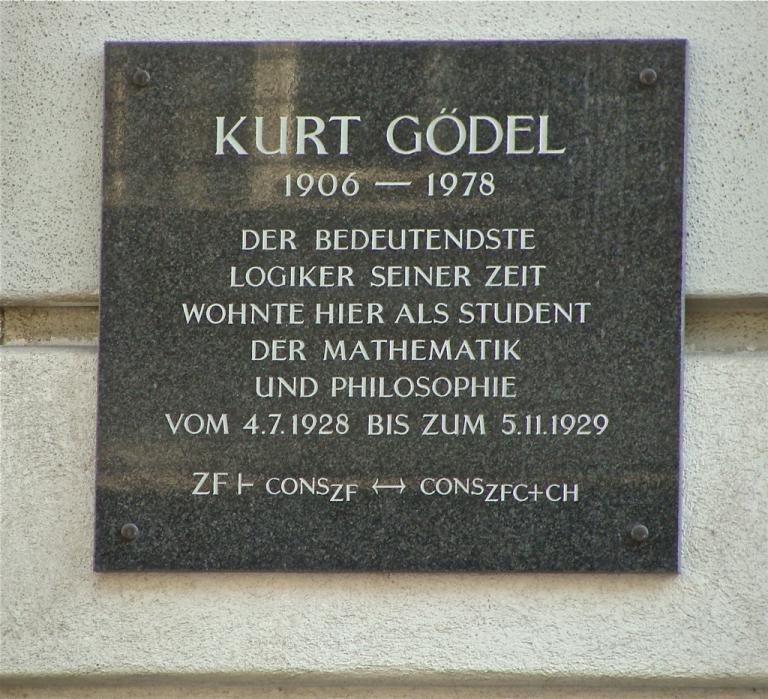
“The most significant logician of his time lived here as a student of mathematics and philosophy from 4 July 1928 until 5 November 1929.” Lange Gasse 72, 8th District, Vienna
(Wikimedia Commons public domain image))
I’ve just begun looking at a book by Michel-Yves Bolloré and Olivier Bonnassies that is entitled (in English) God: The Science, The Evidence: The Dawn of a Revolution. I’m told that, in its original French edition, it has been a bestseller.
Early in the book — which is roughly as far as I’ve gotten so far — the authors offer a brief but, I think, usefully clarifying discussion of “evidence” and “proof.”
Absolute proof, they say, is — or should be — accepted by everyone. (By everyone, I would say, who understands it. Andrew Wiles’s 1994 proof of Fermat’s last theorem, which weighs in at approximately 129 pages, has apparently convinced every mathematician who has mastered it, but it would probably be lost on me and would certainly elude an illiterate tribesman in the Amazon rainforest.) A single absolute proof is sufficient to demonstrate the truth of a proposition; no additional proof is necessary. Moreover, absolute proofs — or, simply, proofs — are universal and timeless. So far, so good. But such proofs exist only in abstract, theoretical domains such as mathematics, games, and pure logic, where it’s possible to have a complete and exhaustive knowledge of rules, axioms, and data. Where correct reasoning is applied to data that are fully known and exact, a valid conclusion necessarily follows.
By contrast, what Bolloré and Bonnassies term “relative proofs” — and I would call “evidence” — cannot be absolute because we do not control all of the relevant data. Or, at least, we can’t know with absolute certainty that we do.
The authors offer a helpful categorization of scientific (and some other) arguments based on the strength of the evidence supporting them:
Group 1: Absolute proof — This is found, as noted, only in theoretical or formal domains.
Group 2: Theories that can be tested against reality, can be mathematically modeled, and are subject to experimentation — The evidence that supports many theories in fields such as physics, mechanics, electromagnetism, and chemistry is so strong and compelling that it approaches absolute proof. Accordingly, it’s rarely contested, although (think of Newtonian physics and Einstein’s relativity) it may be further refined.
Group 3: Theories that can be tested against reality, can be mathematically modeled, but aren’t really subject to experimentation — Many theories in such areas as cosmology, geological history, climatology, and econometrics fall into this category. They can be modeled, and the predictions that they generate can be be verified or falsified. In other words, they can have strong support.
Group 4: Theories that can be tested against reality, that can be subjected to experimental confirmation or disconfirmation, but that can’t be mathematically modeled — Fields such as physiology, pharmacology, and biology provide numerous examples of this type of theory. Repeated experimentation can provide strong verification for their reliability and the level of evidence for them is high, indeed comparable to Group 3. But they can’t really be modeled, mathematically, so their reliability or apparent validity is established different means.
Group 5: Theories that can be tested against reality but that aren’t subject to experimentation or disconfirmation and that can’t be mathematically modeled — Many widely accepted scientific models (e.g., Darwinian evolution) and scientific fields (e.g., paleontology and studies of the origins of organic life, theories of the origin of Earth’s moon, and etc.) fall into this classification. This is also the category in which Bolloré and Bonnassies place such ideas as the thesis that God exists and the opposing thesis that nothing exists beyond the material universe. While such theories are subject to neither experimental verification or falsification nor mathematical modeling, they do entail logical implications that can be compared to empirical reality.
Group 6: Theories that carry no implications that can be be tested against reality, subjected to experimentation or disconfirmation, or mathematically modeled — Accordingly, they cannot be validated or falsified and, unless and until they can (the echoes of Sir Karl Popper are unmistakable here), they remain purely speculative hypotheses.
I think that the placement, by Bolloré and Bonnassies, of the argument for the existence of God in Group 5 is intuitively correct, as well as being justified by their system of categorization. God’s existence or nonexistence does indeed suggest some entailments in the so-called “real world,” but there seems no experiment that can either clearly confirm it or clearly disconfirm it and no mathematical model that seems adequate. Philosophers and others (including skeptics) can propose sophisticated arguments examining its real-world implications that might justify or deny the idea, and ordinary people can test it to their own satisfaction in their lived experience, but the matter is unlikely to rise to the level of evidence that undergirds, say, Newton’s laws of motion. And, although some have claimed that the classical arguments for God’s existence (e.g. the cosmological argument, based on the universe’s existence and cause; the teleological argument, based on the apparent design in the universe; the moral argument, based on the existence of objective moral values; and the ontological argument, which was formulated by St. Anselm of Canterbury in the eleventh century and reformulated by the great twentieth-century logician Kurt Gödel) offer absolute proof, many skeptics remain unconvinced.

Sissel. Her full Norwegian name is Sissel Kyrkjebø
(Wikimedia Commons public domain photograph)
Here’s a wonderfully beautiful carol for Christmas (and for a Sunday during the Christmas season): https://www.youtube.com/watch?v=Oqm-hf1LDV4 The lyrics vary. (The song was originally written in French, too.) But here’s one version:
Whence is the goodly fragrance flowing,
Stealing our senses all away,
never the like did come a-blowing,
Shepherds, in flow’ry fields of May,
Whence is that goodly fragrance flowing,
Stealing our senses all away.What is that light so brilliant, breaking
Here in the night across our eyes.
Never so bright, the day-star waking,
Started to climb the morning skies!
What is that light so brilliant, breaking,
Here in the night across our eyes.Bethlehem! there in manger lying,
Find your Redeemer haste away,
Run ye with eager footsteps vieing!
Worship the Saviour born today.
Bethlehem! there in manger lying,
Find your Redeemer haste away.
Posted from Newport Beach, California
History and Religion
Travel and Religion
Previous Post

December 6, 2025
"Far, far away on Judea's plains"
Next Post

December 8, 2025 Another place to avoid
Recent Comments
"Thank you. Many times, on my commute east into Salt Lake City, I've observed the ..."
"What do you think of the Shakespearean authorship problem, noel?"
"How do you handle the pesky Book of Abraham problem. ? The angel with the ..."
"I am thankful for the stir fry my wife made last night and was more ..."
Browse Our Archives
Select a Category Uncategorized
Select a Month November 2026 October 2026 September 2026 August 2026 July 2026 June 2026 May 2026 April 2026 March 2026 February 2026 January 2026 December 2025 November 2025 October 2025 September 2025 August 2025 July 2025 June 2025 May 2025 April 2025 March 2025 February 2025 January 2025 December 2024 November 2024 October 2024 September 2024 August 2024 July 2024 June 2024 May 2024 April 2024 March 2024 February 2024 January 2024 December 2023 November 2023 October 2023 September 2023 August 2023 July 2023 June 2023 May 2023 April 2023 March 2023 February 2023 January 2023 December 2022 November 2022 October 2022 September 2022 August 2022 July 2022 June 2022 May 2022 April 2022 March 2022 February 2022 January 2022 December 2021 November 2021 October 2021 September 2021 August 2021 July 2021 June 2021 May 2021 April 2021 March 2021 February 2021 January 2021 December 2020 November 2020 October 2020 September 2020 August 2020 July 2020 June 2020 May 2020 April 2020 March 2020 February 2020 January 2020 December 2019 November 2019 October 2019 September 2019 August 2019 July 2019 June 2019 May 2019 April 2019 March 2019 February 2019 January 2019 December 2018 November 2018 October 2018 September 2018 August 2018 July 2018 June 2018 May 2018 April 2018 March 2018 February 2018 January 2018 December 2017 November 2017 October 2017 September 2017 August 2017 July 2017 June 2017 May 2017 April 2017 March 2017 February 2017 January 2017 December 2016 November 2016 October 2016 September 2016 August 2016 July 2016 June 2016 May 2016 April 2016 March 2016 February 2016 January 2016 December 2015 November 2015 October 2015 September 2015 August 2015 July 2015 June 2015 May 2015 April 2015 March 2015 February 2015 January 2015 December 2014 November 2014 March 2014 August 2013 February 2012
Follow Us!
TAKE THE
Religious Wisdom Quiz
What did God use to lead the Israelites by day?
Select your answer to see how you score.
A trumpet A pillar of fire A pillar of cloud An angel
Related posts from Sic et Non
"The Appeal of Socialism and the Case Against...

"You really ought to give Iowa a try"...

Is there seeming evidence against the Restoration? Sure!
TRENDING AT PATHEOS Latter-day Saint

For many years, Catholicism has been caught up in division over the...

'Statements of Faith' never get shorter
Nothing demonstrates a conservative commitment to faith and faithfulness like a "statement...

Michele's Reviews - Future Grace by John Piper
In God's Place, at God's Pace, by Future Grace Impatience is...

Bama Gramma's Blackout Christmas: the Power of Light...
Another Christmas Skit: I have an alter ego: Bama Gramma. She shows...

Thanksgiving as a Way of Life: A Christian...
Each year, Thanksgiving brings families and friends together to share meals, stories,...

Two Women Doctors Who Went Against the Current
Women physicians who transformed healthcare for "Indians" “I shall have an advantage...
view all Latter-day Saint blogs
What Are Your Thoughts?leave a comment
Ad-Free & Subscriber Log-In Subscription Support
- About Us
- 2026 Calendar
- Videos
- Podcasts
- Library of World Religions
- Faith In Media Tracker
- Advertise With Us
- Write for Us
- Privacy Policy
- Terms of Service
- Do Not Sell My Data
- Contact Us
- Radiant Digital
- Manage Newsletter Subscriptions
- Unsubscribe From Notifications
- Sitemap
Copyright 2008-2026, Patheos, part of the Radiant Digital network of media brands. All rights reserved.
Subscription Support Ad-Free & Subscriber Log-In
Follow Patheos