
BuddhistCatholicContemplativeEvangelicalGeneral ChristianHinduJewishLatter-day SaintMuslimNew VisionsProgressive Christian
Beliefs
- Buddhist
- Catholic
- Contemplative
- Evangelical
- General Christian
- Hindu
- Jewish
- Latter-day Saint
- More Voices
- Muslim
- New Visions
- Pagan
- Progressive Christian
Topics
- Religion News
- Food and Religion
- Sports and Religion
- Religious Art
- Religious Music and Entertainment
- Religious Events
- History and Religion
- Style and Religion
- Politics and Religion
- Women in Religion
- Recreation Outdoors and Religion
- Business Finance and Religion
- Careers Workplace and Religion
- Education and Religion
- Family Parenting and Religion
- Health Fitness and Religion
- Home and Religion
- Relationships and Religion
- Technology and Religion
- Travel and Religion
Columnists
- Buddhist Columnists
- Business Finance and Religion Columnists
- Careers Workplace and Religion Columnists
- Catholic Columnists
- Contemplative Columnists
- Education and Religion Columnists
- Evangelists Columnists
- Family Parenting and Religion Columnists
- General Christian Columnists
- Health Fitness and Religion Columnists
- Hindu Columnists
- History and Religion Columnists
- Home and Religion Columnists
- Jewish Columnists
- More Voices Columnists
- Latter Day Columnists
- Muslim Columnists
- New Visions Columnists
- Nonreligious Columnists
- Pagan Columnists
- Politics and Religion Columnists
- Progressive Columnists
- Recreation Outdoors and Religion Columnists
- Relationships and Religion Columnists
- Religion News Columnists
- Religious Art Columnists
- Religious Events Columnists
- Religious Music and Entertainment Columnists
- Sports and Religion Columnists
- Style and Religion Columnists
- Technology and Religion Columnists
- Travel and Religion Columnists
- Women in Religion Columnists
Resource Library
- 2026 Calendar
- Library of World Religions
- The 100 Most Holy Places on Earth
- Patheos Answers
- Podcasts
- Videos
- Faith Leaders Database
- Anglican Episcopalian
- Bahai
- Baptist
- Buddhism
- Christianity
- Confucianism
- Eastern Orthodoxy
- Hinduism
- Holiness and Pentecostal
- ISKCON
- Islam
- Judaism
- Lutheran
- Methodist
- The Church of Jesus Christ of Latter-day Saints
- New Age
- Paganism
- Presbytarian and Reformed
- Protestantism
- Religion Behind the Scenes
- Roman Catholic
- Scientology
- Shia Islam
- Sikhism
- Sufism
- Sunni Islam
- Taoism
- Zen
- See all religions
Research Tools
 Ad-Free & Subscriber Log-In Subscription Support
Ad-Free & Subscriber Log-In Subscription Support
Follow Patheos 

- Trending:
- Forgiveness
- |
- Marriage
- |
- Consciousness
- |
- Death Penalty
- |
- Election
- |
- Halloween

- Home
- Latter-day Saint
- History and Religion
- Weird, right?
Weird, right?
Last updated on: November 4, 2025 at 4:07 pm by Dan Peterson
Weird, right? 2025-11-04T16:07:25-07:00 Dan Peterson
Patheos Explore the world's faith through different perspectives on religion and spirituality! Patheos has the views of the prevalent religions and spiritualities of the world.

Looking eastward across the Heber Valley (Wikimedia Commons public domain photo)
I’m up in Heber, Utah, today, far removed from my normal routine and unable to devote my full attention or time to my usual activities. So, with regard to this blog, I think that I’ll return to some of my recent reading.
For a number of years now, I’ve been slightly troubled by accounts of distressing near-death experiences. They’re not many in number compared to the sea of relatively uniform and very positive NDEs reported by Raymond Moody in his 1975 book Life after Life and then by a large number of other experiencers, researchers, and authors in its wake, but, still, they pose a challenge. For one thing, they depart dramatically from the model or paradigm that Moody proposed, with its various elements (e.g., a life review, brilliant but soothing light, a tunnel, a being or beings of light, and so forth). Moreover, they seem to offer no comforting or positive message and, strikingly, there is no obvious correlation between such distressing experiences and the moral character or the religiosity of those who report them.
They’ve posed a particularly problematic challenge to me because they haven’t really been congruent with the fundamental point that I take away from accounts of near-death experiences overall and because, in particular, they seem inconsistent with my own religious worldview. I haven’t bothered a great deal with them because they’ve struck me as anomalous and odd, but I’ve certainly noticed them.
So I was pleased when I ran across a plausible proposed explanation for them from Dr. Sam Parnia’s book Lucid Dying: The New Science Revolutionizing How We Understand Life and Death. For it, he draws from two well-known major studies that he had led. If he is correct, my problem with them is resolved:
In fact, soon after Moody’s work was popularized, some people had arbitrarily claimed that there were distressing, negative, or hellish near-death experiences, too. But the evidence from AWARE-I (and later AWARE-II as well) showed these claims represented nothing more than frightening memories formed by people afterward when they had been disorientated and not fully awake. For instance, if doctors or nurses had been holding them down, they had mistakenly thought they were being attacked by “frightening creatures.” If they had undergone a painful medical procedure, they had mistakenly thought the pain was because they were “burning in hell.” These were not at all like the experiences that Moody had identified. In the medical literature these experiences had been categorized as intensive care unit (ICU) delirium. But some people had arbitrarily decided to label these as frightening or hellish near-death experiences without any scientific rigor. (79)
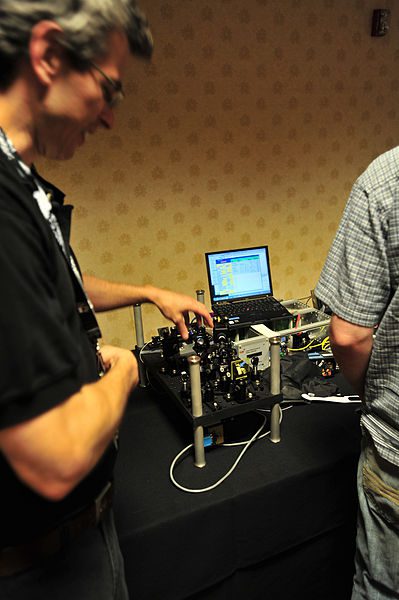
An ordinary neighborhood quantum entangled photon generator. Not the same device, but something related.
(Photo by Nate Grigg, Salt Lake City)
I also want to share with you some passages that I marked recently while reading Vasileios Basios, “The Coherence Enigma: Detecting Non-Local Consciousness Correlates via Random Events Generators (REGs) at Life’s Final Edge,” in Michael Nahm, Marjorie Woollacott, and Natasha Tassell-Matamua, eds., On the Banks of the River Styx: New Perspectives on Terminal Lucidity and other Near-Death Phenomena:
The predominant theory in mainstream neuroscience is that consciousness emerges exclusively from cerebral activity. However, an increasing amount of research suggests an even more intriguing idea: that consciousness could extend beyond the physical boundaries of the skull. This would give rise to “non-local” effects, which have the capacity to influence the physical world in small, subtle yet measurable ways. This investigation into consciousness extends beyond theoretical speculation. Various experiments using REGs have demonstrated the possibility that mental activity, especially intention, attention or emotion, can influence physical systems. . . .
Our team’s research focuses on random event generators (REGs), which use quantum mechanics to generate random numbers. Unlike computer-generated pseudo-random numbers, these originate from electronic (Zener) diodes. These systems are well shielded and protected against external disturbances. (180)
Vasileios Basios, who studied with (among others) the 1977 Nobel Chemistry laureate Ilya Prigogine, is a senior researcher in the Department of Physics of Complex Systems at the University of Brussels, in Belgium. According to Dr. Basios, his team’s research “answered this profound question: does the transition from life to death create detectible changes in the quantum realm? The answer is in the affirmative” (181). “The findings of this investigation are both unprecedented and statistically robust” (183).
What happened, apparently, was that Dr. Basios’s team
detected measurable deviations from pure chance in the temporal vicinity of the transition from life to death of human consciousness. The present study suggests that the dying process may create detectible ripples in the fabric of randomness itself in a form of non-local consciousness correlates. This finding challenges our understanding of consciousness, death and even the very nature of reality” (180).
“The observed effect,” he says,
was of such potency that the overall probability of these results occurring by chance was less than 5% — thus meeting the “gold standard” for statistical significance in scientific research.
Perhaps most intriguingly, it was discovered that approximately 25% for the ICU [Intensive Care Unit], and 28% of the hospice death cases produced what is classified as “highly unlikely” statistical patterns — results with false positive probabilities ranging from 0.0001 to 0.01. From a scientific perspective, the likelihood of such patterns emerging by chance is negligible, with a probability ranging from less than one in 100 to less than one in 10,000 under typical circumstances. Notably, these patterns manifest exclusively around the reported time of death!
The rank-based analysis yielded even more striking results. Upon examination of individual cases, researchers identified a concurrence between REG activity and recorded death events, with some of the highest daily peaks in REG activity almost coinciding with the occurrence of death. In the dataset, four of the seven highest daily peaks on a key statistical channel occurred on days when patients died. The probability calculations for these extreme events were found to be remarkably low, with some reaching probabilities of less than one in a million! . . .
The most significant anomalies were observed within approximately six-minute periods surrounding the time of death. (183-184)
It’s important to mention that, according to Dr. Basios, “the dying process remained undisturbed” during his team’s research. “The REG devices operated in a passive manner, with no contact with patients or interference with medical care. All data were anonymised.” (186)
Our findings carry profound implications for our understanding of both consciousness and the dying process. These findings represent a substantial challenge to the prevailing view that the domains of mind and matter are entirely separate. Instead, they propose a more integrated understanding, suggesting that consciousness might be a fundamental feature of reality rather than merely an emergent property of complex brain activity. (184)
I’m puzzled by the results that Dr. Basios reports. Nothing in my worldview has led me to expect them, and nothing in my worldview would be adversely affected if they were to be found in error. On the other hand, if they turn out to be well-founded, they seem rather significant to me. Why, in a purely “physicalist” world, would anything not physically connected with a biological organism be affected when that organism ceases to function?
Posted from Heber, Utah
History and Religion
Travel and Religion
Previous Post

November 3, 2025
What is it like to fall to one's death?
Next Post

November 5, 2025 How to Explain the Book of Mormon?
Recent Comments
"Sutherland's lecture sounds interesting. He seems to restate the Washington consensus that trade brings peace ..."
Learning more about a region of ..."
"In a meeting today, I learned another important reason why accurate (or at least as ..."
From Serbia’s “White City,” Belgrade
"I've been watching a lot of video interviews of NDErs and researchers. I think in ..."
"PL: "Let's hope he doesn't have your address..."I have to frankly confess that a few ..."
From Serbia’s “White City,” Belgrade
Browse Our Archives
Select a Category Uncategorized
Select a Month October 2026 September 2026 August 2026 July 2026 June 2026 May 2026 April 2026 March 2026 February 2026 January 2026 December 2025 November 2025 October 2025 September 2025 August 2025 July 2025 June 2025 May 2025 April 2025 March 2025 February 2025 January 2025 December 2024 November 2024 October 2024 September 2024 August 2024 July 2024 June 2024 May 2024 April 2024 March 2024 February 2024 January 2024 December 2023 November 2023 October 2023 September 2023 August 2023 July 2023 June 2023 May 2023 April 2023 March 2023 February 2023 January 2023 December 2022 November 2022 October 2022 September 2022 August 2022 July 2022 June 2022 May 2022 April 2022 March 2022 February 2022 January 2022 December 2021 November 2021 October 2021 September 2021 August 2021 July 2021 June 2021 May 2021 April 2021 March 2021 February 2021 January 2021 December 2020 November 2020 October 2020 September 2020 August 2020 July 2020 June 2020 May 2020 April 2020 March 2020 February 2020 January 2020 December 2019 November 2019 October 2019 September 2019 August 2019 July 2019 June 2019 May 2019 April 2019 March 2019 February 2019 January 2019 December 2018 November 2018 October 2018 September 2018 August 2018 July 2018 June 2018 May 2018 April 2018 March 2018 February 2018 January 2018 December 2017 November 2017 October 2017 September 2017 August 2017 July 2017 June 2017 May 2017 April 2017 March 2017 February 2017 January 2017 December 2016 November 2016 October 2016 September 2016 August 2016 July 2016 June 2016 May 2016 April 2016 March 2016 February 2016 January 2016 December 2015 November 2015 October 2015 September 2015 August 2015 July 2015 June 2015 May 2015 April 2015 March 2015 February 2015 January 2015 December 2014 November 2014 March 2014 August 2013 February 2012
Follow Us!
TAKE THE
Religious Wisdom Quiz
What does Paul say is the wages of sin?
Select your answer to see how you score.
Punishment Hell Separation from God Death
Related posts from Sic et Non



Panel Perspectives on the Book of Abraham, and...
TRENDING AT PATHEOS Latter-day Saint

I was strolling through the top floor of the brand new Parthenon...

What Does Gêvâh Mean For Kimberley Guifoyle &...
This week, a lot of the news is focused on Kimberly Guilfoyle....

INNER CIRCLE: Profound Mystery (Of Christ In All...
Ephesians 5:31-32 “For this reason, a man will leave his father and...

Do Not Rejoice When Your Enemy Falls: The...
Turning an execution into a public spectacle is a disturbing expression of...

'The Chosen' S6 Trailer: The Passion Gets Very...
Not many watching 'The Chosen' worry about spoilers, but just because they...

The purpose-driven labor priest
A labor activist reads Rick Warren and it gets me wondering about...
view all Latter-day Saint blogs
What Are Your Thoughts?leave a comment
Ad-Free & Subscriber Log-In Subscription Support
- About Us
- 2026 Calendar
- Videos
- Podcasts
- Library of World Religions
- Faith In Media Tracker
- Advertise With Us
- Write for Us
- Privacy Policy
- Terms of Service
- Do Not Sell My Data
- Contact Us
- Radiant Digital
- Manage Newsletter Subscriptions
- Unsubscribe From Notifications
- Sitemap
Copyright 2008-2026, Patheos. All rights reserved.
Subscription Support Ad-Free & Subscriber Log-In
Follow Patheos