
BuddhistCatholicContemplativeEvangelicalGeneral ChristianHinduJewishLatter-day SaintMuslimNew VisionsProgressive Christian
Beliefs
- Buddhist
- Catholic
- Contemplative
- Evangelical
- General Christian
- Hindu
- Jewish
- Latter-day Saint
- More Voices
- Muslim
- New Visions
- Pagan
- Progressive Christian
Topics
- Religion News
- Food and Religion
- Sports and Religion
- Religious Art
- Religious Music and Entertainment
- Religious Events
- History and Religion
- Style and Religion
- Politics and Religion
- Women in Religion
- Recreation Outdoors and Religion
- Business Finance and Religion
- Careers Workplace and Religion
- Education and Religion
- Family Parenting and Religion
- Health Fitness and Religion
- Home and Religion
- Relationships and Religion
- Technology and Religion
- Travel and Religion
Columnists
- Buddhist Columnists
- Business Finance and Religion Columnists
- Careers Workplace and Religion Columnists
- Catholic Columnists
- Contemplative Columnists
- Education and Religion Columnists
- Evangelists Columnists
- Family Parenting and Religion Columnists
- General Christian Columnists
- Health Fitness and Religion Columnists
- Hindu Columnists
- History and Religion Columnists
- Home and Religion Columnists
- Jewish Columnists
- More Voices Columnists
- Latter Day Columnists
- Muslim Columnists
- New Visions Columnists
- Nonreligious Columnists
- Pagan Columnists
- Politics and Religion Columnists
- Progressive Columnists
- Recreation Outdoors and Religion Columnists
- Relationships and Religion Columnists
- Religion News Columnists
- Religious Art Columnists
- Religious Events Columnists
- Religious Music and Entertainment Columnists
- Sports and Religion Columnists
- Style and Religion Columnists
- Technology and Religion Columnists
- Travel and Religion Columnists
- Women in Religion Columnists
Resource Library
- 2026 Calendar
- Library of World Religions
- The 100 Most Holy Places on Earth
- Patheos Answers
- Podcasts
- Videos
- Faith Leaders Database
- Anglican Episcopalian
- Bahai
- Baptist
- Buddhism
- Christianity
- Confucianism
- Eastern Orthodoxy
- Hinduism
- Holiness and Pentecostal
- ISKCON
- Islam
- Judaism
- Lutheran
- Methodist
- The Church of Jesus Christ of Latter-day Saints
- New Age
- Paganism
- Presbytarian and Reformed
- Protestantism
- Religion Behind the Scenes
- Roman Catholic
- Scientology
- Shia Islam
- Sikhism
- Sufism
- Sunni Islam
- Taoism
- Zen
- See all religions
Research Tools
 Ad-Free & Subscriber Log-In Subscription Support
Ad-Free & Subscriber Log-In Subscription Support
Follow Patheos 

- Trending:
- Forgiveness
- |
- Marriage
- |
- Consciousness
- |
- Death Penalty
- |
- Election
- |
- Halloween

- Home
- Latter-day Saint
- Travel and Religion
- The Beatles, once again
The Beatles, once again
Last updated on: November 28, 2025 at 12:03 pm by Dan Peterson
The Beatles, once again 2025-11-28T12:03:50-07:00 Dan Peterson
Patheos Explore the world's faith through different perspectives on religion and spirituality! Patheos has the views of the prevalent religions and spiritualities of the world.
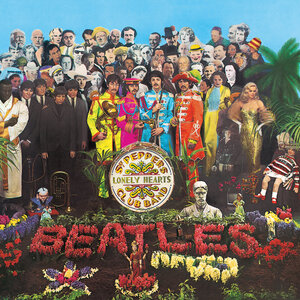
The album cover for “Sgt. Pepper’s Lonely Hearts Club Band,” which I own. (Fair use, I hope)
A week or so ago, an intrepid critic of the Church of Jesus Christ of Latter-day Saints announced to a tough audience of similarly hostile critics that members of that Church hate and condemn the Beatles or, anyway, should hate and condemn them. Inspired by his research, I expressed my own disdain for the Beatles, and my righteous indignation against them, in a post that was rather cryptically titled “On my apparently deep dislike of the Beatles.” I’ve decided, though, that I need to examine the matter a bit more fully.
The first exhibit in this particular critic’s case that Latter-day Saints abhor, or should abhor, the Beatles comes from a passage in a General Conference address from President Thomas S. Monson — who was, yes, the President of the Church at the time — in which President Monson “criticized” their song “All You Need Is Love.”
You may or may not have the lyrics to that song at the tip of your tongue, so I’ll post them here:
Love, love, love
Love, love, love
Love, love, loveThere’s nothing you can do that can’t be done
Nothing you can sing that can’t be sung
Nothing you can say, but you can learn
How to play the game
It’s easyNothing you can make that can’t be made
No one you can save that can’t be saved
Nothing you can do, but you can learn
How to be you in time
It’s easyAll you need is love
All you need is love
All you need is love, love
Love is all you needLove, love, love
Love, love, love
Love, love, loveAll you need is love
All you need is love
All you need is love, love
Love is all you needNothing you can know that isn’t known
Nothing you can see that isn’t shown
There’s nowhere you can be that isn’t where
You’re meant to be
It’s easyAll you need is love
All you need is love
All you need is love, love
Love is all you needAll you need is love (all together now!)
All you need is love (everybody!)
All you need is love, love
Love is all you needLove is all you need (love is all you need)
Love is all you need (love is all you need)
Love is all you need (love is all you need)
Love is all you need (love is all you need)Love is all you need (love is all you need)
Love is all you need (love is all you need)
Love is all you need (love is all you need)
Love is all you need (love is all you need)Love is all you need (love is all you need)
Love is all you need (love is all you need)
Love is all you need (love is all you need)
(Love is all you need)
Love is all you need (love is all you need)Yesterday (love is all you need)
Oh (love is all you need)
(Love is all you need)
(Love is all you need)
And you may or may not recall President Monson’s fierce denunciation of both “All You Need is Love” and the Beatles. So I’ll provide it for you:
I recently read in the Wall Street Journal an article by Jonathan Sacks, Britain’s chief rabbi. Among other things, he writes: “In virtually every Western society in the 1960s there was a moral revolution, an abandonment of its entire traditional ethic of self-restraint. All you need, sang the Beatles, is love. The Judeo-Christian moral code was jettisoned. In its place came [the adage]: [Do] whatever works for you. The Ten Commandments were rewritten as the Ten Creative Suggestions.”
Rabbi Sacks goes on to lament:
“We have been spending our moral capital with the same reckless abandon that we have been spending our financial capital. …
“There are large parts of [the world] where religion is a thing of the past and there is no counter-voice to the culture of buy it, spend it, wear it, flaunt it, because you’re worth it. The message is that morality is passé, conscience is for wimps, and the single overriding command is ‘Thou shalt not be found out.’”
The passage just quoted comes from an address that President Monson delivered at the October 2011 semiannual General Conference of the Church, under the title of “Stand in Holy Places.”
You will, I think, notice immediately that President Monson’s denunciation of the Beatles isn’t really very fierce at all, that it isn’t really much of a denunciation, that it isn’t exactly a blanket condemnation of the Beatles (but is only a criticism of an idea contained in a single song of theirs), and, perhaps most saliently, that it isn’t even in President Monson’s own words: Instead, it’s a quotation from Rabbi Jonathan Sacks, and specifically from an article of his entitled “Reversing the Decay of London Undone” that was published in the Wall Street Journal for 20 August 2011.
So exactly who was Jonathan Sacks? Now, I realize that, for some secularist critics like the fellow who raised this issue and like those who received it with agreement and even, in at least one or two cases, with enthusiasm, it’s a settled assumption that the leaders of the Church of Jesus Christ of Latter-day Saints are closed-minded frontier yokels, fanatics, and rubes who would be expected to dislike the Beatles and, for that matter, anything else that’s even slightly inconsistent with their Ozzie-and-Harriet and Smallville-style provincialism. But Jonathan Sacks doesn’t seem to have been that sort of a person.
Jonathan Sacks (1948-2020) had earned a bachelor’s degree and a a first-class honours master’s degree in philosophy at the University of Cambridge and then, following postgraduate work at New College, Oxford, and King’s College, London, earned a Ph.D. from the University of London. Additionally, after studies at the London School of Jewish Studies and London’s Etz Chaim Yeshiva he qualified for rabbinic ordination. He also received a doctorate that was bestowed by the Archbishop of Canterbury.
At the time of his article in the Wall Street Journal, Dr. Sacks was the chief rabbi of the United Hebrew Congregations of the British Commonwealth. After retiring as chief rabbi, he served as Ingeborg and Ira Rennert Global Distinguished Professor of Judaic Thought at New York University, as Kressel and Ephrat Family University Professor of Jewish Thought at Yeshiva University, and as Professor of Law, Ethics, and the Bible at King’s College London. The author of more than forty books, he was knighted by Queen Elizabeth II in 2005 and, in 2009, having been made a life peer, he took a seat in the British House of Lords as Baron Sacks of Aldgate.
Not, I would argue, your typical, run-of-the-mill backwoods bumpkin.
Now let’s look very cursorily at what Rabbi Dr. Sacks actually said, and what President Monson quoted from him. Is love really all you need? It’s enormously important, yes. No question about that. But might self-discipline, responsibility, fidelity, common sense, good judgment, altruism, honesty, self-sacrifice, and several other such values contribute at least a little smidgin to individual and societal flourishing and happiness?
President Monson’s quotation from Rabbi Sacks seems to me a pretty weak reed upon which to base a claim that Latter-day Saints condemn, or should condemn, the Beatles in toto.
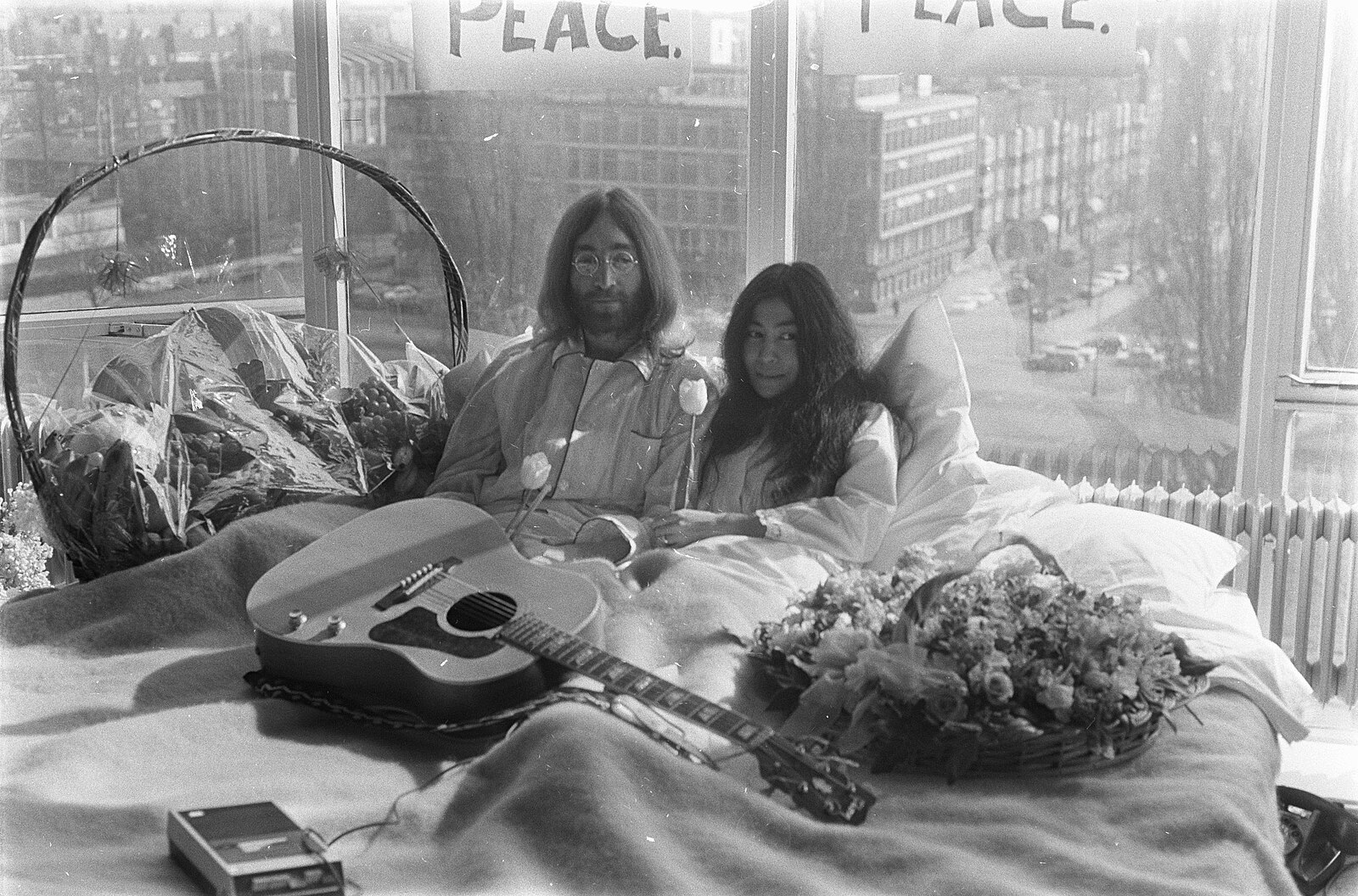
John Lennon and Yoko Ono in bed at the Hilton Hotel in Amsterdam in 1969 (Wikimedia Commons public domain image)
Fortunately, though, our critic has a much more damning quote that he can deploy. It comes from remarks that Elder David B. Haight, then of the Quorum of the Twelve Apostles, delivered to the Annual Meeting of the Utah Association of Women on 24 April 1981. Although I expect that many of you have that particular talk committed to memory and that at least some of you may have actually had it bound with your copy of the scriptures, I’ll supply the relevant passage to you. In his speech to the assembled women, Elder Haight said that
Many of today’s problems can be traced to the music of the Beatles in the early 1960s. I witnessed the early developing of protests on college campuses, protests against the Vietnam War, with protestors using Beatle-type music to express their feelings against our government, against our military, and against authority in general.
I hope that it won’t shock you to learn that I don’t entirely share Elder Haight’s view. However, I take his point, and I take it seriously. The moral influence of the Beatles wasn’t entirely positive. Their prominent experimentation with psychedelic and other drugs, for example, had a decidedly negative impact. The “Youth Rebellion” of the 1960s, in which they were extraordinarily prominent participants and role models, wasn’t an unambiguous step forward for Western Civilization. And, to the extent that rock culture (along with the Pill and a host of other things) contributed to a loosening of standards of sexual morality, it’s scarcely surprising that Church leaders might occasionally have been unenthusiastic about it.
But Elder Haight’s nearly half-century old comment to a Utah women’s group does indeed represent a pretty strong (albeit rather brief and apparently not-often-repeated) negative judgment on the influence of the Beatles.
And here is how, as expressed by second critic at the same online site to which I’ve been referring, the Latter-day Saints are to be condemned on the basis of President Monson’s and Elder Haight’s remarks:
We Latter-day Saints, so the second critic contends, claim to have actual prophets like Isaiah and Paul walking the earth today. Their voices are literally the voice of God himself on this earth. And David B. Haight was one of them. Thus, if Elder Haight declares the Beatles to be at the root of many if not most of the ills of society, it’s no different than if God himself had come down in a cloud of glory and thundered that forth. And if we don’t accept it as the authoritative Word of God to us, essentially as scripture, that simply demonstrates that we really don’t believe our purported “prophets” to really be prophets. We don’t take them seriously.
I’m sometimes astonished, truthfully, by how many of our ex-LDS critics, including the secularizing ones, appear to be failed fundamentalists.
I don’t believe that I ever belonged to a church in which even our canonized scripture was held to be inerrant, let alone that modern apostles enjoy inerrancy in every comment they utter. (Such infallibility isn’t even ascribed to Catholic popes, who are thought to be infallible only when speaking ex cathedra on matters of faith or morals.) Nor do I believe that I ever belonged to a church in which it was taught that every isolated remark of every individual ordained apostle is to be received as binding scripture. Apparently, though, these critics did.
Do I take what individual apostles say very seriously? Indeed, I do. And I certainly agree that the products of popular culture are not without (sometimes troubling) moral implications. There are some television shows and films and songs and art works that are simply incompatible with a seriously Latter-day Saint moral framework. (And I’m not referring here only to sexual morality, although that’s a really obvious area of concern.) We need to be discerning and selective in our consumption of what our current society offers to us. In that sense, I have no problem at all with what Rabbi Sacks said, as quoted by President Monson. And I take Elder Haight’s reservation about the Beatles as worthy of serious consideration. Great though they were, John, Paul, George, and Ringo aren’t and never were beyond criticism.
Posted from Park City, Utah
Travel and Religion
History and Religion
Previous Post

November 27, 2025
Four more for Thanksgiving
Next Post

November 28, 2025 Queer Theory and the Church of Jesus Christ
Recent Comments
"DP: “But Mr. Sutherland worries about the fact that our time, when we can communicate ..."
Learning more about a region of ..."
"Another class of memories are of individuals who previously lived. Some of these remembered individuals ..."
"Sutherland's lecture sounds interesting. He seems to restate the Washington consensus that trade brings peace ..."
Learning more about a region of ..."
"In a meeting today, I learned another important reason why accurate (or at least as ..."
From Serbia’s “White City,” Belgrade
Browse Our Archives
Select a Category Uncategorized
Select a Month October 2026 September 2026 August 2026 July 2026 June 2026 May 2026 April 2026 March 2026 February 2026 January 2026 December 2025 November 2025 October 2025 September 2025 August 2025 July 2025 June 2025 May 2025 April 2025 March 2025 February 2025 January 2025 December 2024 November 2024 October 2024 September 2024 August 2024 July 2024 June 2024 May 2024 April 2024 March 2024 February 2024 January 2024 December 2023 November 2023 October 2023 September 2023 August 2023 July 2023 June 2023 May 2023 April 2023 March 2023 February 2023 January 2023 December 2022 November 2022 October 2022 September 2022 August 2022 July 2022 June 2022 May 2022 April 2022 March 2022 February 2022 January 2022 December 2021 November 2021 October 2021 September 2021 August 2021 July 2021 June 2021 May 2021 April 2021 March 2021 February 2021 January 2021 December 2020 November 2020 October 2020 September 2020 August 2020 July 2020 June 2020 May 2020 April 2020 March 2020 February 2020 January 2020 December 2019 November 2019 October 2019 September 2019 August 2019 July 2019 June 2019 May 2019 April 2019 March 2019 February 2019 January 2019 December 2018 November 2018 October 2018 September 2018 August 2018 July 2018 June 2018 May 2018 April 2018 March 2018 February 2018 January 2018 December 2017 November 2017 October 2017 September 2017 August 2017 July 2017 June 2017 May 2017 April 2017 March 2017 February 2017 January 2017 December 2016 November 2016 October 2016 September 2016 August 2016 July 2016 June 2016 May 2016 April 2016 March 2016 February 2016 January 2016 December 2015 November 2015 October 2015 September 2015 August 2015 July 2015 June 2015 May 2015 April 2015 March 2015 February 2015 January 2015 December 2014 November 2014 March 2014 August 2013 February 2012
Follow Us!
TAKE THE
Religious Wisdom Quiz
Who said: "You are a chosen people, a royal priesthood, a holy nation, God's special possession"?
Select your answer to see how you score.
Moses Peter James Paul
Related posts from Sic et Non


Notes on Women, Priesthood, and General Conference

"The Book of Moses as a Temple Text"

TRENDING AT PATHEOS Latter-day Saint

The First Eucharistic Controversy: Christ’s Real Presence
For Catholics, the Eucharist is the source and summit of the Christian...

How to Make a Decision When You Can't...
Main point: It’s much more valuable to stay close to God so...

Archdiocese Hosts Military Marriage Retreat in Germany
RASTATT, Germany — The transient military lifestyle, with its frequent deployments and...

Nearly every morning, I make the drive to Detroit with my high-school-age...

The Real AI Story Is Adoption Without Trust
Artificial intelligence has crossed a political threshold. It is no longer a...

A new article, written by Jeff Lindsay and Gale L. Pooley,...
view all Latter-day Saint blogs
What Are Your Thoughts?leave a comment
Ad-Free & Subscriber Log-In Subscription Support
- About Us
- 2026 Calendar
- Videos
- Podcasts
- Library of World Religions
- Faith In Media Tracker
- Advertise With Us
- Write for Us
- Privacy Policy
- Terms of Service
- Do Not Sell My Data
- Contact Us
- Radiant Digital
- Manage Newsletter Subscriptions
- Unsubscribe From Notifications
- Sitemap
Copyright 2008-2026, Patheos. All rights reserved.
Subscription Support Ad-Free & Subscriber Log-In
Follow Patheos