
BuddhistCatholicContemplativeEvangelicalGeneral ChristianHinduJewishLatter-day SaintMuslimNew VisionsProgressive Christian
Beliefs
- Buddhist
- Catholic
- Contemplative
- Evangelical
- General Christian
- Hindu
- Jewish
- Latter-day Saint
- More Voices
- Muslim
- New Visions
- Pagan
- Progressive Christian
Topics
- Religion News
- Food and Religion
- Sports and Religion
- Religious Art
- Religious Music and Entertainment
- Religious Events
- History and Religion
- Style and Religion
- Politics and Religion
- Women in Religion
- Recreation Outdoors and Religion
- Business Finance and Religion
- Careers Workplace and Religion
- Education and Religion
- Family Parenting and Religion
- Health Fitness and Religion
- Home and Religion
- Relationships and Religion
- Technology and Religion
- Travel and Religion
Columnists
- Buddhist Columnists
- Business Finance and Religion Columnists
- Careers Workplace and Religion Columnists
- Catholic Columnists
- Contemplative Columnists
- Education and Religion Columnists
- Evangelists Columnists
- Family Parenting and Religion Columnists
- General Christian Columnists
- Health Fitness and Religion Columnists
- Hindu Columnists
- History and Religion Columnists
- Home and Religion Columnists
- Jewish Columnists
- More Voices Columnists
- Latter Day Columnists
- Muslim Columnists
- New Visions Columnists
- Nonreligious Columnists
- Pagan Columnists
- Politics and Religion Columnists
- Progressive Columnists
- Recreation Outdoors and Religion Columnists
- Relationships and Religion Columnists
- Religion News Columnists
- Religious Art Columnists
- Religious Events Columnists
- Religious Music and Entertainment Columnists
- Sports and Religion Columnists
- Style and Religion Columnists
- Technology and Religion Columnists
- Travel and Religion Columnists
- Women in Religion Columnists
Resource Library
- 2026 Calendar
- Library of World Religions
- The 100 Most Holy Places on Earth
- Patheos Answers
- Podcasts
- Videos
- Faith Leaders Database
- Anglican Episcopalian
- Bahai
- Baptist
- Buddhism
- Christianity
- Confucianism
- Eastern Orthodoxy
- Hinduism
- Holiness and Pentecostal
- ISKCON
- Islam
- Judaism
- Lutheran
- Methodist
- The Church of Jesus Christ of Latter-day Saints
- New Age
- Paganism
- Presbytarian and Reformed
- Protestantism
- Religion Behind the Scenes
- Roman Catholic
- Scientology
- Shia Islam
- Sikhism
- Sufism
- Sunni Islam
- Taoism
- Zen
- See all religions
Research Tools
 Ad-Free & Subscriber Log-In Subscription Support
Ad-Free & Subscriber Log-In Subscription Support
Follow Patheos 

- Trending:
- Forgiveness
- |
- Marriage
- |
- Consciousness
- |
- Death Penalty
- |
- Election
- |
- Halloween

- Home
- Latter-day Saint
- Travel and Religion
- Returning to a place from which we were forced into exile
Returning to a place from which we were forced into exile
Last updated on: November 21, 2025 at 4:06 pm by Dan Peterson
Returning to a place from which we were forced into exile 2025-11-21T16:06:06-07:00 Dan Peterson
Patheos Explore the world's faith through different perspectives on religion and spirituality! Patheos has the views of the prevalent religions and spiritualities of the world.
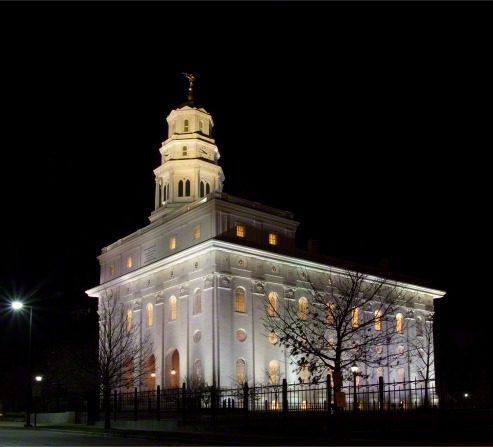
The reconstructed Nauvoo Illinois Temple, the original of which was destroyed by arson (and then, perhaps mercifully, by a tornado) not long after the forcible expulsion of the Latter-day Saints from the then United States of America in 1846. (LDS Media Library)
This is the third time that I’ve been back to Nauvoo in 2025, and the fourth time that I’ve come back during 2024 and 2025. We’re here for more work on our series of Becoming Brigham documentaries, which still appears to be on track for launch in the latter part of January 2026. Things seem to be on track for launching the series in mid- to late January, with weekly short features appearing each week thereafter. We won’t be attempting to monetize the series; we’ll make the episodes available as widely as possible and at no charge. I hope, though, that you’ll watch them when they appear, and that you’ll share them with others and help us to get the word out. I’m really pleased with what we’ve been getting, and I think that you’ll find value in the content we’ve captured.
It’s distinctly colder here than the last time I was in the area, which was only a few weeks ago. But it was very beautiful late this afternoon, with the declining sun from the west brilliantly illuminating the face of the magnificent westward-facing Nauvoo Illinois Temple and backlighting the trees , which still retain (though not for much longer) their autumn foliage of green, red, orange, and gold.
I wonder what the Nauvoo Saints of, say, 1846-1847 would have thought about such return trips as mine. Would they have been astounded that many of the old Nauvoo houses and other important buildings are back in the hands of Latter-day Saints, who were driven out of the city nearly two centuries ago? How would they feel about the reconstructed temple that crowns the bluff and overlooks the Mississippi River?
“I was in Nauvoo on the 26th of May, 1846, for the last time, and left the city of the Saints feeling that most likely I was taking a final farewell of Nauvoo for this life. I looked upon the temple and city as they receded from view and asked the Lord to remember the sacrifices of His Saints.” (Wilford Woodruff [1807-1898], after 1839 a member of the Quorum of the Twelve Apostles and, from 1889 until his death in September 1898, the fourth president of the Church of Jesus Christ of Latter-day Saints)
I think of such things. And, despite the early hour at which I was obliged to stagger out of bed yesterday morning and the nearly three-hour flight to St. Louis and the increasingly familiar three-hour drive from St. Louis up the River, I always try to think about the ease of my journey. I don’t want to take that ease for granted. I want to appreciate the sacrifices made by my spiritual forebears (and, in one genealogical line at least, by my biological ancestors), and to carry on worthily after them.
Here is an excerpt from an account given by Col. Thomas Kane, not a Latter-day Saint, who visited Nauvoo in September 1846, after the Latter-day Saints had abandoned the city:
I had left my steamer at Keokuk, at the foot of the Lower Fall, to hire a carriage, and to contend for some fragments of a dirty meal with the swarming flies, the only scavengers of the locality.
From this place to where the deep water of the river returns, my eye wearied to see everywhere sordid, vagabond, and idle settlers, and a country marred, without being improved, by their careless hands. I was descending the last hill-side upon my journey, when a landscape in delightful contrast broke upon my view. Half encircled by a bend of the river, a beautiful city lay glittering in the fresh morning sun; its bright new dwellings, set in cool green gardens, ranging up around a stately dome-shaped hill, which was crowned by a noble edifice, whose high tapering spire was radiant with white and gold. The city appeared to cover several miles, and beyond it, in the background, there rolled off a fair country, chequered by the careful lines of fruitful husbandry. The un-mistakeable marks of industry, enterprise, and educated wealth everywhere, made the scene one of singular and most striking beauty. It was a natural impulse to visit this inviting region. I procured a skiff, and rowing across the river, landed at the chief wharf of the city. No one met me there. I looked, and saw no one. I could hear no one move, though the quiet everywhere was such that I heard the flies buzz, and the water-ripples break against the shallow of the beach. I walked through the solitary street. The town lay as in a dream, under some deadening spell of loneliness, from which I almost feared to wake it, for plainly it had not slept long. There was no grass growing up in the paved ways; rains had not entirely washed away the prints of dusty footsteps.
Yet I went about unchecked. I went into empty workshops, rope-walks and smithies. The spinner’s wheel was idle; the carpenter had gone from his work-bench and shavings, his unfinished sash and casing. Fresh bark was in the tanner’s vat, and the fresh-chopped lightwood stood piled against the baker’s oven. The blacksmith’s shop was cold; but his coal heap and lading pool, and crooked water horn were all there, as if he had just gone off for a holiday. No work-people anywhere looked to know my errand.
If I went into the gardens, clinking the wicket-latch loudly after me, to pull the marigolds, heartsease, and lady-slippers, and draw a drink with the water-sodden well-bucket and its noisy chain; or, knocking off with my stick the tall, heavy-headed dahlias and sunflowers, hunted over the beds for cucumbers and love-apples—no one called out to me from any opened window, or dog sprang forward to bark an alarm.
I could have supposed the people hidden in the houses, but the doors were unfastened; and when at last I timidly entered them, I found dead ashes white upon the hearths, and had to tread a tip-toe, as if walking down the aisle of a country church, to avoid rousing irreverent echoes from the naked floors. On the outskirts of the town was the city graveyard; but there was no record of plague there, nor did it in anywise differ much from other Protestant American cemeteries. Some of the mounds were not long sodded; some of the stones were newly set, their dates recent, and their black inscriptions glossy in the mason’s hardly dried lettering ink. Beyond the graveyard, out in the fields, I saw, in one spot hard by where the fruited boughs of a young orchard had been roughly torn down, the still smouldering remains of a barbecue fire, that had been constructed of rails from the fencing around it. It was the latest sign of life there. Fields upon fields of heavy-headed yellow grain lay rotting un-gathered upon the ground. No one was there to take in their rich harvest.
As far as the eye could reach they stretched away—they sleeping, too, in the hazy air of autumn. Only two portions of the city seemed to suggest the import of this mysterious solitude. On the southern suburb, the houses looking out upon the country showed, by their splintered wood-work and walls battered to the foundation, that they had lately been the mark of a destructive cannonade. And in and around the splendid Temple, which had been the chief object of my admiration, armed men were barracked, surrounded by their stacks of musketry and pieces of heavy ordnance. These challenged me to render an account of myself, and why I had had the temerity to cross the water without written permit from a leader of their band.
Though these men were generally more or less under the influence of ardent spirits, after I had explained myself as a passing stranger, they seemed anxious to gain my good opinion. They told the story of the Dead City; that it had been a notable manufacturing and commercial mart, sheltering over twenty thousand persons; that they had waged war with its inhabitants for several years, and had been finally successful only a few days before my visit, in an action fought in front of the ruined suburb; after which they had driven them forth at the point of the sword. The defence, they said, had been obstinate, but gave way on the third day’s bombardment. They boasted greatly of their prowess, especially in this battle, as they called it; but I discovered they were not of one mind as to certain of the exploits that had distinguished it, one of which, as I remember, was, that they had slain a father and his son, a boy of fifteen, not long residents of the fated city, whom they admitted to have borne a character without reproach.
They also conducted me inside the massive sculptured walls of the curious Temple, in which they said the banished inhabitants were accustomed to celebrate the mystic rites of an unhallowed worship. They particularly pointed out to me certain features of the building which, having been the peculiar objects of a former superstitious regard, they had, as a matter of duty, sedulously defiled and defaced. The reputed sites of certain shrines they had thus particularly noticed; and various sheltered chambers, in one of which was a deep well, constructed, they believed, with a dreadful design. Beside these, they led me to see a large and deep chiselled marble vase or basin, supported upon twelve oxen, also of marble, and of the size of life, of which they told some romantic stories. They said the deluded persons, most of whom were emigrants from a great distance, believed their Deity countenanced their reception here of a baptism of regeneration, as proxies for whomsoever they held in warm affection in the countries from which they had come. That here parents ‘went into the water’ for their lost children, children for their parents, widows for their spouses, and young persons for their lovers; that thus the Great Vase came to be for them associated with all dear and distant memories, and was therefore the object, of all others in the building, to which they attached the greatest degree of idolatrous affection. On this account, the victors had so diligently desecrated it, as to render the apartment in which it was contained too noisome to abide in.
They permitted me also to ascend into the steeple, to see where it had been lightning-struck the Sabbath before; and to look out, east and south, on wasted farms like those I had seen near the city, extending till they were lost in the distance. Here, in the face of the pure day, close to the scar of the divine wrath left by the thunderbolt, were fragments of food, cruises of liquor, and broken drinking vessels, with a bass drum and a steamboat signal bell, of which I afterwards learned the use with pain. (Quoted in George A. Smith, “Historical Address” [8 and 9 October 1868], Journal of Discourses 13:115-118. My thanks to FAIR for making this text easily accessible.]
Posted from Keokuk, Iowa
Travel and Religion
History and Religion
Previous Post
November 10, 2025
But, umm, the notion of a restoration isn't uniquely LDS!
Next Post

November 12, 2025 Reporting from the City of Joseph
Recent Comments
"Sutherland's lecture sounds interesting. He seems to restate the Washington consensus that trade brings peace ..."
Learning more about a region of ..."
"In a meeting today, I learned another important reason why accurate (or at least as ..."
From Serbia’s “White City,” Belgrade
"I've been watching a lot of video interviews of NDErs and researchers. I think in ..."
"PL: "Let's hope he doesn't have your address..."I have to frankly confess that a few ..."
From Serbia’s “White City,” Belgrade
Browse Our Archives
Select a Category Uncategorized
Select a Month October 2026 September 2026 August 2026 July 2026 June 2026 May 2026 April 2026 March 2026 February 2026 January 2026 December 2025 November 2025 October 2025 September 2025 August 2025 July 2025 June 2025 May 2025 April 2025 March 2025 February 2025 January 2025 December 2024 November 2024 October 2024 September 2024 August 2024 July 2024 June 2024 May 2024 April 2024 March 2024 February 2024 January 2024 December 2023 November 2023 October 2023 September 2023 August 2023 July 2023 June 2023 May 2023 April 2023 March 2023 February 2023 January 2023 December 2022 November 2022 October 2022 September 2022 August 2022 July 2022 June 2022 May 2022 April 2022 March 2022 February 2022 January 2022 December 2021 November 2021 October 2021 September 2021 August 2021 July 2021 June 2021 May 2021 April 2021 March 2021 February 2021 January 2021 December 2020 November 2020 October 2020 September 2020 August 2020 July 2020 June 2020 May 2020 April 2020 March 2020 February 2020 January 2020 December 2019 November 2019 October 2019 September 2019 August 2019 July 2019 June 2019 May 2019 April 2019 March 2019 February 2019 January 2019 December 2018 November 2018 October 2018 September 2018 August 2018 July 2018 June 2018 May 2018 April 2018 March 2018 February 2018 January 2018 December 2017 November 2017 October 2017 September 2017 August 2017 July 2017 June 2017 May 2017 April 2017 March 2017 February 2017 January 2017 December 2016 November 2016 October 2016 September 2016 August 2016 July 2016 June 2016 May 2016 April 2016 March 2016 February 2016 January 2016 December 2015 November 2015 October 2015 September 2015 August 2015 July 2015 June 2015 May 2015 April 2015 March 2015 February 2015 January 2015 December 2014 November 2014 March 2014 August 2013 February 2012
Follow Us!
TAKE THE
Religious Wisdom Quiz
Who saw the vision of the valley of dry bones?
Select your answer to see how you score.
Ezekiel Daniel Isaiah Jeremiah
Related posts from Sic et Non


Notes on Women, Priesthood, and General Conference

"The Book of Moses as a Temple Text"

TRENDING AT PATHEOS Latter-day Saint

Janie Learns the Way of the Cross: A...
Teaching children about Jesus' Passion can be challenging. Many parents and educators...

Looking For Good Catholic Writing - October 2026
He alone extends the heavens, and he walks upon the waves of...

In "Irreplaceable," our book on vocation and technology, Trevor Sutton and I...

I was strolling through the top floor of the brand new Parthenon...

What Does Gêvâh Mean For Kimberley Guifoyle &...
This week, a lot of the news is focused on Kimberly Guilfoyle....

INNER CIRCLE: Profound Mystery (Of Christ In All...
Ephesians 5:31-32 “For this reason, a man will leave his father and...
view all Latter-day Saint blogs
What Are Your Thoughts?leave a comment
Ad-Free & Subscriber Log-In Subscription Support
- About Us
- 2026 Calendar
- Videos
- Podcasts
- Library of World Religions
- Faith In Media Tracker
- Advertise With Us
- Write for Us
- Privacy Policy
- Terms of Service
- Do Not Sell My Data
- Contact Us
- Radiant Digital
- Manage Newsletter Subscriptions
- Unsubscribe From Notifications
- Sitemap
Copyright 2008-2026, Patheos. All rights reserved.
Subscription Support Ad-Free & Subscriber Log-In
Follow Patheos