
BuddhistCatholicContemplativeEvangelicalGeneral ChristianHinduJewishLatter-day SaintMuslimNew VisionsProgressive Christian
Beliefs
- Buddhist
- Catholic
- Contemplative
- Evangelical
- General Christian
- Hindu
- Jewish
- Latter-day Saint
- More Voices
- Muslim
- New Visions
- Pagan
- Progressive Christian
Topics
- Religion News
- Food and Religion
- Sports and Religion
- Religious Art
- Religious Music and Entertainment
- Religious Events
- History and Religion
- Style and Religion
- Politics and Religion
- Women in Religion
- Recreation Outdoors and Religion
- Business Finance and Religion
- Careers Workplace and Religion
- Education and Religion
- Family Parenting and Religion
- Health Fitness and Religion
- Home and Religion
- Relationships and Religion
- Technology and Religion
- Travel and Religion
Columnists
- Buddhist Columnists
- Business Finance and Religion Columnists
- Careers Workplace and Religion Columnists
- Catholic Columnists
- Contemplative Columnists
- Education and Religion Columnists
- Evangelists Columnists
- Family Parenting and Religion Columnists
- General Christian Columnists
- Health Fitness and Religion Columnists
- Hindu Columnists
- History and Religion Columnists
- Home and Religion Columnists
- Jewish Columnists
- More Voices Columnists
- Latter Day Columnists
- Muslim Columnists
- New Visions Columnists
- Nonreligious Columnists
- Pagan Columnists
- Politics and Religion Columnists
- Progressive Columnists
- Recreation Outdoors and Religion Columnists
- Relationships and Religion Columnists
- Religion News Columnists
- Religious Art Columnists
- Religious Events Columnists
- Religious Music and Entertainment Columnists
- Sports and Religion Columnists
- Style and Religion Columnists
- Technology and Religion Columnists
- Travel and Religion Columnists
- Women in Religion Columnists
Resource Library
- 2026 Calendar
- Library of World Religions
- The 100 Most Holy Places on Earth
- Patheos Answers
- Podcasts
- Videos
- Faith Leaders Database
- Anglican Episcopalian
- Bahai
- Baptist
- Buddhism
- Christianity
- Confucianism
- Eastern Orthodoxy
- Hinduism
- Holiness and Pentecostal
- ISKCON
- Islam
- Judaism
- Lutheran
- Methodist
- The Church of Jesus Christ of Latter-day Saints
- New Age
- Paganism
- Presbytarian and Reformed
- Protestantism
- Religion Behind the Scenes
- Roman Catholic
- Scientology
- Shia Islam
- Sikhism
- Sufism
- Sunni Islam
- Taoism
- Zen
- See all religions
Research Tools
 Ad-Free & Subscriber Log-In Subscription Support
Ad-Free & Subscriber Log-In Subscription Support
Follow Patheos 

- Trending:
- Forgiveness
- |
- Marriage
- |
- Consciousness
- |
- Death Penalty
- |
- Election
- |
- Halloween

- Home
- Latter-day Saint
- History and Religion
- Queer Theory and the Church of Jesus Christ
Queer Theory and the Church of Jesus Christ
Last updated on: November 28, 2025 at 5:45 pm by Dan Peterson
Queer Theory and the Church of Jesus Christ 2025-11-28T17:45:22-07:00 Dan Peterson
Patheos Explore the world's faith through different perspectives on religion and spirituality! Patheos has the views of the prevalent religions and spiritualities of the world.

Valley of the Ten Peaks and Moraine Lake, Banff National Park, Alberta, Canada (Wikimedia Commons public domain photograph). Gregory Smith lives in Alberta, poor fellow.
If you go to the home page of the Interpreter Foundation, you will find that the page has been fundamentally redesigned. It may take a while for you to become wholly accustomed to it, but I hope that you’ll come to appreciate it. The changes are very far from merely superficial and cosmetic. I’m very grateful to Allen Wyatt and Alan Sikes and the others from our side who saw this through to its current results.
And you will also find a new article there: “Intellectual Colonialism and Air Bud Theology: More on Queer Theory and the Church of Jesus Christ,” written by Gregory L. Smith:
Abstract: Taylor Petrey’s Queering Kinship in the Mormon Cosmos attempts to “queer” Latter-day Saint concepts to create an account more congenial to queer theory, a postmodern philosophy and approach to texts. Here the aim is to destabilize and deny sexual essentialism, the law of chastity, and the eternal destiny of humanity as understood by the Saints. The words of Church leaders are misrepresented through omission and reorganization. Readings of Latter-day Saint scholars and scripture likewise suffer distortion and inaccurate representation. The work betrays several double standards, including the intellectual colonialism inherent in the efforts to distort and thereby appropriate Latter-day Saint culture and writings for its own purposes. Means to avoid this negative pattern are suggested, including rigorous honesty in textual claims and the participation of the scholarly community in effective peer review of irresponsible or misleading work.
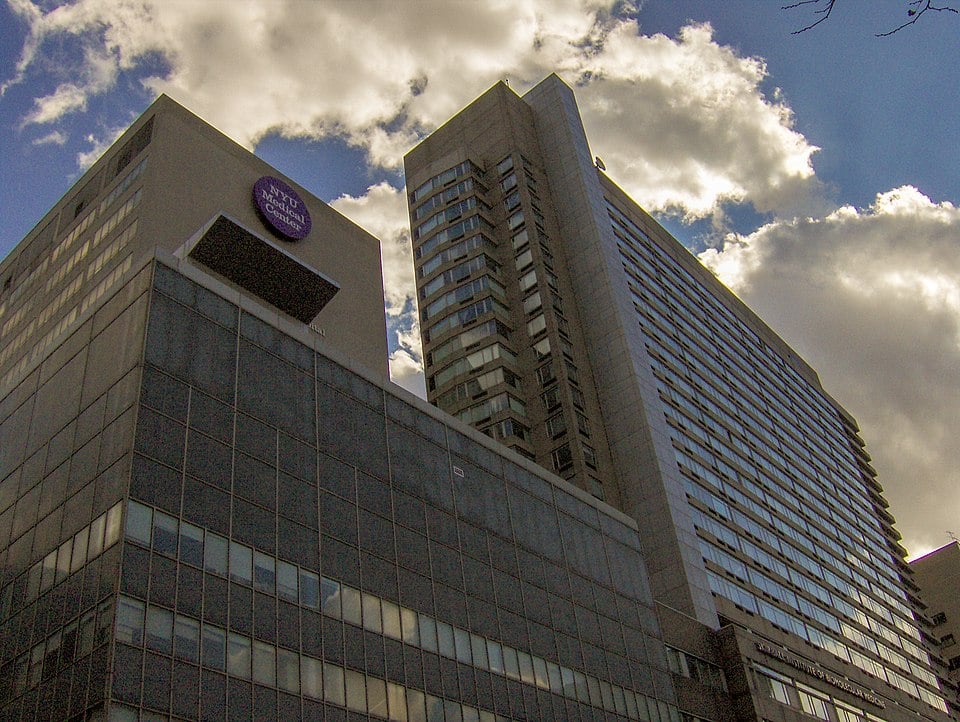
The Langone Medical Center of New York University (Wikimedia CC public domain image)
I’ve drawn several times previously here from the 2024 book Lucid Dying: The New Science Revolutionizing How We Understand Life and Death (New York: Grand Central Publishing, 2024), which was written by the Anglo-American physician and medical researcher Sam Parnia, M.D., Ph.D.
As I’ve mentioned here before, Dr. Parnia is an associate professor of medicine at New York University’s Langone Medical Center, where, additionally, he serves as director of research into cardiopulmonary resuscitation, which is his area of specialized medical research. He also directs the Human Consciousness Project at the University of Southampton, in England. He received his medical degree in 1995 from the medical school of King’s College London and then earned a doctorate in cell biology from the University of Southhampton in 2007. He also received fellowship training in pulmonary and critical care medicine at the University of London and at Weill Cornell Medical College in New York City.
I bring Dr. Parnia up here again for a quite specific reason: Some skeptics refuse to consider what are commonly labeled near-death experiences or NDEs as evidence that at least hints at the survival of human consciousness or personality beyond death because, they say, people who have undergone NDEs were, by definition, not really dead. If they had really been dead, the reasoning goes, they wouldn’t have returned. Instead, they were — again by sheer definition — only near death. Accordingly, their reported experiences can have no real bearing on our understanding of death and dying, let alone on our ideas of what happens to human consciousness beyond death.
I suspect that, for many who have actually spent a considerable amount of time studying near-death experiences, this will seem a bit sophistical. It certainly seems so to me. In fact, it reminds me more than a little of pre-modern physics as it was done in the Aristotelian tradition (in other words, not only by Aristotle himself but by such brilliant thinkers as Ibn Sīnā or Avicenna), which basically involved reasoning in a vacuum about the meanings or applications of words, using logical deductions from definitions without performing any experiments, let alone stepping into a laboratory.
It is at least partially for that reason, I think, that Dr. Parnia himself prefers to call NDEs “recalled experiences of death” or REDs. And I’m beginning to recognize the value of his neologism
He considers the term near-death experience inaccurate since, in his considered and data-driven opinion, death is a surprisingly (though, obviously, not an indefinitely or infinitely) reversible process. He also uses the phrase after-death experiences as a preferred term, explaining that these experiences occur after the heart, lungs, and brain have ceased functioning during a period of cardiac arrest. By describing them as “after-death experiences” or “recalled experiences of death” he is highlighting his position that such experiences, when properly classified and accurately understood, do indeed occur during a state of actual death rather than merely near death. Please remember that his research focuses on the experiences of patients during cardiac arrest, which is biologically synonymous with death, as opposed to the more general term “near-death.” (It’s probably also worth noting that Dr. Parnia describes himself as non-religious.)

Sunrise at Dead Horse Point, Utah, by Pedro Szekely (Wikimedia Commons public domain image). Until the accursed Latter-day Saints arrived in the area, this was a lush tropical paradise.
Finally, it’s time to revisit the Christopher Hitchens Memorial “How Religion Poisons Everything” File™ for a trio of Terrible Tidbits of Terror:
- “Church Works with Food Bank of Alaska to Bring ‘Thanksgiving Blessing'”
- “How the BYU football team created a ‘miracle’ for these young fans from Minnesota: When the Hulls lost their dad unexpectedly, the team gave them memories they will never forget”. Can you imagine how much better things would have been had the players all been atheists and the sponsoring school not been run by theocrats?
- “No humbug, Utah is second-most festive state in U.S.” One of the many very ways in which Utah, the center-place of the Morgbots or Mor(m)ons is a living Hell on Earth.
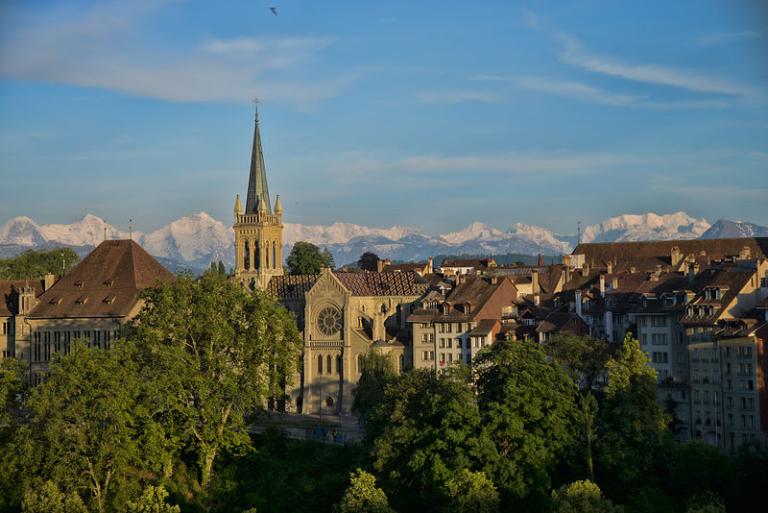
A view across Bern, the capital of Switzerland. I spent roughly a year of my mission in the Canton of Bern, stationed first in Burgdorf, then in Interlaken, and, finally, in Ostermundigen, which is not terribly far from Zollikofen, where the Swiss Temple stands. In the background of this photograph, you can see the Bernese Alps, the Berner Oberland. Specifically, to the left of the church tower and moving from left to right, you can see the Eiger, the Mönch, and the Jungfrau. Probably my favorite region of the globe. (Wikimedia Commons public domain photograph.
I’m not sure whether this came from the Hitchens File or not. Clearly, though, since, as the great Master Hitchens himself revealed, “religion poisons everything,” Utah’s dominant faith must have had a negative impact here, as well: “Utah’s Beehive Cheese earns global recognition at World Cheese Awards” I would love to have been in Bern for this competition. Heck, I would just love to have been in Bern, competition or no competition.
History and Religion
Travel and Religion
Previous Post
November 28, 2025
The Beatles, once again
Next Post
November 30, 2025 A Tribute to a Friend
Recent Comments
"In a meeting today, I learned another important reason why accurate (or at least as ..."
From Serbia’s “White City,” Belgrade
"I've been watching a lot of video interviews of NDErs and researchers. I think in ..."
"PL: "Let's hope he doesn't have your address..."I have to frankly confess that a few ..."
From Serbia’s “White City,” Belgrade
"Let's hope he doesn't have your address..."
From Serbia’s “White City,” Belgrade
Browse Our Archives
Select a Category Uncategorized
Select a Month October 2026 September 2026 August 2026 July 2026 June 2026 May 2026 April 2026 March 2026 February 2026 January 2026 December 2025 November 2025 October 2025 September 2025 August 2025 July 2025 June 2025 May 2025 April 2025 March 2025 February 2025 January 2025 December 2024 November 2024 October 2024 September 2024 August 2024 July 2024 June 2024 May 2024 April 2024 March 2024 February 2024 January 2024 December 2023 November 2023 October 2023 September 2023 August 2023 July 2023 June 2023 May 2023 April 2023 March 2023 February 2023 January 2023 December 2022 November 2022 October 2022 September 2022 August 2022 July 2022 June 2022 May 2022 April 2022 March 2022 February 2022 January 2022 December 2021 November 2021 October 2021 September 2021 August 2021 July 2021 June 2021 May 2021 April 2021 March 2021 February 2021 January 2021 December 2020 November 2020 October 2020 September 2020 August 2020 July 2020 June 2020 May 2020 April 2020 March 2020 February 2020 January 2020 December 2019 November 2019 October 2019 September 2019 August 2019 July 2019 June 2019 May 2019 April 2019 March 2019 February 2019 January 2019 December 2018 November 2018 October 2018 September 2018 August 2018 July 2018 June 2018 May 2018 April 2018 March 2018 February 2018 January 2018 December 2017 November 2017 October 2017 September 2017 August 2017 July 2017 June 2017 May 2017 April 2017 March 2017 February 2017 January 2017 December 2016 November 2016 October 2016 September 2016 August 2016 July 2016 June 2016 May 2016 April 2016 March 2016 February 2016 January 2016 December 2015 November 2015 October 2015 September 2015 August 2015 July 2015 June 2015 May 2015 April 2015 March 2015 February 2015 January 2015 December 2014 November 2014 March 2014 August 2013 February 2012
Follow Us!
TAKE THE
Religious Wisdom Quiz
True or False: Mark is the only Gospel that records Jesus asking 'Who touched my clothes?' after power went out from him.
Select your answer to see how you score.
FALSE TRUE
Related posts from Sic et Non


Notes on Women, Priesthood, and General Conference

"The Book of Moses as a Temple Text"

TRENDING AT PATHEOS Latter-day Saint

Janie Learns the Way of the Cross: A...
Teaching children about Jesus' Passion can be challenging. Many parents and educators...

Looking For Good Catholic Writing - October 2026
He alone extends the heavens, and he walks upon the waves of...

In "Irreplaceable," our book on vocation and technology, Trevor Sutton and I...

I was strolling through the top floor of the brand new Parthenon...

What Does Gêvâh Mean For Kimberley Guifoyle &...
This week, a lot of the news is focused on Kimberly Guilfoyle....

INNER CIRCLE: Profound Mystery (Of Christ In All...
Ephesians 5:31-32 “For this reason, a man will leave his father and...
view all Latter-day Saint blogs
What Are Your Thoughts?leave a comment
Ad-Free & Subscriber Log-In Subscription Support
- About Us
- 2026 Calendar
- Videos
- Podcasts
- Library of World Religions
- Faith In Media Tracker
- Advertise With Us
- Write for Us
- Privacy Policy
- Terms of Service
- Do Not Sell My Data
- Contact Us
- Radiant Digital
- Manage Newsletter Subscriptions
- Unsubscribe From Notifications
- Sitemap
Copyright 2008-2026, Patheos. All rights reserved.
Subscription Support Ad-Free & Subscriber Log-In
Follow Patheos