
BuddhistCatholicContemplativeEvangelicalGeneral ChristianHinduJewishLatter-day SaintMuslimNew VisionsProgressive Christian
Beliefs
- Buddhist
- Catholic
- Contemplative
- Evangelical
- General Christian
- Hindu
- Jewish
- Latter-day Saint
- More Voices
- Muslim
- New Visions
- Pagan
- Progressive Christian
Topics
- Religion News
- Food and Religion
- Sports and Religion
- Religious Art
- Religious Music and Entertainment
- Religious Events
- History and Religion
- Style and Religion
- Politics and Religion
- Women in Religion
- Recreation Outdoors and Religion
- Business Finance and Religion
- Careers Workplace and Religion
- Education and Religion
- Family Parenting and Religion
- Health Fitness and Religion
- Home and Religion
- Relationships and Religion
- Technology and Religion
- Travel and Religion
Columnists
- Buddhist Columnists
- Business Finance and Religion Columnists
- Careers Workplace and Religion Columnists
- Catholic Columnists
- Contemplative Columnists
- Education and Religion Columnists
- Evangelists Columnists
- Family Parenting and Religion Columnists
- General Christian Columnists
- Health Fitness and Religion Columnists
- Hindu Columnists
- History and Religion Columnists
- Home and Religion Columnists
- Jewish Columnists
- More Voices Columnists
- Latter Day Columnists
- Muslim Columnists
- New Visions Columnists
- Nonreligious Columnists
- Pagan Columnists
- Politics and Religion Columnists
- Progressive Columnists
- Recreation Outdoors and Religion Columnists
- Relationships and Religion Columnists
- Religion News Columnists
- Religious Art Columnists
- Religious Events Columnists
- Religious Music and Entertainment Columnists
- Sports and Religion Columnists
- Style and Religion Columnists
- Technology and Religion Columnists
- Travel and Religion Columnists
- Women in Religion Columnists
Resource Library
- 2026 Calendar
- Library of World Religions
- The 100 Most Holy Places on Earth
- Patheos Answers
- Podcasts
- Videos
- Faith Leaders Database
- Anglican Episcopalian
- Bahai
- Baptist
- Buddhism
- Christianity
- Confucianism
- Eastern Orthodoxy
- Hinduism
- Holiness and Pentecostal
- ISKCON
- Islam
- Judaism
- Lutheran
- Methodist
- The Church of Jesus Christ of Latter-day Saints
- New Age
- Paganism
- Presbytarian and Reformed
- Protestantism
- Religion Behind the Scenes
- Roman Catholic
- Scientology
- Shia Islam
- Sikhism
- Sufism
- Sunni Islam
- Taoism
- Zen
- See all religions
Research Tools
 Ad-Free & Subscriber Log-In Subscription Support
Ad-Free & Subscriber Log-In Subscription Support
Follow Patheos 

- Trending:
- Forgiveness
- |
- Marriage
- |
- Consciousness
- |
- Death Penalty
- |
- Election
- |
- Halloween

- Home
- Latter-day Saint
- History and Religion
- How to Explain the Book of Mormon?
How to Explain the Book of Mormon?
Last updated on: November 5, 2025 at 8:23 pm by Dan Peterson
How to Explain the Book of Mormon? 2025-11-05T20:23:57-07:00 Dan Peterson
Patheos Explore the world's faith through different perspectives on religion and spirituality! Patheos has the views of the prevalent religions and spiritualities of the world.

A small portion of Deer Creek Reservoir pretty much as it appeared today. (Wikimedia Commons public domain photo)
Up to the Heber Valley again today and back down again. Sometimes life gets in the way of what we would prefer to be doing. But it’s a nice drive, up Provo Canyon and along the shore of Deer Creek Reservoir. So I didn’t mind that too much.

During the time that I served as editor of the FARMS Review (one of the several titles under which it was published during my tenure), this was the entrance to my editorial office. (Wikimedia Commons public domain photo)
A new article in our reprint series went up today on the website of the Interpreter Foundation. It is Steadfast in Defense of Faith: “Reflections on the Genesis and Evolution of the FARMS Review under the Editorship of Daniel C. Peterson (1989–2011),” written by Shirley S. Ricks.
Part of our book chapter reprint series, this article originally appeared in Steadfast in Defense of Faith: Essays in Honor of Daniel C. Peterson, edited by Shirley Ricks, Stephen D. Ricks, and Louis Midgley. For more information, go to https://interpreterfoundation.org/books/steadfast-in-defense-of-faith/.
“In this essay, I attempt to honor the vision and dedication of our friend Daniel C. Peterson, who brought to fruition a periodical with the intent to publish reviews of all books published on the Book of Mormon in a given year.”
Needless to say, the article is — as informed readers would surely expect it to be — a tedious but lengthy catalogue of cruelty, buffoonery, mendacity, hypocrisy, gluttony, callousness, mean-spiritedness, greed, failure, and sloth. I’m reliably informed that it’s nevertheless a highly sanitized abridgment of ¥e Lyfe and Abhominable Crymes of Daniel Petersonn, Apologist, Late of S. Gabriel’s Parish in Alta California, Briefly Subject to the Infidel Turk in el-Cairo, and Now Resident in the Quondam Townshippe of Sharon.
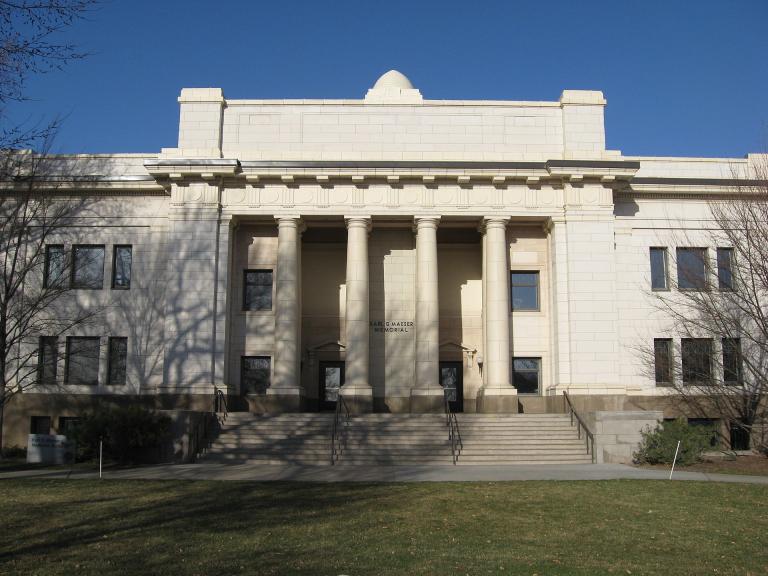
Karl G. Maeser, who joined the Church in Dresden, Germany, is generally regarded as the true founder of Brigham Young University. Above, the Maeser Memorial Building at BYU, which is one of the oldest buildings of the University. (Wikimedia Commons public domain photograph)
Whatever the outcome on the football field turns out to be in Lubbock, Texas, this coming Saturday, Brigham Young University and its supporters have already scored a significant victory: “BYU fans have helped raise thousands of dollars for an ailing member of the Texas Tech family: An online fundraiser has yielded more than $63,000 in donations for a Red Raiders fan who was severely injured in an auto accident.” Perhaps we can raise the number a little higher still before this weekend’s game? Even a small donation — I’ve made a tiny and insignificant one myself — would be valuable, and it would send an important message on behalf of BYU and its fan base: Help Support Maddie’s Road to Recovery.

Richard Lyman Buahman in 2016. (Photograph from the Neal A. Maxwell Institute for Religious Scholarship))
I’ve had a busy day today that kept me away from my keyboard and, thus, from doing the work that I typically do. So, once again, I’m going to share some notes from things that I’ve recently read. Here are a few passages from Richard Lyman Bushman, Joseph Smith’s Gold Plates: A Cultural History (New York: Oxford University Press, 2023). Here, he is discussing the Book of Mormon and the plates, and the treatment of them by three outside authors: William Alexander Linn, The Story of the Mormons From the Date of their Origin to the Year 1901 (1902); I. Woodbridge Riley, The Founder of Mormonism: A Psychological Study of Joseph Smith (1902); and Lily Dougall’s novel The Mormon Prophet (1899):
William Linn’s book was the least original of the three. Linn summarized current knowledge without advancing anything new about the origins of the Book of Mormon or the nature of Mormonism. He adhered to the standard Spaulding theory about the book’s origins. It was obvious, Linn thought, “some directing mind,” other than Smith’s “gave the final shape to the scheme.” The mastermind behind the text and the Golden Bible hoax must have been Sidney Rigdon building on the romance by Solomon Spalding.
Unlike Linn, Riley and Dougall found the Spalding hypothesis unconvincing. Riley spent over twenty-five pages minutely analyzing the “Spaulding-Rigdon Theory.” He went through the hypothesis point by point, noting the lack of evidence and concluding that “these marks of the book are not the marks of the man Rigdon.” Dougall dismissed the theory summarily, observing “that it [Book of Mormon] was an original production seems probable.”
The abandonment of the Spaulding-Rigdon hypothesis by two serious writers turned Mormon studies in a new direction. If Rigdon was not the mastermind behind the Book of Mormon, Joseph Smith must have been, and how could that be explained? How did this unprepossessing treasure-seeker compose such a complex text? That question compelled observers to speculate about Joseph Smith’s mentality and temperament. What were the psychic sources of his visions and revelations?
Abner Cole and Eber D. Howe, the first of the serious critics, saw no need to investigate Smith’s mentality. They borrowed motives and mentality from historical stereotypes. Smith was an impostor and confidence man like other charlatans who troubled human society.
With Rigdon gone and Smith the author of Mormonism, Dougall and Riley needed a more encompassing explanation. Both asked what light the newly emerging science of psychology might throw on visions and revelations. Although addressing the same question, the two took different approaches. Riley claimed that Smith obviously suffered from epilepsy. His description of the First Vision with its darkness and his inability to speak, followed by a bright light and then release could not have been clearer. Riley traced the inclination to mental disturbances back through the family line, finding that the Smiths had been mentally impaired for generations.
Although cognizant of developments in psychological science, Lily Dougall took a more humanistic approach. She talked to William James about Smith’s visions not long before James’s Gifford Lectures at the University of Edinburgh, which became The Varieties of Religious Experience. Dougall blended art with science, aiming to imagine Smith’s psychology artistically rather than scientifically. Dougall also wrote from a theological position. She spent her life breaking free from the strictures of her evangelical Christian father’s hard-edge Christianity. She gravitated toward modernist doubts about miracles and to broad church toleration of a wide range of Christian beliefs. She wanted to respect Mormons, even while distancing herself from their irrational belief in miracles and revelations. She was aware of the polemical, moralist tradition that preceded her. In her candid introduction, she acknowledged that “it has been earnestly suggested to me that to write on so false a religion in other than a polemic spirit would tend to the undermining of civilised life.” (91-92)
I note in passing that epilepsy was also invoked for a relatively brief while as an explanation for the Qur’an, which is believed by Muslims to be the transcription of revelations received by the Prophet Muhammad (ca. 570-632 AD):
Riley’s epilepsy diagnosis appealed in a time when physiological psychology seemed like a promising path for psychic research, but its range was limited. Epilepsy was of no help in understanding the gold plates. Riley had nothing to say about how the plates figured in Smith’s psychic economy. The epilepsy diagnosis, moreover, was tied to fashions in psychological research. At the time, epilepsy was also offered as an explanation of St. Paul’s Damascus vision too. As early ambitions for a broad application of the syndrome lost traction, their usefulness in understanding Joseph Smith faded as well. (95)
Professor Bushman also discusses Children of God (1939), by Vardis Fisher. It was, in its time, probably the most successful of “Mormon novels.”
Fisher and Dougall did their best to imagine what it meant subjectively to see God and write the Book of Mormon. The natural tendency of storytelling was to present an empathetic account, allowing the lead characters at least a measure of sincerity. To imagine them as duplicitous from the start would reduce interest in their fate and cast a long shadow over the rest of the story. Fisher balked, however, when it came to the plates. It was one thing to imagine a vision of God or even an aspiration to write the history of the Indians. It was another to pretend to poessess golden plates. After Joseph tells his family about his vision of the plates, Fisher has Joseph’s father express belief in their reality, warning Joseph to take care that the records not be stolen. At this point, Joseph must decide to go along with his father’s naive faith or tell him that they were not a material reality, that he “would visit the records only in a vision.” At the crucial moment, Joseph “let the opportunity pass” to tell the truth. He implicitly confirmed his followers’ belief that “he would visit a hill and open a vault and look with mortal eyes upon plates of gold.” Rationalizing the deceit to himself, Fisher’s Joseph reflects that “perhaps, indeed, the plates were real; for in this, as in many other matters, he was still uncertain.” (96)
Back, though, to Lily Dougall’s The Mormon Prophet:
Dougall likewise begins with a Smith who believes in his own plates but at the end has him confess his doubts. After one of her appeals for him to listen to reason, Joseph confesses to Susannah that he may not have seen the gold plates at all; they were just bricks. “As to them plates, I told you before I didn’t have them as much in my hands as I said I did. I got wrong a bit there too.” As from the beginning, the plates were the hinge between two understandings of Joseph Smith, sincere visionary or deceitful fraud. (97)
History and Religion
Travel and Religion
Previous Post

November 4, 2025
Weird, right?
Next Post
November 6, 2025 Denying the Seemingly Undeniable
Recent Comments
"Another class of memories are of individuals who previously lived. Some of these remembered individuals ..."
"Sutherland's lecture sounds interesting. He seems to restate the Washington consensus that trade brings peace ..."
Learning more about a region of ..."
"In a meeting today, I learned another important reason why accurate (or at least as ..."
From Serbia’s “White City,” Belgrade
"I've been watching a lot of video interviews of NDErs and researchers. I think in ..."
Browse Our Archives
Select a Category Uncategorized
Select a Month October 2026 September 2026 August 2026 July 2026 June 2026 May 2026 April 2026 March 2026 February 2026 January 2026 December 2025 November 2025 October 2025 September 2025 August 2025 July 2025 June 2025 May 2025 April 2025 March 2025 February 2025 January 2025 December 2024 November 2024 October 2024 September 2024 August 2024 July 2024 June 2024 May 2024 April 2024 March 2024 February 2024 January 2024 December 2023 November 2023 October 2023 September 2023 August 2023 July 2023 June 2023 May 2023 April 2023 March 2023 February 2023 January 2023 December 2022 November 2022 October 2022 September 2022 August 2022 July 2022 June 2022 May 2022 April 2022 March 2022 February 2022 January 2022 December 2021 November 2021 October 2021 September 2021 August 2021 July 2021 June 2021 May 2021 April 2021 March 2021 February 2021 January 2021 December 2020 November 2020 October 2020 September 2020 August 2020 July 2020 June 2020 May 2020 April 2020 March 2020 February 2020 January 2020 December 2019 November 2019 October 2019 September 2019 August 2019 July 2019 June 2019 May 2019 April 2019 March 2019 February 2019 January 2019 December 2018 November 2018 October 2018 September 2018 August 2018 July 2018 June 2018 May 2018 April 2018 March 2018 February 2018 January 2018 December 2017 November 2017 October 2017 September 2017 August 2017 July 2017 June 2017 May 2017 April 2017 March 2017 February 2017 January 2017 December 2016 November 2016 October 2016 September 2016 August 2016 July 2016 June 2016 May 2016 April 2016 March 2016 February 2016 January 2016 December 2015 November 2015 October 2015 September 2015 August 2015 July 2015 June 2015 May 2015 April 2015 March 2015 February 2015 January 2015 December 2014 November 2014 March 2014 August 2013 February 2012
Follow Us!
TAKE THE
Religious Wisdom Quiz
Which Christian denomination is led by the Pope?
Select your answer to see how you score.
Catholic Protestant Anglican Orthodox
Related posts from Sic et Non


Some notes on the archaeology of the Bible


TRENDING AT PATHEOS Latter-day Saint

The Sermon on the Mount, Part I: Matthew...
The Sermon on the Mount, Part I (Matthew 4:12-5:12) St. Matthew moves...

What's up from Crossway: Reviewing some of their latest A few weeks...

Janie Learns the Way of the Cross: A...
Teaching children about Jesus' Passion can be challenging. Many parents and educators...

Looking For Good Catholic Writing - October 2026
He alone extends the heavens, and he walks upon the waves of...

In "Irreplaceable," our book on vocation and technology, Trevor Sutton and I...

I was strolling through the top floor of the brand new Parthenon...
view all Latter-day Saint blogs
What Are Your Thoughts?leave a comment
Ad-Free & Subscriber Log-In Subscription Support
- About Us
- 2026 Calendar
- Videos
- Podcasts
- Library of World Religions
- Faith In Media Tracker
- Advertise With Us
- Write for Us
- Privacy Policy
- Terms of Service
- Do Not Sell My Data
- Contact Us
- Radiant Digital
- Manage Newsletter Subscriptions
- Unsubscribe From Notifications
- Sitemap
Copyright 2008-2026, Patheos. All rights reserved.
Subscription Support Ad-Free & Subscriber Log-In
Follow Patheos