
BuddhistCatholicContemplativeEvangelicalGeneral ChristianHinduJewishLatter-day SaintMuslimNew VisionsProgressive Christian
Beliefs
- Buddhist
- Catholic
- Contemplative
- Evangelical
- General Christian
- Hindu
- Jewish
- Latter-day Saint
- More Voices
- Muslim
- New Visions
- Pagan
- Progressive Christian
Topics
- Religion News
- Food and Religion
- Sports and Religion
- Religious Art
- Religious Music and Entertainment
- Religious Events
- History and Religion
- Style and Religion
- Politics and Religion
- Women in Religion
- Recreation Outdoors and Religion
- Business Finance and Religion
- Careers Workplace and Religion
- Education and Religion
- Family Parenting and Religion
- Health Fitness and Religion
- Home and Religion
- Relationships and Religion
- Technology and Religion
- Travel and Religion
Columnists
- Buddhist Columnists
- Business Finance and Religion Columnists
- Careers Workplace and Religion Columnists
- Catholic Columnists
- Contemplative Columnists
- Education and Religion Columnists
- Evangelists Columnists
- Family Parenting and Religion Columnists
- General Christian Columnists
- Health Fitness and Religion Columnists
- Hindu Columnists
- History and Religion Columnists
- Home and Religion Columnists
- Jewish Columnists
- More Voices Columnists
- Latter Day Columnists
- Muslim Columnists
- New Visions Columnists
- Nonreligious Columnists
- Pagan Columnists
- Politics and Religion Columnists
- Progressive Columnists
- Recreation Outdoors and Religion Columnists
- Relationships and Religion Columnists
- Religion News Columnists
- Religious Art Columnists
- Religious Events Columnists
- Religious Music and Entertainment Columnists
- Sports and Religion Columnists
- Style and Religion Columnists
- Technology and Religion Columnists
- Travel and Religion Columnists
- Women in Religion Columnists
Resource Library
- 2026 Calendar
- Library of World Religions
- The 100 Most Holy Places on Earth
- Patheos Answers
- Podcasts
- Videos
- Faith Leaders Database
- Anglican Episcopalian
- Bahai
- Baptist
- Buddhism
- Christianity
- Confucianism
- Eastern Orthodoxy
- Hinduism
- Holiness and Pentecostal
- ISKCON
- Islam
- Judaism
- Lutheran
- Methodist
- The Church of Jesus Christ of Latter-day Saints
- New Age
- Paganism
- Presbytarian and Reformed
- Protestantism
- Religion Behind the Scenes
- Roman Catholic
- Scientology
- Shia Islam
- Sikhism
- Sufism
- Sunni Islam
- Taoism
- Zen
- See all religions
Research Tools
 Ad-Free & Subscriber Log-In Subscription Support
Ad-Free & Subscriber Log-In Subscription Support
Follow Patheos 

- Trending:
- Forgiveness
- |
- Marriage
- |
- Consciousness
- |
- Death Penalty
- |
- Election
- |
- Halloween

- Home
- Latter-day Saint
- Travel and Religion
- “Signifying nothing”
“Signifying nothing”
Last updated on: October 17, 2025 at 8:40 am by Dan Peterson
“Signifying nothing” 2025-10-17T08:40:23-06:00 Dan Peterson
Patheos Explore the world's faith through different perspectives on religion and spirituality! Patheos has the views of the prevalent religions and spiritualities of the world.
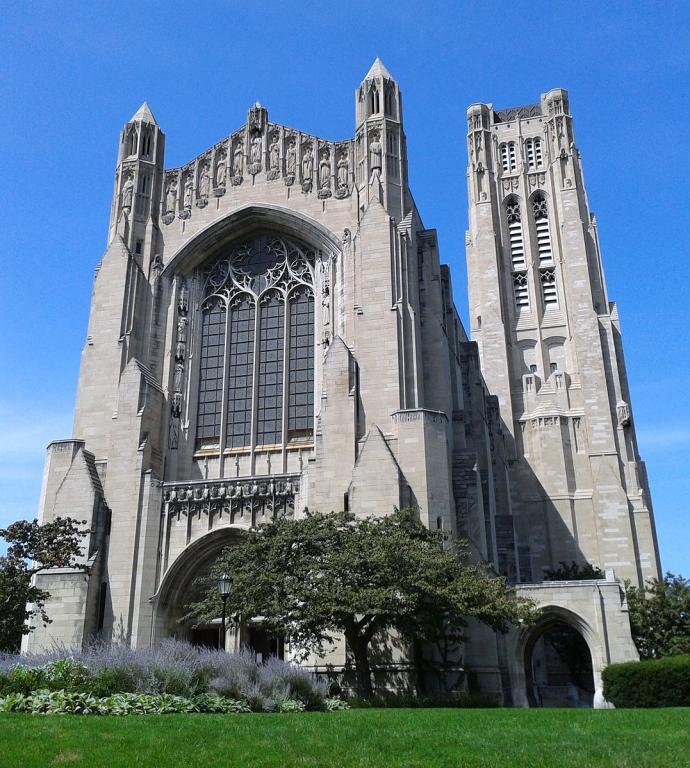
Rockefeller Chapel, at the University of Chicago (photo by Matthew Bisanz, Wikimedia Commons public domain photograph.)
Just in case you haven’t already seen this from President Dallin H. Oaks and his wife Kristen: “A Birthday Wish to My Wonderful Wife.”
From the Law School of the University of Chicago: “Dallin H. Oaks, ’57, Former UChicago Law Professor, Named President of the Mormon Church”
Jenny Oaks Baker on her father, new President of The Church of Jesus Christ of Latter-day Saints”
From a pair of non-Latter-day Saint writers: “A Bridge Builder’s Legacy: What America Owes to President Russell M. Nelson”
Two more Latter-day Saint chapels burn: “Fires damage Latter-day Saint meetinghouses in New Zealand and New Caledonia” They’re so far distant geographically that it’s difficult to imagine a conspiracy or a connection behind these fires. But such incidents are becoming common enough that it’s also difficult to avoid considering the possibility.
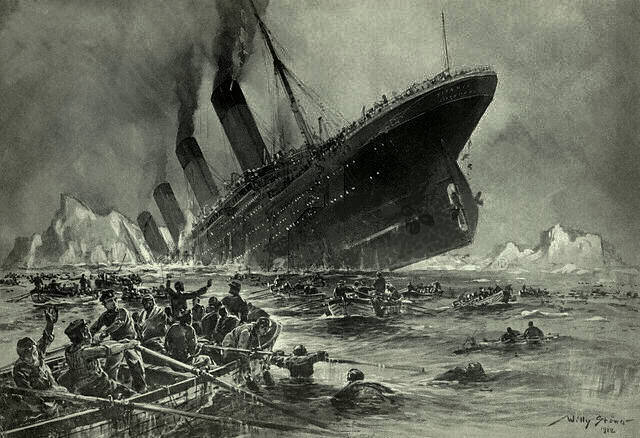
Willy Stöwer, “Der Untergang der Titanic” (1912) (Wikimedia Commons public domain image)
Yesterday, in a blog entry entitled “‘All is Vanity,'” I jotted down a few thoughts on the seeming absurdity of a life that inevitably ends in non-existence, in a universe with neither God nor meaning. Among other things, I compared our activities in such a life, such a world, to rearranging the deck chairs on the Titanic.
I want to return to the topic a bit more. It’s still on my mind. Let me start by first looking again at that image:
In the third part of T. S. Eliot’s “Burnt Norton,” which, in its turn, is the first of his Four Quartets, he writes of a state of being “distracted from distraction by distraction.” In that sense, I suppose, one might find comfort in rearranging those deck chairs and satisfaction in putting them into gratifyingly neat and straight rows, trying with great determination to ignore the fact that the ship upon which one is shuffling the chairs is rapidly sinking into the frigid North Atlantic. Eventually, though, the slope of the deck will make their order unsustainable and one’s effort to line them up impossible. In the end, they will tumble into the waves and, with their would-be orderer, sink to the ocean floor some 12,500 feet below.
Returning to the fate of actual human persons, Shakespeare’s Sonnet 60 is relevant:
Like as the waves make towards the pebbled shore,
So do our minutes hasten to their end;
Each changing place with that which goes before,
In sequent toil all forwards do contend.
Nativity, once in the main of light,
Crawls to maturity, wherewith being crown’d,
Crooked eclipses ’gainst his glory fight,
And Time that gave doth now his gift confound.
Time doth transfix the flourish set on youth
And delves the parallels in beauty’s brow,
Feeds on the rarities of nature’s truth,
And nothing stands but for his scythe to mow:
And yet to times in hope my verse shall stand,
Praising thy worth, despite his cruel hand.
The sonnet’s final two lines offer the confident hope that the poet’s praise for the person addressed by the poem will survive, notwithstanding that person’s aging and eventual death. And, in fact, it has survived. Being praised by Shakespeare, perhaps the greatest writer in all of English literature or even in world literature altogether, does confer certain unusual advantages. But it’s a rather faint kind of immortality. If there is no life after death, the person praised will be wholly unaware of such praise and will derive no benefit from it. Moreover, we don’t even know the identity of the person to whom Sonnet 60 is addressed. He or she is forgotten. And, if we want to be really cosmic about it, even the works of Shakespeare won’t survive the future red-giant phase of our Sun, when it expands to incinerate the Earth and, perhaps, even to absorb it (along with the other inner planets, Mercury and Venus).
Another passage from Shakespeare is also apropos here:
Tomorrow, and tomorrow, and tomorrow
Creeps in this petty pace from day to day
To the last syllable of recorded time;
And all our yesterdays have lighted fools
The way to dusty death. Out, out, brief candle!
Life’s but a walking shadow, a poor player
That struts and frets his hour upon the stage
And then is heard no more. It is a tale
Told by an idiot, full of sound and fury
Signifying nothing. (Macbeth, V.v. 19–28)
The lines are spoken by the title character of the play, Macbeth. Although he and Lady Macbeth had gained the throne of Scotland, she has just committed suicide and his words reflect his deep nihilism and despair. Once a noble and heroic Scottish general, he has become a regicide, a usurper, a murderer, and a tyrant, and, perhaps as a consequence of his crimes (if not as a moral preparation for them), he has come to believe that life is ultimately meaningless, a series of futile events with no ultimate purpose or significance.
It’s certainly true that earthly glory confers no meaningful immortality, not even the wan metaphorical “immortality” of “living on” in the memories of others. The monarchs of Assyria and Babylonia and Egypt were once the most powerful men on the planet. Apart from specialist scholars, though, how many today can even name three or four of them?
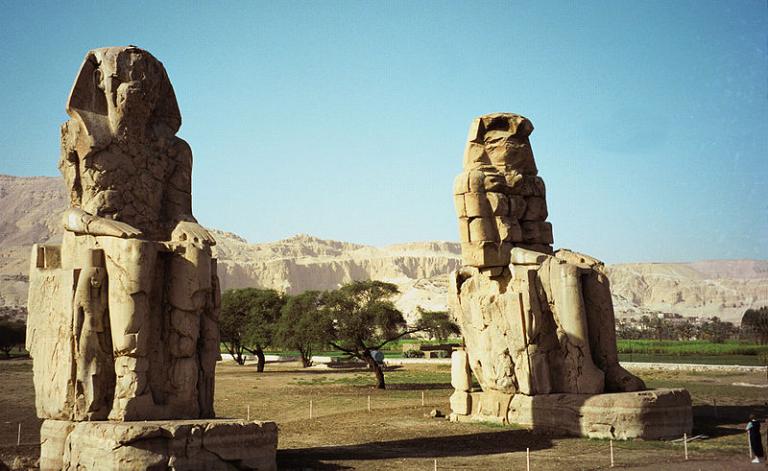
The Colossi of Memnon (Wikimedia Commons public domain image))
These two substantially ruined statues of Amenhotep IV (Eighteenth Dynasty; ca. 1350 BC), located on the western bank of the Nile across from Luxor, are all that remains of his massive memorial temple. (Wikimedia Commons public domain photograph)
When I lead tours to Egypt, we invariably pause to look at the so-called (and miscalled) Colossi of Memnon, which are actually massive statues of Pharaoh Amenhotep IV that stand before his largely vanished mortuary temple on the West Bank of the Nile River near Luxor. While there, I read to them Percy Bysshe Shelley’s 1819 sonnet “Oxymandias”:
I met a traveller from an antique land
Who said: Two vast and trunkless legs of stone
Stand in the desert. Near them, on the sand,
Half sunk, a shattered visage lies, whose frown,
And wrinkled lip, and sneer of cold command,
Tell that its sculptor well those passions read
Which yet survive, stamped on these lifeless things,
The hand that mocked them and the heart that fed:
And on the pedestal these words appear:
“My name is Ozymandias, King of Kings:
Look on my works, ye Mighty, and despair!”
No thing beside remains. Round the decay
Of that colossal wreck, boundless and bare
The lone and level sands stretch far away.
Quick quiz: Off the top of your head, how much do you know about the life, reign, and personality of Amenhotep IV? And yet, once, he may have been the single most powerful, most important, and wealthiest person in the world.
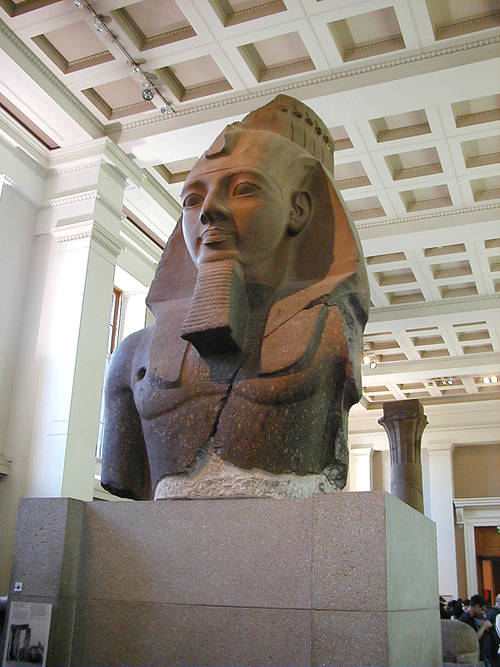
“The Younger Memnon” (actually a bust of the New Kingdom pharaoh Ramses II), which is now located in the British Museum in London, may have been the inspiration for Shelley’s poem.
To choose yet another example, closer in time and place: Grover Cleveland (1837-1908) was elected twice as president of the United States. Until recently, he was the only person who had served two non-consecutive terms in the White House, as the 22nd and 24th president, serving from 1885 to 1889 and again from 1893 to 1897.
Back in the nineties, I spent a summer at Princeton University in New Jersey. One day, walking around the core of the town, I visited the Princeton Cemetery. (I enjoy historic cemeteries; it’s a strange quirk of mine.) I had done no reading in preparation for my visit to the cemetery, so I was pleasantly surprised to come, by chance, upon the grave of President Grover Cleveland. It was a beautiful sunny day, and I had the cemetery entirely to myself. I was struck by the simplicity of the grave. Grover Cleveland had once (twice!) been the most powerful man in the country, and here was his final earthly resting place, surrounded by the graves of hundreds of others who have been almost entirely forgotten, if not entirely so. There was no great monument. There were no visitors. This is what he had come to after all the pomp and power of America’s highest office.
Another quick quiz: Off the top of your head, how much do you know about the life, the presidency, and the personality of Grover Cleveland?
Given his presuppositions, Bertrand Russell, whom I quoted in yesterday’s blog entry, was surely right: Human achievements do not endure. And, in the end, the universe is entirely indifferent to them all. They will have made no difference whatever.
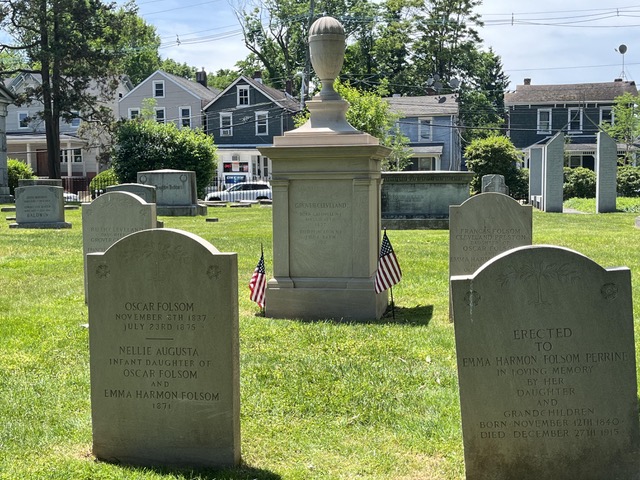
In this photograph, two American flags decorate the grave of President Grover Cleveland. (Wikimedia Commons public domain photograph). On the day that I visited the cemetery, there were no decorations at all.
In conclusion, I share something from the Christopher Hitchens Memorial “How Religion Poisons Everything” File™: “From Competition to Collaboration: How BYU Athletics Shines Christ’s Light Through Service”
Travel and Religion
History and Religion
Previous Post
October 15, 2025
"All is Vanity"
Next Post

October 17, 2025 A horror has come upon the residents of Cody, Wyoming
Recent Comments
"I have cpnsidered in my mond if the 4 volume Saints could be made into ..."
From Serbia’s “White City,” Belgrade
"Another class of memories are of individuals who previously lived. Some of these remembered individuals ..."
"Sutherland's lecture sounds interesting. He seems to restate the Washington consensus that trade brings peace ..."
Learning more about a region of ..."
"In a meeting today, I learned another important reason why accurate (or at least as ..."
From Serbia’s “White City,” Belgrade
Browse Our Archives
Select a Category Uncategorized
Select a Month October 2026 September 2026 August 2026 July 2026 June 2026 May 2026 April 2026 March 2026 February 2026 January 2026 December 2025 November 2025 October 2025 September 2025 August 2025 July 2025 June 2025 May 2025 April 2025 March 2025 February 2025 January 2025 December 2024 November 2024 October 2024 September 2024 August 2024 July 2024 June 2024 May 2024 April 2024 March 2024 February 2024 January 2024 December 2023 November 2023 October 2023 September 2023 August 2023 July 2023 June 2023 May 2023 April 2023 March 2023 February 2023 January 2023 December 2022 November 2022 October 2022 September 2022 August 2022 July 2022 June 2022 May 2022 April 2022 March 2022 February 2022 January 2022 December 2021 November 2021 October 2021 September 2021 August 2021 July 2021 June 2021 May 2021 April 2021 March 2021 February 2021 January 2021 December 2020 November 2020 October 2020 September 2020 August 2020 July 2020 June 2020 May 2020 April 2020 March 2020 February 2020 January 2020 December 2019 November 2019 October 2019 September 2019 August 2019 July 2019 June 2019 May 2019 April 2019 March 2019 February 2019 January 2019 December 2018 November 2018 October 2018 September 2018 August 2018 July 2018 June 2018 May 2018 April 2018 March 2018 February 2018 January 2018 December 2017 November 2017 October 2017 September 2017 August 2017 July 2017 June 2017 May 2017 April 2017 March 2017 February 2017 January 2017 December 2016 November 2016 October 2016 September 2016 August 2016 July 2016 June 2016 May 2016 April 2016 March 2016 February 2016 January 2016 December 2015 November 2015 October 2015 September 2015 August 2015 July 2015 June 2015 May 2015 April 2015 March 2015 February 2015 January 2015 December 2014 November 2014 March 2014 August 2013 February 2012
Follow Us!
TAKE THE
Religious Wisdom Quiz
A Samaritan stopped to help a wounded man after a priest and a Levite passed by. Where was the man traveling from and to?
Select your answer to see how you score.
From Galilee to Judea From Jerusalem to Jericho From Samaria to Nazareth From Bethany to Jerusalem
Related posts from Sic et Non


Notes on Women, Priesthood, and General Conference

"The Book of Moses as a Temple Text"

TRENDING AT PATHEOS Latter-day Saint

57th Dove Awards Honor Dolly Parton, Crown New...
On gospel music’s biggest night, the 57th annual GMA Dove Awards honored...

The First Eucharistic Controversy: Christ’s Real Presence
For Catholics, the Eucharist is the source and summit of the Christian...

What a Stop Sign Can Teach Us About...
How to Make a Decision When You Can't Hear God Main point:...

Archdiocese Hosts Military Marriage Retreat in Germany
RASTATT, Germany — The transient military lifestyle, with its frequent deployments and...

Nearly every morning, I make the drive to Detroit with my high-school-age...

The Real AI Story Is Adoption Without Trust
Artificial intelligence has crossed a political threshold. It is no longer a...
view all Latter-day Saint blogs
What Are Your Thoughts?leave a comment
Ad-Free & Subscriber Log-In Subscription Support
- About Us
- 2026 Calendar
- Videos
- Podcasts
- Library of World Religions
- Faith In Media Tracker
- Advertise With Us
- Write for Us
- Privacy Policy
- Terms of Service
- Do Not Sell My Data
- Contact Us
- Radiant Digital
- Manage Newsletter Subscriptions
- Unsubscribe From Notifications
- Sitemap
Copyright 2008-2026, Patheos. All rights reserved.
Subscription Support Ad-Free & Subscriber Log-In
Follow Patheos