
BuddhistCatholicContemplativeEvangelicalGeneral ChristianHinduJewishLatter-day SaintMuslimNew VisionsProgressive Christian
Beliefs
- Buddhist
- Catholic
- Contemplative
- Evangelical
- General Christian
- Hindu
- Jewish
- Latter-day Saint
- More Voices
- Muslim
- New Visions
- Pagan
- Progressive Christian
Topics
- Religion News
- Food and Religion
- Sports and Religion
- Religious Art
- Religious Music and Entertainment
- Religious Events
- History and Religion
- Style and Religion
- Politics and Religion
- Women in Religion
- Recreation Outdoors and Religion
- Business Finance and Religion
- Careers Workplace and Religion
- Education and Religion
- Family Parenting and Religion
- Health Fitness and Religion
- Home and Religion
- Relationships and Religion
- Technology and Religion
- Travel and Religion
Columnists
- Buddhist Columnists
- Business Finance and Religion Columnists
- Careers Workplace and Religion Columnists
- Catholic Columnists
- Contemplative Columnists
- Education and Religion Columnists
- Evangelists Columnists
- Family Parenting and Religion Columnists
- General Christian Columnists
- Health Fitness and Religion Columnists
- Hindu Columnists
- History and Religion Columnists
- Home and Religion Columnists
- Jewish Columnists
- More Voices Columnists
- Latter Day Columnists
- Muslim Columnists
- New Visions Columnists
- Nonreligious Columnists
- Pagan Columnists
- Politics and Religion Columnists
- Progressive Columnists
- Recreation Outdoors and Religion Columnists
- Relationships and Religion Columnists
- Religion News Columnists
- Religious Art Columnists
- Religious Events Columnists
- Religious Music and Entertainment Columnists
- Sports and Religion Columnists
- Style and Religion Columnists
- Technology and Religion Columnists
- Travel and Religion Columnists
- Women in Religion Columnists
Resource Library
- 2026 Calendar
- Library of World Religions
- The 100 Most Holy Places on Earth
- Patheos Answers
- Podcasts
- Videos
- Faith Leaders Database
- Anglican Episcopalian
- Bahai
- Baptist
- Buddhism
- Christianity
- Confucianism
- Eastern Orthodoxy
- Hinduism
- Holiness and Pentecostal
- ISKCON
- Islam
- Judaism
- Lutheran
- Methodist
- The Church of Jesus Christ of Latter-day Saints
- New Age
- Paganism
- Presbytarian and Reformed
- Protestantism
- Religion Behind the Scenes
- Roman Catholic
- Scientology
- Shia Islam
- Sikhism
- Sufism
- Sunni Islam
- Taoism
- Zen
- See all religions
Research Tools
 Ad-Free & Subscriber Log-In Subscription Support
Ad-Free & Subscriber Log-In Subscription Support
Follow Patheos 

- Trending:
- Forgiveness
- |
- Marriage
- |
- Consciousness
- |
- Death Penalty
- |
- Election
- |
- Halloween

- Home
- Latter-day Saint
- Travel and Religion
- “All is Vanity”
“All is Vanity”
Last updated on: October 15, 2025 at 6:30 pm by Dan Peterson
“All is Vanity” 2025-10-15T18:30:56-06:00 Dan Peterson
Patheos Explore the world's faith through different perspectives on religion and spirituality! Patheos has the views of the prevalent religions and spiritualities of the world.
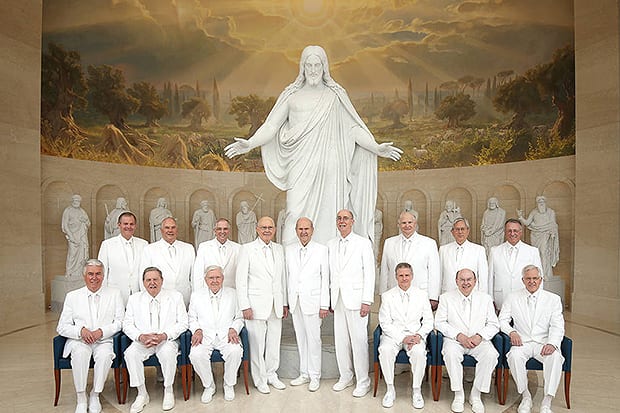
Every member of the First Presidency and the Quorum of the Twelve Apostles of The Church of Jesus Christ of Latter-day Saints, dressed in white temple clothing, posed before marble replicas of Bertel Thorvaldsen’s Christus and his apostles in an iconic photograph at the Rome Italy Temple Visitors’ Center in Rome, Italy on Monday, 11 March 2019. Front center are President Russell M. Nelson and his counselors in the First Presidency, President Dallin H. Oaks and President Henry B. Eyring. Also included are members of the Quorum of the Twelve Apostles: President M. Russell Ballard, Elder Jeffrey R. Holland, Elder Dieter F. Uchtdorf, Elder David A. Bednar, Elder Quentin L. Cook, Elder D. Todd Christofferson, Elder Neil L. Andersen, Elder Ronald A. Rasband, Elder Gary E. Stevenson, Elder Dale G. Renlund, Elder Gerrit W. Gong, and Elder Ulisses Soares. Photo by Jeffrey D. Allred, Deseret News. (I hope that they won’t mind my use of this astonishing photograph, with acknowledgement. If there is an objection, I can be reached at [email protected].)
This article that I wrote went up yesterday in Meridian Magazine: “The Keys of Heaven and Apostolic Succession.” At its conclusion, I recommend several resources that I think some will find both useful and enjoyable. (I’m still stunned at the fact that we can hear the recorded voice of President Wilford Woodruff from 1897 as he testifies of the Prophet Joseph Smith.) Also in Meridian, here is a summary of the meeting in which the new First Presidency was announced: “Dallin H. Oaks Ordained as Church’s New President.”
And, while we’re in the neighborhood, this is an excellent profile of the Church’s new president: “Who is President Dallin H. Oaks? A man shaped by loss, defined by resilience and warmth: Behind his prodigious intellect and an enormous capacity for hard work is a warm, jovial family man with a defining faith in Jesus Christ” For what little it may be worth, it’s consistent with my own handful of personal experiences with President Oaks over many years.
My unfortunate habit of paying more attention to critics of the Church than most of them deserve can sometimes be more than a little discouraging. I’m already seeing attacks on the character and life of President Oaks (who is, among other things, said to have a long record of intolerance, lies, and unethical behavior). I expected no less. But I admit to some surprise at seeing attacks so soon on D. Todd Christofferson.
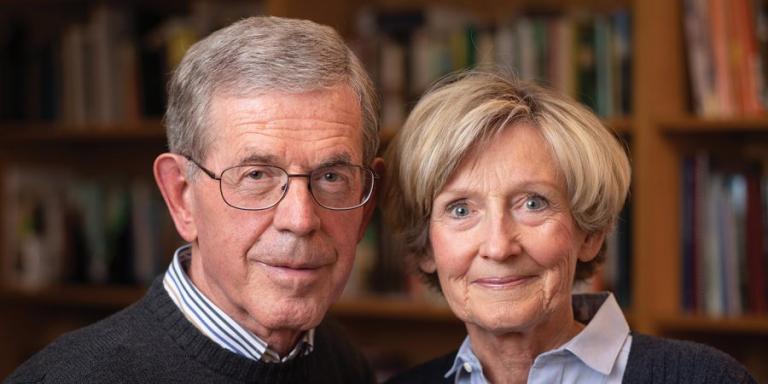
A former president of Ricks College (now Brigham Young University – Idaho), dean of the J. Reuben Clark Law School at Brigham Young University (BYU Provo), provost of BYU, and General Authority (First Quorum of the Seventy, from 1996 to 2010) Elder Bruce C. Hafen, assisted by his wife, Marie K. Hafen as temple matron, also presided over the St. George Utah Temple of the Church of Jesus Christ of Latter-day Saints.
Incidentally, in yesterday’s blog entry I shared a link to an article about Provo, a city “with a scandalous past.” I intended, but forgot, to mention an anecdote about Elder Bruce C. Hafen from back during his pre-general authority days as Provost of Brigham Young University. (It’s an office that many colleges and universities have, but that BYU only had during, I think, two university presidencies and does not currently have.) He invited faculty and staff to propose definitions of the term provost, and the winning entry — I don’t know from whom it came — was “provost (adj): ‘most like Provo.'”

This artist’s conception illustrates a Jupiter-like planet alone in the dark of space, floating freely without a parent star. Astronomers recently uncovered evidence for ten such lone worlds, which are thought to have been “booted,” or ejected, from developing solar systems. The planet survey, called the Microlensing Observations in Astrophysics (MOA) project, scanned the central bulge of our Milky Way galaxy from 2006 to 2007. It used a 5.9-foot (1.8-meter) telescope at Mount John University Observatory in New Zealand, and a technique called gravitational microlensing. Astronomers estimate that free-floating worlds are more common than stars in our Milky Way galaxy, and perhaps in other galaxies, too.
A reader of this blog who comments civilly, intelligently, and respectfully despite his fundamental disagreement with my worldview — he can correct me if I’m wrong, but I think he’s an atheist or an agnostic — wrote to contest my summary of what I take to be the apostle Paul’s position in 1 Corinthians 15:
Moreover, if Christ did not rise from the dead, if there is no hope for a life beyond the grave, then it seems pointless to sacrifice our time, our talents, our energy, or our wealth for any cause beyond ourselves.
He writes, reasonably enough, that, even if there is no eternal life, we are alive now. We can still love, and find joy and happiness, especially if we don’t think overly deeply about how it will all end. And kindness and charity are still possible and, yes, fulfilling in their way.
This is all true, and I happily acknowledge it. (He badly misfires, however, when he seems to suggest that my viewpoint is “mercenary.” I made no mention of any desire for divine reward or any fear of divine wrath, and such considerations have absolutely no bearing on my position.)
This is a big issue, and I’m still formulating my thoughts on it. So let me take a quick and preliminary pass at a response.
I’ve always been impressed by the eloquent summation given by the British philosopher, logician, mathematician, public intellectual, 1950 Nobel laureate in Literature, and vocal atheist Bertrand Russell (1872-1970) — who was very famous when I was growing up — in “A Free Man’s Worship” (1903). It’s probably the most famous passage from what is perhaps his best known and most reprinted essay:
Purposeless [and . . .] void of meaning, is the world which Science presents for our belief. Amid such a world, if anywhere, our ideals henceforward must find a home. That Man is the product of causes which had no prevision of the end they were achieving; that his origin, his growth, his hopes and fears, his loves and his beliefs, are but the outcome of accidental collocations of atoms; that no fire, no heroism, no intensity of thought and feeling, can preserve an individual life beyond the grave; that all the labours of the ages, all the devotion, all the inspiration, all the noonday brightness of human genius, are destined to extinction in the vast death of the solar system, and that the whole temple of Man’s achievement must inevitably be buried beneath the débris of a universe in ruins—all these things, if not quite beyond dispute, are yet so nearly certain, that no philosophy which rejects them can hope to stand. Only within the scaffolding of these truths, only on the firm foundation of unyielding despair, can the soul’s habitation henceforth be safely built.”
That seems a pretty clear-eyed view of things from an atheistic, naturalistic viewpoint. It’s cold and clear and lacking sentimentality.
Can we find local happiness in a blind, indifferent universe that’s full of chaos and pointless suffering? Certainly. As Voltaire’s Candide puts it, taking a Stoic rather than a despairing point of view, Il faut cultiver notre jardin (“We must cultivate our garden”). We can find limited happiness on our little patch, in our little locality, if we don’t look too far into the future or too far abroad.
But doing so can sometimes seem rather like the proverbial rearranging of the deck chairs on the Titanic. Building sand castles on the beach can be fun, but it seems quite pointless, or at least quixotic, to put any huge degree of effort into constructing elaborate and artistic sand castles that will be destroyed within, at most, a few hours.
If, indeed, we don’t simply commit suicide — in his essay The Myth of Sisyphus, Albert Camus famously declares that, given life’s absurdity, its objective meaninglessness, suicide is the “one truly serious philosophical problem” — perhaps the best response to the absence of God, the inevitability of death, and the sheer random pointlessness of life and the cosmos, would be to tend to our own livelihood and well-being, perhaps extending our care to our loved ones and immediate neighbors, while leaving others to cultivate their gardens as they choose.
Curiously, the biblical book of Ecclesiastes expresses such a view rather well:
1:1 The words of the Preacher, the son of David, king in Jerusalem.
2 Vanity of vanities, saith the Preacher, vanity of vanities; all is vanity.
3 What profit hath a man of all his labour which he taketh under the sun?
4 One generation passeth away, and another generation cometh: but the earth abideth for ever.
5 The sun also ariseth, and the sun goeth down, and hasteth to his place where he arose.
6 The wind goeth toward the south, and turneth about unto the north; it whirleth about continually, and the wind returneth again according to his circuits.
7 All the rivers run into the sea; yet the sea is not full; unto the place from whence the rivers come, thither they return again.
8 All things are full of labour; man cannot utter it: the eye is not satisfied with seeing, nor the ear filled with hearing.
9 The thing that hath been, it is that which shall be; and that which is done is that which shall be done: and there is no new thing under the sun.
10 Is there any thing whereof it may be said, See, this is new? it hath been already of old time, which was before us.
11 There is no remembrance of former things; neither shall there be any remembrance of things that are to come with those that shall come after.
12 I the Preacher was king over Israel in Jerusalem.
13 And I gave my heart to seek and search out by wisdom concerning all things that are done under heaven: this sore travail hath God given to the sons of man to be exercised therewith.
14 I have seen all the works that are done under the sun; and, behold, all is vanity and vexation of spirit.
15 That which is crooked cannot be made straight: and that which is wanting cannot be numbered.
16 I communed with mine own heart, saying, Lo, I am come to great estate, and have gotten more wisdom than all they that have been before me in Jerusalem: yea, my heart had great experience of wisdom and knowledge.
17 And I gave my heart to know wisdom, and to know madness and folly: I perceived that this also is vexation of spirit.
18 For in much wisdom is much grief: and he that increaseth knowledge increaseth sorrow. . . . (1:1-18)
3:19 For that which befalleth the sons of men befalleth beasts; even one thing befalleth them: as the one dieth, so dieth the other; yea, they have all one breath; so that a man hath no preeminence above a beast: for all is vanity.
20 All go unto one place; all are of the dust, and all turn to dust again. (3:19-20)
One helpful little essay on the subject that I can commend is from the prominent Evangelical Protestant philosopher William Lane Craig: “The Absurdity of Life without God.”
Travel and Religion
History and Religion
Previous Post

October 14, 2025
He's from a "conservative city with a scandalous past"
Next Post

October 16, 2025 "Signifying nothing"
Recent Comments
"DP: “But Mr. Sutherland worries about the fact that our time, when we can communicate ..."
Learning more about a region of ..."
"Another class of memories are of individuals who previously lived. Some of these remembered individuals ..."
"Sutherland's lecture sounds interesting. He seems to restate the Washington consensus that trade brings peace ..."
Learning more about a region of ..."
"In a meeting today, I learned another important reason why accurate (or at least as ..."
From Serbia’s “White City,” Belgrade
Browse Our Archives
Select a Category Uncategorized
Select a Month October 2026 September 2026 August 2026 July 2026 June 2026 May 2026 April 2026 March 2026 February 2026 January 2026 December 2025 November 2025 October 2025 September 2025 August 2025 July 2025 June 2025 May 2025 April 2025 March 2025 February 2025 January 2025 December 2024 November 2024 October 2024 September 2024 August 2024 July 2024 June 2024 May 2024 April 2024 March 2024 February 2024 January 2024 December 2023 November 2023 October 2023 September 2023 August 2023 July 2023 June 2023 May 2023 April 2023 March 2023 February 2023 January 2023 December 2022 November 2022 October 2022 September 2022 August 2022 July 2022 June 2022 May 2022 April 2022 March 2022 February 2022 January 2022 December 2021 November 2021 October 2021 September 2021 August 2021 July 2021 June 2021 May 2021 April 2021 March 2021 February 2021 January 2021 December 2020 November 2020 October 2020 September 2020 August 2020 July 2020 June 2020 May 2020 April 2020 March 2020 February 2020 January 2020 December 2019 November 2019 October 2019 September 2019 August 2019 July 2019 June 2019 May 2019 April 2019 March 2019 February 2019 January 2019 December 2018 November 2018 October 2018 September 2018 August 2018 July 2018 June 2018 May 2018 April 2018 March 2018 February 2018 January 2018 December 2017 November 2017 October 2017 September 2017 August 2017 July 2017 June 2017 May 2017 April 2017 March 2017 February 2017 January 2017 December 2016 November 2016 October 2016 September 2016 August 2016 July 2016 June 2016 May 2016 April 2016 March 2016 February 2016 January 2016 December 2015 November 2015 October 2015 September 2015 August 2015 July 2015 June 2015 May 2015 April 2015 March 2015 February 2015 January 2015 December 2014 November 2014 March 2014 August 2013 February 2012
Follow Us!
TAKE THE
Religious Wisdom Quiz
What did God create on the second day?
Select your answer to see how you score.
Trees Sun Fish Sky
Related posts from Sic et Non


Notes on Women, Priesthood, and General Conference

"The Book of Moses as a Temple Text"

TRENDING AT PATHEOS Latter-day Saint

The First Eucharistic Controversy: Christ’s Real Presence
For Catholics, the Eucharist is the source and summit of the Christian...

How to Make a Decision When You Can't...
Main point: It’s much more valuable to stay close to God so...

Archdiocese Hosts Military Marriage Retreat in Germany
RASTATT, Germany — The transient military lifestyle, with its frequent deployments and...

Nearly every morning, I make the drive to Detroit with my high-school-age...

The Real AI Story Is Adoption Without Trust
Artificial intelligence has crossed a political threshold. It is no longer a...

A new article, written by Jeff Lindsay and Gale L. Pooley,...
view all Latter-day Saint blogs
What Are Your Thoughts?leave a comment
Ad-Free & Subscriber Log-In Subscription Support
- About Us
- 2026 Calendar
- Videos
- Podcasts
- Library of World Religions
- Faith In Media Tracker
- Advertise With Us
- Write for Us
- Privacy Policy
- Terms of Service
- Do Not Sell My Data
- Contact Us
- Radiant Digital
- Manage Newsletter Subscriptions
- Unsubscribe From Notifications
- Sitemap
Copyright 2008-2026, Patheos. All rights reserved.
Subscription Support Ad-Free & Subscriber Log-In
Follow Patheos