
BuddhistCatholicContemplativeEvangelicalGeneral ChristianHinduJewishLatter-day SaintMuslimNew VisionsProgressive Christian
Beliefs
- Buddhist
- Catholic
- Contemplative
- Evangelical
- General Christian
- Hindu
- Jewish
- Latter-day Saint
- More Voices
- Muslim
- New Visions
- Pagan
- Progressive Christian
Topics
- Religion News
- Food and Religion
- Sports and Religion
- Religious Art
- Religious Music and Entertainment
- Religious Events
- History and Religion
- Style and Religion
- Politics and Religion
- Women in Religion
- Recreation Outdoors and Religion
- Business Finance and Religion
- Careers Workplace and Religion
- Education and Religion
- Family Parenting and Religion
- Health Fitness and Religion
- Home and Religion
- Relationships and Religion
- Technology and Religion
- Travel and Religion
Columnists
- Buddhist Columnists
- Business Finance and Religion Columnists
- Careers Workplace and Religion Columnists
- Catholic Columnists
- Contemplative Columnists
- Education and Religion Columnists
- Evangelists Columnists
- Family Parenting and Religion Columnists
- General Christian Columnists
- Health Fitness and Religion Columnists
- Hindu Columnists
- History and Religion Columnists
- Home and Religion Columnists
- Jewish Columnists
- More Voices Columnists
- Latter Day Columnists
- Muslim Columnists
- New Visions Columnists
- Nonreligious Columnists
- Pagan Columnists
- Politics and Religion Columnists
- Progressive Columnists
- Recreation Outdoors and Religion Columnists
- Relationships and Religion Columnists
- Religion News Columnists
- Religious Art Columnists
- Religious Events Columnists
- Religious Music and Entertainment Columnists
- Sports and Religion Columnists
- Style and Religion Columnists
- Technology and Religion Columnists
- Travel and Religion Columnists
- Women in Religion Columnists
Resource Library
- 2026 Calendar
- Library of World Religions
- The 100 Most Holy Places on Earth
- Patheos Answers
- Podcasts
- Videos
- Faith Leaders Database
- Anglican Episcopalian
- Bahai
- Baptist
- Buddhism
- Christianity
- Confucianism
- Eastern Orthodoxy
- Hinduism
- Holiness and Pentecostal
- ISKCON
- Islam
- Judaism
- Lutheran
- Methodist
- The Church of Jesus Christ of Latter-day Saints
- New Age
- Paganism
- Presbytarian and Reformed
- Protestantism
- Religion Behind the Scenes
- Roman Catholic
- Scientology
- Shia Islam
- Sikhism
- Sufism
- Sunni Islam
- Taoism
- Zen
- See all religions
Research Tools
 Ad-Free & Subscriber Log-In Subscription Support
Ad-Free & Subscriber Log-In Subscription Support
Follow Patheos 

- Trending:
- Forgiveness
- |
- Marriage
- |
- Consciousness
- |
- Death Penalty
- |
- Election
- |
- Halloween

- Home
- Latter-day Saint
- History and Religion
- Tempting Fate on the Oregon Coast?
Tempting Fate on the Oregon Coast?
Last updated on: September 4, 2025 at 10:24 pm by Dan Peterson
Tempting Fate on the Oregon Coast? 2025-09-04T22:24:23-06:00 Dan Peterson
Patheos Explore the world's faith through different perspectives on religion and spirituality! Patheos has the views of the prevalent religions and spiritualities of the world.
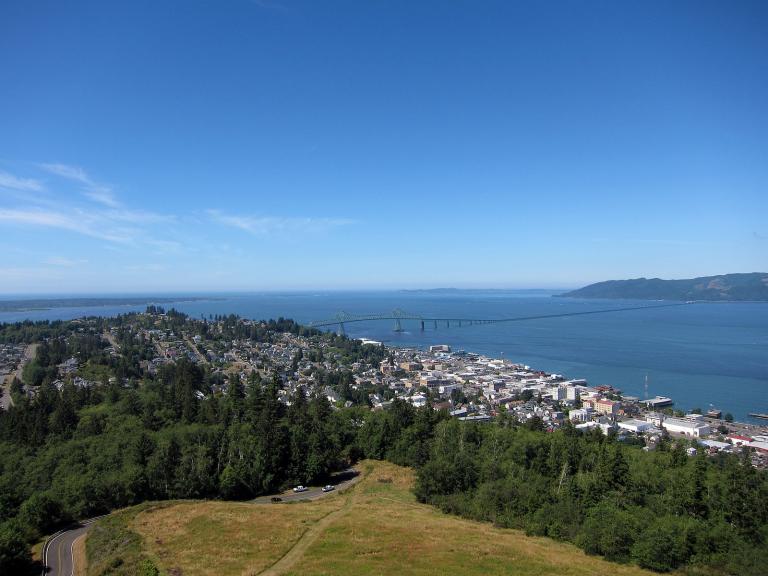
A view of Astoria, Oregon; the Astoria–Megler Bridge; and the mouth of the Columbia River from atop the Astoria Column. (Wikimedia Commons public domain image)
With our friends, we headed up to Astoria this morning. It’s the oldest city in the state of Oregon and, in fact, having been founded in 1811, was the first permanent American settlement west of the Rocky Mountains. Astoria is located on the south shore of the mighty Columbia River, near where the Columbia confronts the Pacific Ocean — creating the most continually turbulent estuary in the United States (and, possibly, in the world). Astoria was named after John Jacob Astor, whose American Fur Company founded Fort Astoria at the site in the early nineteenth century, establishing a monopoly in the fur trade that made him enormously wealthy. (His great grandson, John Jacob Astor IV, was — famously, tragically, and perhaps heroically — a passenger aboard RMS Titanic during its maiden and final voyage. John Jacob IV died at the age of forty-seven, on 15 April 1912.)
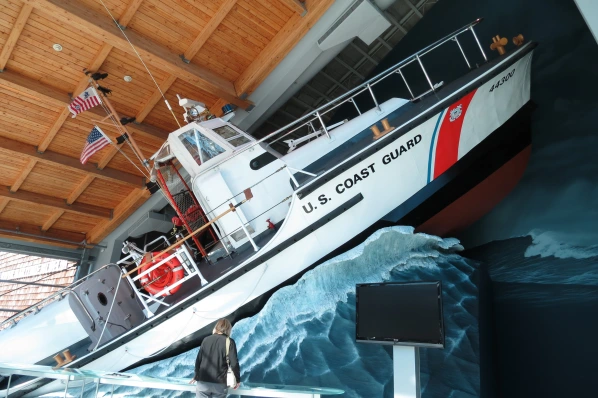
This dramatic display features an actual (retired) 44-foot Coast Guard rescue boat. Waves in the vicinity of the “Columbia Bar” often reach a height of forty feet. (Wikimedia Commons public domain image)
We started off by spending a couple of hours in the very good Columbia River Maritime Museum (CRMM), which does an excellent job of, among other things, telling about the two thousand (or perhaps three thousand) shipwrecks that have occurred along the Oregon coast (and especially near the mouth of the Columbia River) over the past two hundred and fifty years or so and illustrating and celebrating the impressive skill and heroism of members of the United States Coast Guard. Today, we watched a 3D film about a nuclear aircraft carrier and its battle group during international maneuvers. I found it quite interesting. This is perhaps the fourth or fifth time that my wife and I have visited the CRMM, and we recommend it.
We also recommend Bowpicker Fish and Chips, which is where we headed immediately after we were done at the Museum. In fact, Bowpicker is located almost directly across from the Museum in a converted gillnet boat. Bowpicker does Albacore tuna fish and chips. Or, if you would prefer, it also offers Albacore tuna chips and fish. The fish is caught locally, usually about thirty-five miles off shore, and it’s very, very good, which explains why there’s always a queue (which moves fairly rapidly). There are also no tables or seats, except for one park table with benches that’s situated across the street.
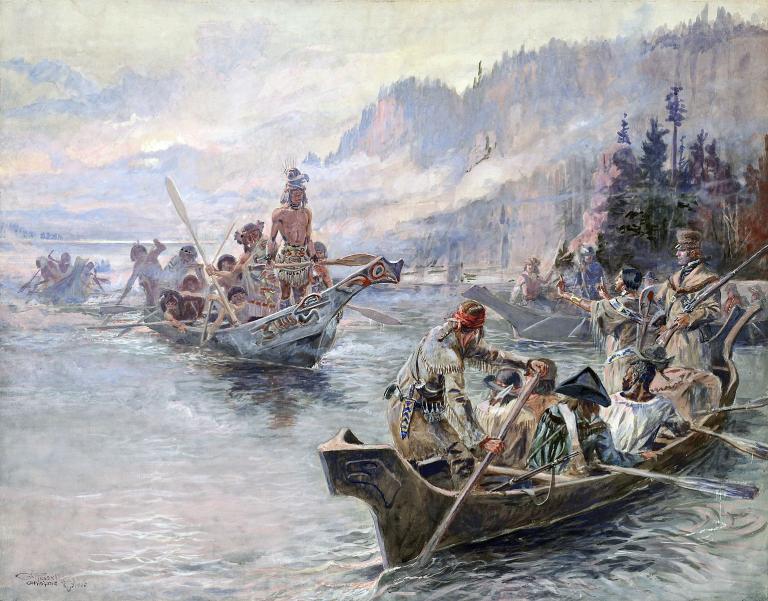
“Lewis and Clark on the Lower Columbia,” by Charles Marion Russell (1905)
(Wikimedia Commons public domain image)
From Bowpicker, we drove up the hill to the Astoria Column, with its panoramic view of the surrounding area. Then we crossed over the Lower Columbia River via the Astoria-Megler Bridge to the state of Washington, where we spent a fair amount of time at the Lewis and Clark Interpretive Center, high up on the cliffs at Cape Disappointment.
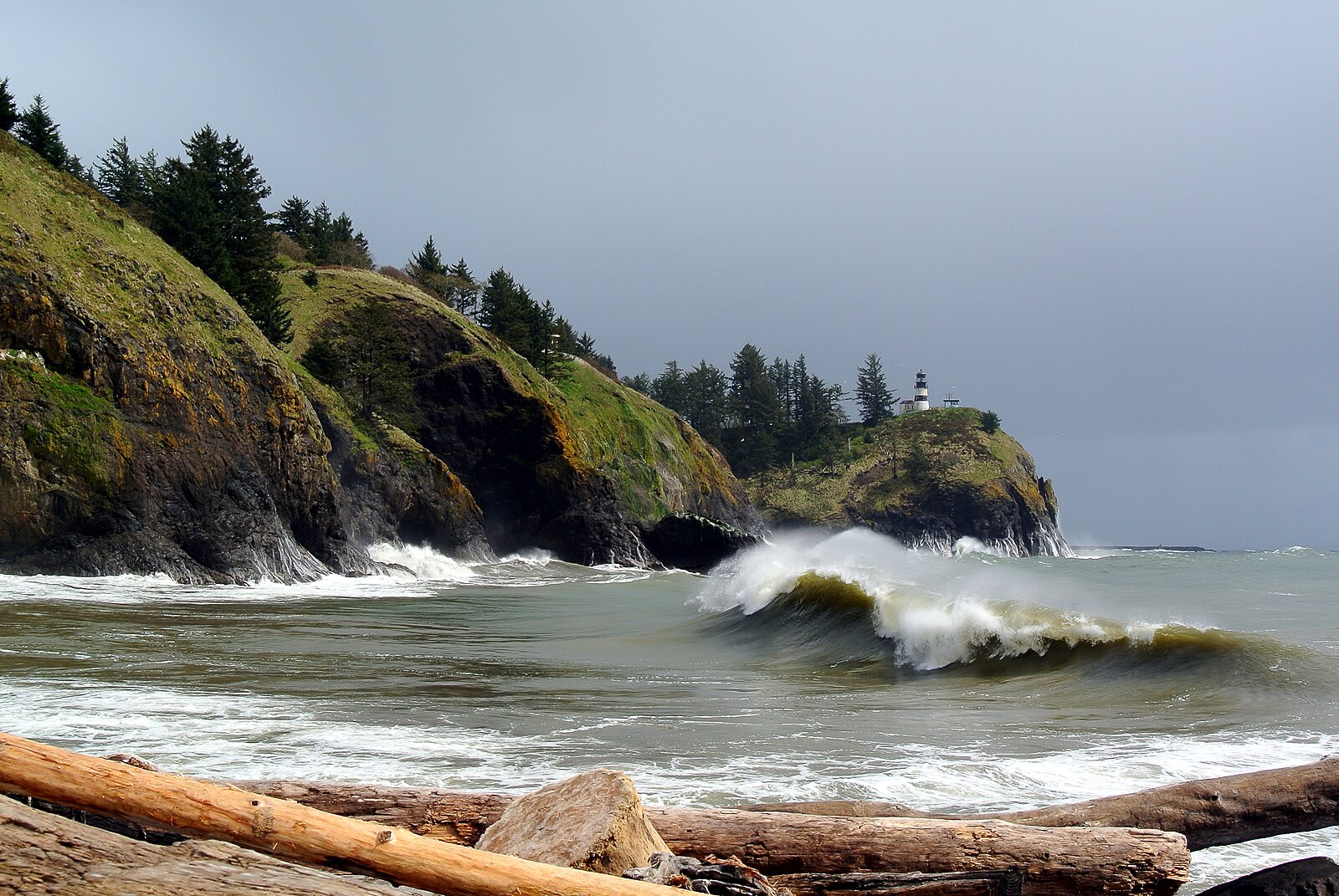
Cape Disappointment with its lighthouse. The Lewis and Clark Interpretive Center is out of sight to the left of the lighthouse, but the two are within relatively easy walking distance of each other. (Wikimedia Commons public domain photograph)
In the gift shop at the Columbia River Maritime Museum, I browed through a book entitled The Next Tsunami: Living on a Restless Coast, written by Bonnie Henderson. As you’ll be able to understand from the blurb about the book that appears on Amazon.com, maybe it was unwise on my part to stand there browsing through it:
On a March evening in 1964, ten-year-old Tom Horning awoke near midnight to find his yard transformed. A tsunami triggered by Alaska’s momentous Good Friday earthquake had wreaked havoc in his Seaside, Oregon, neighborhood. It was, as far as anyone knew, the Pacific Northwest coast’s first-ever tsunami. More than twenty years passed before geologists discovered that it was neither Seaside’s first nor worst tsunami. In fact, massive tsunamis strike the Pacific coast every few hundred years, triggered not by distant temblors but by huge quakes less than one hundred miles off the Northwest coast. Not until the late 1990s would scientists use evidence like tree rings and centuries-old warehouse records from Japan to fix the date, hour, and magnitude of the Pacific Northwest coast’s last megathrust earthquake: 9 p.m., January 26, 1700, magnitude 9.0—one of the largest quakes the world has known. When the next one strikes—this year or hundreds of years from now—the tsunami it generates is likely to be the most devastating natural disaster in the history of the United States. In The Next Tsunami, Bonnie Henderson shares the stories of scientists like meteorologist Alfred Wegener, who formulated his theory of continental drift while gazing at ice floes calving from Greenland glaciers, and geologist Brian Atwater, who paddled his dented aluminum canoe up coastal streams looking for layers of peat sandwiched among sand and silt. The story begins and ends with Tom Horning, who grew up to become a geologist and return to his family home at the mouth of the river in Seaside—arguably the Northwest community with the most to lose from what scientist Atwater predicts will be an “apocalyptic” disaster. No one in Seaside understands earthquake science—and the politics and complicated psychology of living in a tsunami zone—better than Horning. Henderson’s compelling story of how scientists came to understand the Cascadia Subduction Zone—a fault line capable of producing earthquakes even larger than the 2011 Tohoku quake in Japan—and how ordinary people cope with that knowledge is essential reading for anyone interested in the charged intersection of science, human nature, and public policy.
I dunno. Maybe we should check out of our place here in Seaside and move a bit further inland and higher? My quick skim through The Next Tsunami probably won’t be any particular help with a good night’s sleep tonight.
By the way, I remember that 1964 earthquake in Alaska. My parents and I were camping on the beach near Ventura, California, when we were awakened by park rangers in (what seemed to me) the middle of the night and told to evacuate the beach for fear of a coming tsunami. They told us that it might conceivably be as high as a hundred feet. When it actually arrived, though, it was (fortunately) only a foot or two above normal. However, my older brother, ten years my senior, wasn’t with us. He was at home in San Gabriel. When he and his cronies heard about a coming tsunami, though, they immediately headed for Santa Monica, where they spent all night floating on their surfboards waiting for The Wave to come. They were deeply disappointed. But what if it had really come in at a hundred feet high? They would have ended up crashing through the glass on the fifth floor of the Pacific Telephone building, high up on the cliff above the Pacific Coast Highway.
Posted from Seaside, Oregon
History and Religion
Travel and Religion
Previous Post

September 3, 2025
Hearing from Reeve and Rich themselves
Next Post
September 5, 2025 Voices for dignity, respect, truth, happiness, and Jesus
Recent Comments
"DP: “But Mr. Sutherland worries about the fact that our time, when we can communicate ..."
Learning more about a region of ..."
"Another class of memories are of individuals who previously lived. Some of these remembered individuals ..."
"Sutherland's lecture sounds interesting. He seems to restate the Washington consensus that trade brings peace ..."
Learning more about a region of ..."
"In a meeting today, I learned another important reason why accurate (or at least as ..."
From Serbia’s “White City,” Belgrade
Browse Our Archives
Select a Category Uncategorized
Select a Month October 2026 September 2026 August 2026 July 2026 June 2026 May 2026 April 2026 March 2026 February 2026 January 2026 December 2025 November 2025 October 2025 September 2025 August 2025 July 2025 June 2025 May 2025 April 2025 March 2025 February 2025 January 2025 December 2024 November 2024 October 2024 September 2024 August 2024 July 2024 June 2024 May 2024 April 2024 March 2024 February 2024 January 2024 December 2023 November 2023 October 2023 September 2023 August 2023 July 2023 June 2023 May 2023 April 2023 March 2023 February 2023 January 2023 December 2022 November 2022 October 2022 September 2022 August 2022 July 2022 June 2022 May 2022 April 2022 March 2022 February 2022 January 2022 December 2021 November 2021 October 2021 September 2021 August 2021 July 2021 June 2021 May 2021 April 2021 March 2021 February 2021 January 2021 December 2020 November 2020 October 2020 September 2020 August 2020 July 2020 June 2020 May 2020 April 2020 March 2020 February 2020 January 2020 December 2019 November 2019 October 2019 September 2019 August 2019 July 2019 June 2019 May 2019 April 2019 March 2019 February 2019 January 2019 December 2018 November 2018 October 2018 September 2018 August 2018 July 2018 June 2018 May 2018 April 2018 March 2018 February 2018 January 2018 December 2017 November 2017 October 2017 September 2017 August 2017 July 2017 June 2017 May 2017 April 2017 March 2017 February 2017 January 2017 December 2016 November 2016 October 2016 September 2016 August 2016 July 2016 June 2016 May 2016 April 2016 March 2016 February 2016 January 2016 December 2015 November 2015 October 2015 September 2015 August 2015 July 2015 June 2015 May 2015 April 2015 March 2015 February 2015 January 2015 December 2014 November 2014 March 2014 August 2013 February 2012
Follow Us!
TAKE THE
Religious Wisdom Quiz
What city's walls fell after the Israelites marched around them?
Select your answer to see how you score.
Ai Jericho Jerusalem Bethel
Related posts from Sic et Non
The Gulf of Alaska and Yakutat Bay

Native Americans, Musk Oxen, and More

Maybe I believe it but think I DON'T...
TRENDING AT PATHEOS Latter-day Saint

Swimfan: Forgotten Aughts Pleasures
This is a recovery effort. In 2002, My Big Fat Greek Wedding...

Top Three Anti-Catholic Lies About Catholicism
This is my initial transcript for the video, "THE 3 WORST...

Pope Leo Celebrates Mass for Nurses & Docs...
I don't have any idea how he did it, but Pope Leo...

The Sermon on the Mount, Part I: Matthew...
The Sermon on the Mount, Part I (Matthew 4:12-5:12) St. Matthew moves...

What's up from Crossway: Reviewing some of their latest A few weeks...

Janie Learns the Way of the Cross: A...
Teaching children about Jesus' Passion can be challenging. Many parents and educators...
view all Latter-day Saint blogs
What Are Your Thoughts?leave a comment
Ad-Free & Subscriber Log-In Subscription Support
- About Us
- 2026 Calendar
- Videos
- Podcasts
- Library of World Religions
- Faith In Media Tracker
- Advertise With Us
- Write for Us
- Privacy Policy
- Terms of Service
- Do Not Sell My Data
- Contact Us
- Radiant Digital
- Manage Newsletter Subscriptions
- Unsubscribe From Notifications
- Sitemap
Copyright 2008-2026, Patheos. All rights reserved.
Subscription Support Ad-Free & Subscriber Log-In
Follow Patheos