
BuddhistCatholicContemplativeEvangelicalGeneral ChristianHinduJewishLatter-day SaintMuslimNew VisionsProgressive Christian
Beliefs
- Buddhist
- Catholic
- Contemplative
- Evangelical
- General Christian
- Hindu
- Jewish
- Latter-day Saint
- More Voices
- Muslim
- New Visions
- Pagan
- Progressive Christian
Topics
- Religion News
- Food and Religion
- Sports and Religion
- Religious Art
- Religious Music and Entertainment
- Religious Events
- History and Religion
- Style and Religion
- Politics and Religion
- Women in Religion
- Recreation Outdoors and Religion
- Business Finance and Religion
- Careers Workplace and Religion
- Education and Religion
- Family Parenting and Religion
- Health Fitness and Religion
- Home and Religion
- Relationships and Religion
- Technology and Religion
- Travel and Religion
Columnists
- Buddhist Columnists
- Business Finance and Religion Columnists
- Careers Workplace and Religion Columnists
- Catholic Columnists
- Contemplative Columnists
- Education and Religion Columnists
- Evangelists Columnists
- Family Parenting and Religion Columnists
- General Christian Columnists
- Health Fitness and Religion Columnists
- Hindu Columnists
- History and Religion Columnists
- Home and Religion Columnists
- Jewish Columnists
- More Voices Columnists
- Latter Day Columnists
- Muslim Columnists
- New Visions Columnists
- Nonreligious Columnists
- Pagan Columnists
- Politics and Religion Columnists
- Progressive Columnists
- Recreation Outdoors and Religion Columnists
- Relationships and Religion Columnists
- Religion News Columnists
- Religious Art Columnists
- Religious Events Columnists
- Religious Music and Entertainment Columnists
- Sports and Religion Columnists
- Style and Religion Columnists
- Technology and Religion Columnists
- Travel and Religion Columnists
- Women in Religion Columnists
Resource Library
- 2026 Calendar
- Library of World Religions
- The 100 Most Holy Places on Earth
- Patheos Answers
- Podcasts
- Videos
- Faith Leaders Database
- Anglican Episcopalian
- Bahai
- Baptist
- Buddhism
- Christianity
- Confucianism
- Eastern Orthodoxy
- Hinduism
- Holiness and Pentecostal
- ISKCON
- Islam
- Judaism
- Lutheran
- Methodist
- The Church of Jesus Christ of Latter-day Saints
- New Age
- Paganism
- Presbytarian and Reformed
- Protestantism
- Religion Behind the Scenes
- Roman Catholic
- Scientology
- Shia Islam
- Sikhism
- Sufism
- Sunni Islam
- Taoism
- Zen
- See all religions
Research Tools
 Ad-Free & Subscriber Log-In Subscription Support
Ad-Free & Subscriber Log-In Subscription Support
Follow Patheos 

- Trending:
- Forgiveness
- |
- Marriage
- |
- Consciousness
- |
- Death Penalty
- |
- Election
- |
- Halloween

- Home
- Latter-day Saint
- Travel and Religion
- Perhaps I should just let sleeping dogmatists lie?
Perhaps I should just let sleeping dogmatists lie?
Last updated on: September 22, 2025 at 4:09 pm by Dan Peterson
Perhaps I should just let sleeping dogmatists lie? 2025-09-22T16:09:42-06:00 Dan Peterson
Patheos Explore the world's faith through different perspectives on religion and spirituality! Patheos has the views of the prevalent religions and spiritualities of the world.

A Latter-day Saint congregation in 2012. (LDS Media Library)
This column in the Deseret News is worth a look: “Perspective: Online influencers aren’t accurately representing Latter-day Saint reality: Disaffected influencers might be leaving a religious movement, but they’re not leading one”
So is this piece, from the Deseret News Editorial Board: “Opinion: Regaining trust in vaccinations”
And this, too: “Ready to join the new counterculture? Braver Angels’ leader says it will take courage: In a culture of widening contempt, we have the power to choose something better, says Maury Giles” (Scarcely relevant footnote: Years ago, I participated — at his invitation — in three small meetings organized by David Blankenhorn: one Malaga, in southern Spain; one at the Carter Center in Atlanta; and one on the Mediterranean island of Malta. They were attempts to foster dialogue between the West and the Islamic Middle East. I haven’t been involved in Braver Angels, but I applaud its intent. David Blankenhorn is always trying to improve conversation across yawning divides.)

This gentleman is probably doing neither field archaeology, ancient history, textual analysis, nor historical linguistics. (Wikimedia Commons public domain image)
Responding to a comment following my blog entry “Calling All Experts!” I remarked that, on medical subjects, “as I do in many areas of my life, I tend to accept the consensus of experts.”
Unsurprisingly, that remark draw mockery from my groupies at the Peterson Obsession Board. After all, they follow me with absolutely rapt attention pretty much twenty-four hours a day, seven days a week, and many of them are either incapable of accurately understanding what I say or too intoxicated with hatred to care about attempting such an understanding.
“Folks,” says one of them, “you can’t make this stuff up” — a formulaic comment that is commonly used on the Obsession Board, as in this case, to signal that something made-up has just been presented or is about to be presented. After all, he says, Peterson is a guy “who employs [sic] LDS academics for the express purpose of going against the consensus of experts.” Which, I guess, is supposed to be a contradiction. Which, comments another groupie, proves me a “hypocrite.”
Except, of course, that it doesn’t.
Why? I’ll try to explain this so clearly that any reasonably intelligent and minimally honest reader should be able to follow me. How my groupies at the Obsession Board will react, of course, is a different matter.
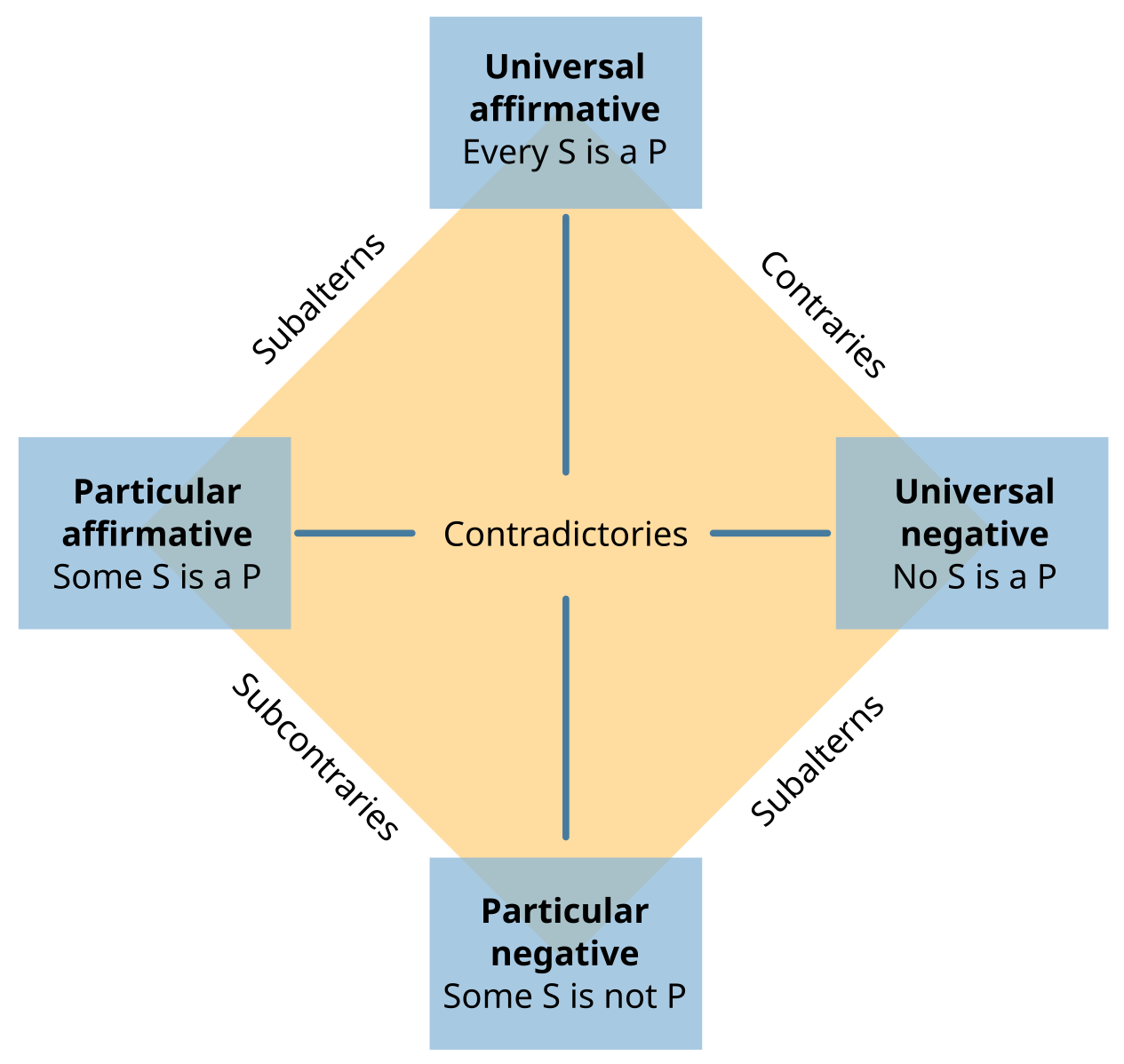
The logical “square of opposition” (Wikimedia Commons public domain image)
The four corners of the chart shown above represent the four basic forms of propositions recognized in classical (Aristotelian) logic:
A propositions, or universal affirmatives, take the form: All S are P or Every S is a P.
E propositions, or universal negations, take the form: No S are P or No S is a P.
I propositions, or particular affirmatives, take the form: Some S are P or Some S is a P.
O propositions, or particular negations, take the form: Some S are not P or Some S is not P.
On the assumption made within classical (Aristotelian) categorical logic, that every category contains at least one member, the following relationships hold within the square:
Firstly, A and O propositions are contradictory, as are E and I propositions. Propositions are contradictory when the truth of one implies the falsity of the other, and conversely. Thus, the truth of a proposition of the form All S are P implies the falsity of the corresponding proposition of the form Some S are not P. For example, if the proposition “All expert consensus opinions are trustworthy” (A) is true, then the proposition “Some expert consensus opinions are not trustworthy” (O) must be false. Similarly, if “No expert consensus views are trustworthy” (E) is false, then the proposition “Some expert consensus views are trustworthy” must be true.
Secondly, A and E propositions are contrary. Propositions are contrary when they cannot both be true. An A proposition — e.g., “All experts are right” — cannot be true at the same time as the corresponding E proposition: “No experts are right.” Please note, however, that A and E propositions, while they are contrary, are not contradictory. While they cannot both be true, they can both be false; “All experts are right” and “No experts are right” don’t exhaust the logical possibilities: “Some experts are right” (a proposition of form I), if it is the case, obviously falsifies the corresponding A and E propositions.
Next, I and O propositions are what classical Aristotelian logic terms subcontrary. Propositions are subcontrary when it is impossible for both to be false. Because “Some experts are infallible” is false, “Some experts are not infallible” must be true. Please notice, however, that it is possible for corresponding I and O propositions both to be true, as with “Some authorities are reliable,” and “Some authorities are not reliable.” Again, I and O propositions are subcontrary, but they are neither contrary nor contradictory.
Finally, two propositions are deemed to stand in the relation of subalternation when the truth of the first (the “superaltern”) implies the truth of the second (the “subaltern”), but not conversely. A propositions stand in the relation of subalternation with the corresponding I propositions. The truth of the A proposition “All experts are fallible” implies the truth of the proposition “Some experts are fallible.” However, the truth of the O proposition “Some experts are not correct” does not imply the truth of the E proposition “No experts are correct.” In traditional logic, the truth of an A or an E proposition implies the truth of the corresponding I or O proposition, respectively. Consequently, the falsity of an I or O proposition implies the falsity of the corresponding A or E proposition, respectively. However, the truth of a particular proposition does not imply the truth of the corresponding universal proposition, nor does the falsity of a universal proposition carry downwards to the respective particular propositions.
To return to my own specific case: I wrote that, in many areas of my life, I tend to accept the consensus of experts. I did not say that I always accept the consensus of experts in all areas of my life. What I actually did say can be translated into an I proposition, as follows: [Peterson believes that] Some consensus views of experts are worthy of trust, i.e., that Some S are P. Is it possible, though, for an I proposition to be true at the same time that an O proposition — Some S are not P — is true? Yes, it is. See above. They are subcontraries. They are not contrary statements, nor are they contradictory statements. It is possible — and it doesn’t make one a “hypocrite” — to believe, at the same time, that Some consensus views of experts are worthy of trust and that Some consensus views of experts are not worthy of trust.
Thus, I can be inclined to accept consensus medical and pharmacological views while, at the same time — and with neither hypocrisy nor self-contradiction — I dissent from consensus views about some aspects of pre-Classical Mesoamerica and related matters.
I doubt, of course, that this little excursus into the first week of Logic 101 — drawn quite unoriginally from https://iep.utm.edu/sqr-opp/ — will help my groupies over at the Obsession Board. I doubt that they want help. Still, although I’m retired from the university, I remain by disposition a teacher. As the late Geoffrey Chaucer put it:
A Clerk ther was of Oxenford also,
That unto logyk hadde longe ygo. . . .
Sownynge in moral vertu was his speche,
And gladly wolde he lerne and gladly teche.A Clerk there was also, from Oxford,
That had gone into the study of logic long ago. . . .
His speech was always consistent with moral virtue,
And gladly would he learn, and gladly teach.

The Church’s humanitarian efforts are already many and varied.
(LDS.org)
Religions typically teach and encourage service, so, in the spirit of the Christopher Hitchens Memorial “How Religion Poisons Everything” File™ where this was found, we are obligated to conclude that service, emotional health benefits, well-being, and decreased depression must be terribly, toxically, bad things: “The startling emotional health benefits of serving others: In study after study, service towards others — both strangers and family — shows a measurable impact in boosting well-being and decreasing depression”
Travel and Religion
History and Religion
Previous Post

September 20, 2025
Herman's Hermits and the Screwtape Letters
Next Post

September 23, 2025 Is there seeming evidence against the Restoration? Sure!
Recent Comments
"I have cpnsidered in my mond if the 4 volume Saints could be made into ..."
From Serbia’s “White City,” Belgrade
"DP: “But Mr. Sutherland worries about the fact that our time, when we can communicate ..."
Learning more about a region of ..."
"Another class of memories are of individuals who previously lived. Some of these remembered individuals ..."
"Sutherland's lecture sounds interesting. He seems to restate the Washington consensus that trade brings peace ..."
Learning more about a region of ..."
Browse Our Archives
Select a Category Uncategorized
Select a Month October 2026 September 2026 August 2026 July 2026 June 2026 May 2026 April 2026 March 2026 February 2026 January 2026 December 2025 November 2025 October 2025 September 2025 August 2025 July 2025 June 2025 May 2025 April 2025 March 2025 February 2025 January 2025 December 2024 November 2024 October 2024 September 2024 August 2024 July 2024 June 2024 May 2024 April 2024 March 2024 February 2024 January 2024 December 2023 November 2023 October 2023 September 2023 August 2023 July 2023 June 2023 May 2023 April 2023 March 2023 February 2023 January 2023 December 2022 November 2022 October 2022 September 2022 August 2022 July 2022 June 2022 May 2022 April 2022 March 2022 February 2022 January 2022 December 2021 November 2021 October 2021 September 2021 August 2021 July 2021 June 2021 May 2021 April 2021 March 2021 February 2021 January 2021 December 2020 November 2020 October 2020 September 2020 August 2020 July 2020 June 2020 May 2020 April 2020 March 2020 February 2020 January 2020 December 2019 November 2019 October 2019 September 2019 August 2019 July 2019 June 2019 May 2019 April 2019 March 2019 February 2019 January 2019 December 2018 November 2018 October 2018 September 2018 August 2018 July 2018 June 2018 May 2018 April 2018 March 2018 February 2018 January 2018 December 2017 November 2017 October 2017 September 2017 August 2017 July 2017 June 2017 May 2017 April 2017 March 2017 February 2017 January 2017 December 2016 November 2016 October 2016 September 2016 August 2016 July 2016 June 2016 May 2016 April 2016 March 2016 February 2016 January 2016 December 2015 November 2015 October 2015 September 2015 August 2015 July 2015 June 2015 May 2015 April 2015 March 2015 February 2015 January 2015 December 2014 November 2014 March 2014 August 2013 February 2012
Follow Us!
TAKE THE
Religious Wisdom Quiz
Which is the only book that does not mention "God"?
Select your answer to see how you score.
Esther Song of Solomon Lamentations Ezra
Related posts from Sic et Non


Notes on Women, Priesthood, and General Conference

"The Book of Moses as a Temple Text"

TRENDING AT PATHEOS Latter-day Saint

Letters on Living the Faith by C.S. Lewis
Most of us met C.S. Lewis as a public intellectual. Mere Christianity....

When Halloween Unmasks Married Hearts
Written by Dr. David K. Ewen from Eternal Truth Bible College Behind...

Aristotle. He’s been called the father of logic, the father of the...

Methodist Central Hall and Westminster Abbey
Situated on the same square is Methodist Central Hall and Westminster Abbey. ...

57th Dove Awards Honor Dolly Parton, Crown New...
On gospel music’s biggest night, the 57th annual GMA Dove Awards honored...

The First Eucharistic Controversy: Christ’s Real Presence
For Catholics, the Eucharist is the source and summit of the Christian...
view all Latter-day Saint blogs
What Are Your Thoughts?leave a comment
Ad-Free & Subscriber Log-In Subscription Support
- About Us
- 2026 Calendar
- Videos
- Podcasts
- Library of World Religions
- Faith In Media Tracker
- Advertise With Us
- Write for Us
- Privacy Policy
- Terms of Service
- Do Not Sell My Data
- Contact Us
- Radiant Digital
- Manage Newsletter Subscriptions
- Unsubscribe From Notifications
- Sitemap
Copyright 2008-2026, Patheos. All rights reserved.
Subscription Support Ad-Free & Subscriber Log-In
Follow Patheos