
BuddhistCatholicContemplativeEvangelicalGeneral ChristianHinduJewishLatter-day SaintMuslimNew VisionsProgressive Christian
Beliefs
- Buddhist
- Catholic
- Contemplative
- Evangelical
- General Christian
- Hindu
- Jewish
- Latter-day Saint
- More Voices
- Muslim
- New Visions
- Pagan
- Progressive Christian
Topics
- Religion News
- Food and Religion
- Sports and Religion
- Religious Art
- Religious Music and Entertainment
- Religious Events
- History and Religion
- Style and Religion
- Politics and Religion
- Women in Religion
- Recreation Outdoors and Religion
- Business Finance and Religion
- Careers Workplace and Religion
- Education and Religion
- Family Parenting and Religion
- Health Fitness and Religion
- Home and Religion
- Relationships and Religion
- Technology and Religion
- Travel and Religion
Columnists
- Buddhist Columnists
- Business Finance and Religion Columnists
- Careers Workplace and Religion Columnists
- Catholic Columnists
- Contemplative Columnists
- Education and Religion Columnists
- Evangelists Columnists
- Family Parenting and Religion Columnists
- General Christian Columnists
- Health Fitness and Religion Columnists
- Hindu Columnists
- History and Religion Columnists
- Home and Religion Columnists
- Jewish Columnists
- More Voices Columnists
- Latter Day Columnists
- Muslim Columnists
- New Visions Columnists
- Nonreligious Columnists
- Pagan Columnists
- Politics and Religion Columnists
- Progressive Columnists
- Recreation Outdoors and Religion Columnists
- Relationships and Religion Columnists
- Religion News Columnists
- Religious Art Columnists
- Religious Events Columnists
- Religious Music and Entertainment Columnists
- Sports and Religion Columnists
- Style and Religion Columnists
- Technology and Religion Columnists
- Travel and Religion Columnists
- Women in Religion Columnists
Resource Library
- 2026 Calendar
- Library of World Religions
- The 100 Most Holy Places on Earth
- Patheos Answers
- Podcasts
- Videos
- Faith Leaders Database
- Anglican Episcopalian
- Bahai
- Baptist
- Buddhism
- Christianity
- Confucianism
- Eastern Orthodoxy
- Hinduism
- Holiness and Pentecostal
- ISKCON
- Islam
- Judaism
- Lutheran
- Methodist
- The Church of Jesus Christ of Latter-day Saints
- New Age
- Paganism
- Presbytarian and Reformed
- Protestantism
- Religion Behind the Scenes
- Roman Catholic
- Scientology
- Shia Islam
- Sikhism
- Sufism
- Sunni Islam
- Taoism
- Zen
- See all religions
Research Tools
 Ad-Free & Subscriber Log-In Subscription Support
Ad-Free & Subscriber Log-In Subscription Support
Follow Patheos 

- Trending:
- Forgiveness
- |
- Marriage
- |
- Consciousness
- |
- Death Penalty
- |
- Election
- |
- Halloween

- Home
- Latter-day Saint
- Travel and Religion
- Hearing from Reeve and Rich themselves
Hearing from Reeve and Rich themselves
Last updated on: September 3, 2025 at 10:49 pm by Dan Peterson
Hearing from Reeve and Rich themselves 2025-09-03T22:49:21-06:00 Dan Peterson
Patheos Explore the world's faith through different perspectives on religion and spirituality! Patheos has the views of the prevalent religions and spiritualities of the world.
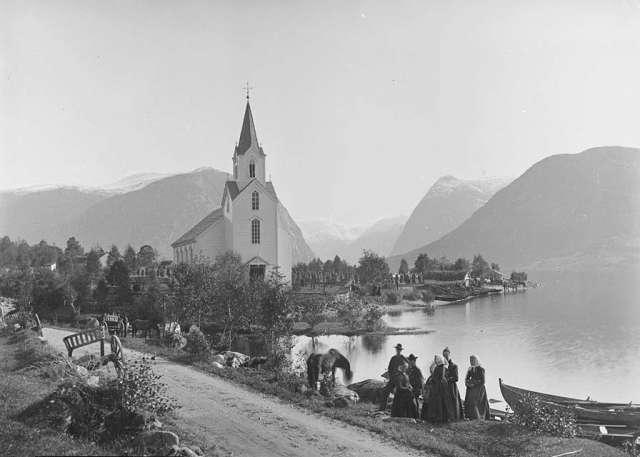
Helgheim kyrkje i Jølster, ved Jølstravatnet (Helgheim Church in Jølster [Norway], with Lake Jølster] This photo, from the 1880s or 1890s, shows the little church that my grandmother, a life-long Lutheran, attended until she left for America at eighteen (i.e., during this very time). The farm on which she was born and raised, Søgnesand, is at the very end of the Kjøsnesfjord, the area in the distance, enclosed by mountains, at the center of the photograph. They had to travel to the church by boat or, in the winter, sometimes by walking across the iced-over lake. I’ve visited this area several times, and love it very much. The farm still belongs to relatives of mine. (Public domain photo from Wikimedia Commons)
We drove back from Depoe Bay over to the Portland Airport this morning to pick up friends of ours who had just flown in from Salt Lake City. Then we drove westward to Seaside, where we and our friends enjoyed dinner out with another pair of Utah friends who are also visiting here, both of them natives of Oregon. He earned his medical degree from the Oregon Health and Science University School of Medicine. He is also a past mission president in Norway, and he and I and his wife had a great time over Italian food — yes, I confess that I ate yet again today — discussing our experiences in Norway and with our Norwegian family histories.
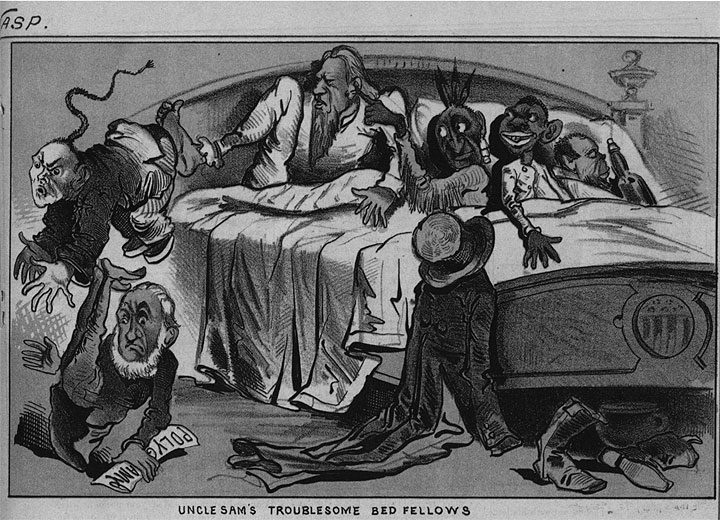
In this 1879 cartoon, Uncle Sam has already kicked the Chinaman and the Latter-day Saint out of his bed, while the Indian and the Black and the (drunken) Irishman await their turn.
(Wikimedia Commons public domain image)
Inspired by my recent remarks at FAIR about Brigham Young and slavery and my recent article in Meridian Magazine on the same topic, I’m being roundly mocked and attacked over at the Peterson Obsession Board — and possibly elsewhere. Among other things, the Obsessed have labeled me a liar and a sociopath for the argument that I’ve made. Some have insisted, despite my repeated, explicit statements that Brigham Young was a racist by twenty-first century standards, that I’m claiming that Brigham Young wasn’t a racist by twenty-first century standards. My Malevolent Stalker points out that I (supposedly) defend slavery because the desire for a celestial mansion in which I’ll be served by slaves is central to my religious faith.
In response to such attacks, I’ve simply told people to read W. Paul Reeve, Christopher B. Rich Jr., and LaJean Purcell Carruth, This Abominable Slavery: Race, Religion, and the Battle Over Human Bondage in Antebellum Utah (Oxford, 2024), and to get back to me when they’ve finished it. I’m reasonably confident, however, that none of the Obsessed has done so. For that matter, nothing in what they’ve been saying about me suggests that they’ve even listened to my FAIR talk or read my Meridian article.
Well, ere I left my room this morning I happened across two parts of a 2024 Gospel Tangents interview entitled, respectively, “Busting Utah’s Slavery Myths (Paul Reeve/Christopher Rich 1 of 3)” and “Was Brigham Young Wrong? (Paul Reeve/Christopher Rich 2 of 3).” I offer here some passages from the transcript of the interview that I marked:
It’s time to bust some slavery myths about Utah Slavery. Dr Paul Reeve & Christopher Rich have written a book called “This Abominable Slavery.” Was Brigham Young making Utah a slave state or a free state? Newly discovered documents from the 1850s are causing us to re-evaluate past narratives. . . .
LaJean Carruth. She’s a co-author on the book. The book wouldn’t exist without her transcriptions. We have a new source base that no prior scholars had access to. . . .
And so Brigham Young, the evidence demonstrates that he always wanted Utah to come in as a free state. . . . Brigham Young made it stridently clear that he was opposed to sending any constitution to Washington that was based on slavery. . . .
Paul: So your question was, did Utah apply as a slave state? The answer is no.
GT: Absolutely no.
Paul: Absolutely no. The Constitution of Deseret is neutral on the question of slavery. And then in 1856, the second time Utah applies, the proposal to apply as a slave state is soundly rejected by the Constitutional Convention that is held in Utah in 1856.
And in 1852, the legislature meets and attempts to address that question. Really, the question they’re attempting to address is can human beings be held as property? According to the law, the answer that they put into law is no. Human beings can’t be held as property. So it elevates those who are enslaved, African-Americans who are enslaved in Utah territory above the condition of property. . . .
So, obviously, we’re making a nuanced argument here. Legally, according to law, yeah. If you grant human beings rights, they’re not mere property. Okay, it’s like an ox cart is a piece of property. It has no rights. Okay? Human beings, like you grant them some rights and they are then above the status of mere property and the legislature passes an Act in Relation to Service that does grant them some rights. . . .
the intent was that the condition of servitude not pass to the next generation, making it then a conservative form of gradual emancipation that, over time, the children born to enslaved parents would not have inherited the condition of their enslaved parents. . . .
Because I’ve also heard that, human slavery and servitude, this is just semantics. Right? They’re really slaves. Utah’s the only slave state west of the Mississippi. Is that true?
Paul: False.
Christopher: False. False for a couple of reasons. So, the first thing you mentioned is are servitude and slavery the same thing?
GT: Right.
Christopher: From a modern perspective, it’s hard for us to tell the difference. For somebody living in the early 19th century, however, servitude and slavery would have been quite different from each other. As Paul was mentioning, one of the main things is the ability to consent, certain rights that are inherent. Within a service relationship, servitude, you are a human being. You have rights just like any other human being would, but you exist in what’s called unfree labor, meaning that you’ve entered into a legal relationship with your master where you’re not free to quit that employment relationship until certain conditions are fulfilled. So, examples of servitude are apprenticeship, for example, which is usually minor children enter into this relationship with their masters to learn a particular skill. Indentured servitude, when immigrants would come to the United States, they would be held in servitude for a certain period of time until they’d paid off the price of their passage across the ocean. So you have a number of these forms of servitude, which are in between what we might call absolute freedom on one end of the spectrum and then chattel slavery on the other end of the spectrum where an individual, him or herself, is considered property, can be bought and sold, has no consent over any of that at all. And so, again, so for people like Brigham Young, men of his generation, would have seen a difference between servitude and slavery. They honestly would have viewed them to be different things. Now, that’s changing in this period. The United States is slowly moving towards a free labor system. And so, you have some men like Orson Pratt who are not seeing that distinction. They do believe that servitude and slavery are the same thing. And that’s really what this battle in the legislature is all about. It’s not should we legalize slavery? But is there a difference between servitude and slavery? . . .
Brigham Young really believes that what the legislature passes is not chattel slavery. They haven’t created a law that places human beings as property . . .
So, this is actually something that happens in a lot of places where a nominally free jurisdiction will allow enslavers to bring enslaved people into that jurisdiction insofar as their status is legally transformed from slave to servant, and then certain legal protections will apply to them. So, this happened in Illinois, for example. It happened in Indiana. And this is probably where Latter-day Saints became familiar with those type of laws. They likely encountered something like an Act in Relation to Service while they were living in Illinois during the 1840s. . . .
Paul: Well Oregon passed a law that simply said you can’t bring Black people into Oregon territory.
GT: Period.
Paul: Period. Right. Some states and territories did this in the 19th century. Right? Even free Black people are not allowed to migrate into territories with these laws. Utah does not pass a law. It welcomes everyone. Right? It’s a part of the Latter-day Saint gathering. So, they have this religious notion they’re going to gather everyone into Utah territory. They have a theological vision of conversion. So, they never pass a law like Oregon that says that Black people are not allowed into the territory. And Oregon also comes close. Right? What was the bill that they voted on or they were really close to passing, but it didn’t pass? . . .
In Utah, you see the same thing. You see a relatively small number of pro-slavery Latter-day Saints, who are asking for Utah to protect slavery in the constitution. And men, like Brigham Young and Orson Pratt, say, no. We’re not going to do that. And ultimately, a very large majority of the Constitutional Convention say absolutely not. We are not going to do that. Moreover, we’re not going to bar free African Americans from coming here. And that’s something that should be said as well. We don’t deal with it as much in the book. But while there were enslaved African Americans, there were also a sizable number of free African Americans in early Utah territory, many of whom were Latter-day Saints. . . .
GT: Can we talk a little bit about—so 1852. Is it fair to say that Utah legalized slavery in 1852? Because that’s what I’ve heard. Would you say that’s a fair statement?
Christopher: No. At the very least, it’s complicated. From the perspective of the legislators, they would say no. From the perspective of Brigham Young and the majority of the legislators, they would say we have legalized servitude. And they would have argued this is, in many ways, different from chattel slavery and was intended to be so. And from a purely legal standpoint, that argument has weight from the perspective of 1852. . . .
Christopher: Yeah, and as we’re arguing, that this is ultimately a form of gradual emancipation, that this is a step towards freedom. And Brigham Young actually insists on language in the law that said—within the statute, the relationship between a servant and a master is referred to as a contract. It’s referred to contractually for both African Americans and for European immigrants. In the original version of the law, if the contract was broken, if a master abused his servant in some way, and that contract was broken, the law said that the servant should go to a new master. Brigham Young says, no. If this contract is broken, they should be free “same as white folks.” So, he views this law, in his own mind, as a way of moving African Americans towards freedom while they remain in the state of servitude, which, probably, he would have likened to apprenticeship, which was something that he had personally experienced.

An artistic enhancement and colorization of a public domain 19th-century photograph of Green Flake. Probably taken in Salt Lake City, Utah around the 1890s.
Finally, I share a passage from the interview about the status of slavery in antebellum California. A commenter called “Patrice” raised a question on the matter when I told a story of Brigham Young refusing, somewhere in 1850-1854, to send Green Flake to California so that he could be sold by his enslaver. “Patrice” doubted that such a thing could have happened, since California had ostensibly outlawed slavery:
And then, with the California Gold Rush, a lot of Southerners went to California, bringing enslaved people with them. So, I’ve seen different estimates, some as low as low as 400, but I’ve seen up to 1,500 enslaved people laboring in the gold mines. And there were a large number of Southerners, pro-slavery advocates, who were in the state legislature. So, despite the fact that it was a free state, the legislature came up with ways to allow enslavers to maintain the labor of enslaved people. So they passed one statute, which functionally allowed slavery to exist into the mid-1850s or so.
There is apparently another part of this interview that remains for me to read. So far, though, I see no real daylight between what Reeve and Rich have to say about their book, on the one hand, and, on the other hand, my allegedly lying, self-interested, and sociopathic reports about their book.
Posted from Seaside, Oregon
Travel and Religion
History and Religion
Previous Post

September 2, 2025
On the ineptitude of using Green Flake to criticize me
Next Post

September 4, 2025 Tempting Fate on the Oregon Coast?
Recent Comments
"DP: “But Mr. Sutherland worries about the fact that our time, when we can communicate ..."
Learning more about a region of ..."
"Another class of memories are of individuals who previously lived. Some of these remembered individuals ..."
"Sutherland's lecture sounds interesting. He seems to restate the Washington consensus that trade brings peace ..."
Learning more about a region of ..."
"In a meeting today, I learned another important reason why accurate (or at least as ..."
From Serbia’s “White City,” Belgrade
Browse Our Archives
Select a Category Uncategorized
Select a Month October 2026 September 2026 August 2026 July 2026 June 2026 May 2026 April 2026 March 2026 February 2026 January 2026 December 2025 November 2025 October 2025 September 2025 August 2025 July 2025 June 2025 May 2025 April 2025 March 2025 February 2025 January 2025 December 2024 November 2024 October 2024 September 2024 August 2024 July 2024 June 2024 May 2024 April 2024 March 2024 February 2024 January 2024 December 2023 November 2023 October 2023 September 2023 August 2023 July 2023 June 2023 May 2023 April 2023 March 2023 February 2023 January 2023 December 2022 November 2022 October 2022 September 2022 August 2022 July 2022 June 2022 May 2022 April 2022 March 2022 February 2022 January 2022 December 2021 November 2021 October 2021 September 2021 August 2021 July 2021 June 2021 May 2021 April 2021 March 2021 February 2021 January 2021 December 2020 November 2020 October 2020 September 2020 August 2020 July 2020 June 2020 May 2020 April 2020 March 2020 February 2020 January 2020 December 2019 November 2019 October 2019 September 2019 August 2019 July 2019 June 2019 May 2019 April 2019 March 2019 February 2019 January 2019 December 2018 November 2018 October 2018 September 2018 August 2018 July 2018 June 2018 May 2018 April 2018 March 2018 February 2018 January 2018 December 2017 November 2017 October 2017 September 2017 August 2017 July 2017 June 2017 May 2017 April 2017 March 2017 February 2017 January 2017 December 2016 November 2016 October 2016 September 2016 August 2016 July 2016 June 2016 May 2016 April 2016 March 2016 February 2016 January 2016 December 2015 November 2015 October 2015 September 2015 August 2015 July 2015 June 2015 May 2015 April 2015 March 2015 February 2015 January 2015 December 2014 November 2014 March 2014 August 2013 February 2012
Follow Us!
TAKE THE
Religious Wisdom Quiz
Which book of the Bible contains the phrase "Vanity of vanities"?
Select your answer to see how you score.
Proverbs Ecclesiastes Job Psalms
Related posts from Sic et Non


Notes on Women, Priesthood, and General Conference

"America's Most Neighborly City"? It's not in Switzerland

"The Book of Moses as a Temple Text"
TRENDING AT PATHEOS Latter-day Saint

Swimfan: Forgotten Aughts Pleasures
This is a recovery effort. In 2002, My Big Fat Greek Wedding...

Top Three Anti-Catholic Lies About Catholicism
This is my initial transcript for the video, "THE 3 WORST...

Pope Leo Celebrates Mass for Nurses & Docs...
I don't have any idea how he did it, but Pope Leo...

The Sermon on the Mount, Part I: Matthew...
The Sermon on the Mount, Part I (Matthew 4:12-5:12) St. Matthew moves...

What's up from Crossway: Reviewing some of their latest A few weeks...

Janie Learns the Way of the Cross: A...
Teaching children about Jesus' Passion can be challenging. Many parents and educators...
view all Latter-day Saint blogs
What Are Your Thoughts?leave a comment
Ad-Free & Subscriber Log-In Subscription Support
- About Us
- 2026 Calendar
- Videos
- Podcasts
- Library of World Religions
- Faith In Media Tracker
- Advertise With Us
- Write for Us
- Privacy Policy
- Terms of Service
- Do Not Sell My Data
- Contact Us
- Radiant Digital
- Manage Newsletter Subscriptions
- Unsubscribe From Notifications
- Sitemap
Copyright 2008-2026, Patheos. All rights reserved.
Subscription Support Ad-Free & Subscriber Log-In
Follow Patheos