
BuddhistCatholicContemplativeEvangelicalGeneral ChristianHinduJewishLatter-day SaintMuslimNew VisionsProgressive Christian
Beliefs
- Buddhist
- Catholic
- Contemplative
- Evangelical
- General Christian
- Hindu
- Jewish
- Latter-day Saint
- More Voices
- Muslim
- New Visions
- Pagan
- Progressive Christian
Topics
- Religion News
- Food and Religion
- Sports and Religion
- Religious Art
- Religious Music and Entertainment
- Religious Events
- History and Religion
- Style and Religion
- Politics and Religion
- Women in Religion
- Recreation Outdoors and Religion
- Business Finance and Religion
- Careers Workplace and Religion
- Education and Religion
- Family Parenting and Religion
- Health Fitness and Religion
- Home and Religion
- Relationships and Religion
- Technology and Religion
- Travel and Religion
Columnists
- Buddhist Columnists
- Business Finance and Religion Columnists
- Careers Workplace and Religion Columnists
- Catholic Columnists
- Contemplative Columnists
- Education and Religion Columnists
- Evangelists Columnists
- Family Parenting and Religion Columnists
- General Christian Columnists
- Health Fitness and Religion Columnists
- Hindu Columnists
- History and Religion Columnists
- Home and Religion Columnists
- Jewish Columnists
- More Voices Columnists
- Latter Day Columnists
- Muslim Columnists
- New Visions Columnists
- Nonreligious Columnists
- Pagan Columnists
- Politics and Religion Columnists
- Progressive Columnists
- Recreation Outdoors and Religion Columnists
- Relationships and Religion Columnists
- Religion News Columnists
- Religious Art Columnists
- Religious Events Columnists
- Religious Music and Entertainment Columnists
- Sports and Religion Columnists
- Style and Religion Columnists
- Technology and Religion Columnists
- Travel and Religion Columnists
- Women in Religion Columnists
Resource Library
- 2026 Calendar
- Library of World Religions
- The 100 Most Holy Places on Earth
- Patheos Answers
- Podcasts
- Videos
- Faith Leaders Database
- Anglican Episcopalian
- Bahai
- Baptist
- Buddhism
- Christianity
- Confucianism
- Eastern Orthodoxy
- Hinduism
- Holiness and Pentecostal
- ISKCON
- Islam
- Judaism
- Lutheran
- Methodist
- The Church of Jesus Christ of Latter-day Saints
- New Age
- Paganism
- Presbytarian and Reformed
- Protestantism
- Religion Behind the Scenes
- Roman Catholic
- Scientology
- Shia Islam
- Sikhism
- Sufism
- Sunni Islam
- Taoism
- Zen
- See all religions
Research Tools
 Ad-Free & Subscriber Log-In Subscription Support
Ad-Free & Subscriber Log-In Subscription Support
Follow Patheos 

- Trending:
- Forgiveness
- |
- Marriage
- |
- Consciousness
- |
- Death Penalty
- |
- Election
- |
- Halloween

- Home
- Latter-day Saint
- Shall we not go on in so great a cause?
Shall we not go on in so great a cause?
Last updated on: August 28, 2025 at 11:07 am by Dan Peterson
Shall we not go on in so great a cause? 2025-08-28T11:07:34-06:00 Dan Peterson
Patheos Explore the world's faith through different perspectives on religion and spirituality! Patheos has the views of the prevalent religions and spiritualities of the world.
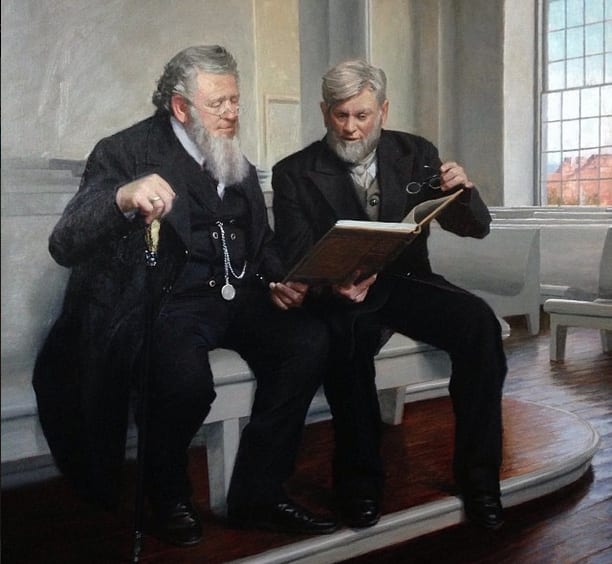
This painting, by Casey Childs, used to hang in the foyer of the St. George Utah Temple. I believe that I also saw it there after that temple’s recent renovation and rededication. It depicts President Brigham Young (left), late in his life, going over the records of the ordinances performed thus far in the temple with Elder Wilford Woodruff of the Council of the Twelve, who was the first president of the St. George Utah Temple and who would eventually serve as the fourth president and prophet of the Church of Jesus Christ of Latter-day Saints. The modern work of redeeming the dead really got underway in the St. George Temple. (I found the painting on Pinterest, and hope that I’m committing no major offense against copyright by posting it here. If so, I apologize and will happily take it down.)
A new article of mine has gone up in Meridian Magazine: “Brigham Young, Race, and Slavery: Reexamining Utah’s 1852 Service Act.” If you can bear to do so, please feel free to take a look at it.
Also on the subject of Brigham Young, we were back again today in the Pioneer Memorial Museum in Salt Lake City — the headquarters of the Daughters of the Utah Pioneers — for more filming. The footage that we obtain there will eventually become part of Becoming Brigham, a forthcoming series of short documentaries from the Interpreter Foundation and Red Brick Filmworks.
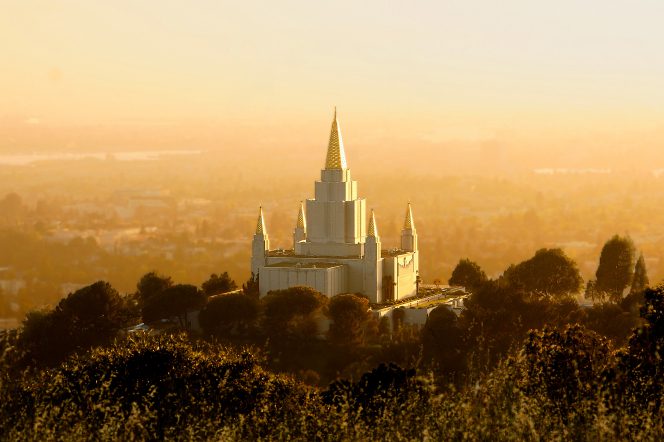
The Oakland California Temple (LDS.org)
While waiting for the filming to begin — our film team are setting up cameras, positioning lights, and so forth, and strictly (and prudently) forbid ignoramuses such as I to mess with the equipment — I read an interesting article from a British magazine called The Catholic Herald: “Pope Leo’s desire for ‘flatmates’ offers a valuable lesson to all Catholics: It is encouraging to discover the Pope’s determination to live in community and bring Augustinian spirituality to the heart and apex of the Catholic Church, beginning with the papal apartments.” The article is interesting overall, but a particular point stood out to me for separate mention:
The article cites the English historian Peter Ackroyd as having noted that something like 90 per cent of the world’s ghost stories are found in English literature. Ackroyd apparently also suggests that one of the reasons for this seeming obsession with tales of the macabre lies in Henry VIII’s spectacular dissolution and pillaging of the the nation’s monasteries at the commencement of the English Reformation. Why? Because it abruptly ended the long-established English Catholic practice of prayer for the dead.
I don’t know whether this is actually true. But it’s an intriguing thought.
I’ll try to flesh the argument out as I understand it, a bit beyond what the article itself actually says: With his destruction of the monasteries, Henry put an end to the perceived reality of “the Communion of the Saints,” which was conceived as the spiritual union of all who are united in Christ — that is to say, the union of all Christians — including the faithful on Earth (“the Church Militant”), the souls still working through Purgatory (“the Church Penitent,” or “the Church Suffering”), and the saints in Heaven (“the Church Triumphant”), who form, altogether, one “mystical body” head by Christ. (The damned, the souls in Hell, are excluded; they are literally excommunicant.) Members of the Communion of the Saints participate in each other’s spiritual welfare and well-being, praying for one another out of the recognition that death ends neither their mutual love nor their fellowship with one another
The author of the article, a British Catholic convert named Gavin Ashenden, argues that the abolition of the monasteries by Henry VIII (whom he terms “psychopathic”) was a catastrophe,
leaving a scar on the national psyche that has never yet been healed. . . . The suppression of our monasteries interrupted a profound sense of communal belonging across space and time, between the generations. Consequently a profound neurosis entered the collective English soul which erupted in the sterile preoccupation with ghosts and ghost stories.
As I say, I don’t know whether the claim advanced by Peter Ackroyd and, now, by Gavin Ashenden holds up, but I find it an interesting opportunity for reflection, as follows:
Latter-day Saints don’t use the term “Communion of Saints” or “Communion of the Saints.” But, in its essence, I don’t think that the concept is entirely foreign to us. We don’t officially pray for the dead or seek intercession from the Saints, but we do perform ordinances on behalf of the dead in our temples and, through genealogical research or family history work, we seek out the names of the dead in order to serve them. The fourth element of the “four-fold mission of the Church” is “uniting families for eternity.”
Moreover, we expect that those who have gone on before us remain interested in our lives and our choices. I could elaborate further on this — and may, at some point, do so — but these seem to me clear indicators of a conception rather like that of a “Communion of the Saints.” Which may, I think, help to explain what I judge to be a pretty healthy view of death and of the dead among believing Latter-day Saints. We are, I think, exceptionally receptive to accounts of near-death experiences. And when we hear reports of encounters with the dead occurring during family history research or attendant upon temple service, we welcome them — and there is, in them, no trace of darkness or the macabre. On the contrary, there is light.
Henry VIII may perhaps have left a scar on the English psyche that survived him for centuries. His action may well have disrupted the profound sense of communal belonging across space and time, between the generations, that once prevailed, creating a profound neurosis about death and the dead. The ordinances of the temple, however, and the profoundly important work of the redemption of the dead, offer a path to healing.
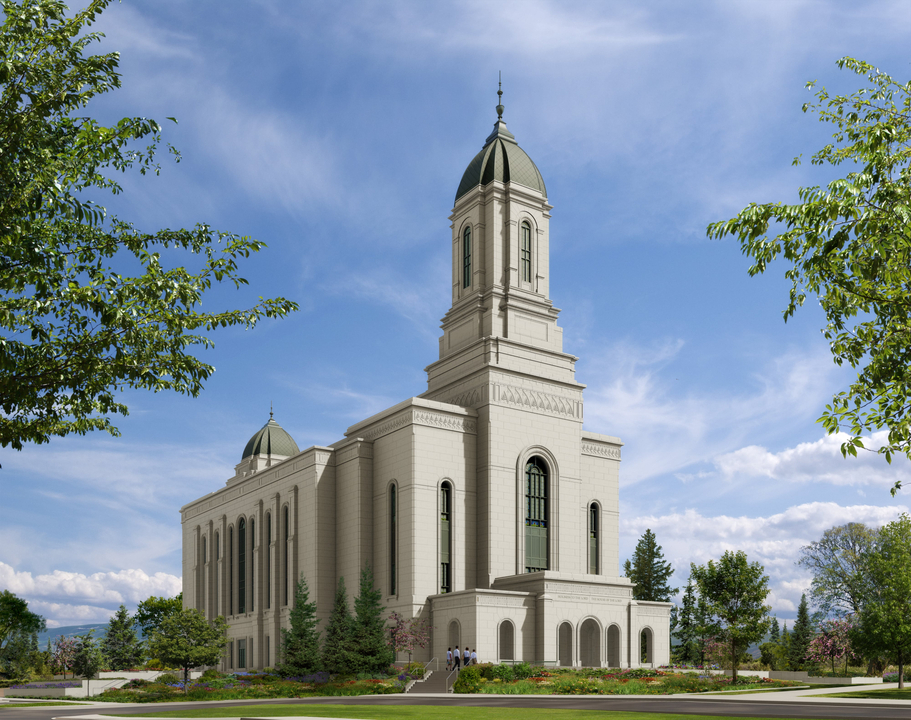
An artist’s conception of the coming Heber Valley Utah Temple (LDS.org fair use)
This is great news: “Construction for Heber Valley Utah Temple underway: 3 years after its groundbreaking, construction work on the previously postponed Heber Valley Utah Temple has begun”
Brethren, shall we not go on in so great a cause? Go forward and not backward. Courage, brethren; and on, on to the victory! Let your hearts rejoice, and be exceedingly glad. Let the earth break forth into singing. Let the dead speak forth anthems of eternal praise to the King Immanuel, who hath ordained, before the world was, that which would enable us to redeem them out of their prison; for the prisoners shall go free. -Joseph Smith, 6 September 1842; Nauvoo, Illinois (Doctrine and Covenants 128:22)
Previous Post

August 26, 2025
Good and Faithful Servants
Next Post

August 28, 2025 Men and Women and Girls and Boys, etc.
Recent Comments
"Sutherland's lecture sounds interesting. He seems to restate the Washington consensus that trade brings peace ..."
Learning more about a region of ..."
"In a meeting today, I learned another important reason why accurate (or at least as ..."
From Serbia’s “White City,” Belgrade
"I've been watching a lot of video interviews of NDErs and researchers. I think in ..."
"PL: "Let's hope he doesn't have your address..."I have to frankly confess that a few ..."
From Serbia’s “White City,” Belgrade
Browse Our Archives
Select a Category Uncategorized
Select a Month October 2026 September 2026 August 2026 July 2026 June 2026 May 2026 April 2026 March 2026 February 2026 January 2026 December 2025 November 2025 October 2025 September 2025 August 2025 July 2025 June 2025 May 2025 April 2025 March 2025 February 2025 January 2025 December 2024 November 2024 October 2024 September 2024 August 2024 July 2024 June 2024 May 2024 April 2024 March 2024 February 2024 January 2024 December 2023 November 2023 October 2023 September 2023 August 2023 July 2023 June 2023 May 2023 April 2023 March 2023 February 2023 January 2023 December 2022 November 2022 October 2022 September 2022 August 2022 July 2022 June 2022 May 2022 April 2022 March 2022 February 2022 January 2022 December 2021 November 2021 October 2021 September 2021 August 2021 July 2021 June 2021 May 2021 April 2021 March 2021 February 2021 January 2021 December 2020 November 2020 October 2020 September 2020 August 2020 July 2020 June 2020 May 2020 April 2020 March 2020 February 2020 January 2020 December 2019 November 2019 October 2019 September 2019 August 2019 July 2019 June 2019 May 2019 April 2019 March 2019 February 2019 January 2019 December 2018 November 2018 October 2018 September 2018 August 2018 July 2018 June 2018 May 2018 April 2018 March 2018 February 2018 January 2018 December 2017 November 2017 October 2017 September 2017 August 2017 July 2017 June 2017 May 2017 April 2017 March 2017 February 2017 January 2017 December 2016 November 2016 October 2016 September 2016 August 2016 July 2016 June 2016 May 2016 April 2016 March 2016 February 2016 January 2016 December 2015 November 2015 October 2015 September 2015 August 2015 July 2015 June 2015 May 2015 April 2015 March 2015 February 2015 January 2015 December 2014 November 2014 March 2014 August 2013 February 2012
Follow Us!
TAKE THE
Religious Wisdom Quiz
Who interpreted dreams for a Persian king about goats and rams?
Select your answer to see how you score.
Daniel Obadiah Hosea Joel
Related posts from Sic et Non


Notes on Women, Priesthood, and General Conference

"The Book of Moses as a Temple Text"

TRENDING AT PATHEOS Latter-day Saint

In "Irreplaceable," our book on vocation and technology, Trevor Sutton and I...

I was strolling through the top floor of the brand new Parthenon...

What Does Gêvâh Mean For Kimberley Guifoyle &...
This week, a lot of the news is focused on Kimberly Guilfoyle....

INNER CIRCLE: Profound Mystery (Of Christ In All...
Ephesians 5:31-32 “For this reason, a man will leave his father and...

Do Not Rejoice When Your Enemy Falls: The...
Turning an execution into a public spectacle is a disturbing expression of...

'The Chosen' S6 Trailer: The Passion Gets Very...
Not many watching 'The Chosen' worry about spoilers, but just because they...
view all Latter-day Saint blogs
What Are Your Thoughts?leave a comment
Ad-Free & Subscriber Log-In Subscription Support
- About Us
- 2026 Calendar
- Videos
- Podcasts
- Library of World Religions
- Faith In Media Tracker
- Advertise With Us
- Write for Us
- Privacy Policy
- Terms of Service
- Do Not Sell My Data
- Contact Us
- Radiant Digital
- Manage Newsletter Subscriptions
- Unsubscribe From Notifications
- Sitemap
Copyright 2008-2026, Patheos. All rights reserved.
Subscription Support Ad-Free & Subscriber Log-In
Follow Patheos