
BuddhistCatholicContemplativeEvangelicalGeneral ChristianHinduJewishLatter-day SaintMuslimNew VisionsProgressive Christian
Beliefs
- Buddhist
- Catholic
- Contemplative
- Evangelical
- General Christian
- Hindu
- Jewish
- Latter-day Saint
- More Voices
- Muslim
- New Visions
- Pagan
- Progressive Christian
Topics
- Religion News
- Food and Religion
- Sports and Religion
- Religious Art
- Religious Music and Entertainment
- Religious Events
- History and Religion
- Style and Religion
- Politics and Religion
- Women in Religion
- Recreation Outdoors and Religion
- Business Finance and Religion
- Careers Workplace and Religion
- Education and Religion
- Family Parenting and Religion
- Health Fitness and Religion
- Home and Religion
- Relationships and Religion
- Technology and Religion
- Travel and Religion
Columnists
- Buddhist Columnists
- Business Finance and Religion Columnists
- Careers Workplace and Religion Columnists
- Catholic Columnists
- Contemplative Columnists
- Education and Religion Columnists
- Evangelists Columnists
- Family Parenting and Religion Columnists
- General Christian Columnists
- Health Fitness and Religion Columnists
- Hindu Columnists
- History and Religion Columnists
- Home and Religion Columnists
- Jewish Columnists
- More Voices Columnists
- Latter Day Columnists
- Muslim Columnists
- New Visions Columnists
- Nonreligious Columnists
- Pagan Columnists
- Politics and Religion Columnists
- Progressive Columnists
- Recreation Outdoors and Religion Columnists
- Relationships and Religion Columnists
- Religion News Columnists
- Religious Art Columnists
- Religious Events Columnists
- Religious Music and Entertainment Columnists
- Sports and Religion Columnists
- Style and Religion Columnists
- Technology and Religion Columnists
- Travel and Religion Columnists
- Women in Religion Columnists
Resource Library
- 2026 Calendar
- Library of World Religions
- The 100 Most Holy Places on Earth
- Patheos Answers
- Podcasts
- Videos
- Faith Leaders Database
- Anglican Episcopalian
- Bahai
- Baptist
- Buddhism
- Christianity
- Confucianism
- Eastern Orthodoxy
- Hinduism
- Holiness and Pentecostal
- ISKCON
- Islam
- Judaism
- Lutheran
- Methodist
- The Church of Jesus Christ of Latter-day Saints
- New Age
- Paganism
- Presbytarian and Reformed
- Protestantism
- Religion Behind the Scenes
- Roman Catholic
- Scientology
- Shia Islam
- Sikhism
- Sufism
- Sunni Islam
- Taoism
- Zen
- See all religions
Research Tools
 Ad-Free & Subscriber Log-In Subscription Support
Ad-Free & Subscriber Log-In Subscription Support
Follow Patheos 

- Trending:
- Forgiveness
- |
- Marriage
- |
- Consciousness
- |
- Death Penalty
- |
- Election
- |
- Halloween

- Home
- Latter-day Saint
- Travel and Religion
- More or less how I got here on this topic
More or less how I got here on this topic
Last updated on: August 12, 2025 at 9:53 am by Dan Peterson
More or less how I got here on this topic 2025-08-12T09:53:18-06:00 Dan Peterson
Patheos Explore the world's faith through different perspectives on religion and spirituality! Patheos has the views of the prevalent religions and spiritualities of the world.

“Swan Princess,” by visual artist Viona ielegems (Wikimedia Commons public domain image). She looks nothing at all like the anime Odette that we watched last night.
Last night, my wife and I watched an anime film version of Swan Lake with a very young third-generation unit. (The name and gender of the third-generation unit have been redacted so as to obscure a potential target, at least partially, from attacks by some of my anonymous detractors.) I’m not a real fan of anime, and the pacing and the dubbed voice-acting in this film were, I thought, unusually poor. But the story is a good one and, moreover, the music was by Tchaikovsky, so I judged the benefits for the third-generation unit to be worthwhile.
Anyway, at the point in the story where the evil sorcerer Rothbart has tricked Prince Siegfried into declaring his love for Odile, Rothbart’s equally evil daughter, thus dooming the beautiful Princess Odette, the third-generation unit erupted with indignation, crying out “This isn’t a good story! I don’t like this story! I don’t want to watch it! I hate this story!” I calmed the third-generation unit down with assurances that this wasn’t the end of the tale — although, in some versions, it pretty much is — and we held on until the satisfying resolution finally arrived. It was a very cute moment.

The Orem Utah Temple by night, in a photo by Brent R. (presumably my former stake president) on ChurchofJesusChristTemples.org. The temple sits within the boundaries of my stake, and is located not terribly far from where this afternoon’s meeting took place.
I spent several hours today in a meeting with the three vice presidents of the Interpreter Foundation and the leaders of a newly-founded organization called United Advocates. The apologetic ecology is changing a bit, and we’re looking at ways to make our work more effective. But heck, I just love meetings.
In other Interpreter Foundation news, this installment of the Interpreter Foundation podcast went up today: “The Interpreter Foundation Podcast — July 30, 2025: Abraham and His Family Conference“
In the 30 July 2025 episode of the Interpreter Foundation Podcast, Terry Hutchinson, John Gee, and John Thompson discussed the Abraham and His Family Conference that was held in May. You can listen to or download the discussion segment of the podcast at the link that I’ve embedded above.
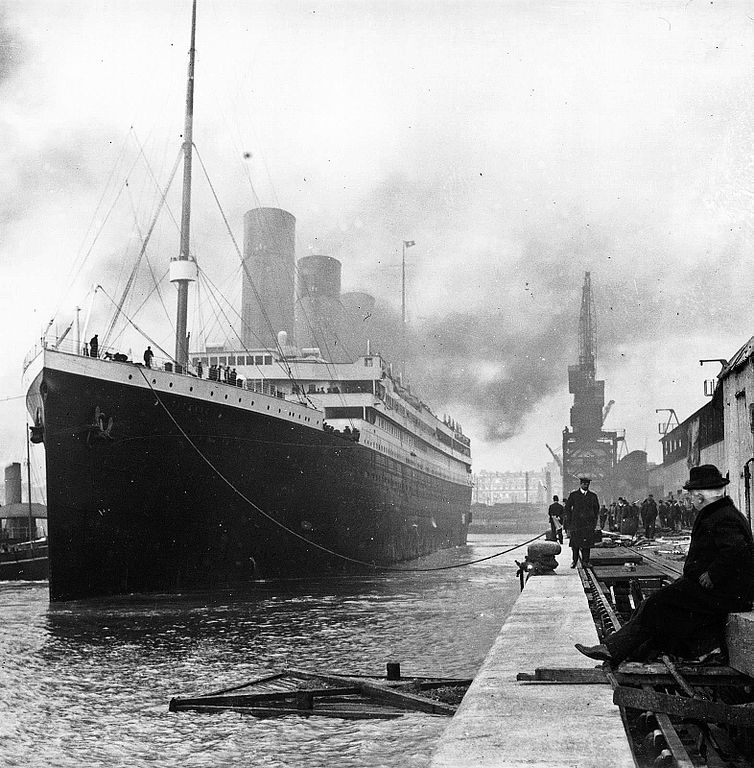
H.M.S. Titanic at the dock in England, in April 1912 (Wikimedia Commons public domain photo)
Robert F. Kennedy Jr. should never, ever, have been appointed Secretary of Health and Human Services:
- From Reason: “RFK Jr. Shifts $500 Million From mRNA Research to ‘Safer’ Vaccines. Do the Data Back That Up? The Health and Human Services secretary once again stands athwart biomedical progress yelling, “Stop!””
- From National Review: “Don’t Abandon mRNA”
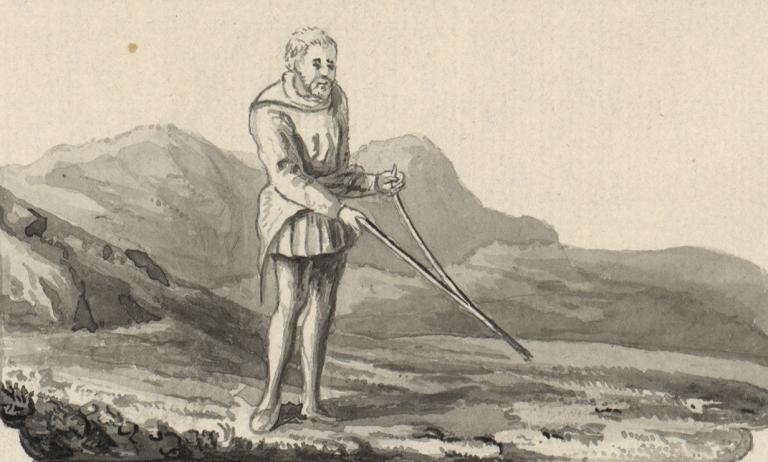
An illustration from the eight-volume “A Tour in Wales” (1781), by Thomas Pennant (1726-1798). (Wikimedia Commons public domain image)
Four or five times now, perhaps, I’ve publicly mentioned my one and only direct experience with water witching, or dowsing, with a divining rod. It was successful — completely against my expectations and to my considerable shock. (See one account here.) Although I’ve simply described what happened in my case without drawing any grand conclusion from it, I’ve been severely attacked and ridiculed in certain quarters for having recounted the story. They like to portray me as obsessed with dowsing, as claiming great divining ability, rejecting science, and so forth, essentially because I won’t falsify history by pretending that I didn’t have the experience that, in fact, I had. (It seems that some critics’ professed commitment to transparency and accurate history isn’t very deep, or, at least, that their ideological commitments and/or their need to be seen as conforming to acceptable elite opinion and/or their urge to mock me are deeper.)
Anyway, with that as background you’ll understand why this passage, from Eric A. Eliason, “Seer Stones, Salamanders, and Early Mormon ‘Folk Magic’ in the Light of Folklore Studies and Bible Scholarship,” BYU Studies Quarterly 55/1 (2016): 73-93, caught my attention. Eric Eliason (Ph.D., University of Texas at Austin) is a folklorist in the Department of English at Brigham Young University:
The presumption that the difference between magic and proper belief is something intrinsic rather than relational to the definer is still very much alive. But on close analysis, complex definitions distinguishing “magical” from “modern” thinking rarely amount to more than “What you do is superstition, while what I do is science or true religion.” One of the biggest surprises rural students have in American university folklore courses, including at BYU, is discovering their suburban peers need to be taught what divining rods are and how to use them. Today, regardless of class, race, education, wealth, region, or religion, rural students tend to know of holding a forked stick gently in one’s hand to feel for the downward tug that points to underground water and a good spot for a well. Dowsing seems not only understandable, but essential, in rural areas where families are on their own to secure water, and where hired well drillers make no guarantees and charge by the foot. City kids are shocked that their country classmates could be such shameless occult dabblers in a modern age where you don’t have to think about where water comes from. You just turn on the tap and out it comes — like magic. My rural LDS students don’t understand why their suburban counterparts have so little respect for or belief in a common spiritual gift often displayed by their educated and reasonable bishops and stake presidents.
It is simply wrong to assume that divining practices are some long-abandoned exotic aspect of America’s frontier past rather than a continuing worldwide phenomenon, used not only by rural Americans, but by soldiers in Vietnam to find enemy tunnels, by oil and precious metal prospecting companies, and even by contemporary salvage professionals to recover, yes, lost treasure. (82)
For what it’s worth — I’m merely reporting here — I have a friend, a former Rhodes scholar at Oxford who holds both a Stanford law degree and an M.D. from the University of Utah, who grew up in southern Arizona and who has told me of his successes there with water witching. And another friend, now passed on, was a professional landscape architect with (as I recall) a master’s degree in horticulture who dowsed for water lines before commencing any job. Colleagues laughed at him, he recalled, but they often cut water lines, while he reported that he never did. Finally, I remember sitting parked with my brother near a vacant lot in a St. Louis suburb. We were early for a flight and were enjoying hamburgers when, suddenly, a Department of Water and Power truck pulled up. Its driver got out, fetched a divining rod from the back of his truck, and proceeded to walk up and down the vacant lot, making notes in a small book. Then he put his divining rod back where it came from and drove away.
I grew up without the slightest belief in paranormal phenomena like water witching, telepathy, and clairvoyance. I assumed that they were mere superstition, supported by no evidence, refuted by repeated negative experimental results. My faith doesn’t require that I believe in them, and lack of evidence for them would leave my theology unaffected. But I freely confess that my experience with dowsing jarred me.
Years later, I went through a period in which I read a number of books by the late John Hick, a well-known Anglo-American philosopher who taught at Cornell University, Princeton Theological Seminary, and Cambridge University but spent most of his career at the University of Birmingham in the United Kingdom and Claremont Graduate University in the United States. In one of his books — I don’t now remember which one of them — he surprised me by writing with considerable respect about the work of the Society for Psychical Research, in Great Britain.
Then, shortly after it was published in 2003, I read The Afterlife Experiments: Breakthrough Scientific Evidence of Life After Death, written by Professor Gary E. Schwartz. I found it surprising, as well.
More recently, I read (and a few weeks ago, reread) Extraordinary Knowing: Science, Skepticism, and the Inexplicable Powers of the Human Mind, by the late Elizabeth Lloyd Mayer, a professor of psychology at the University of California at Berkeley. This book opened my mind still further to the possibility that, just maybe, my onetime certainty that no evidence exists for paranormal phenomena might rest on at least slightly shaky ground.
Most recently, of course, I read (and publicly admitted that I had read) The Essential Guide to Remote Viewing:The Secret Military Remote Perception Skill Anyone Can Learn, which was given to me by its author, Paul H. Smith, Ph.D., Major–U.S. Army (ret.).
I apologize abjectly for my willingness even to look at such things, and for my openness to the possibility that I might have been wrong.
Travel and Religion
History and Religion
Previous Post

August 10, 2025
Taking Note of Polygamy Denialism
Next Post

August 12, 2025 Don't give up hope, and don't give up
Recent Comments
"DP: “But Mr. Sutherland worries about the fact that our time, when we can communicate ..."
Learning more about a region of ..."
"Another class of memories are of individuals who previously lived. Some of these remembered individuals ..."
"Sutherland's lecture sounds interesting. He seems to restate the Washington consensus that trade brings peace ..."
Learning more about a region of ..."
"In a meeting today, I learned another important reason why accurate (or at least as ..."
From Serbia’s “White City,” Belgrade
Browse Our Archives
Select a Category Uncategorized
Select a Month October 2026 September 2026 August 2026 July 2026 June 2026 May 2026 April 2026 March 2026 February 2026 January 2026 December 2025 November 2025 October 2025 September 2025 August 2025 July 2025 June 2025 May 2025 April 2025 March 2025 February 2025 January 2025 December 2024 November 2024 October 2024 September 2024 August 2024 July 2024 June 2024 May 2024 April 2024 March 2024 February 2024 January 2024 December 2023 November 2023 October 2023 September 2023 August 2023 July 2023 June 2023 May 2023 April 2023 March 2023 February 2023 January 2023 December 2022 November 2022 October 2022 September 2022 August 2022 July 2022 June 2022 May 2022 April 2022 March 2022 February 2022 January 2022 December 2021 November 2021 October 2021 September 2021 August 2021 July 2021 June 2021 May 2021 April 2021 March 2021 February 2021 January 2021 December 2020 November 2020 October 2020 September 2020 August 2020 July 2020 June 2020 May 2020 April 2020 March 2020 February 2020 January 2020 December 2019 November 2019 October 2019 September 2019 August 2019 July 2019 June 2019 May 2019 April 2019 March 2019 February 2019 January 2019 December 2018 November 2018 October 2018 September 2018 August 2018 July 2018 June 2018 May 2018 April 2018 March 2018 February 2018 January 2018 December 2017 November 2017 October 2017 September 2017 August 2017 July 2017 June 2017 May 2017 April 2017 March 2017 February 2017 January 2017 December 2016 November 2016 October 2016 September 2016 August 2016 July 2016 June 2016 May 2016 April 2016 March 2016 February 2016 January 2016 December 2015 November 2015 October 2015 September 2015 August 2015 July 2015 June 2015 May 2015 April 2015 March 2015 February 2015 January 2015 December 2014 November 2014 March 2014 August 2013 February 2012
Follow Us!
TAKE THE
Religious Wisdom Quiz
What was a standard day's wage in Biblical times?
Select your answer to see how you score.
Mina Talent Denarius Shekel
Related posts from Sic et Non

Michael Faraday, James Clerk Maxwell, and the Open...



A great American thinker on dogmatic scientific orthodoxy
TRENDING AT PATHEOS Latter-day Saint

Nearly every morning, I make the drive to Detroit with my high-school-age...

The Real AI Story Is Adoption Without Trust
Artificial intelligence has crossed a political threshold. It is no longer a...

A new article, written by Jeff Lindsay and Gale L. Pooley,...

Swimfan: Forgotten Aughts Pleasures
This is a recovery effort. In 2002, My Big Fat Greek Wedding...

Top Three Anti-Catholic Lies About Catholicism
This is my initial transcript for the video, "THE 3 WORST...

Pope Leo Celebrates Mass for Nurses & Docs...
I don't have any idea how he did it, but Pope Leo...
view all Latter-day Saint blogs
What Are Your Thoughts?leave a comment
Ad-Free & Subscriber Log-In Subscription Support
- About Us
- 2026 Calendar
- Videos
- Podcasts
- Library of World Religions
- Faith In Media Tracker
- Advertise With Us
- Write for Us
- Privacy Policy
- Terms of Service
- Do Not Sell My Data
- Contact Us
- Radiant Digital
- Manage Newsletter Subscriptions
- Unsubscribe From Notifications
- Sitemap
Copyright 2008-2026, Patheos. All rights reserved.
Subscription Support Ad-Free & Subscriber Log-In
Follow Patheos