
BuddhistCatholicContemplativeEvangelicalGeneral ChristianHinduJewishLatter-day SaintMuslimNew VisionsProgressive Christian
Beliefs
- Buddhist
- Catholic
- Contemplative
- Evangelical
- General Christian
- Hindu
- Jewish
- Latter-day Saint
- More Voices
- Muslim
- New Visions
- Pagan
- Progressive Christian
Topics
- Religion News
- Food and Religion
- Sports and Religion
- Religious Art
- Religious Music and Entertainment
- Religious Events
- History and Religion
- Style and Religion
- Politics and Religion
- Women in Religion
- Recreation Outdoors and Religion
- Business Finance and Religion
- Careers Workplace and Religion
- Education and Religion
- Family Parenting and Religion
- Health Fitness and Religion
- Home and Religion
- Relationships and Religion
- Technology and Religion
- Travel and Religion
Columnists
- Buddhist Columnists
- Business Finance and Religion Columnists
- Careers Workplace and Religion Columnists
- Catholic Columnists
- Contemplative Columnists
- Education and Religion Columnists
- Evangelists Columnists
- Family Parenting and Religion Columnists
- General Christian Columnists
- Health Fitness and Religion Columnists
- Hindu Columnists
- History and Religion Columnists
- Home and Religion Columnists
- Jewish Columnists
- More Voices Columnists
- Latter Day Columnists
- Muslim Columnists
- New Visions Columnists
- Nonreligious Columnists
- Pagan Columnists
- Politics and Religion Columnists
- Progressive Columnists
- Recreation Outdoors and Religion Columnists
- Relationships and Religion Columnists
- Religion News Columnists
- Religious Art Columnists
- Religious Events Columnists
- Religious Music and Entertainment Columnists
- Sports and Religion Columnists
- Style and Religion Columnists
- Technology and Religion Columnists
- Travel and Religion Columnists
- Women in Religion Columnists
Resource Library
- 2026 Calendar
- Library of World Religions
- The 100 Most Holy Places on Earth
- Patheos Answers
- Podcasts
- Videos
- Faith Leaders Database
- Anglican Episcopalian
- Bahai
- Baptist
- Buddhism
- Christianity
- Confucianism
- Eastern Orthodoxy
- Hinduism
- Holiness and Pentecostal
- ISKCON
- Islam
- Judaism
- Lutheran
- Methodist
- The Church of Jesus Christ of Latter-day Saints
- New Age
- Paganism
- Presbytarian and Reformed
- Protestantism
- Religion Behind the Scenes
- Roman Catholic
- Scientology
- Shia Islam
- Sikhism
- Sufism
- Sunni Islam
- Taoism
- Zen
- See all religions
Research Tools
 Ad-Free & Subscriber Log-In Subscription Support
Ad-Free & Subscriber Log-In Subscription Support
Follow Patheos 

- Trending:
- Forgiveness
- |
- Marriage
- |
- Consciousness
- |
- Death Penalty
- |
- Election
- |
- Halloween

- Home
- Latter-day Saint
- Travel and Religion
- Dang it, we ran out of time
Dang it, we ran out of time
Last updated on: July 16, 2025 at 3:04 pm by Dan Peterson
Dang it, we ran out of time 2025-07-16T15:04:45-06:00 Dan Peterson
Patheos Explore the world's faith through different perspectives on religion and spirituality! Patheos has the views of the prevalent religions and spiritualities of the world.
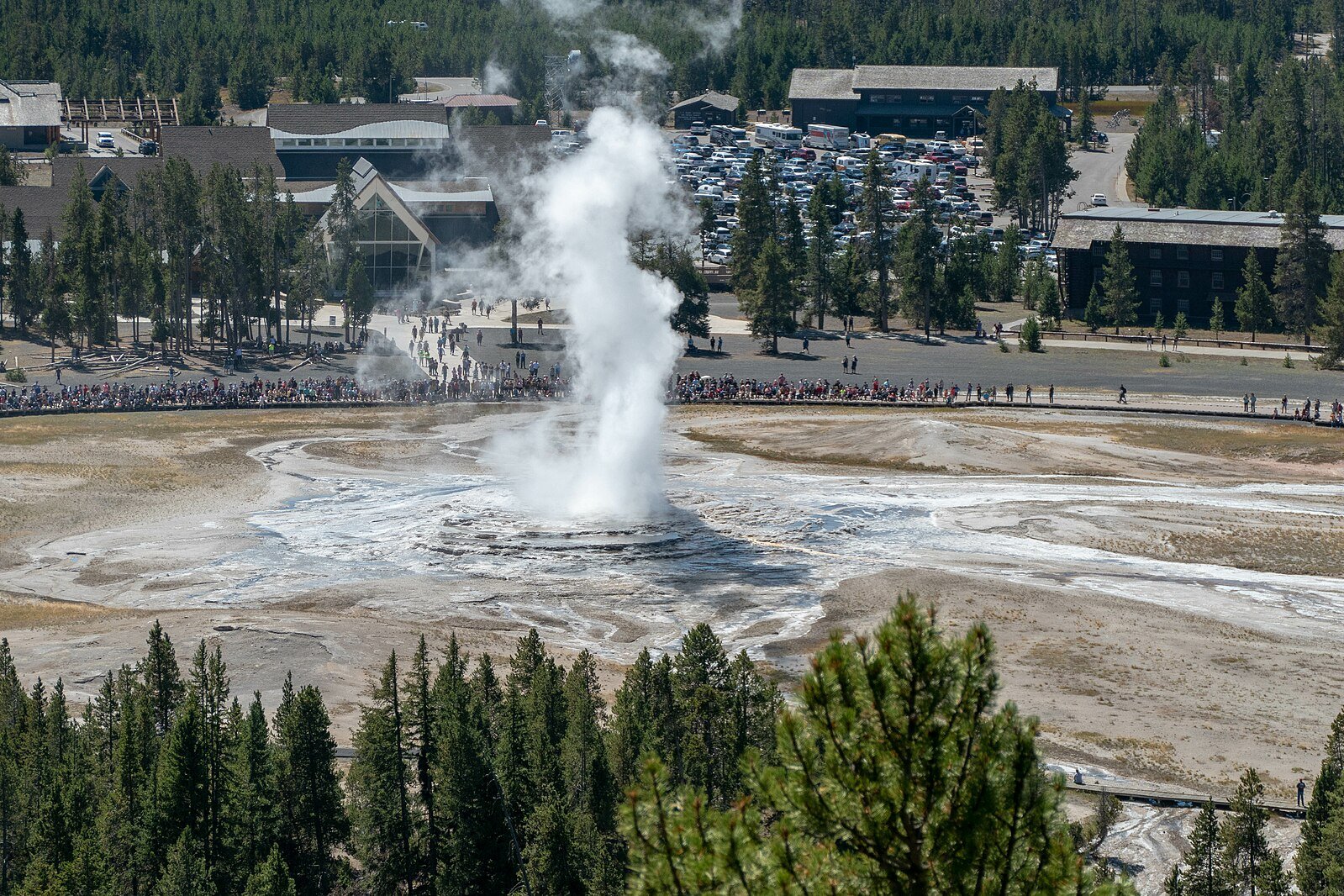
Wikimedia Commons public domain image of Old Faithful Geyser in Yellowstone National Park. I came from California with my parents to visit Old Faithful from California when I was a very little boy. It’s one of my earliest memories. I’ve come many times since, though still not often enough. We’ll have to come at least once more, with progeny in tow.
So near and yet so far. We didn’t have enough minutes to do Yellowstone even approximate justice today; this has been, for at least two of us, a working vacation, one of whom has fixed hours of employment geared to a different time zone. So the eventual choice today wasn’t to go into the National Park but to take the grandchild who is with us here to the Grizzly and Wolf Discovery Center right near our lodging. It was a real hit with the Third-Generation Unit. (I obscure the gender so as to render him/her/it a more difficult target for the tender mercies of my obsessive anonymous internet critics; to choose an example of past behavior, one of them, a still-active stalker, once found my then-very-young son’s Christmas wishlist on an online site and used its contents to frame an attack on my parenting.) Now, though, we have an excuse to come back to Yellowstone.

On the campus at the University of California at Berkeley, where Dr. Elizabeth Lloyd Meyer taught until her unexpected death. (Wikimedia Commons public domain photo)
I’ve shared some material here in the past from Elizabeth Lloyd Mayer’s posthumously-published 2008 book Extraordinary Knowing: Science, Skepticism, and the Inexplicable Powers of the Human Mind, which impressed me very much. To refresh memories, I share the biography for her that appears at the end of the book:
Known as Lisby by her many friends and colleagues, Elizabeth Lloyd Mayer was an internationally known psychoanalyst, researcher, and clinician, the author of groundbreaking papers on female development, clinical technique, the nature of science, and intuition. A graduate of Radcliffe College, she received her doctorate from Stanford University and graduated from the San Francisco Psychoanalytic Institute, where she later became a training and supervising analyst. She was associate clinical professor of psychology at the University of California, Berkeley, and in the psychiatry department at the University of California Medical Center, San Francisco. She was also a fellow of the International Consciousness Research Laboratories at Princeton and on the research faculty of the Institute for Health and Healing at California Pacific Medical Center. She maintained a private practice in Berkeley for thirty years. Dr. Mayer served on the editorial boards of many of the major journals in her field, including the Journal of the American Psychoanalytic Association, International Journal of Psychoanalysis, Gender and Psychoanalysis, The Psychoanalytic Quarterly, and Contemporary Psychoanalysis. She was the first winner of the American Psychoanalytic Association’s prestigious Menninger Award. A contralto with a long-standing interest in traditional folk and classical music, she was a founder of the California Revels and its artistic director for many years. The mother of two daughters, she was also the producer of an award-winning video series on music education for children and was named Alameda County’s Woman of the Year for Arts and Culture in 1995. Dr. Mayer died on New Year’s Day, 2005, shortly after completing Extraordinary Knowing. (263)
I’ll be on the road for pretty much the rest of the day, heading home, so here are today’s passages:
I claim that paranormal phenomena may really exist. . . . The hypothesis that paranormal phenomena are real but lie outside the limits of science is supported by a great mass of evidence. . . . I find it plausible that a world of mental phenomena should exist, too fluid and evanescent to be grasped with the cumbersome tools of science. . . . One of my grandmothers was a notorious and successful faith healer. One of my cousins was for many years the editor of the Journal of the Society for Psychical Research. Both these ladies were well educated, highly intelligent, and fervent believers in paranormal phenomena. They may have been deluded, but neither of them was a fool. Their beliefs were based on personal experience and careful scrutiny of evidence. Nothing that they believed was incompatible with science. Whether paranormal phenomena exist or not, the evidence for their existence is corrupted by a vast amount of nonsense and outright fraud. Before we can begin to evaluate the evidence, we must get rid of the hucksters and charlatans who have turned unsolved mysteries into a profitable business. (238)
Clearly, Professor Mayer herself was not obviously and naïvely gullible. But, as she puts it, “I had to doubt my existing models of reality or I had to doubt myself” (214). In the “Epilogue” to Extraordinary Knowing, she refers back to the surprising personal story with which her book opens (and which I very briefly summarized here):
It’s been fifteen years since my daughter’s harp came back. I’ve opened the door to questions about reality that shake the foundations of the world as I’ve known it. The real cost of the journey has been to give up one variety of certainty. This means the loss of a familiar world that plays by the rules, in which cause leads reliably to effects we can specify, rationality triumphs in predictable ways, and we have some sense that we can gain control over our experience. Worse, the world opening up to me is too often inhabited by ideas I deeply mistrust and people who swallow every New Age fad, people whose credulity horrifies me. (263)
Here is the first of a couple of examples that I’ll pass on from among the many that she cites and describes:
Under highly controlled, double-blind conditions, these experiments suggest that human beings have a nervous system wired to perceive events three to five seconds into the future.
Reacting in advance to a loud noise? To a calming versus emotionally stimulating picture? Seeing three seconds into the future, maybe five? Such a response may not seem like much. But if it’s true, it changes everything. (229)
And here is the second:
Consider, for example, experiments testing what are known as Bell’s theorem and the EPR (Einstein-Podolsky-Rosen) paradox. These experiments have definitively demonstrated that, under certain conditions, particles that have been in close association with each other as a two-particle system will defy familiar constraints of time and space in relation to each other. They’ll each instantly compensate for a change in the state of the other, no matter how distant they happen to be and without any identifiable channel for communication between them. This quantum physics equivalent of human entrainment is called entanglement. In “Entanglement: The Weirdest Link,” scientist reporter Michael Brooks discusses the latest developments concerning what Einstein once dubbed spukhafte Fernwirkungen, “spooky action at a distance.” Thomas Durt of Vrije University in Brussels also believes entanglement is everywhere. He has recently shown, from the basic equations that Schrödinger considered, that almost all quantum interactions produce entanglement, whatever the conditions. “When you see light coming from a faraway star, the photon is almost certainly entangled with the atoms of the star and the atoms encountered along the way,” he says. And the constant interactions between electrons in the atoms that make up your body are no exception. According to Durt, we are a mass of entanglements. (257)
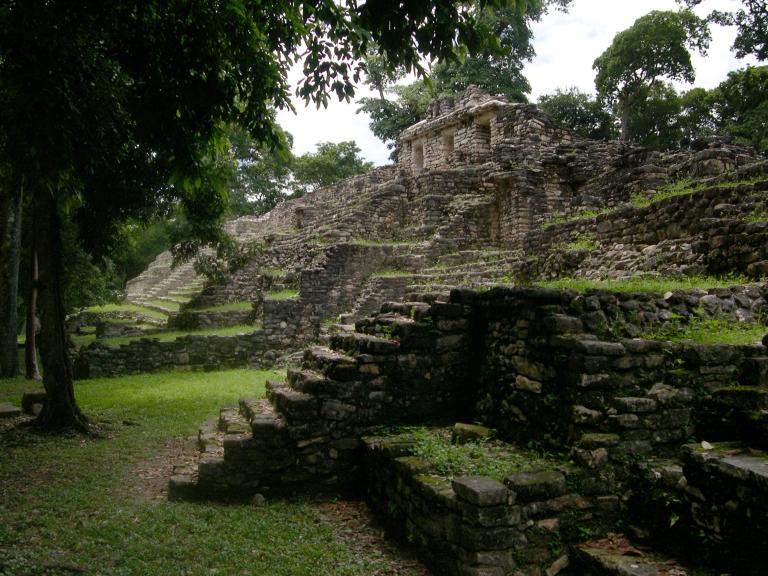
A scene in the ancient Maya city of Yaxchilan, located beside the Usumacinta River in what is today the Mexican state of Chiapas (Wikimedia Commons public domain photo)
Elsewhere on the web, my claim here (in a comment responding to a comment) that the development of limited geographical models for the Book of Mormon was primarily driven by close reading of the book’s text is being mocked. I said that panicked recognition of a lack of archaeological and DNA evidence for a hemispheric model wasn’t a motivator. It was, one of the mockers says, just pure coincidence that such models were developed. The lack of evidence wasn’t a factor at all.
Well, I stand corrected. Crick and Watson arrived at their double helix model for DNA in February of 1953, and the study of DNA took off thereafter. Within mere decades of February 1953, DNA analysis began to be applied to the Pre-Columbian Americas.
Which – coupled with a remarkable display of clairvoyance — explains why John Sorenson was down in Chiapas, in the very south of Mexico, on a dig with BYU’s New World Archaeological Foundation that began in January 1953. The DNA data from decades later that would ultimately force creation of a limited Tehuantepec model drove him to it. Obviously. Only small minds believe that historical causation works in just one direction. Sophisticated minds, at least when they badly need to do so, can believe that the Second World War was one of the causes of the Versailles Treaty and that Reconstruction caused the American Civil War.
And, of course, the origins of the limited-geographical Mesoamerican model for the Book of Mormon go back well before John Sorenson (who, however, remains its best-known advocate) to people like M. Wells Jakeman and, before him, to Janne M. Sjödahl at the start of the 1920s and, if we cast the net a bit further, to Louis Edward Hills (a member of what was then known as the Reorganized Church of Jesus Christ of Latter Day Saints) in about 1917 — which makes the cause-and-effect relationship between post-1953 DNA discoveries and the idea of a limited geography even more remarkable. (For an extended discussion of the subject, see Matthew Roper, “Limited Geography and the Book of Mormon: Historical Antecedents and Early Interpretations,” The FARMS Review 16/2 (2004): 225-275.)
And yes, it’s true that Latter-day Saint scholars seeking to identify a geographical setting for the Book of Mormon have tended to go where they reasoned that relevant evidence would be found rather than to places where they had decided that it wouldn’t be found. Is that really surprising? Researchers looking for genetic links to cancer don’t typically focus first on the Huntington Library’s holdings of Western Americana. Historians looking for the causes of the decline and fall of the Roman Empire probably don’t start their work with a census of elk herds in the Canadian Rockies. Similarly, those looking for evidence of the large cities described in the Book of Mormon for the Pre-Classic period are likely to search first in places where large cities were built in the Americas during the Pre-Classic period.
Another critic demands, with a straight face, that believers in the Book of Mormon prove it authentically ancient prior to trying to figure out where its narrative might have occurred and, therefore, prior to looking for supporting evidence in that location. Otherwise, he says, with every appearance of being serious, we’re putting the cart before the horse. Oy veh.
Posted from West Yellowstone, Montana
Travel and Religion
History and Religion
Previous Post
July 15, 2025
A Tale of Two Temples
Next Post
July 17, 2025 An Application of Ockham's Razor to Apologetic Motivations
Recent Comments
"“Enough and to Spare”I love their closing statement:“Joseph’s revelations related to the issues of scarcity ..."
"Thanks John. You always have so many interesting facts. I could listen to you read ..."
"You dig out some really interesting information from the background details of the Church."
"The G-20 interreligious summit is happening in Salt Lake City for the first time. President ..."
Browse Our Archives
Select a Category Uncategorized
Select a Month October 2026 September 2026 August 2026 July 2026 June 2026 May 2026 April 2026 March 2026 February 2026 January 2026 December 2025 November 2025 October 2025 September 2025 August 2025 July 2025 June 2025 May 2025 April 2025 March 2025 February 2025 January 2025 December 2024 November 2024 October 2024 September 2024 August 2024 July 2024 June 2024 May 2024 April 2024 March 2024 February 2024 January 2024 December 2023 November 2023 October 2023 September 2023 August 2023 July 2023 June 2023 May 2023 April 2023 March 2023 February 2023 January 2023 December 2022 November 2022 October 2022 September 2022 August 2022 July 2022 June 2022 May 2022 April 2022 March 2022 February 2022 January 2022 December 2021 November 2021 October 2021 September 2021 August 2021 July 2021 June 2021 May 2021 April 2021 March 2021 February 2021 January 2021 December 2020 November 2020 October 2020 September 2020 August 2020 July 2020 June 2020 May 2020 April 2020 March 2020 February 2020 January 2020 December 2019 November 2019 October 2019 September 2019 August 2019 July 2019 June 2019 May 2019 April 2019 March 2019 February 2019 January 2019 December 2018 November 2018 October 2018 September 2018 August 2018 July 2018 June 2018 May 2018 April 2018 March 2018 February 2018 January 2018 December 2017 November 2017 October 2017 September 2017 August 2017 July 2017 June 2017 May 2017 April 2017 March 2017 February 2017 January 2017 December 2016 November 2016 October 2016 September 2016 August 2016 July 2016 June 2016 May 2016 April 2016 March 2016 February 2016 January 2016 December 2015 November 2015 October 2015 September 2015 August 2015 July 2015 June 2015 May 2015 April 2015 March 2015 February 2015 January 2015 December 2014 November 2014 March 2014 August 2013 February 2012
Follow Us!
TAKE THE
Religious Wisdom Quiz
Who was made mute and only spoke God's word until Jerusalem fell?
Select your answer to see how you score.
Ezekiel Daniel Jonah Amos
Related posts from Sic et Non


Some notes on the archaeology of the Bible


TRENDING AT PATHEOS Latter-day Saint

'Super Scam Me' Exposes AI Jon Bon Jovi...
Leslie Pickett believed she was in a relationship with Jon Bon Jovi....

The Brazilian Remake of Kendricks' 'Flywheel' Opens in...
“Flywheel,” the story that launched the Kendrick Brothers’ filmmaking career is getting...

The Dangers of Gradual Accommodation (Winking at Sin)
Recently, the “law of gradualness” resurfaced during the opening of a weeklong,...

The Iron Gates and the Lion of the...
Yesterday, I didn't finish my report about, well, yesterday. So I'll...

The Image: On the Horror of Capitalism and...
The Image Then went the Pharisees, and took counsel how they might...

We are approaching the date of our new American national holiday: October...
view all Latter-day Saint blogs
What Are Your Thoughts?leave a comment
Ad-Free & Subscriber Log-In Subscription Support
- About Us
- 2026 Calendar
- Videos
- Podcasts
- Library of World Religions
- Faith In Media Tracker
- Advertise With Us
- Write for Us
- Privacy Policy
- Terms of Service
- Do Not Sell My Data
- Contact Us
- Radiant Digital
- Manage Newsletter Subscriptions
- Unsubscribe From Notifications
- Sitemap
Copyright 2008-2026, Patheos. All rights reserved.
Subscription Support Ad-Free & Subscriber Log-In
Follow Patheos