
BuddhistCatholicContemplativeEvangelicalGeneral ChristianHinduJewishLatter-day SaintMuslimNew VisionsProgressive Christian
Beliefs
- Buddhist
- Catholic
- Contemplative
- Evangelical
- General Christian
- Hindu
- Jewish
- Latter-day Saint
- More Voices
- Muslim
- New Visions
- Pagan
- Progressive Christian
Topics
- Religion News
- Food and Religion
- Sports and Religion
- Religious Art
- Religious Music and Entertainment
- Religious Events
- History and Religion
- Style and Religion
- Politics and Religion
- Women in Religion
- Recreation Outdoors and Religion
- Business Finance and Religion
- Careers Workplace and Religion
- Education and Religion
- Family Parenting and Religion
- Health Fitness and Religion
- Home and Religion
- Relationships and Religion
- Technology and Religion
- Travel and Religion
Columnists
- Buddhist Columnists
- Business Finance and Religion Columnists
- Careers Workplace and Religion Columnists
- Catholic Columnists
- Contemplative Columnists
- Education and Religion Columnists
- Evangelists Columnists
- Family Parenting and Religion Columnists
- General Christian Columnists
- Health Fitness and Religion Columnists
- Hindu Columnists
- History and Religion Columnists
- Home and Religion Columnists
- Jewish Columnists
- More Voices Columnists
- Latter Day Columnists
- Muslim Columnists
- New Visions Columnists
- Nonreligious Columnists
- Pagan Columnists
- Politics and Religion Columnists
- Progressive Columnists
- Recreation Outdoors and Religion Columnists
- Relationships and Religion Columnists
- Religion News Columnists
- Religious Art Columnists
- Religious Events Columnists
- Religious Music and Entertainment Columnists
- Sports and Religion Columnists
- Style and Religion Columnists
- Technology and Religion Columnists
- Travel and Religion Columnists
- Women in Religion Columnists
Resource Library
- 2026 Calendar
- Library of World Religions
- The 100 Most Holy Places on Earth
- Patheos Answers
- Podcasts
- Videos
- Faith Leaders Database
- Anglican Episcopalian
- Bahai
- Baptist
- Buddhism
- Christianity
- Confucianism
- Eastern Orthodoxy
- Hinduism
- Holiness and Pentecostal
- ISKCON
- Islam
- Judaism
- Lutheran
- Methodist
- The Church of Jesus Christ of Latter-day Saints
- New Age
- Paganism
- Presbytarian and Reformed
- Protestantism
- Religion Behind the Scenes
- Roman Catholic
- Scientology
- Shia Islam
- Sikhism
- Sufism
- Sunni Islam
- Taoism
- Zen
- See all religions
Research Tools
 Ad-Free & Subscriber Log-In Subscription Support
Ad-Free & Subscriber Log-In Subscription Support
Follow Patheos 

- Trending:
- Forgiveness
- |
- Marriage
- |
- Consciousness
- |
- Death Penalty
- |
- Election
- |
- Halloween

- Home
- Latter-day Saint
- Travel and Religion
- Some notes on the origin of life and the Shroud of Turin
Some notes on the origin of life and the Shroud of Turin
Last updated on: June 9, 2025 at 1:50 pm by Dan Peterson
Some notes on the origin of life and the Shroud of Turin 2025-06-09T13:50:35-06:00 Dan Peterson
Patheos Explore the world's faith through different perspectives on religion and spirituality! Patheos has the views of the prevalent religions and spiritualities of the world.
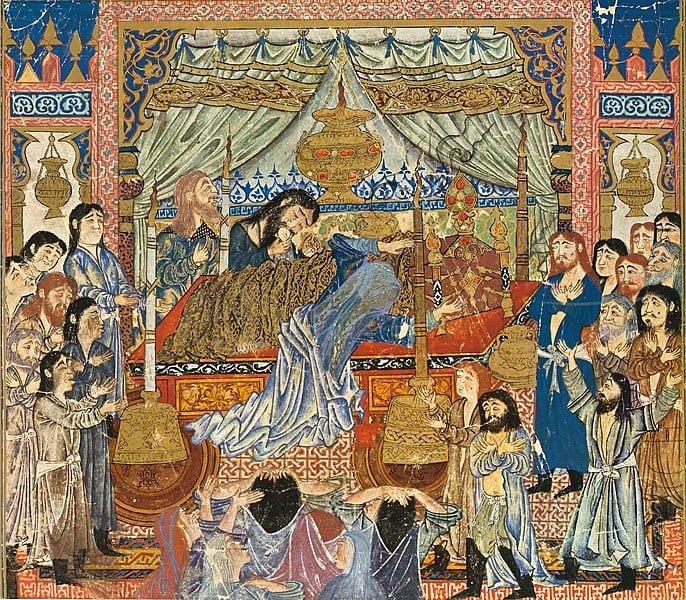
The death of Alexander the Great, in the eleventh-century Persian epic “Shahnameh” or “Book of Kings,” which I taught for many years at Brigham Young University (painted for an illuminated copy of the “Shahnameh” around AD 1330, in Tabriz). Alexander is yet another famous conqueror whose “greatness” might legitimately be viewed as, umm, problematic.
A little article of mine went up this morning in Meridian Magazine: “When “Great” Men Are Anything But: Rethinking Power Through the Lens of Christ”
Statues may rise for those called “great,” but history often forgets the blood they shed to get there. The world crowns the conqueror, but heaven sees greatness another way.
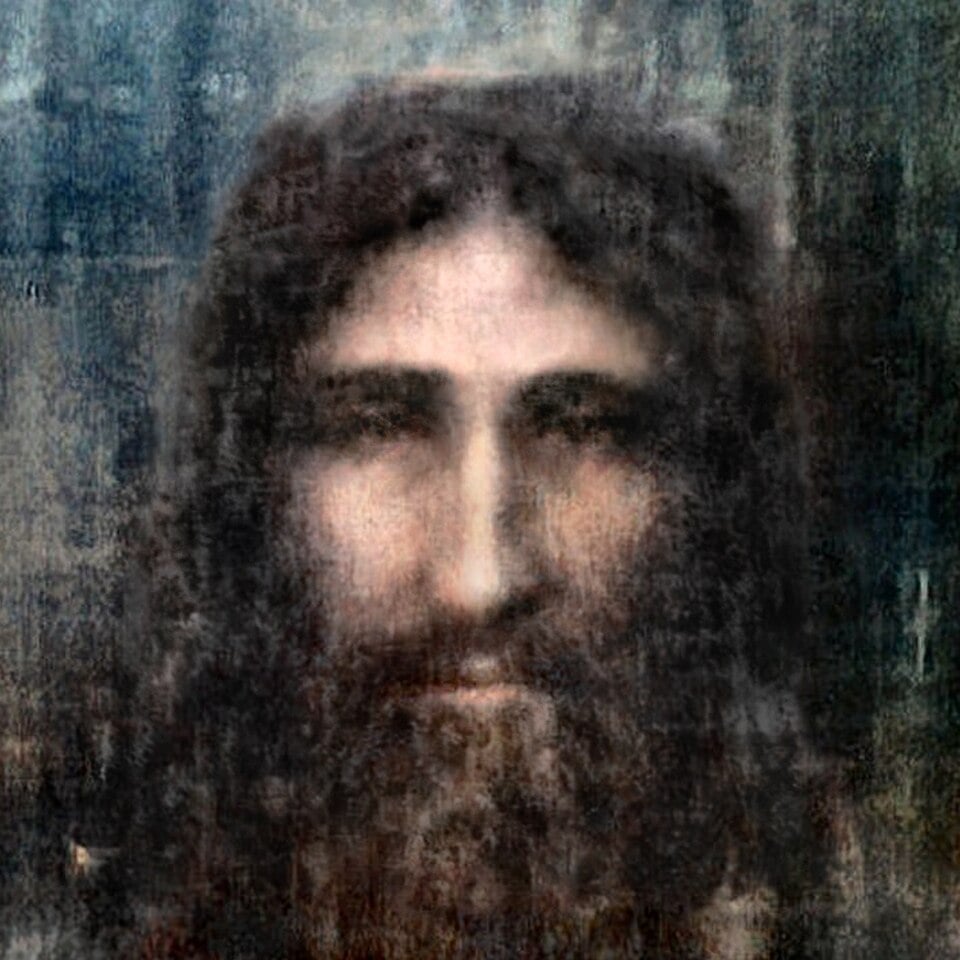
One artist’s impression of the face of Jesus based upon the image on the Shroud of Turin (Wikimedia Commons public domain photo)
I have never had strong feelings or a firm opinion about the famous Shroud of Turin and, although I find it interesting, I haven’t spent a lot of time on it or read systematically about it. Here, though, is a brief recent article on the topic that I think some might find worth a quick read: “A Quick Bible Study Vol. 271: Shroud of Turin Expert Russ Breault Interview”

A 2010 aerial view of downtown Helsinki, Finland (Wikimedia Commons public domain image)
I’m occasionally described as anti-evolution and, even, as a young-earth creationist. I’m certainly not the latter, and I can’t remember a time when I ever was. Since my childhood, since long before I became a committed Latter-day Saint, I’ve had a perhaps unusually strong interest in dinosaurs and the like. Seeing estimates for the Mesozoic Era, the so-called “Age of the Dinosaurs,” that place it between about 252 million years ago and sixty-six million years ago has never caused me to bat an eye. Occasionally, I’m confronted with demands that I fess up about how old I really believe the Earth to be. My answer is that, at least according to current scientific estimates, it’s about 4.543 billion years old, and that I have no reason whatever to dispute that.
I’m also not even remotely anti-evolution. I haven’t published very much on the subject, but I think that the evidence for the historical development of terrestrial life is overwhelming. And I hope that what little I have written about evolution (e.g., “How Can We Make Sense of Evolution?: A Latter-day Saint Perspective”) and my eagerness to solicit and to conduct such interviews as these will make the job of fundamentally misrepresenting my opinions on the matter at least somewhat more challenging to honest observers. (I have absolutely no such hope for the small anonymous handful of my more determined and unscrupulous critics.)
With the preceding explanation in mind, I do think that some critics of Darwinian, or Neo-Darwinian, or unguided evolution — whatever term you prefer to use — and advocates of what is often called “intelligent design” have raised more than a few points that deserve thoughtful consideration rather than mere summary dismissal.
Below, I share with you a trio of quotations from Matti Leisola and Jonathan Witt, Heretic: One Scientist’s Journey from Darwin to Design (Seattle: Discovery Institute Press, 2018). Matti Leisola, DSc, is a bioengineer and former dean of Chemistry and Material Sciences at Helsinki University of Technology. He is an expert in enzymes and rare sugars, having published 140 peer-reviewed articles and won the Latsis Prize from the ETH-Zürich (the Eidgenössische Technische Hochschule Zürich, the Swiss Federal Institute of Technology). He served for a time as the research director of Cultor, an international biotech company, co-founded the International Society of Rare Sugars, and was the initiating editor of BIO-Complexity.:
I am not, and I don’t pretend to be, a biologist. But this passage, which Leisola and Witt cite from the last chapter of a work called Enzymes, struck me. It’s about attempts to explain the origins of, well, enzymes:
The difficulties appear to have been greatly underestimated . . . difficulties seem to have been increased rather than diminished recently. Unfortunately, progress has not been helped by a strong tendency to make light of those difficulties, or even to ignore them altogether. . . . The problem in fact seems as far from solution as it ever was. . . . We are thus led to an apparently insoluble dilemma. . . . The subject is full of difficulties. (25)
Leisola and Witt go on to write that
The story of the unguided, chemical evolution of the first life has some variations depending on whose version you hear, but its main contours can be summarized as follows:
- At the time when the chemical constituents of the first life were developing, the Earth had virtually no free oxygen, important since the presence of free oxygen would prevent the formation of compounds essential for the origin of life.
- Nature invented a way to produce the chemical “letters” of the DNA/RNA alphabet: cytosine, adenine, thymine/uracil, and guanine (C, A, T/U, and G for short).
- Nature invented a way to make the sugars ribose and deoxyribose.
- Nature invented a way to combine these sugars, phosphoric acid, and the DNA/RNA alphabet letters (the four nucleobases — C, A, T/U, and G) into long chains.
- Nature invented a self-replicating molecule — DNA or RNA, and eventually both.
- Nature invented a method to make twenty distinct amino acids. This is a higher-level alphabet consisting of twenty characters.
- Nature invented a way to combine these amino acids into sophisticated protein machines.
- After inventing all this, nature changed the self-replicating molecule into a system in which DNA coded for amino acids and thus for proteins.
- Finally, nature invented a membrane system that isolated the invented molecules from the environment and metabolism began. (26-27)
As I say, I am not a biologist. So, if there are errors in the summary quoted immediately above, I would appreciate being cautioned against them, with specifics.
Leisola and Witt comment as follows upon the list that they’ve just offered:
As for the point about the early atmosphere containing no free oxygen, later findings have cast doubt on this, and an atmosphere with oxygen spells double trouble for nature’s efforts to generate the building blocks of life. But even setting aside that major problem, the invention stages of the story face major obstacles. All the inventions in the bullet points above somehow occurred in the face of one of nature’s basic laws, according to which natural systems, when left alone, tend towards disorder and, in the case of chemical reactions, towards equilibrium, Nature, as it turns out, even has trouble getting there with the help of modern technology, brilliant laboratory scientists, and meticulous chemical engineering. (27)
There follows, in their discussion, a section on the chemical-evolution experiments of Stanley Miller, which — at least back when I was in high school — were taught as having settled a great deal more about the origins of organic terrestrial life than they actually had.
Travel and Religion
History and Religion
Previous Post

June 8, 2025
An ancestor whose example challenges me to be faithful, too
Next Post

June 10, 2025 Some Good News for the Interpreter Foundation
Recent Comments
"In a meeting today, I learned another important reason why accurate (or at least as ..."
From Serbia’s “White City,” Belgrade
"PL: "Let's hope he doesn't have your address..."I have to frankly confess that a few ..."
From Serbia’s “White City,” Belgrade
"Let's hope he doesn't have your address..."
From Serbia’s “White City,” Belgrade
"PL: "The layers are peeling back."He appears to be suffering under an odd but powerful ..."
From Serbia’s “White City,” Belgrade
Browse Our Archives
Select a Category Uncategorized
Select a Month October 2026 September 2026 August 2026 July 2026 June 2026 May 2026 April 2026 March 2026 February 2026 January 2026 December 2025 November 2025 October 2025 September 2025 August 2025 July 2025 June 2025 May 2025 April 2025 March 2025 February 2025 January 2025 December 2024 November 2024 October 2024 September 2024 August 2024 July 2024 June 2024 May 2024 April 2024 March 2024 February 2024 January 2024 December 2023 November 2023 October 2023 September 2023 August 2023 July 2023 June 2023 May 2023 April 2023 March 2023 February 2023 January 2023 December 2022 November 2022 October 2022 September 2022 August 2022 July 2022 June 2022 May 2022 April 2022 March 2022 February 2022 January 2022 December 2021 November 2021 October 2021 September 2021 August 2021 July 2021 June 2021 May 2021 April 2021 March 2021 February 2021 January 2021 December 2020 November 2020 October 2020 September 2020 August 2020 July 2020 June 2020 May 2020 April 2020 March 2020 February 2020 January 2020 December 2019 November 2019 October 2019 September 2019 August 2019 July 2019 June 2019 May 2019 April 2019 March 2019 February 2019 January 2019 December 2018 November 2018 October 2018 September 2018 August 2018 July 2018 June 2018 May 2018 April 2018 March 2018 February 2018 January 2018 December 2017 November 2017 October 2017 September 2017 August 2017 July 2017 June 2017 May 2017 April 2017 March 2017 February 2017 January 2017 December 2016 November 2016 October 2016 September 2016 August 2016 July 2016 June 2016 May 2016 April 2016 March 2016 February 2016 January 2016 December 2015 November 2015 October 2015 September 2015 August 2015 July 2015 June 2015 May 2015 April 2015 March 2015 February 2015 January 2015 December 2014 November 2014 March 2014 August 2013 February 2012
Follow Us!
TAKE THE
Religious Wisdom Quiz
What did God place on Jeremiah’s mouth as a sign of his calling?
Select your answer to see how you score.
A scroll Burning coal A staff His words
Related posts from Sic et Non

What if Wallace had prevailed, rather than Darwin?


Studying the Pearl of Great Price, and Evolution

TRENDING AT PATHEOS Latter-day Saint

The Sermon on the Mount, Part I: Matthew...
The Sermon on the Mount, Part I (Matthew 4:12-5:12) St. Matthew moves...

What's up from Crossway: Reviewing some of their latest A few weeks...

Janie Learns the Way of the Cross: A...
Teaching children about Jesus' Passion can be challenging. Many parents and educators...

Looking For Good Catholic Writing - October 2026
He alone extends the heavens, and he walks upon the waves of...

In "Irreplaceable," our book on vocation and technology, Trevor Sutton and I...

I was strolling through the top floor of the brand new Parthenon...
view all Latter-day Saint blogs
What Are Your Thoughts?leave a comment
Ad-Free & Subscriber Log-In Subscription Support
- About Us
- 2026 Calendar
- Videos
- Podcasts
- Library of World Religions
- Faith In Media Tracker
- Advertise With Us
- Write for Us
- Privacy Policy
- Terms of Service
- Do Not Sell My Data
- Contact Us
- Radiant Digital
- Manage Newsletter Subscriptions
- Unsubscribe From Notifications
- Sitemap
Copyright 2008-2026, Patheos. All rights reserved.
Subscription Support Ad-Free & Subscriber Log-In
Follow Patheos