
BuddhistCatholicContemplativeEvangelicalGeneral ChristianHinduJewishLatter-day SaintMuslimNew VisionsProgressive Christian
Beliefs
- Buddhist
- Catholic
- Contemplative
- Evangelical
- General Christian
- Hindu
- Jewish
- Latter-day Saint
- More Voices
- Muslim
- New Visions
- Pagan
- Progressive Christian
Topics
- Religion News
- Food and Religion
- Sports and Religion
- Religious Art
- Religious Music and Entertainment
- Religious Events
- History and Religion
- Style and Religion
- Politics and Religion
- Women in Religion
- Recreation Outdoors and Religion
- Business Finance and Religion
- Careers Workplace and Religion
- Education and Religion
- Family Parenting and Religion
- Health Fitness and Religion
- Home and Religion
- Relationships and Religion
- Technology and Religion
- Travel and Religion
Columnists
- Buddhist Columnists
- Business Finance and Religion Columnists
- Careers Workplace and Religion Columnists
- Catholic Columnists
- Contemplative Columnists
- Education and Religion Columnists
- Evangelists Columnists
- Family Parenting and Religion Columnists
- General Christian Columnists
- Health Fitness and Religion Columnists
- Hindu Columnists
- History and Religion Columnists
- Home and Religion Columnists
- Jewish Columnists
- More Voices Columnists
- Latter Day Columnists
- Muslim Columnists
- New Visions Columnists
- Nonreligious Columnists
- Pagan Columnists
- Politics and Religion Columnists
- Progressive Columnists
- Recreation Outdoors and Religion Columnists
- Relationships and Religion Columnists
- Religion News Columnists
- Religious Art Columnists
- Religious Events Columnists
- Religious Music and Entertainment Columnists
- Sports and Religion Columnists
- Style and Religion Columnists
- Technology and Religion Columnists
- Travel and Religion Columnists
- Women in Religion Columnists
Resource Library
- 2026 Calendar
- Library of World Religions
- The 100 Most Holy Places on Earth
- Patheos Answers
- Podcasts
- Videos
- Faith Leaders Database
- Anglican Episcopalian
- Bahai
- Baptist
- Buddhism
- Christianity
- Confucianism
- Eastern Orthodoxy
- Hinduism
- Holiness and Pentecostal
- ISKCON
- Islam
- Judaism
- Lutheran
- Methodist
- The Church of Jesus Christ of Latter-day Saints
- New Age
- Paganism
- Presbytarian and Reformed
- Protestantism
- Religion Behind the Scenes
- Roman Catholic
- Scientology
- Shia Islam
- Sikhism
- Sufism
- Sunni Islam
- Taoism
- Zen
- See all religions
Research Tools
 Ad-Free & Subscriber Log-In Subscription Support
Ad-Free & Subscriber Log-In Subscription Support
Follow Patheos 

- Trending:
- Forgiveness
- |
- Marriage
- |
- Consciousness
- |
- Death Penalty
- |
- Election
- |
- Halloween

- Home
- Latter-day Saint
- History and Religion
- Some notes on the Gold Plates
Some notes on the Gold Plates
Last updated on: June 30, 2025 at 1:33 pm by Dan Peterson
Some notes on the Gold Plates 2025-06-30T13:33:20-06:00 Dan Peterson
Patheos Explore the world's faith through different perspectives on religion and spirituality! Patheos has the views of the prevalent religions and spiritualities of the world.
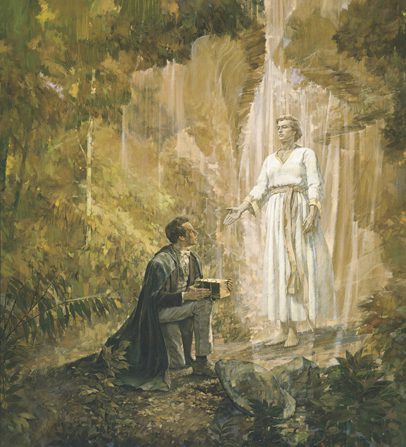
“Joseph Smith Receives the Gold Plates”
(Kenneth Riley, LDS Media Library)
I want to share some passages that I marked a while back from Richard Lyman Bushman, Joseph Smith’s Gold Plates: A Cultural History (New York and Oxford: Oxford University Press, 2023).
The account of the golden plates as we know it is documented very early:
The first known mention of the gold plates in writing occurred in the fall of 1828 in letters to Asael Smith, Joseph Smith Jr.’ s grandfather. Joseph Smith Sr. had not seen his father for twelve years.
Their letters are lost, but a reply from Joseph Sr.’ s brother Jesse dated June 17, 1829, refers to letters from Joseph Smith Sr. and two sons Hyrum and Joseph Jr. Jesse quotes Joseph Jr. as saying that “the Angel of the Lord has revealed to him the hidden treasures of wisdom & knowledge, even divine revelation, which has lain in the bowels of the earth for thousands of years.” Jesse also refers to spectacles and hieroglyphics as if one of the letters had talked about translation. The family apparently was told the whole story. (40)
Some critics of the Restoration have sought to make much of the fact that Emma Smith, Joseph’s wife, didn’t go west with the body of the Saints. But
Emma viewed herself as one who had never left the faith. “I know Mormonism to be the truth; and believe the Church to have been established by divine direction.” She knew she had “been called apostate; but I have never apostatized, nor forsaken the faith I at first accepted.” She felt she had good reasons for her belief. In the interview, she showed the rationalist bent of her mind. She said nothing about her love for her husband or her trust in his character. Hers was not a sentimental or spiritual faith. It was based on her observation of Joseph translating. Nothing she knew about him qualified him to dictate the book. “It is marvelous to me,” she said, “as much so as to any one else.” (50)
This point seems to me of particular importance:
The immediate family was more concerned about where to conceal the plates than to establish the plates’ reality. . . . The family seemed not to have been troubled by the question of the plates’ existence. (51)
In the next passage that I’ll cite, Joseph Smith’s mother, Lucy Mack Smith, recalls the day of the showing of the plates to the Eight Witnesses:
“Soon after they came, all of the male part of the company, together with my husband, Samuel [Smith], and Hyrum [Smith], retired to a place where the family were in the habit of offering up their secret devotions to God. They went to this place because it had been revealed to Joseph that the plates would be carried thither by one of the ancient Nephites.” (55)
That experience of the Eight Witnesses is, obviously, a very significant one:
When John Whitmer was later asked if he saw the plates “covered with a cloth,” he answered no. Joseph “handed them uncovered into our hands, and we turned the leaves sufficient to satisfy us.”
That was the kind of testimony rationalists could understand. It assimilated the plates into the ordinary world of material objects. No guardian spirits, no angels, no magical rituals. If accurate, the testimony of the eight witnesses satisfied the requirements of the rational enlightenment for sensory evidence. The problem was that too much rested on the testimonies. Belief in what they said implied acceptance of too many fabulous items: an angel appearing in Manchester, a simple young man conversing with the heavens, another Bible from ancient America. The problem was posed by Cornelius Blatchly, a onetime Quaker who wrote Martin Harris in 1829 only a few months after the witnesses said they saw the plates. Blatchly wanted to know more about this “wonderful record” but only if it could be “substantiated by indisputable evidences and witnesses.” In November 1829, Oliver Cowdery wrote back on Martin’s behalf. Knowing his account was fabulous, he insisted the witnesses could not have been mistaken in what they saw. “It was a clear, open beautiful day, far from any inhabitants, in a remote field, at the time we saw the record.” It was “brought and laid before us, by an angel, arrayed in glorious light.” Blatchly thanked Cowdery for his account but concluded that “so important a matter as a new bible” required “the most incontrovertible facts, circumstances and proofs.” Oliver’s account, in Blatchly’s judgment, failed to meet that high standard. (56)
And here is one of the accounts that I myself have found most interesting:
John’s mother, Mary Whitmer, another plain-spoken witness, said she saw the plates when she went to do the milking. In 1878, years after the event, her son said that his mother had grown weary with the work of housing and feeding the translating contingent. In June 1829, Joseph, Oliver, and Emma squeezed into an already crowded household. Emma must have been pressed into service, but the two men were of no help. They spent their days in an upstairs room recording the translation. Mary Whitmer had reason to complain of the added burden. Mary’s son David told Orson Pratt and Joseph F. Smith in 1878 that as his mother was going to milk the cows, an old man carrying a pack met her in the yard. He recognized that “you are tried because of the increase of your toil,” and so “it is proper therefore that you should receive a witness that your faith may be strengthened.” Then he took the plates out of the knapsack and showed them to her. Whitmer said that seeing the plates “nerved her up for her increased responsibilities.” One of Mary’s grandsons, John C. Whitmer, added that “this strange person turned the leaves of the book of plates over, leaf after leaf, and also showed her the engravings upon them.” Then he vanished with the plates.
Mary Whitmer did not record the experience herself, but she told the story to her grandchildren “on several occasions.” Her account was of a piece with other stories the Whitmers told. David Whitmer linked his mother’s angel to the “very pleasant, nice-looking old man” he had seen on the road while bringing Joseph and Oliver to Fayette. His nephew John also described the visitor as “a stranger carrying something on his back that looked like a knapsack” and “spoke to her in a kind, friendly tone.” (57)
History and Religion
Travel and Religion
Previous Post

June 30, 2025
Twenty-two years ago
Next Post

July 1, 2025 Comments on Current Politics, with a Nod to the 15th Century
Recent Comments
"Sutherland's lecture sounds interesting. He seems to restate the Washington consensus that trade brings peace ..."
Learning more about a region of ..."
"In a meeting today, I learned another important reason why accurate (or at least as ..."
From Serbia’s “White City,” Belgrade
"I've been watching a lot of video interviews of NDErs and researchers. I think in ..."
"PL: "Let's hope he doesn't have your address..."I have to frankly confess that a few ..."
From Serbia’s “White City,” Belgrade
Browse Our Archives
Select a Category Uncategorized
Select a Month October 2026 September 2026 August 2026 July 2026 June 2026 May 2026 April 2026 March 2026 February 2026 January 2026 December 2025 November 2025 October 2025 September 2025 August 2025 July 2025 June 2025 May 2025 April 2025 March 2025 February 2025 January 2025 December 2024 November 2024 October 2024 September 2024 August 2024 July 2024 June 2024 May 2024 April 2024 March 2024 February 2024 January 2024 December 2023 November 2023 October 2023 September 2023 August 2023 July 2023 June 2023 May 2023 April 2023 March 2023 February 2023 January 2023 December 2022 November 2022 October 2022 September 2022 August 2022 July 2022 June 2022 May 2022 April 2022 March 2022 February 2022 January 2022 December 2021 November 2021 October 2021 September 2021 August 2021 July 2021 June 2021 May 2021 April 2021 March 2021 February 2021 January 2021 December 2020 November 2020 October 2020 September 2020 August 2020 July 2020 June 2020 May 2020 April 2020 March 2020 February 2020 January 2020 December 2019 November 2019 October 2019 September 2019 August 2019 July 2019 June 2019 May 2019 April 2019 March 2019 February 2019 January 2019 December 2018 November 2018 October 2018 September 2018 August 2018 July 2018 June 2018 May 2018 April 2018 March 2018 February 2018 January 2018 December 2017 November 2017 October 2017 September 2017 August 2017 July 2017 June 2017 May 2017 April 2017 March 2017 February 2017 January 2017 December 2016 November 2016 October 2016 September 2016 August 2016 July 2016 June 2016 May 2016 April 2016 March 2016 February 2016 January 2016 December 2015 November 2015 October 2015 September 2015 August 2015 July 2015 June 2015 May 2015 April 2015 March 2015 February 2015 January 2015 December 2014 November 2014 March 2014 August 2013 February 2012
Follow Us!
TAKE THE
Religious Wisdom Quiz
In this Gospel, Jesus' first miracle is not recorded, and the narrative begins with a voice crying in the wilderness. Which Gospel starts with John the Baptist's ministry?
Select your answer to see how you score.
Luke John Matthew Mark
Related posts from Sic et Non


Notes on Women, Priesthood, and General Conference

"The Book of Moses as a Temple Text"

TRENDING AT PATHEOS Latter-day Saint

In "Irreplaceable," our book on vocation and technology, Trevor Sutton and I...

I was strolling through the top floor of the brand new Parthenon...

What Does Gêvâh Mean For Kimberley Guifoyle &...
This week, a lot of the news is focused on Kimberly Guilfoyle....

INNER CIRCLE: Profound Mystery (Of Christ In All...
Ephesians 5:31-32 “For this reason, a man will leave his father and...

Do Not Rejoice When Your Enemy Falls: The...
Turning an execution into a public spectacle is a disturbing expression of...

'The Chosen' S6 Trailer: The Passion Gets Very...
Not many watching 'The Chosen' worry about spoilers, but just because they...
view all Latter-day Saint blogs
What Are Your Thoughts?leave a comment
Ad-Free & Subscriber Log-In Subscription Support
- About Us
- 2026 Calendar
- Videos
- Podcasts
- Library of World Religions
- Faith In Media Tracker
- Advertise With Us
- Write for Us
- Privacy Policy
- Terms of Service
- Do Not Sell My Data
- Contact Us
- Radiant Digital
- Manage Newsletter Subscriptions
- Unsubscribe From Notifications
- Sitemap
Copyright 2008-2026, Patheos. All rights reserved.
Subscription Support Ad-Free & Subscriber Log-In
Follow Patheos