
BuddhistCatholicContemplativeEvangelicalGeneral ChristianHinduJewishLatter-day SaintMuslimNew VisionsProgressive Christian
Beliefs
- Buddhist
- Catholic
- Contemplative
- Evangelical
- General Christian
- Hindu
- Jewish
- Latter-day Saint
- More Voices
- Muslim
- New Visions
- Pagan
- Progressive Christian
Topics
- Religion News
- Food and Religion
- Sports and Religion
- Religious Art
- Religious Music and Entertainment
- Religious Events
- History and Religion
- Style and Religion
- Politics and Religion
- Women in Religion
- Recreation Outdoors and Religion
- Business Finance and Religion
- Careers Workplace and Religion
- Education and Religion
- Family Parenting and Religion
- Health Fitness and Religion
- Home and Religion
- Relationships and Religion
- Technology and Religion
- Travel and Religion
Columnists
- Buddhist Columnists
- Business Finance and Religion Columnists
- Careers Workplace and Religion Columnists
- Catholic Columnists
- Contemplative Columnists
- Education and Religion Columnists
- Evangelists Columnists
- Family Parenting and Religion Columnists
- General Christian Columnists
- Health Fitness and Religion Columnists
- Hindu Columnists
- History and Religion Columnists
- Home and Religion Columnists
- Jewish Columnists
- More Voices Columnists
- Latter Day Columnists
- Muslim Columnists
- New Visions Columnists
- Nonreligious Columnists
- Pagan Columnists
- Politics and Religion Columnists
- Progressive Columnists
- Recreation Outdoors and Religion Columnists
- Relationships and Religion Columnists
- Religion News Columnists
- Religious Art Columnists
- Religious Events Columnists
- Religious Music and Entertainment Columnists
- Sports and Religion Columnists
- Style and Religion Columnists
- Technology and Religion Columnists
- Travel and Religion Columnists
- Women in Religion Columnists
Resource Library
- 2026 Calendar
- Library of World Religions
- The 100 Most Holy Places on Earth
- Patheos Answers
- Podcasts
- Videos
- Faith Leaders Database
- Anglican Episcopalian
- Bahai
- Baptist
- Buddhism
- Christianity
- Confucianism
- Eastern Orthodoxy
- Hinduism
- Holiness and Pentecostal
- ISKCON
- Islam
- Judaism
- Lutheran
- Methodist
- The Church of Jesus Christ of Latter-day Saints
- New Age
- Paganism
- Presbytarian and Reformed
- Protestantism
- Religion Behind the Scenes
- Roman Catholic
- Scientology
- Shia Islam
- Sikhism
- Sufism
- Sunni Islam
- Taoism
- Zen
- See all religions
Research Tools
 Ad-Free & Subscriber Log-In Subscription Support
Ad-Free & Subscriber Log-In Subscription Support
Follow Patheos 

- Trending:
- Forgiveness
- |
- Marriage
- |
- Consciousness
- |
- Death Penalty
- |
- Election
- |
- Halloween

- Home
- Latter-day Saint
- History and Religion
- Rightly Understanding the Restoration’s Doctrinal History
Rightly Understanding the Restoration’s Doctrinal History
Last updated on: June 7, 2025 at 2:11 pm by Dan Peterson
Rightly Understanding the Restoration’s Doctrinal History 2025-06-07T14:11:21-06:00 Dan Peterson
Patheos Explore the world's faith through different perspectives on religion and spirituality! Patheos has the views of the prevalent religions and spiritualities of the world.

The beginning of the Valle Sagrado, not far from Cusco (Wikimedia Commons public domain photograph). I’ve made two visits to Peru. Fascinating place.
One of my nephews — my late brother’s eldest son — has been in town, along with a daughter of his who is participating in a camp at BYU. On Thursday evening, they took us out to dinner at AjiPeru. I enjoyed the lomo saltado and washed it down with glasses of cold chicha morada and maracuya. (I’m not even remotely a “foodie,” but describing meals and menus clearly drives a few of my anonymous online critics mad[der], which is what they seem to live for. So I’m only thinking of them when I post such morsels.)
My nephew holds a doctorate (from a premier graduate program) in engineering, but he’s always had literary inclinations, so he’s now shared with me a manuscript anthology of relatively short meditations — mostly, but not all, of his own composition, in both poetry and prose — on what fatherhood has meant to him and has taught him. I haven’t read the entire manuscript (I only received it on Thursday evening), but there are parts of it that are quite moving and even profound. Not at all the kinds of things that most (I think) would expect when first picking up a book of reflections on being a Dad. He’s now considering possible publication venues, including self-publishing.
He came by our house this morning, and we had a good visit about his manuscript and a host of other things. It’s good to catch up; it’s too easy to let relationships slide through lack of time.
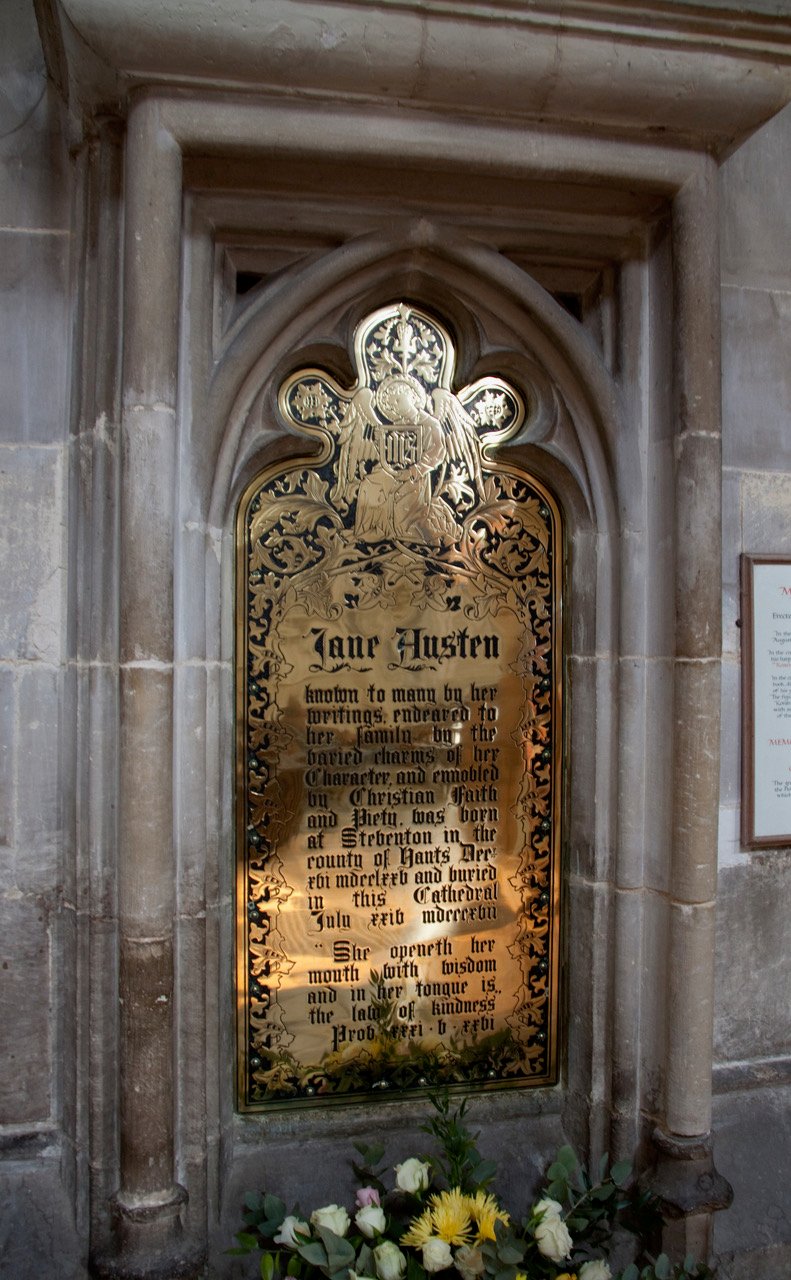
The Jane Austen Memorial in Winchester Cathedral (Wikimedia Commons public domain photograph)
Flipping through the channels late last night, we discovered that the 1995 BBC version of Pride and Prejudice, with Jennifer Ehle and Colin Firth, was running on BYUtv. So, being the pre-programmed robots that we are, we instantly sat down and watched the first episode there and then watched two more episodes on my wife’s computer. We would have binge-watched the entire thing yet again — how many times have we watched it and its Keira Knightley alternative? I have literally no idea — but, gradually, as we asymptotically approach mature judgment, we’re coming to recognize our limits. And we knew that our granddaughter would be up early, no matter how late we watched Pride and Prejudice. Partly we were in the mood to revisit Jane Austen’s great story because we had just visited her cottage home in Chawton, Hampshire and done an Austen-themed walking tour in London’s Mayfair district and paid our respects at her tomb in Winchester Cathedral. But we would almost certainly have watched the movie anyway, even if we hadn’t just done yet another Austen pilgrimage. We’re addicts.
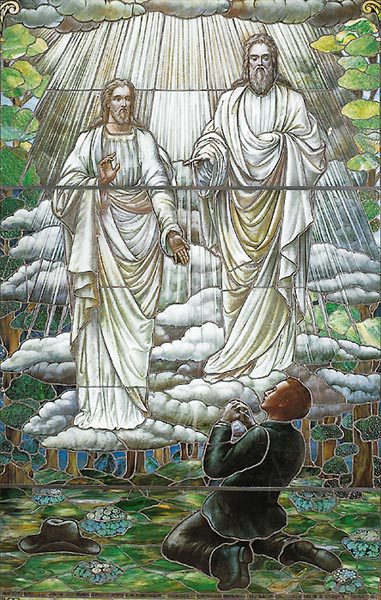
Joseph Smith’s First Vision
(A stained glass window from roughly 1913)
Wikimedia Commons public domain image
I want to call your attention to a still relatively recent article that I judge to be extremely important: Barry R. Bickmore, “Show Them unto No Man”: Part 1. Esoteric Teachings and the Problem of Early Latter-day Saint Doctrinal History” BYU Studies 62/1 (2023): 29-60. In order to do so, I cite an exceptionally long passage from it, justifying my extended quotation by pointing out that it neatly summarizes the significant argument that Professor Bickmore is pursuing in his essay and that I hope, thereby, to whet your appetite for reading more of what he has to say:
Esotericism is the practice of keeping two sets of doctrines—an “exoteric” set meant to be understood by the general public and an “esoteric” (that is, hidden) set meant to be understood only by believers, or even a privileged subset of believers. What is more, the exoteric teachings may be deliberately crafted to make extrapolation to the esoteric doctrines difficult. For example, it is now widely recognized that esotericism was practiced in early Christianity, and when Jesus’s disciples asked him why he taught in parables, he replied that “it is given unto you to know the mysteries of the kingdom of heaven, but to them it is not given” (Matt. 13:10–11). Christian writers in the first few centuries after Christ often noted that they were in possession of an esoteric tradition handed down from the Apostles, withheld from unbelievers and rarely written down. Such esoteric teachings clearly existed,5 but although we can find clues about what they involved, their specific content remains largely unknown. Because of this, it is an inescapable fact that historical reconstructions of early Christian doctrinal history must involve a heavy dose of speculation and bias. Regarding the esoteric tradition in early Christianity, Methodist scholar Margaret Barker writes, “It is the unwritten nature of this tradition which proves to be the greatest problem in any investigation which relies entirely on written sources, there being nothing else to use. We can proceed only by reading between the lines and arguing from silence, always a dangerous procedure.”
The bias involved is not limited to the influence of religious, political, or other points of view. In addition, historians approaching the doctrinal history of a religion that incorporates esotericism often exhibit a bias toward downplaying its importance. That is, they make the practical assumption that even if they know they are missing some information about esoteric teachings, that information probably is not critical for drawing correct conclusions about the belief system. For instance, even several decades after the discovery of the Dead Sea Scrolls showed that Second Temple Judaism was rife with exactly the sort of esotericism practiced in early Christianity, Guy Stroumsa could write that “the existence of esoteric trends in the earliest strata of Christianity . . . [is] still ignored or played down by some scholars.” If its existence is acknowledged, it is too often viewed “almost exclusively within the context of the Hellenistic mystery cults.”
Given that the whole point of esotericism is to withhold from public view the clearest and most advanced expositions of doctrine, downplaying the importance of esoteric teachings seems problematic. But how can we assess the seriousness of the problem, when the issue is one of missing information?
In this essay, I argue that the cost of ignoring esotericism when reconstructing doctrinal history is very steep indeed. To demonstrate this point, I present some examples of early Latter-day Saint doctrinal statements that, upon reflection, appear difficult to interpret correctly without referring to Joseph Smith’s documented practice of esotericism. In these cases, we actually have both the exoteric and esoteric versions of Smith’s early teaching. Among Joseph Smith’s earliest writings are the Book of Mormon and the book of Moses, a pair of documents unquestionably produced by Smith near-contemporaneously and respectively claiming to expound exoteric and esoteric teachings.
I also show that a number of historians have nevertheless proposed pathways of early Latter-day Saint doctrinal change that are demonstrably implausible, precisely because they have misunderstood the exoteric-esoteric relationship between these documents, and because they have too often refused to even consider the possibility that Joseph Smith was working from a sophisticated, and perhaps even successful, plan to restore legitimately primitive aspects of early Christianity. No matter what the source of their bias, it is clear that these historians have made very serious mistakes of interpretation, with the result that they present early Church doctrinal history as much more disjointed than it actually was. (31-33)
I was pleased to see that Professor Bickmore specifically (albeit in passing) addresses some recent attempts to recast the development of Restoration doctrine in what seem to be pretty clearly naturalistic terms, as deriving largely if not entirely from ideas available to Joseph Smith in his mundane intellectual environment rather than from revelation. Such treatments require response.
History and Religion
Travel and Religion
Previous Post

June 6, 2025
Remember!
Next Post

June 8, 2025 An ancestor whose example challenges me to be faithful, too
Recent Comments
"In a meeting today, I learned another important reason why accurate (or at least as ..."
From Serbia’s “White City,” Belgrade
"I've been watching a lot of video interviews of NDErs and researchers. I think in ..."
"PL: "Let's hope he doesn't have your address..."I have to frankly confess that a few ..."
From Serbia’s “White City,” Belgrade
"Let's hope he doesn't have your address..."
From Serbia’s “White City,” Belgrade
Browse Our Archives
Select a Category Uncategorized
Select a Month October 2026 September 2026 August 2026 July 2026 June 2026 May 2026 April 2026 March 2026 February 2026 January 2026 December 2025 November 2025 October 2025 September 2025 August 2025 July 2025 June 2025 May 2025 April 2025 March 2025 February 2025 January 2025 December 2024 November 2024 October 2024 September 2024 August 2024 July 2024 June 2024 May 2024 April 2024 March 2024 February 2024 January 2024 December 2023 November 2023 October 2023 September 2023 August 2023 July 2023 June 2023 May 2023 April 2023 March 2023 February 2023 January 2023 December 2022 November 2022 October 2022 September 2022 August 2022 July 2022 June 2022 May 2022 April 2022 March 2022 February 2022 January 2022 December 2021 November 2021 October 2021 September 2021 August 2021 July 2021 June 2021 May 2021 April 2021 March 2021 February 2021 January 2021 December 2020 November 2020 October 2020 September 2020 August 2020 July 2020 June 2020 May 2020 April 2020 March 2020 February 2020 January 2020 December 2019 November 2019 October 2019 September 2019 August 2019 July 2019 June 2019 May 2019 April 2019 March 2019 February 2019 January 2019 December 2018 November 2018 October 2018 September 2018 August 2018 July 2018 June 2018 May 2018 April 2018 March 2018 February 2018 January 2018 December 2017 November 2017 October 2017 September 2017 August 2017 July 2017 June 2017 May 2017 April 2017 March 2017 February 2017 January 2017 December 2016 November 2016 October 2016 September 2016 August 2016 July 2016 June 2016 May 2016 April 2016 March 2016 February 2016 January 2016 December 2015 November 2015 October 2015 September 2015 August 2015 July 2015 June 2015 May 2015 April 2015 March 2015 February 2015 January 2015 December 2014 November 2014 March 2014 August 2013 February 2012
Follow Us!
TAKE THE
Religious Wisdom Quiz
What queen visited Solomon to test his wisdom?
Select your answer to see how you score.
Queen of Tyre Queen of Sheba Queen of Egypt Queen Esther
Related posts from Sic et Non


Notes on Women, Priesthood, and General Conference

"The Book of Moses as a Temple Text"

TRENDING AT PATHEOS Latter-day Saint

Janie Learns the Way of the Cross: A...
Teaching children about Jesus' Passion can be challenging. Many parents and educators...

Looking For Good Catholic Writing - October 2026
He alone extends the heavens, and he walks upon the waves of...

In "Irreplaceable," our book on vocation and technology, Trevor Sutton and I...

I was strolling through the top floor of the brand new Parthenon...

What Does Gêvâh Mean For Kimberley Guifoyle &...
This week, a lot of the news is focused on Kimberly Guilfoyle....

INNER CIRCLE: Profound Mystery (Of Christ In All...
Ephesians 5:31-32 “For this reason, a man will leave his father and...
view all Latter-day Saint blogs
What Are Your Thoughts?leave a comment
Ad-Free & Subscriber Log-In Subscription Support
- About Us
- 2026 Calendar
- Videos
- Podcasts
- Library of World Religions
- Faith In Media Tracker
- Advertise With Us
- Write for Us
- Privacy Policy
- Terms of Service
- Do Not Sell My Data
- Contact Us
- Radiant Digital
- Manage Newsletter Subscriptions
- Unsubscribe From Notifications
- Sitemap
Copyright 2008-2026, Patheos. All rights reserved.
Subscription Support Ad-Free & Subscriber Log-In
Follow Patheos