
BuddhistCatholicContemplativeEvangelicalGeneral ChristianHinduJewishLatter-day SaintMuslimNew VisionsProgressive Christian
Beliefs
- Buddhist
- Catholic
- Contemplative
- Evangelical
- General Christian
- Hindu
- Jewish
- Latter-day Saint
- More Voices
- Muslim
- New Visions
- Pagan
- Progressive Christian
Topics
- Religion News
- Food and Religion
- Sports and Religion
- Religious Art
- Religious Music and Entertainment
- Religious Events
- History and Religion
- Style and Religion
- Politics and Religion
- Women in Religion
- Recreation Outdoors and Religion
- Business Finance and Religion
- Careers Workplace and Religion
- Education and Religion
- Family Parenting and Religion
- Health Fitness and Religion
- Home and Religion
- Relationships and Religion
- Technology and Religion
- Travel and Religion
Columnists
- Buddhist Columnists
- Business Finance and Religion Columnists
- Careers Workplace and Religion Columnists
- Catholic Columnists
- Contemplative Columnists
- Education and Religion Columnists
- Evangelists Columnists
- Family Parenting and Religion Columnists
- General Christian Columnists
- Health Fitness and Religion Columnists
- Hindu Columnists
- History and Religion Columnists
- Home and Religion Columnists
- Jewish Columnists
- More Voices Columnists
- Latter Day Columnists
- Muslim Columnists
- New Visions Columnists
- Nonreligious Columnists
- Pagan Columnists
- Politics and Religion Columnists
- Progressive Columnists
- Recreation Outdoors and Religion Columnists
- Relationships and Religion Columnists
- Religion News Columnists
- Religious Art Columnists
- Religious Events Columnists
- Religious Music and Entertainment Columnists
- Sports and Religion Columnists
- Style and Religion Columnists
- Technology and Religion Columnists
- Travel and Religion Columnists
- Women in Religion Columnists
Resource Library
- 2026 Calendar
- Library of World Religions
- The 100 Most Holy Places on Earth
- Patheos Answers
- Podcasts
- Videos
- Faith Leaders Database
- Anglican Episcopalian
- Bahai
- Baptist
- Buddhism
- Christianity
- Confucianism
- Eastern Orthodoxy
- Hinduism
- Holiness and Pentecostal
- ISKCON
- Islam
- Judaism
- Lutheran
- Methodist
- The Church of Jesus Christ of Latter-day Saints
- New Age
- Paganism
- Presbytarian and Reformed
- Protestantism
- Religion Behind the Scenes
- Roman Catholic
- Scientology
- Shia Islam
- Sikhism
- Sufism
- Sunni Islam
- Taoism
- Zen
- See all religions
Research Tools
 Ad-Free & Subscriber Log-In Subscription Support
Ad-Free & Subscriber Log-In Subscription Support
Follow Patheos 

- Trending:
- Forgiveness
- |
- Marriage
- |
- Consciousness
- |
- Death Penalty
- |
- Election
- |
- Halloween

- Home
- Latter-day Saint
- History and Religion
- Is our reasoning ability overdeveloped? A biological error?
Is our reasoning ability overdeveloped? A biological error?
Last updated on: June 15, 2025 at 8:24 pm by Dan Peterson
Is our reasoning ability overdeveloped? A biological error? 2025-06-15T20:24:24-06:00 Dan Peterson
Patheos Explore the world's faith through different perspectives on religion and spirituality! Patheos has the views of the prevalent religions and spiritualities of the world.

The law school of the University of Pennsylvania, where Professor David Skeel holds an endowed chair (Wikimedia Commons public domain media image)
Some readers here may recall that, in fits and starts, I’ve been working very occasionally on a massive project — planned to result, if it ever results in anything at all, in four or five sizable volumes — for which my working title has long been The Reasonable Leap into Light: An Argument for Skeptics. It is designed to argue, in a painstaking cumulative case, that it is rational to accept the claims of, first, theism; then, second, of Christian theism; and, finally, of Restored Christian theism. To that end, I share here some passages that I’ve extracted from David Skeel, True Paradox: How Christianity Makes Sense of Our Complex World (IVP Books, 2014).
David Skeel is S. Samuel Arsht Professor of Corporate Law at the University of Pennsylvania Law School. He does a pretty good job, I think, of framing a few of the basic issues that I will consider, should they ever actually see the light of day, in the first three or four volumes of Reasonable Leap into Light:
Some materialists suggest that our idea-making capacity doesn’t have a purpose at all — or at least that our mental capacities have far outstripped the most important benefits. . . .
Steven Pinker sums up nicely the notion that our idea-making capacity may be extraneous. It is true, he acknowledges, that people in every place and time “concoct theories of the universe and their place within it.” But to his mind, this yearning is “biologically frivolous and vain.” He explains that “given that the mind is a product of natural selection, it should not have a miraculous ability to commune with all truths; it should have a mere ability to solve problems that are sufficiently similar to the mundane survival challenges of our ancestors.” From this perspective, religion, philosophy and the quest to make sense of why we are here are “the application of mental tools to problems they were not designed to solve.” (40)
He goes on to summarize the theory very concisely:
According to the standard account of evolutionary psychology, the widespread belief in a supernatural being or beings, which appears to date back to the earliest humans, is best explained by a phenomenon known as “hypersensitive agency detection.” Like other animals, the reasoning goes, we developed an acute sense of possible predators. Humans who imagined that every rustling in the tall grass of the African savannah was a lion were more likely to survive than their peers who assumed that the rustling was simply the wind. False positives (mistakenly thinking a predator was nearby even when it wasn’t) are better than false negatives (thinking the sound is not a predator when it is) — at least so long as they did not leave our ancestors so paralyzed by fear that they couldn’t function. (41).
The most extended exposition that I have personally read of that explanation for the omnipresence of religious belief is Faces in the Clouds: A New Theory of Religion (New York: Oxford University Press, 1995), written by an anthropologist named Stewart Elliott Guthrie. Here’s most of the description that’s given on Amazon. I’m not in the mood to go track my copy down; this probably comes from the jacket of the book:
Guthrie says religion can best be understood as systematic anthropomorphism–that is, the attribution of human characteristics to nonhuman things and events. Many writers see anthropomorphism as common or even universal in religion, but few think it is central. To Guthrie, however, it is fundamental. Religion, he writes, consists of seeing the world as humanlike.
As Guthrie shows, people find a wide range of humanlike beings plausible: Gods, spirits, abominable snowmen, HAL the computer, Chiquita Banana. We find messages in random events such as earthquakes, weather, and traffic accidents. We say a fire “rages,” a storm “wreaks vengeance,” and waters “lie still.” Guthrie says that our tendency to find human characteristics in the nonhuman world stems from a deep-seated perceptual strategy: in the face of pervasive (if mostly unconscious) uncertainty about what we see, we bet on the most meaningful interpretation we can. If we are in the woods and see a dark shape that might be a bear or a boulder, for example, it is good policy to think it is a bear. If we are mistaken, we lose little, and if we are right, we gain much. So, Guthrie writes, in scanning the world we always look for what most concerns us–livings things, and especially, human ones. Even animals watch for human attributes, as when birds avoid scarecrows. In short, we all follow the principle–better safe than sorry.
Marshalling a wealth of evidence from anthropology, cognitive science, philosophy, theology, advertising, literature, art, and animal behavior, Guthrie offers a fascinating array of examples to show how this perceptual strategy pervades secular life and how it characterizes religious experience. Challenging the very foundations of religion, Faces in the Clouds forces us to take a new look at this fundamental element of human life.
Although I don’t follow his argument all the way to his reductive conclusion about the origin of religious belief, I think that Guthrie has a point. Sometimes, I test my own ability to discern faces in the clouds and, for that matter, in random patterns on our bathroom floor tiles. I never fail to find them.
Professor Skeel, too, is unconvinced by such theorizing:
The first thing to note is that the step from hearing a rustle in the tall grass and suspecting a lion to a conclusion that the entire cosmos has been ordered by God is not a small one. It is better described as an Olympian leap. The usefulness of heightened sensitivity to the possible presence of lions is far more obvious than, for instance, the benefits of detecting gods in or behind the cosmos. Some of the more recent accounts attempt to address this shortcoming, positing that the earliest religious beliefs were an accident of our hypersensitive agency, but that religion proved to be an effective means of enhancing the cohesiveness of a particular group. Religion was an accident, the reasoning goes, but it proved to be a happy accident (at least in this sense). (42)
But it does not seem likely that our hands, feet, liver and heart are useful adaptations yet our idea-making capacity was an accident. (43)
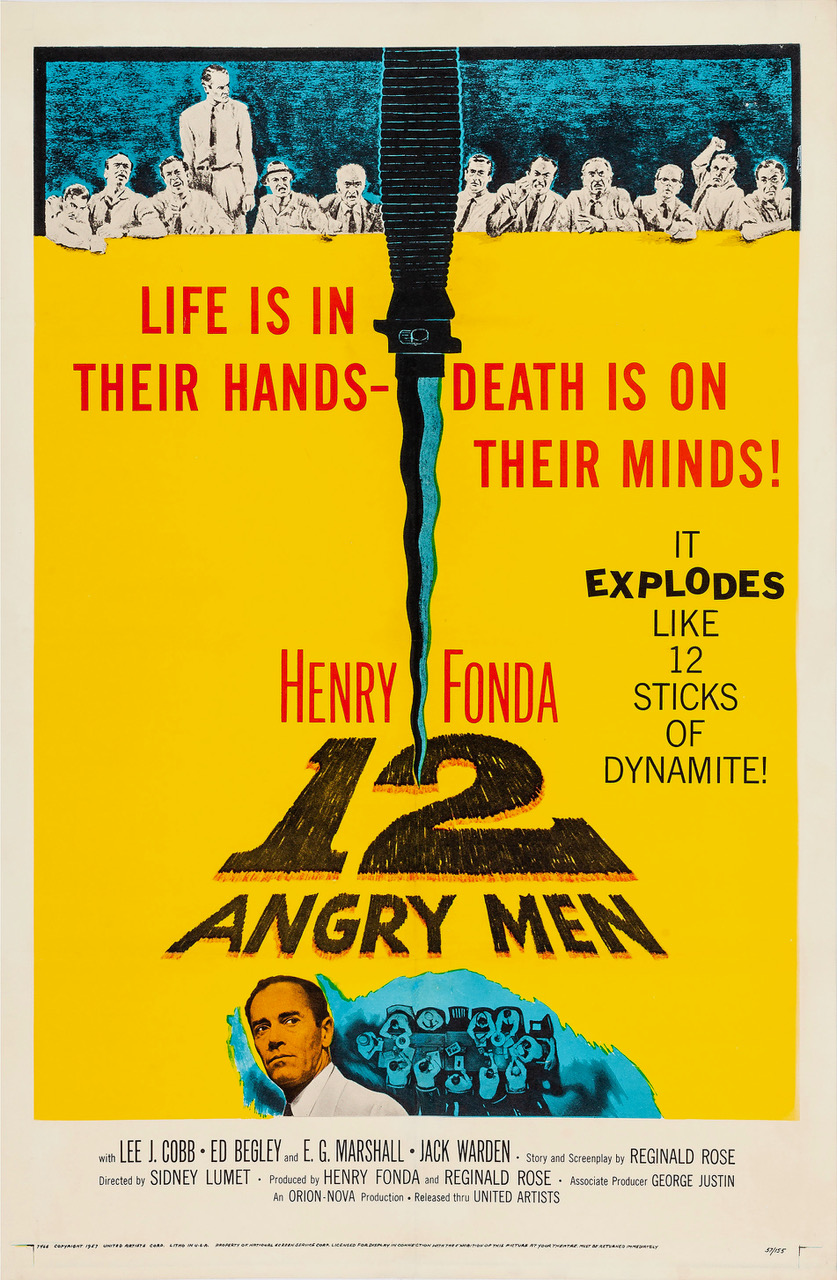
A poster for the great 1957 film adaptation (Wikimedia Commons public domain image)
Yesterday (Saturday), my wife and I attended a matinee performance of Twelve Angry Men up at the Hale Centre Theatre in Sandy. It was very well done. I had been looking forward to it because, among other things, I’ve used the all-male cast and title of the play (and of the great 1957 movie version of it that featured Henry Fonda, Jack Klugman, Lee J. Cobb, Martin Balsam, E. G. Marshall, Jack Warden, and Ed Begley) in my discussions of the Witnesses of the Book of Mormon (e.g., in a 2019 presentation at the annual FAIR Conference). But I was a bit surprised (and saddened) yesterday at how relevant I found the play to contemporary national issues.
History and Religion
Travel and Religion
Previous Post

June 14, 2025
"Records, Writing, and Language"
Next Post

June 16, 2025 Can we know what he looked like?
Recent Comments
"DP: “But Mr. Sutherland worries about the fact that our time, when we can communicate ..."
Learning more about a region of ..."
"Another class of memories are of individuals who previously lived. Some of these remembered individuals ..."
"Sutherland's lecture sounds interesting. He seems to restate the Washington consensus that trade brings peace ..."
Learning more about a region of ..."
"In a meeting today, I learned another important reason why accurate (or at least as ..."
From Serbia’s “White City,” Belgrade
Browse Our Archives
Select a Category Uncategorized
Select a Month October 2026 September 2026 August 2026 July 2026 June 2026 May 2026 April 2026 March 2026 February 2026 January 2026 December 2025 November 2025 October 2025 September 2025 August 2025 July 2025 June 2025 May 2025 April 2025 March 2025 February 2025 January 2025 December 2024 November 2024 October 2024 September 2024 August 2024 July 2024 June 2024 May 2024 April 2024 March 2024 February 2024 January 2024 December 2023 November 2023 October 2023 September 2023 August 2023 July 2023 June 2023 May 2023 April 2023 March 2023 February 2023 January 2023 December 2022 November 2022 October 2022 September 2022 August 2022 July 2022 June 2022 May 2022 April 2022 March 2022 February 2022 January 2022 December 2021 November 2021 October 2021 September 2021 August 2021 July 2021 June 2021 May 2021 April 2021 March 2021 February 2021 January 2021 December 2020 November 2020 October 2020 September 2020 August 2020 July 2020 June 2020 May 2020 April 2020 March 2020 February 2020 January 2020 December 2019 November 2019 October 2019 September 2019 August 2019 July 2019 June 2019 May 2019 April 2019 March 2019 February 2019 January 2019 December 2018 November 2018 October 2018 September 2018 August 2018 July 2018 June 2018 May 2018 April 2018 March 2018 February 2018 January 2018 December 2017 November 2017 October 2017 September 2017 August 2017 July 2017 June 2017 May 2017 April 2017 March 2017 February 2017 January 2017 December 2016 November 2016 October 2016 September 2016 August 2016 July 2016 June 2016 May 2016 April 2016 March 2016 February 2016 January 2016 December 2015 November 2015 October 2015 September 2015 August 2015 July 2015 June 2015 May 2015 April 2015 March 2015 February 2015 January 2015 December 2014 November 2014 March 2014 August 2013 February 2012
Follow Us!
TAKE THE
Religious Wisdom Quiz
Where did Elisha perform many miracles?
Select your answer to see how you score.
Bethel Samaria Jericho Shunem
Related posts from Sic et Non

What if Wallace had prevailed, rather than Darwin?

Entry to the Temple through the Principles of...


Once more unto the breach, dear friends, once...
TRENDING AT PATHEOS Latter-day Saint

Nearly every morning, I make the drive to Detroit with my high-school-age...

The Real AI Story Is Adoption Without Trust
Artificial intelligence has crossed a political threshold. It is no longer a...

A new article, written by Jeff Lindsay and Gale L. Pooley,...

Swimfan: Forgotten Aughts Pleasures
This is a recovery effort. In 2002, My Big Fat Greek Wedding...

Top Three Anti-Catholic Lies About Catholicism
This is my initial transcript for the video, "THE 3 WORST...

Pope Leo Celebrates Mass for Nurses & Docs...
I don't have any idea how he did it, but Pope Leo...
view all Latter-day Saint blogs
What Are Your Thoughts?leave a comment
Ad-Free & Subscriber Log-In Subscription Support
- About Us
- 2026 Calendar
- Videos
- Podcasts
- Library of World Religions
- Faith In Media Tracker
- Advertise With Us
- Write for Us
- Privacy Policy
- Terms of Service
- Do Not Sell My Data
- Contact Us
- Radiant Digital
- Manage Newsletter Subscriptions
- Unsubscribe From Notifications
- Sitemap
Copyright 2008-2026, Patheos. All rights reserved.
Subscription Support Ad-Free & Subscriber Log-In
Follow Patheos