
BuddhistCatholicContemplativeEvangelicalGeneral ChristianHinduJewishLatter-day SaintMuslimNew VisionsProgressive Christian
Beliefs
- Buddhist
- Catholic
- Contemplative
- Evangelical
- General Christian
- Hindu
- Jewish
- Latter-day Saint
- More Voices
- Muslim
- New Visions
- Pagan
- Progressive Christian
Topics
- Religion News
- Food and Religion
- Sports and Religion
- Religious Art
- Religious Music and Entertainment
- Religious Events
- History and Religion
- Style and Religion
- Politics and Religion
- Women in Religion
- Recreation Outdoors and Religion
- Business Finance and Religion
- Careers Workplace and Religion
- Education and Religion
- Family Parenting and Religion
- Health Fitness and Religion
- Home and Religion
- Relationships and Religion
- Technology and Religion
- Travel and Religion
Columnists
- Buddhist Columnists
- Business Finance and Religion Columnists
- Careers Workplace and Religion Columnists
- Catholic Columnists
- Contemplative Columnists
- Education and Religion Columnists
- Evangelists Columnists
- Family Parenting and Religion Columnists
- General Christian Columnists
- Health Fitness and Religion Columnists
- Hindu Columnists
- History and Religion Columnists
- Home and Religion Columnists
- Jewish Columnists
- More Voices Columnists
- Latter Day Columnists
- Muslim Columnists
- New Visions Columnists
- Nonreligious Columnists
- Pagan Columnists
- Politics and Religion Columnists
- Progressive Columnists
- Recreation Outdoors and Religion Columnists
- Relationships and Religion Columnists
- Religion News Columnists
- Religious Art Columnists
- Religious Events Columnists
- Religious Music and Entertainment Columnists
- Sports and Religion Columnists
- Style and Religion Columnists
- Technology and Religion Columnists
- Travel and Religion Columnists
- Women in Religion Columnists
Resource Library
- 2026 Calendar
- Library of World Religions
- The 100 Most Holy Places on Earth
- Patheos Answers
- Podcasts
- Videos
- Faith Leaders Database
- Anglican Episcopalian
- Bahai
- Baptist
- Buddhism
- Christianity
- Confucianism
- Eastern Orthodoxy
- Hinduism
- Holiness and Pentecostal
- ISKCON
- Islam
- Judaism
- Lutheran
- Methodist
- The Church of Jesus Christ of Latter-day Saints
- New Age
- Paganism
- Presbytarian and Reformed
- Protestantism
- Religion Behind the Scenes
- Roman Catholic
- Scientology
- Shia Islam
- Sikhism
- Sufism
- Sunni Islam
- Taoism
- Zen
- See all religions
Research Tools
 Ad-Free & Subscriber Log-In Subscription Support
Ad-Free & Subscriber Log-In Subscription Support
Follow Patheos 

- Trending:
- Forgiveness
- |
- Marriage
- |
- Consciousness
- |
- Death Penalty
- |
- Election
- |
- Halloween

- Home
- Latter-day Saint
- History and Religion
- Transoxiana
Transoxiana
Last updated on: May 1, 2025 at 5:52 am by Dan Peterson
Transoxiana 2025-05-01T05:52:04-06:00 Dan Peterson
Patheos Explore the world's faith through different perspectives on religion and spirituality! Patheos has the views of the prevalent religions and spiritualities of the world.
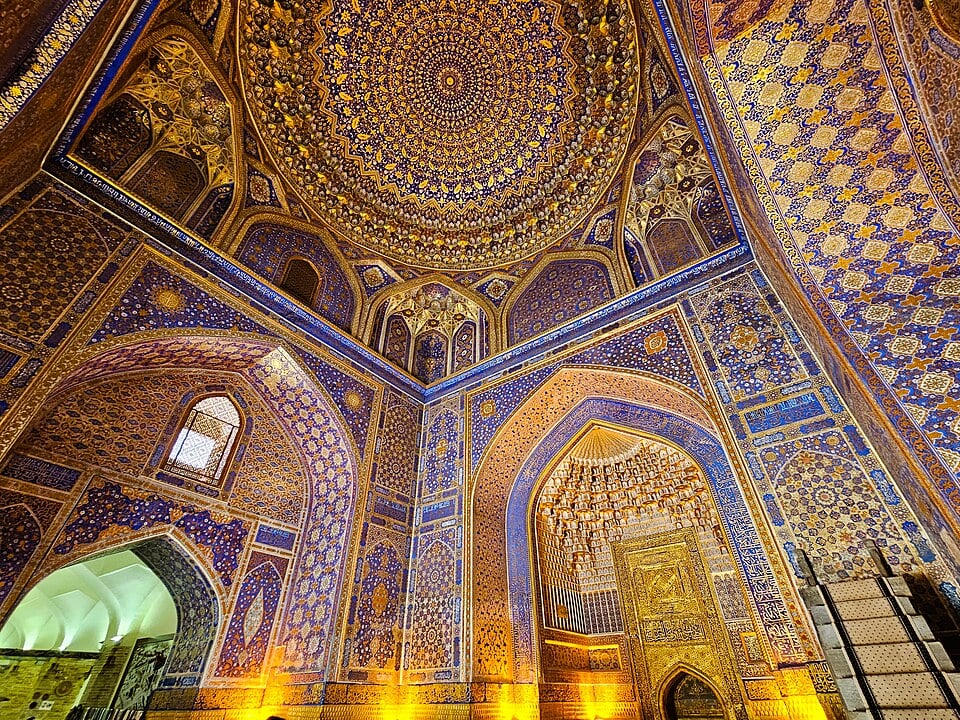
The interior of the Gur-i Mir, the mausoleum of Timur, in Samarkand. (Wikimedia Commons public domain photograph by Prof. Mortel)
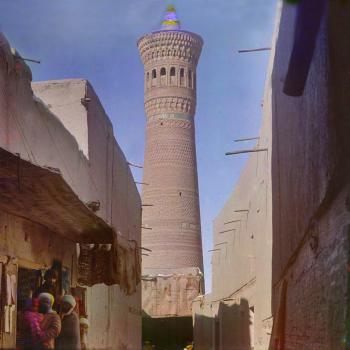
Bukhara and Samarkand, where I’ve spent pretty much the past week, lie in what the West has long called Transoxiana (roughly, “beyond the [River] Oxus”). The name was first coined by Alexander the Great [“the Great”!) — or, anyway, by somebody in his entourage, in the fourth century BC. I’ve always been amused by the corresponding Arabic term for the area, which is Mā Warāʾ an-Nahr (ما وراء النهر, “what is beyond the river”).
The corresponding Chinese term for the region — because, yes, this is an area that has historically been influenced by, and has influenced, both Greece and China, and where Asiatic facial features are quite common — is Hezhong (“land between rivers”; something like “Mesopotamia,” which the West typically uses for Iraq, between the Tigris and the Euphrates). It is the area between the Oxus River (the Amu Darya, roughly to the southwest) and the Jaxartes River (the Syr Darya), roughly to the northeast.)
Medieval Arabic and Islamic sources call the Oxus River or Amu Darya the Jeyhoun (جَـيْـحُـوْن, Jayḥūn), which is cognate with Gihon, the biblical name for one of the four rivers of the Garden of Eden. (See Genesis 2:10-14.).
The Amu Darya or Oxus River forms the border between Iran and Turan, which is important to understand. In Persian lore, the distinction between Iran and Turan — the land of light and the land of darkness, rather comparable to the distinction between Israel and the goyim (or “gentiles”) or between the Greeks and the barbaroi, the “barbarians” (whose meaningless gibberish sounded, to the Greeks, like bar-bar-bar-bar) — is fundamental. (I would even suggest that it plays a role in at least some contemporary Iranian political thinking and discourse.)
Turan is a rather slippery term, though. It could and can seem to refer broadly to non-Iranian areas and peoples. After the arrival of the Turks to the area, it was sometimes applied to them. And the title character of Puccini’s magnificent opera Turandot [= Persian Turandokhtar, “daughter of Turan”] is, of course, a royal Chinese princess.
Anyway, though, this area is the historical Turan. And, all over the place, I’ve seen references to Afrasiyab, which is the name of both a place within Samarkand and a powerful Turanian ruler who figures prominently in the Persian national epic, the Shahnameh, whom I’ve always regarded as something of a villain. Not so much here, though!
And part of it is also the ancient Sogdia, where the Sogdians, who were originally Zoroastrians, wrote important documents in an old form of Persian that also bears the name Sogdian.
The region was conquered by Qutayba b. Muslim between 706 and 715 and, thereafter, gradually became Muslim. But it may have been Buddhist before it was Zoroastrian; the Tang Dynasty Chinese sometimes controlled the eastern part of what is today Uzbekistan. Importantly, paper-making may have arisen in the area under Chinese influence and, from here, been transmitted first to the Islamic world and then to the West.
The name of Samarkand probably derives from the Persian/Sogdian samar (“stone,” “rock”) and kand (“fort,” “town”). If that’s true, it’s linguistically equivalent to the name of Uzbekistan’s capital city to the east of Samarqand, which is Tashkent (Turkic tash [“stone”] and kent (borrowed from Persian/Sogdian kand).
Samarkand is one of oldest cities in central Asia. It was probably already several centuries old when it was conquered by Alexander the Great [sic] in 329 BC, and its population was a multi-religious and multiethnic one back even for diversity was fashionable. At the time that Qutayba b. Muslim captured the city from the Tang Dynasty around AD 710, the majority of its residents were adherents of Zoroastrianism, but Buddhism, Hinduism, Manichaeism, Judaism, and Nestorian Christianity were also represented.
Samarkand was governed by Iranian and Turkic rulers until Ghengis Khan and the Mongols conquered it in 1220 AD. The great Arab traveler Ibn Battuta — far more widely traveled that Marco Polo — visited Samarkand in 1333 and pronounced it “one of the greatest and finest of cities, and the most perfect of them in beauty.”
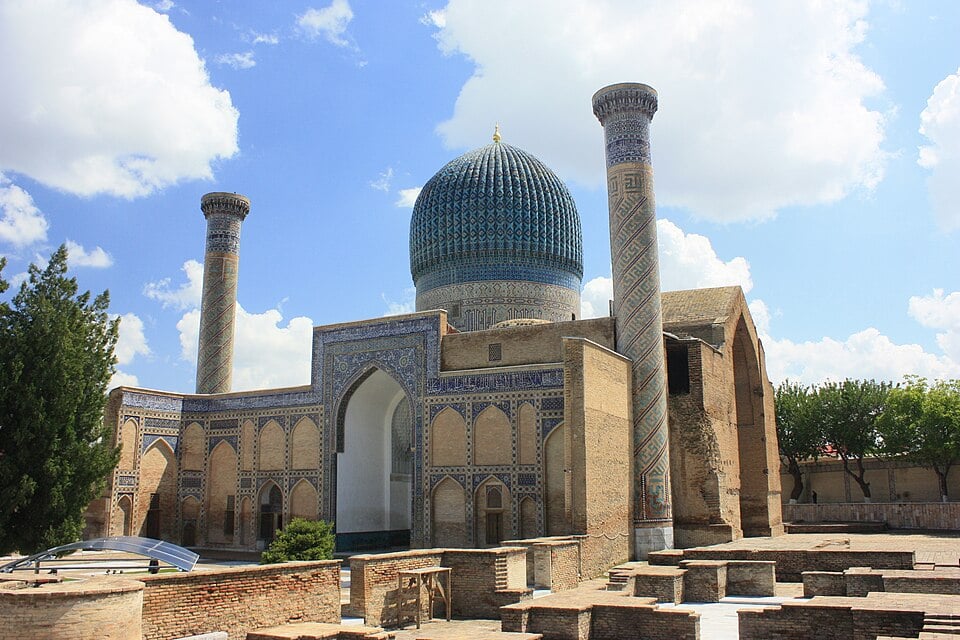
The Gūr-i Amīr in Samarkand (Wikimedia Commons public domain image)
But the best (in a sense) was yet to come: The amir Timur-i Leng — the problematically titled “Timur the Great” — made it his capital, and it became the birthplace of the so-called Timurid Renaissance.
I’ve already mentioned Timur here, in a blog entry from just a few days ago, and it has drawn criticism. But I’ll say just a little bit more about him. He was a Turco-Mongol conqueror who founded the Timurid Empire, which essentially covered modern-day Afghanistan, Iran, and Central Asia. An undefeated commander, he is widely regarded as one of the greatest of all military leaders and tacticians. Additionally, he was a a great patron of art and architecture, and that is shown most clearly in Samarkand. Great names such as that of the brilliant historical and social theorist Ibn Khaldun (1332-1406) and the great Persian lyric poet Hafez (1325-1390) have been associated with Timur.
I’ll take Hafez first and, since I’m running out of time and energy, I’ll simply cite the retelling of the relevant story in Wikipedia:
In one tale, Timur angrily summoned Hafez to account for one of his verses:
‘agar ‘ān Tork-e Šīrāzī * be dast ārad del-ē mā-rā
be khāl-ē Hendu-yaš baxšam * Samarqand ō Boxārā-rāIf that Shirazi Turk accepts my heart in their hand,
for their Indian mole I will give Samarkand and Bukhara.
Samarkand was Timur’s capital and Bukhara was the kingdom’s finest city. “With the blows of my lustrous sword”, Timur complained, “I have subjugated most of the habitable globe… to embellish Samarkand and Bokhara, the seats of my government; and you would sell them for the black mole of some girl in Shiraz!”
Hafez, the tale goes, bowed deeply and replied, “Alas, O Prince, it is this prodigality which is the cause of the misery in which you find me”. So surprised and pleased was Timur with this response that he dismissed Hafez with handsome gifts.
Such an encounter, if it really happened, might have been terrifying, because Timur was a brutal and deadly man who was responsible for the deaths of millions of people.
For Ibn Khaldun’s rather nerve-wracking audience with Timur, see “The Scholar and the Sultan: A Translation of the Historic Encounter between Ibn Khaldun and Timur.”
Notwithstanding his (in my judgment) pathological cruelty, Timur did some good things. For one, he introduced a form of urban planning and, over the course of thirty-five years, built and rebuilt most of the city of Samarkand; he was directly involved in his construction projects. When he didn’t flatly kill them, he brought great artisans and craftsmen from all over his empire to beautify his capital, which became the site of his mausoleum, the Gur-i Mir (or Gur-e Amir).
Ulugh Beg, Timur’s grandson (who ruled from 1409 until his death in 1449, is also worthy of note. His passion was astronomy (and, to some degree, mathematics) and, much in the style of his grandfather, he brought astronomers from all over the empire and beyond to his capital of Samarkand, where in 1428, he built a very famous (though sadly short-lived) observatory.
Like Samarkand, Bukhara is located on the ancient Silk Road and was a center of trade, scholarship, culture, and religion. The complex religious history of the region appears in the origin of its name: According to some, the name Bukhara dates back to the Sanskrit vihara (a term for a Buddhist monastery). According to others, the name Bukhara is possibly derived from the Sogdian βuxārak (‘Place of Good Fortune’), a name for, again, a Buddhist monastery.
By 850, after the Muslim Arab conquest, Bukhara served as the capital of the Samanid Empire. This important because, as the power of the caliphate in Baghdad waned, local cultures began to reassert themselves on the margins of the Abbasid empire. The Samanids, in particular, rejuvenated Persian culture far from Baghdad, the erstwhile center of the Islamic world. Older forms of the Persian language had effectively gone underground for a while, but then they reappeared in a form that was heavily influenced by Arabic (and written in a modified Arabic script). This was “New Persian.”
Rudaki (858-940), the father of New Persian poetry, was born and raised in Bukhara. (Perhaps his most famous poem is about the beauty of Bukhara itself.) So, for that matter, was Imam al-Bukhari (810-870), generally considered the most important scholar of hadith in the history of Sunni Islam. Ibn Sina (aka Avicenna [ca. 980-1037]) was also raised in Bukhara. He is often described as the father of early modern medicine –his most famous medical works being The Book of Healing, a philosophical and scientific encyclopedia, and The Canon of Medicine, a medical encyclopedia that was standard at many medieval and early modern European universities as late as 1650 — and is generally ranked the greatest of all Muslim philosophers. (He even receives favorable mention in Dante’s Inferno, and some of his work was published by Brigham Young University’s one-time Islamic Translation Series.) Besides philosophy and medicine, Avicenna’s vast body of work includes writings on astronomy, alchemy, geography, geology, psychology, Islamic theology, logic, mathematics, and physics, and even some poetry.
Some of us traveled by train from Samarkand to Tashkent on Thursday night (local time), and the long, long, long return home begins shortly with a flight from Tashkent, the capital and largest city of Uzbekistan.
Like other cities in the area, Tashkent is overwhelmingly Muslim now, but it was once an active location for Buddhist monasteries. Genghis Khan destroyed it in 1219, and it lost much of its population. And Timur swept through in the 1300s in his characteristically gentle manner.
In 1966, a shallow earthquake measuring 5.2 on the Richter scale had its epicenter right beneath the center of the city. The quake killed perhaps two hundred people, and left 200,000 or 300,000 homeless. Less damage, perhaps, than Timur did.
Posted from Tashkent, Uzbekistan
History and Religion
Travel and Religion
Previous Post

May 1, 2025
Quick Thoughts Occasioned by the Fairview Texas Temple
Next Post
May 4, 2025 Book of Mormon anachronisms?
Recent Comments
"I have cpnsidered in my mond if the 4 volume Saints could be made into ..."
From Serbia’s “White City,” Belgrade
"DP: “But Mr. Sutherland worries about the fact that our time, when we can communicate ..."
Learning more about a region of ..."
"Another class of memories are of individuals who previously lived. Some of these remembered individuals ..."
"Sutherland's lecture sounds interesting. He seems to restate the Washington consensus that trade brings peace ..."
Learning more about a region of ..."
Browse Our Archives
Select a Category Uncategorized
Select a Month October 2026 September 2026 August 2026 July 2026 June 2026 May 2026 April 2026 March 2026 February 2026 January 2026 December 2025 November 2025 October 2025 September 2025 August 2025 July 2025 June 2025 May 2025 April 2025 March 2025 February 2025 January 2025 December 2024 November 2024 October 2024 September 2024 August 2024 July 2024 June 2024 May 2024 April 2024 March 2024 February 2024 January 2024 December 2023 November 2023 October 2023 September 2023 August 2023 July 2023 June 2023 May 2023 April 2023 March 2023 February 2023 January 2023 December 2022 November 2022 October 2022 September 2022 August 2022 July 2022 June 2022 May 2022 April 2022 March 2022 February 2022 January 2022 December 2021 November 2021 October 2021 September 2021 August 2021 July 2021 June 2021 May 2021 April 2021 March 2021 February 2021 January 2021 December 2020 November 2020 October 2020 September 2020 August 2020 July 2020 June 2020 May 2020 April 2020 March 2020 February 2020 January 2020 December 2019 November 2019 October 2019 September 2019 August 2019 July 2019 June 2019 May 2019 April 2019 March 2019 February 2019 January 2019 December 2018 November 2018 October 2018 September 2018 August 2018 July 2018 June 2018 May 2018 April 2018 March 2018 February 2018 January 2018 December 2017 November 2017 October 2017 September 2017 August 2017 July 2017 June 2017 May 2017 April 2017 March 2017 February 2017 January 2017 December 2016 November 2016 October 2016 September 2016 August 2016 July 2016 June 2016 May 2016 April 2016 March 2016 February 2016 January 2016 December 2015 November 2015 October 2015 September 2015 August 2015 July 2015 June 2015 May 2015 April 2015 March 2015 February 2015 January 2015 December 2014 November 2014 March 2014 August 2013 February 2012
Follow Us!
TAKE THE
Religious Wisdom Quiz
I went uninvited before the king, risking death, saying 'If I perish, I perish.' Who am I?
Select your answer to see how you score.
Ruth Esther Deborah Vashti
Related posts from Sic et Non

TRENDING AT PATHEOS Latter-day Saint

Methodist Central Hall and Westminster Abbey
Situated on the same square is Methodist Central Hall and Westminster Abbey. ...

57th Dove Awards Honor Dolly Parton, Crown New...
On gospel music’s biggest night, the 57th annual GMA Dove Awards honored...

The First Eucharistic Controversy: Christ’s Real Presence
For Catholics, the Eucharist is the source and summit of the Christian...

What a Stop Sign Can Teach Us About...
How to Make a Decision When You Can't Hear God Main point:...

Archdiocese Hosts Military Marriage Retreat in Germany
RASTATT, Germany — The transient military lifestyle, with its frequent deployments and...

Nearly every morning, I make the drive to Detroit with my high-school-age...
view all Latter-day Saint blogs
What Are Your Thoughts?leave a comment
Ad-Free & Subscriber Log-In Subscription Support
- About Us
- 2026 Calendar
- Videos
- Podcasts
- Library of World Religions
- Faith In Media Tracker
- Advertise With Us
- Write for Us
- Privacy Policy
- Terms of Service
- Do Not Sell My Data
- Contact Us
- Radiant Digital
- Manage Newsletter Subscriptions
- Unsubscribe From Notifications
- Sitemap
Copyright 2008-2026, Patheos. All rights reserved.
Subscription Support Ad-Free & Subscriber Log-In
Follow Patheos