
BuddhistCatholicContemplativeEvangelicalGeneral ChristianHinduJewishLatter-day SaintMuslimNew VisionsProgressive Christian
Beliefs
- Buddhist
- Catholic
- Contemplative
- Evangelical
- General Christian
- Hindu
- Jewish
- Latter-day Saint
- More Voices
- Muslim
- New Visions
- Pagan
- Progressive Christian
Topics
- Religion News
- Food and Religion
- Sports and Religion
- Religious Art
- Religious Music and Entertainment
- Religious Events
- History and Religion
- Style and Religion
- Politics and Religion
- Women in Religion
- Recreation Outdoors and Religion
- Business Finance and Religion
- Careers Workplace and Religion
- Education and Religion
- Family Parenting and Religion
- Health Fitness and Religion
- Home and Religion
- Relationships and Religion
- Technology and Religion
- Travel and Religion
Columnists
- Buddhist Columnists
- Business Finance and Religion Columnists
- Careers Workplace and Religion Columnists
- Catholic Columnists
- Contemplative Columnists
- Education and Religion Columnists
- Evangelists Columnists
- Family Parenting and Religion Columnists
- General Christian Columnists
- Health Fitness and Religion Columnists
- Hindu Columnists
- History and Religion Columnists
- Home and Religion Columnists
- Jewish Columnists
- More Voices Columnists
- Latter Day Columnists
- Muslim Columnists
- New Visions Columnists
- Nonreligious Columnists
- Pagan Columnists
- Politics and Religion Columnists
- Progressive Columnists
- Recreation Outdoors and Religion Columnists
- Relationships and Religion Columnists
- Religion News Columnists
- Religious Art Columnists
- Religious Events Columnists
- Religious Music and Entertainment Columnists
- Sports and Religion Columnists
- Style and Religion Columnists
- Technology and Religion Columnists
- Travel and Religion Columnists
- Women in Religion Columnists
Resource Library
- 2026 Calendar
- Library of World Religions
- The 100 Most Holy Places on Earth
- Patheos Answers
- Podcasts
- Videos
- Faith Leaders Database
- Anglican Episcopalian
- Bahai
- Baptist
- Buddhism
- Christianity
- Confucianism
- Eastern Orthodoxy
- Hinduism
- Holiness and Pentecostal
- ISKCON
- Islam
- Judaism
- Lutheran
- Methodist
- The Church of Jesus Christ of Latter-day Saints
- New Age
- Paganism
- Presbytarian and Reformed
- Protestantism
- Religion Behind the Scenes
- Roman Catholic
- Scientology
- Shia Islam
- Sikhism
- Sufism
- Sunni Islam
- Taoism
- Zen
- See all religions
Research Tools
 Ad-Free & Subscriber Log-In Subscription Support
Ad-Free & Subscriber Log-In Subscription Support
Follow Patheos 

- Trending:
- Forgiveness
- |
- Marriage
- |
- Consciousness
- |
- Death Penalty
- |
- Election
- |
- Halloween

- Home
- Latter-day Saint
- “Sweet is the lore which Nature brings”
“Sweet is the lore which Nature brings”
Last updated on: May 17, 2025 at 2:57 pm by Dan Peterson
“Sweet is the lore which Nature brings” 2025-05-17T14:57:32-06:00 Dan Peterson
Patheos Explore the world's faith through different perspectives on religion and spirituality! Patheos has the views of the prevalent religions and spiritualities of the world.
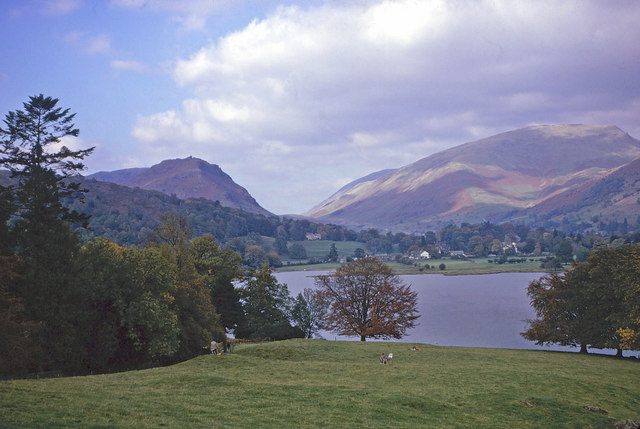
A view of Grasmere, in the Lake District (Wikimedia Commons public domain image)
Our group headed up to the Lake District today, devoting much of our time to William Wordsworth (1770-1850) and to his wife, Mary, and his sister, Dorothy, who were both very important elements of his life and his creativity. It might seem odd that a tour focused on Latter-day Saint history should devote the better part of a day to the greatest of the English Romantic poets, but it makes entire sense to me. For one thing, Grasmere and the Lake District are very beautiful. (We also enjoyed a half-hour boat cruise on Lake Windermere, in the best weather that I can recall having in the area, a beautiful, sunny day at just the right temperature.) For another reason, Wordsworth’s thinking seems to me (and not to me alone) to resonate in a particularly wonderful way with central concepts of the Restoration. So far as I’m aware, his only documented reference to the topic is an inquiry, addressed to his American publisher, about the “wretched” sect that his niece had joined. (His publisher wrote back to say that he knew very little about “Mormonism,” but that Joseph Smith was an imposter.) Had he understood our doctrine, though, I think that he might have found it less “wretched” than he imagined it to be. I’ll attempt to explain why, in at least one respect.
First, I cite a poem of his called “The Tables Turned,” in which he expresses his life-long deep love for the natural world. (It’s not by chance or mere whim that he chose to live in the Lake District, with its hills and mountains and waterfalls and lakes, above anywhere else, and to be buried at St. Oswald’s church in Grasmere rather than in Westminster Abbey.). I apologize for the fact that I’ve been unable to preserve the formatting and the stanza-structure of the poems that I cite here, but they should still be clear enough to understand:. Here’s “The Tables Turned”:
Up! up! my Friend, and quit your books;
Or surely you’ll grow double:
Up! up! my Friend, and clear your looks;
Why all this toil and trouble?
The sun above the mountain’s head,
A freshening lustre mellow
Through all the long green fields has spread,
His first sweet evening yellow.
Books! ’tis a dull and endless strife:
Come, hear the woodland linnet,
How sweet his music! on my life,
There’s more of wisdom in it.
And hark! how blithe the throstle sings!
He, too, is no mean preacher:
Come forth into the light of things,
Let Nature be your teacher.
She has a world of ready wealth,
Our minds and hearts to bless—
Spontaneous wisdom breathed by health,
Truth breathed by cheerfulness.
One impulse from a vernal wood
May teach you more of man,
Of moral evil and of good,
Than all the sages can.
Sweet is the lore which Nature brings;
Our meddling intellect
Mis-shapes the beauteous forms of things:—
We murder to dissect.
Enough of Science and of Art;
Close up those barren leaves;
Come forth, and bring with you a heart
That watches and receives.
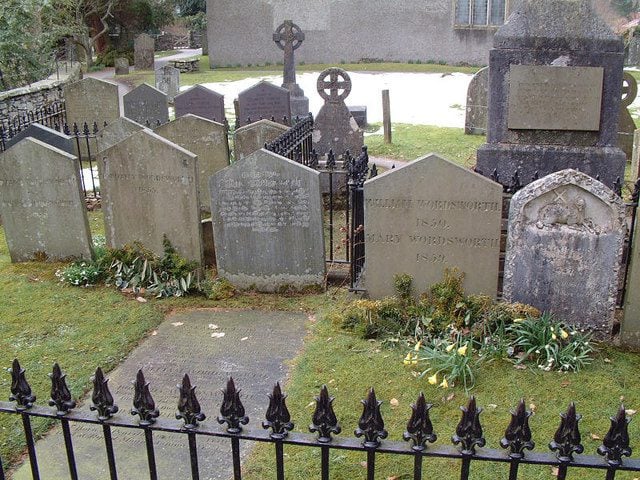
The Wordsworth family plot at St. Oswald’s Church, in Grasmere village. We have made the pilgrimage here several times previously. (Wikimedia Commons public domain image)
But the mundane world about us dulls our sensibilities; we become, very literally, disenchanted. We forget that we are pilgrims and strangers here and we begin to settle in, losing our divine homesickness, our yearning for a better reality. Here is the entirety of his “The World is Too Much with Us”:
The world is too much with us; late and soon,
Getting and spending, we lay waste our powers;—
Little we see in Nature that is ours;
We have given our hearts away, a sordid boon!
This Sea that bares her bosom to the moon;
The winds that will be howling at all hours,
And are up-gathered now like sleeping flowers;
For this, for everything, we are out of tune;
It moves us not. Great God! I’d rather be
A Pagan suckled in a creed outworn;
So might I, standing on this pleasant lea,
Have glimpses that would make me less forlorn;
Have sight of Proteus rising from the sea;
Or hear old Triton blow his wreathèd horn.
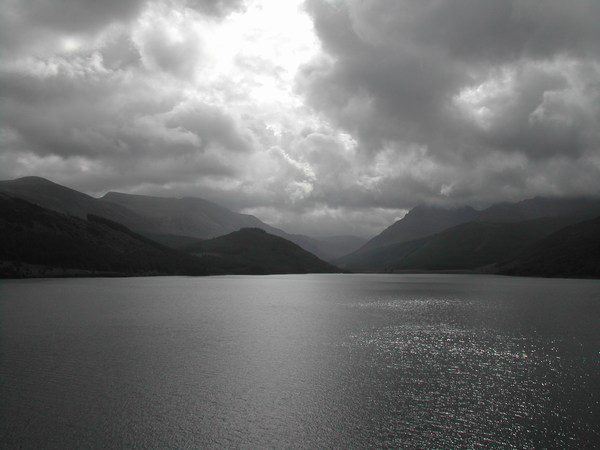
Ennerdale, Cumbria, in the English Lake District
(Photograph by Tom Courtney)
The Jesuit poet Gerard Manley Hopkins (1844-1889) expressed a related sentiment in “God’s Grandeur”:
The world is charged with the grandeur of God.
It will flame out, like shining from shook foil;
It gathers to a greatness, like the ooze of oil
Crushed. Why do men then now not reck his rod?
Generations have trod, have trod, have trod;
And all is seared with trade; bleared, smeared with toil;
And wears man’s smudge and shares man’s smell: the soil
Is bare now, nor can foot feel, being shod.
And for all this, nature is never spent;
There lives the dearest freshness deep down things;
And though the last lights off the black West went
Oh, morning, at the brown brink eastward, springs —
Because the Holy Ghost over the bent
World broods with warm breast and with ah! bright wings.
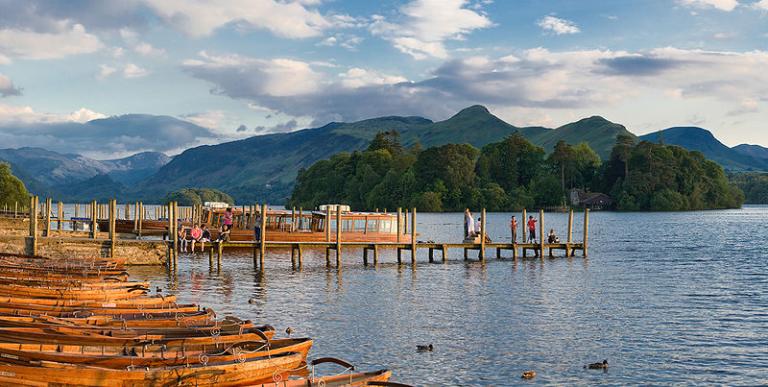
A scene in Cumbria’s Lake District (Wikimedia Commons public domain photo)
Wordsworth’s passion for nature, which he describes as having been rather direct and raw and even unreflective during his early years, gradually settled later on into a calmer affection. He recognized that there was loss in the passage of time, but he also thought that there was some gain, as well. He expresses this throughout his “Lines Composed a Few Miles above Tintern Abbey, On Revisiting the Banks of the Wye during a Tour. July 13, 1798,” from which I cite a passage here. Behind nature, he discerns something much more powerful, something divine:
For nature then
(The coarser pleasures of my boyish days
And their glad animal movements all gone by)
To me was all in all.—I cannot paint
What then I was. The sounding cataract
Haunted me like a passion: the tall rock,
The mountain, and the deep and gloomy wood,
Their colours and their forms, were then to me
An appetite; a feeling and a love,
That had no need of a remoter charm,
By thought supplied, nor any interest
Unborrowed from the eye.—That time is past,
And all its aching joys are now no more,
And all its dizzy raptures. Not for this
Faint I, nor mourn nor murmur; other gifts
Have followed; for such loss, I would believe,
Abundant recompense. For I have learned
To look on nature, not as in the hour
Of thoughtless youth; but hearing oftentimes
The still sad music of humanity,
Nor harsh nor grating, though of ample power
To chasten and subdue.—And I have felt
A presence that disturbs me with the joy
Of elevated thoughts; a sense sublime
Of something far more deeply interfused,
Whose dwelling is the light of setting suns,
And the round ocean and the living air,
And the blue sky, and in the mind of man:
A motion and a spirit, that impels
All thinking things, all objects of all thought,
And rolls through all things. Therefore am I still
A lover of the meadows and the woods
And mountains; and of all that we behold
From this green earth . . .

Dove Cottage, in the village of Grasmere (Wikimedia Commons public domain photo)
Through nature, though, Wordsworth also senses echoes of the still-greater glory of another world, the pre-existent world from which we all come. But he senses them ever more faintly because, with the passage of time, we’re distracted and our perception of them dims. Here are some lines from his “Ode: Intimations of Immortality from Recollections of Early Childhood.” A few of them will be very familiar to some Latter-day Saints:
The child is father of the man;
And I could wish my days to be
Bound each to each by natural piety.
There was a time when meadow, grove, and stream,
The earth, and every common sight,
To me did seem
Apparelled in celestial light,
The glory and the freshness of a dream.
It is not now as it hath been of yore;—
Turn wheresoe’er I may,
By night or day.
The things which I have seen I now can see no more.The Rainbow comes and goes,
And lovely is the Rose,
The Moon doth with delight
Look round her when the heavens are bare,
Waters on a starry night
Are beautiful and fair;
The sunshine is a glorious birth;
But yet I know, where’er I go,
That there hath past away a glory from the earth. . . .Whither is fled the visionary gleam?
Where is it now, the glory and the dream?Our birth is but a sleep and a forgetting:
The Soul that rises with us, our life’s Star,
Hath had elsewhere its setting,
And cometh from afar:
Not in entire forgetfulness,
And not in utter nakedness,
But trailing clouds of glory do we come
From God, who is our home:
Heaven lies about us in our infancy!
Shades of the prison-house begin to close
Upon the growing Boy,
But he beholds the light, and whence it flows,
He sees it in his joy;
The Youth, who daily farther from the east
Must travel, still is Nature’s Priest,
And by the vision splendid
Is on his way attended;
At length the Man perceives it die away,
And fade into the light of common day.Earth fills her lap with pleasures of her own;
Yearnings she hath in her own natural kind,
And, even with something of a Mother’s mind,
And no unworthy aim,
The homely Nurse doth all she can
To make her Foster-child, her Inmate Man,
Forget the glories he hath known,
And that imperial palace whence he came.
Posted from Preston, Lancashire, England
Previous Post

May 16, 2025
On the docks of Liverpool
Next Post

May 18, 2025 One of the greatest places in British LDS history
Recent Comments
"DP: “But Mr. Sutherland worries about the fact that our time, when we can communicate ..."
Learning more about a region of ..."
"Another class of memories are of individuals who previously lived. Some of these remembered individuals ..."
"Sutherland's lecture sounds interesting. He seems to restate the Washington consensus that trade brings peace ..."
Learning more about a region of ..."
"In a meeting today, I learned another important reason why accurate (or at least as ..."
From Serbia’s “White City,” Belgrade
Browse Our Archives
Select a Category Uncategorized
Select a Month October 2026 September 2026 August 2026 July 2026 June 2026 May 2026 April 2026 March 2026 February 2026 January 2026 December 2025 November 2025 October 2025 September 2025 August 2025 July 2025 June 2025 May 2025 April 2025 March 2025 February 2025 January 2025 December 2024 November 2024 October 2024 September 2024 August 2024 July 2024 June 2024 May 2024 April 2024 March 2024 February 2024 January 2024 December 2023 November 2023 October 2023 September 2023 August 2023 July 2023 June 2023 May 2023 April 2023 March 2023 February 2023 January 2023 December 2022 November 2022 October 2022 September 2022 August 2022 July 2022 June 2022 May 2022 April 2022 March 2022 February 2022 January 2022 December 2021 November 2021 October 2021 September 2021 August 2021 July 2021 June 2021 May 2021 April 2021 March 2021 February 2021 January 2021 December 2020 November 2020 October 2020 September 2020 August 2020 July 2020 June 2020 May 2020 April 2020 March 2020 February 2020 January 2020 December 2019 November 2019 October 2019 September 2019 August 2019 July 2019 June 2019 May 2019 April 2019 March 2019 February 2019 January 2019 December 2018 November 2018 October 2018 September 2018 August 2018 July 2018 June 2018 May 2018 April 2018 March 2018 February 2018 January 2018 December 2017 November 2017 October 2017 September 2017 August 2017 July 2017 June 2017 May 2017 April 2017 March 2017 February 2017 January 2017 December 2016 November 2016 October 2016 September 2016 August 2016 July 2016 June 2016 May 2016 April 2016 March 2016 February 2016 January 2016 December 2015 November 2015 October 2015 September 2015 August 2015 July 2015 June 2015 May 2015 April 2015 March 2015 February 2015 January 2015 December 2014 November 2014 March 2014 August 2013 February 2012
Follow Us!
TAKE THE
Religious Wisdom Quiz
Who was the tax collector who climbed a tree to see Jesus?
Select your answer to see how you score.
Matthew Philip Nicodemus Zacchaeus
Related posts from Sic et Non

Our only foreign-born Church president

TRENDING AT PATHEOS Latter-day Saint

Swimfan: Forgotten Aughts Pleasures
This is a recovery effort. In 2002, My Big Fat Greek Wedding...

Top Three Anti-Catholic Lies About Catholicism
This is my initial transcript for the video, "THE 3 WORST...

Pope Leo Celebrates Mass for Nurses & Docs...
I don't have any idea how he did it, but Pope Leo...

The Sermon on the Mount, Part I: Matthew...
The Sermon on the Mount, Part I (Matthew 4:12-5:12) St. Matthew moves...

What's up from Crossway: Reviewing some of their latest A few weeks...

Janie Learns the Way of the Cross: A...
Teaching children about Jesus' Passion can be challenging. Many parents and educators...
view all Latter-day Saint blogs
What Are Your Thoughts?leave a comment
Ad-Free & Subscriber Log-In Subscription Support
- About Us
- 2026 Calendar
- Videos
- Podcasts
- Library of World Religions
- Faith In Media Tracker
- Advertise With Us
- Write for Us
- Privacy Policy
- Terms of Service
- Do Not Sell My Data
- Contact Us
- Radiant Digital
- Manage Newsletter Subscriptions
- Unsubscribe From Notifications
- Sitemap
Copyright 2008-2026, Patheos. All rights reserved.
Subscription Support Ad-Free & Subscriber Log-In
Follow Patheos