
BuddhistCatholicContemplativeEvangelicalGeneral ChristianHinduJewishLatter-day SaintMuslimNew VisionsProgressive Christian
Beliefs
- Buddhist
- Catholic
- Contemplative
- Evangelical
- General Christian
- Hindu
- Jewish
- Latter-day Saint
- More Voices
- Muslim
- New Visions
- Pagan
- Progressive Christian
Topics
- Religion News
- Food and Religion
- Sports and Religion
- Religious Art
- Religious Music and Entertainment
- Religious Events
- History and Religion
- Style and Religion
- Politics and Religion
- Women in Religion
- Recreation Outdoors and Religion
- Business Finance and Religion
- Careers Workplace and Religion
- Education and Religion
- Family Parenting and Religion
- Health Fitness and Religion
- Home and Religion
- Relationships and Religion
- Technology and Religion
- Travel and Religion
Columnists
- Buddhist Columnists
- Business Finance and Religion Columnists
- Careers Workplace and Religion Columnists
- Catholic Columnists
- Contemplative Columnists
- Education and Religion Columnists
- Evangelists Columnists
- Family Parenting and Religion Columnists
- General Christian Columnists
- Health Fitness and Religion Columnists
- Hindu Columnists
- History and Religion Columnists
- Home and Religion Columnists
- Jewish Columnists
- More Voices Columnists
- Latter Day Columnists
- Muslim Columnists
- New Visions Columnists
- Nonreligious Columnists
- Pagan Columnists
- Politics and Religion Columnists
- Progressive Columnists
- Recreation Outdoors and Religion Columnists
- Relationships and Religion Columnists
- Religion News Columnists
- Religious Art Columnists
- Religious Events Columnists
- Religious Music and Entertainment Columnists
- Sports and Religion Columnists
- Style and Religion Columnists
- Technology and Religion Columnists
- Travel and Religion Columnists
- Women in Religion Columnists
Resource Library
- 2026 Calendar
- Library of World Religions
- The 100 Most Holy Places on Earth
- Patheos Answers
- Podcasts
- Videos
- Faith Leaders Database
- Anglican Episcopalian
- Bahai
- Baptist
- Buddhism
- Christianity
- Confucianism
- Eastern Orthodoxy
- Hinduism
- Holiness and Pentecostal
- ISKCON
- Islam
- Judaism
- Lutheran
- Methodist
- The Church of Jesus Christ of Latter-day Saints
- New Age
- Paganism
- Presbytarian and Reformed
- Protestantism
- Religion Behind the Scenes
- Roman Catholic
- Scientology
- Shia Islam
- Sikhism
- Sufism
- Sunni Islam
- Taoism
- Zen
- See all religions
Research Tools
 Ad-Free & Subscriber Log-In Subscription Support
Ad-Free & Subscriber Log-In Subscription Support
Follow Patheos 

- Trending:
- Forgiveness
- |
- Marriage
- |
- Consciousness
- |
- Death Penalty
- |
- Election
- |
- Halloween

- Home
- Latter-day Saint
- History and Religion
- Some Notes on Mesoamerica and the Book of Mormon
Some Notes on Mesoamerica and the Book of Mormon
Last updated on: May 29, 2025 at 10:15 pm by Dan Peterson
Some Notes on Mesoamerica and the Book of Mormon 2025-05-29T22:15:15-06:00 Dan Peterson
Patheos Explore the world's faith through different perspectives on religion and spirituality! Patheos has the views of the prevalent religions and spiritualities of the world.
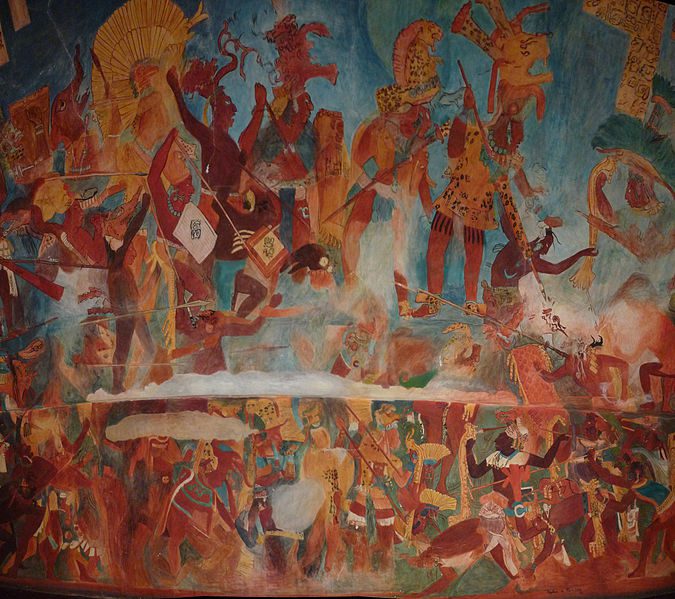
A scene of ancient Mesoamerican warfare in a detail from a reproduction of one of the murals at Bonampak, Chiapas, Mexico. (Wikimedia Commons public domain image)
Here are two further sets of notes from John W. Welch, ed., Reexploring the Book of Mormon: A Decade of New Research (Salt Lake City and Provo: Deseret Book, 1992):
“Nephi’s Bows and Arrows,” by William J. Hamblin (41-44)
“I, Nephi, did make out of wood a bow, and out of a straight stick, an arrow.” (1 Nephi 16:23)
“The symbolic message of the broken bow, first detected by Alan Goff, was highlighted in the March 1984 issue of the F.A.R.M.S. newsletter: “Bows were symbols of political power. One thinks of Odysseus bending the bow to prove himself. An overlord would break the bow of a disobedient vassal to symbolically put the rebel in his place” (see also Jeremiah 49:35; 51:56). That detail is significant in 1 Nephi 16. Nephi’s bow broke, and the bows of Laman and Lemuel lost their springs, but when Nephi fashioned a new bow, making him the only one in camp with a bow, his brothers soon accused Nephi of having political ambitions (see 1 Nephi 16:37-38).”
“Three times in his record, Nephi mentioned that he had broken his bow, but not once did he say that any of his arrows were damaged. Yet in 1 Nephi 16:23, Nephi says that he “did make out of wood a bow, and out of a straight stick, an arrow.” Why would he need to make a new arrow if his old ones were still intact?
“David S. Fox, in a letter to F.A.R.M.S., suggests an answer: “An examination of Nephi’s account shows that whoever wrote that account was familiar in some detail with the eld of archery.” Consider what happens to an arrow at the instant the string is released: the full force of the drawn string is applied to the end of the arrow, trying to accelerate it, but also tending to bend or buckle the arrow. If the bow’s draw weight and the arrow’s stiffness are not perfectly matched, the arrow will stray off the intended course or fall short of the mark. An arrow that is too flexible will leave the bow with a vibration that can cause the arrow to behave erratically. On the other hand, an arrow that is too stiff is probably too heavy for the bow.
“Nephi’s steel bow likely used heavier, stiffer arrows than his simply fashioned wooden bow could handle. Nephi was physically large (see 1 Nephi 2:16; 4:31), and he would have had little reason to use a bow made from metal if he did not have considerable strength. The arrows to match the steel bow used by such a man would undoubtedly have been quite heavy in order for them to be of adequate stiffness. One experienced archer reports, “The arrows from the steel bow when shot from the wooden bow would be like shooting telephone poles.” Hence, it is accurate that Nephi should mention, in one and the same breath, the fact that he made an arrow as well as a bow. Bow wood and arrow wood from the same tree or area could be matched as well.
“One doubts that such information was known to Joseph Smith or to many, if any, of his contemporaries. Archery, as a means of self-defense or as a serious method of hunting or warfare, went out of vogue among Europeans many years before the time of Joseph Smith. On the other hand, archery as a sport did not emerge until the latter half of the nineteenth century.
“David Fox concludes: “Nephi’s statement that he made an arrow out of a straight stick is an additional subtle but significant example of internal consistency within the Book of Mormon. Anyone unfamiliar with the eld of archery would have almost certainly omitted such a statement.””
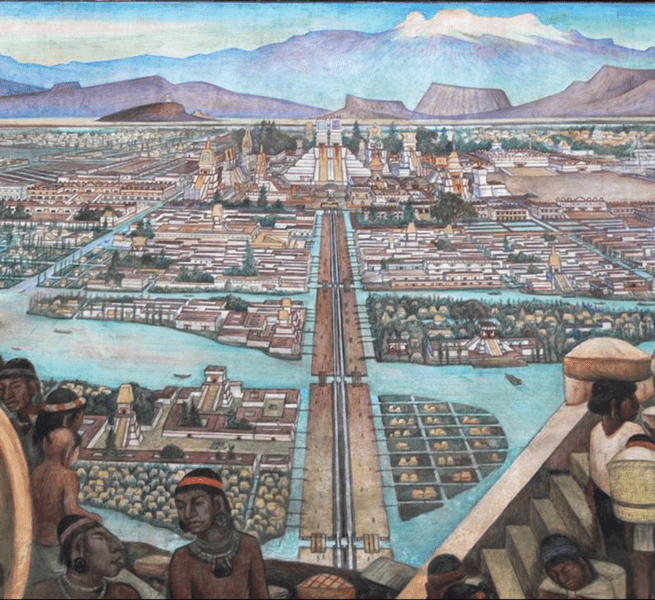
The Aztec capital city of Tenochtitlan. (Wikimedia Commons public domain image)
“Old World Languages in the New World,” by John L. Sorenson, Gordon C. Thomasson, Robert F. Smith, augmented by the work of Brian Stubbs
“And behold, it is wisdom in God that we should obtain these records, that we may preserve unto our children the language of our fathers.” (1 Nephi 3:19; also Mosiah 1:2; Mormon 9:32-33).
For a very long time, most scholars have recognized no evidence for the existence of Old World languages or linguistic influences in the New. Recent developments in historical and comparative linguistics, though, suggest that the orthodox, conventional view is mistaken.
This brief and early Latter-day Saint approach to the subject emphasizes the work of Professor Otto Sadovszky, then of the Department of Anthropology at California State University, Fullerton, who contended that two groups of languages separated by over five thousand miles are closely related.
“The first group is called Penutian, a group of Indian languages of central California that include Miwok and Wintun. The second group is called Ob-Ugrian and includes related languages like Samoyed. These are used around the Ob River of northwest Siberia. [The Ob-Ugrian language group also includes Hungarian, of which Professor Sadovszky was a native speaker — which is why he spotted the similarities.]
“The ten thousand cognate terms and the linguistic quality of the comparisons appear so impressive to Finno-Ugric specialists that they are now more widely accepting historical linkage. A few examples of cognates are Ostyak āj-ko “child” = Miwokan ‘aj-ko “children”; Ostyak lant- “to get blisters from rubbing” = Miwokan lanti “to blister from rubbing.”
The article also draws upon a study by Dr. Mary Ritchie Key of the University of California at Irvine, who contended that “The languages of Polynesia contain elements found in North and South American Indian languages that suggest distant historical connections.”
- See Otto Sadovszky, “Data Sheet for Sadovszky’s ‘Cal-Ugrian Theory’,” University of California at Los Angeles, 1985; “The Discovery of California: Breaking the Silence of the Siberian-to-America Migrator,” The Californians 2, no. 6 (November-December 1984): 9-20; “Siberia’s Frozen Mummy and the Genesis of the California Indian Culture,” The Californians 3, no. 6 (November-December 1985): 9-20; “The New Genetic Relationship and the Paleo-Linguistics of the Central California Indian Ceremonial Houses,” Tenth LACUS Forum, 1983, Quebec City, Quebec (Columbia, South Carolina, 1984). For annotations on his work, see John L. Sorenson and Martin H. Raish, Pre-Columbian Contact with the Americas across the Oceans: An Annotated Bibliography (Provo, Utah: Research Press, 1990), 2:S008-17. Publications by Finnish, Estonian, and Russian scholars on a theory called “Nostratics,” which links Indo-European, Afro-Asiatic, and Uralic proto-languages, seem to include initial evidence of the Penutian connection. Tiit-Rain Viitso, for example, published such an article in 1971.
- Mary Ritchie Key, Polynesian and American Linguistic Connections (Lake Bluff, Illinois: Jupiter Press, 1984); see also John Sorenson and Martin Raish, Pre-Columbian Contact, 1:K062-73.
- See also John L. Sorenson, “Evidences of Culture Contacts between Polynesia and the Americas in Precolumbian Times,” M.A. thesis, BYU, 1952; and David H. Kelley, “Linguistics and Problems in Trans- Pacic Contacts,” Actas y Memorias, 35th Congreso Internacional de Americanistas (Mexico City, 1964), 1:17- 18. Kelley showed the presence of what appear to be specic groups of Uto-Aztecan and early Polynesian cognates clustered around ritual and sacred beliefs.
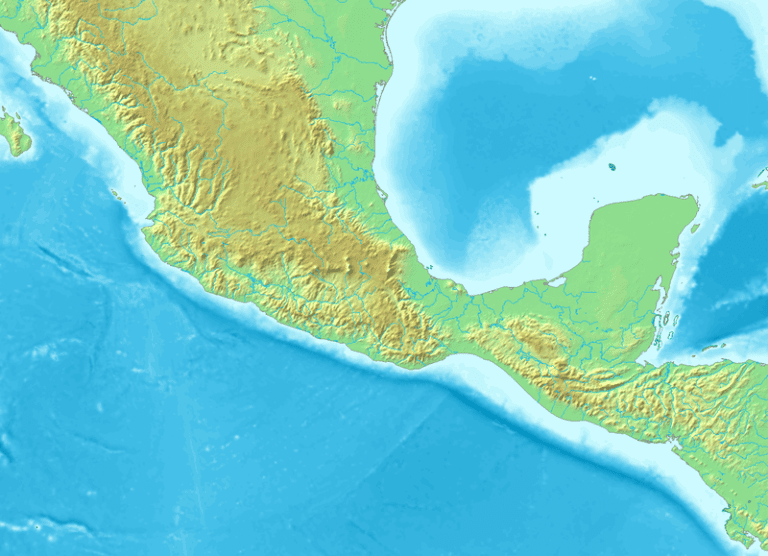
A physical map of Mesoamerica
(Wikimedia Commons public domain image)
I’ve been a tad busy in recent weeks, and especially over the past two or three days, and consequently I’ve fallen a bit behind in calling your attention to recent changes on the moribund and unchanging website of the Interpreter Foundation. Here are a couple of recent items:
“The Heartland Versus Mesoamerica: Part 7: Geology and the Destructions in Third Nephi”
The Temple: Plates, Patterns, & Patriarchs: “Temples beyond Jerusalem,” written by Stephen D. Ricks.
Part of our book chapter reprint series, this article originally appeared in The Temple: Plates, Patterns, & Patriarchs, edited by Stephen D. Ricks and Jeffrey M. Bradshaw. For more information, go to https://interpreterfoundation.org/books/the-temple-plates-patterns-patriarchs/. For video and audio recording of this conference talk, go to https://interpreterfoundation.org/conferences/2022-temple-on-mount-zion-conference/videos/ricks/.
“Following the final breach between the Lamanites and Nephites, Nephi supervised the construction of a temple in the New World. He wrote, “And I, Nephi, did build a temple; and I did construct it after the manner of the temple of Solomon save it were not built of so many precious things; for they were not to be found upon the land, wherefore, it could not be built like unto Solomon’s Temple. But the manner of the construction was like unto the temple of Solomon; and the workmanship thereof was exceedingly fine” (2 Nephi 5:16).”
[I was very pleased, by the way, that Stephen Ricks, a former missionary companion of mine and a longtime department colleague at BYU, and his wife, Shirley Ricks, a member of the Interpreter Foundation’s board of directors, were with us on our just-completed tour of England.]
History and Religion
Travel and Religion
Previous Post

May 29, 2025
No Last Visit to London?
Next Post

May 30, 2025 Beware the chains of hell! And mark the dates!
Recent Comments
"Another class of memories are of individuals who previously lived. Some of these remembered individuals ..."
"Sutherland's lecture sounds interesting. He seems to restate the Washington consensus that trade brings peace ..."
Learning more about a region of ..."
"In a meeting today, I learned another important reason why accurate (or at least as ..."
From Serbia’s “White City,” Belgrade
"I've been watching a lot of video interviews of NDErs and researchers. I think in ..."
Browse Our Archives
Select a Category Uncategorized
Select a Month October 2026 September 2026 August 2026 July 2026 June 2026 May 2026 April 2026 March 2026 February 2026 January 2026 December 2025 November 2025 October 2025 September 2025 August 2025 July 2025 June 2025 May 2025 April 2025 March 2025 February 2025 January 2025 December 2024 November 2024 October 2024 September 2024 August 2024 July 2024 June 2024 May 2024 April 2024 March 2024 February 2024 January 2024 December 2023 November 2023 October 2023 September 2023 August 2023 July 2023 June 2023 May 2023 April 2023 March 2023 February 2023 January 2023 December 2022 November 2022 October 2022 September 2022 August 2022 July 2022 June 2022 May 2022 April 2022 March 2022 February 2022 January 2022 December 2021 November 2021 October 2021 September 2021 August 2021 July 2021 June 2021 May 2021 April 2021 March 2021 February 2021 January 2021 December 2020 November 2020 October 2020 September 2020 August 2020 July 2020 June 2020 May 2020 April 2020 March 2020 February 2020 January 2020 December 2019 November 2019 October 2019 September 2019 August 2019 July 2019 June 2019 May 2019 April 2019 March 2019 February 2019 January 2019 December 2018 November 2018 October 2018 September 2018 August 2018 July 2018 June 2018 May 2018 April 2018 March 2018 February 2018 January 2018 December 2017 November 2017 October 2017 September 2017 August 2017 July 2017 June 2017 May 2017 April 2017 March 2017 February 2017 January 2017 December 2016 November 2016 October 2016 September 2016 August 2016 July 2016 June 2016 May 2016 April 2016 March 2016 February 2016 January 2016 December 2015 November 2015 October 2015 September 2015 August 2015 July 2015 June 2015 May 2015 April 2015 March 2015 February 2015 January 2015 December 2014 November 2014 March 2014 August 2013 February 2012
Follow Us!
TAKE THE
Religious Wisdom Quiz
What kind of bird did Noah send out second from the ark?
Select your answer to see how you score.
Owl Eagle Dove Pidgeon
Related posts from Sic et Non


Some notes on the archaeology of the Bible


TRENDING AT PATHEOS Latter-day Saint

The Sermon on the Mount, Part I: Matthew...
The Sermon on the Mount, Part I (Matthew 4:12-5:12) St. Matthew moves...

What's up from Crossway: Reviewing some of their latest A few weeks...

Janie Learns the Way of the Cross: A...
Teaching children about Jesus' Passion can be challenging. Many parents and educators...

Looking For Good Catholic Writing - October 2026
He alone extends the heavens, and he walks upon the waves of...

In "Irreplaceable," our book on vocation and technology, Trevor Sutton and I...

I was strolling through the top floor of the brand new Parthenon...
view all Latter-day Saint blogs
What Are Your Thoughts?leave a comment
Ad-Free & Subscriber Log-In Subscription Support
- About Us
- 2026 Calendar
- Videos
- Podcasts
- Library of World Religions
- Faith In Media Tracker
- Advertise With Us
- Write for Us
- Privacy Policy
- Terms of Service
- Do Not Sell My Data
- Contact Us
- Radiant Digital
- Manage Newsletter Subscriptions
- Unsubscribe From Notifications
- Sitemap
Copyright 2008-2026, Patheos. All rights reserved.
Subscription Support Ad-Free & Subscriber Log-In
Follow Patheos