
BuddhistCatholicContemplativeEvangelicalGeneral ChristianHinduJewishLatter-day SaintMuslimNew VisionsProgressive Christian
Beliefs
- Buddhist
- Catholic
- Contemplative
- Evangelical
- General Christian
- Hindu
- Jewish
- Latter-day Saint
- More Voices
- Muslim
- New Visions
- Pagan
- Progressive Christian
Topics
- Religion News
- Food and Religion
- Sports and Religion
- Religious Art
- Religious Music and Entertainment
- Religious Events
- History and Religion
- Style and Religion
- Politics and Religion
- Women in Religion
- Recreation Outdoors and Religion
- Business Finance and Religion
- Careers Workplace and Religion
- Education and Religion
- Family Parenting and Religion
- Health Fitness and Religion
- Home and Religion
- Relationships and Religion
- Technology and Religion
- Travel and Religion
Columnists
- Buddhist Columnists
- Business Finance and Religion Columnists
- Careers Workplace and Religion Columnists
- Catholic Columnists
- Contemplative Columnists
- Education and Religion Columnists
- Evangelists Columnists
- Family Parenting and Religion Columnists
- General Christian Columnists
- Health Fitness and Religion Columnists
- Hindu Columnists
- History and Religion Columnists
- Home and Religion Columnists
- Jewish Columnists
- More Voices Columnists
- Latter Day Columnists
- Muslim Columnists
- New Visions Columnists
- Nonreligious Columnists
- Pagan Columnists
- Politics and Religion Columnists
- Progressive Columnists
- Recreation Outdoors and Religion Columnists
- Relationships and Religion Columnists
- Religion News Columnists
- Religious Art Columnists
- Religious Events Columnists
- Religious Music and Entertainment Columnists
- Sports and Religion Columnists
- Style and Religion Columnists
- Technology and Religion Columnists
- Travel and Religion Columnists
- Women in Religion Columnists
Resource Library
- 2026 Calendar
- Library of World Religions
- The 100 Most Holy Places on Earth
- Patheos Answers
- Podcasts
- Videos
- Faith Leaders Database
- Anglican Episcopalian
- Bahai
- Baptist
- Buddhism
- Christianity
- Confucianism
- Eastern Orthodoxy
- Hinduism
- Holiness and Pentecostal
- ISKCON
- Islam
- Judaism
- Lutheran
- Methodist
- The Church of Jesus Christ of Latter-day Saints
- New Age
- Paganism
- Presbytarian and Reformed
- Protestantism
- Religion Behind the Scenes
- Roman Catholic
- Scientology
- Shia Islam
- Sikhism
- Sufism
- Sunni Islam
- Taoism
- Zen
- See all religions
Research Tools
 Ad-Free & Subscriber Log-In Subscription Support
Ad-Free & Subscriber Log-In Subscription Support
Follow Patheos 

- Trending:
- Forgiveness
- |
- Marriage
- |
- Consciousness
- |
- Death Penalty
- |
- Election
- |
- Halloween

- Home
- Latter-day Saint
- Travel and Religion
- On the docks of Liverpool
On the docks of Liverpool
Last updated on: May 16, 2025 at 4:25 pm by Dan Peterson
On the docks of Liverpool 2025-05-16T16:25:21-06:00 Dan Peterson
Patheos Explore the world's faith through different perspectives on religion and spirituality! Patheos has the views of the prevalent religions and spiritualities of the world.
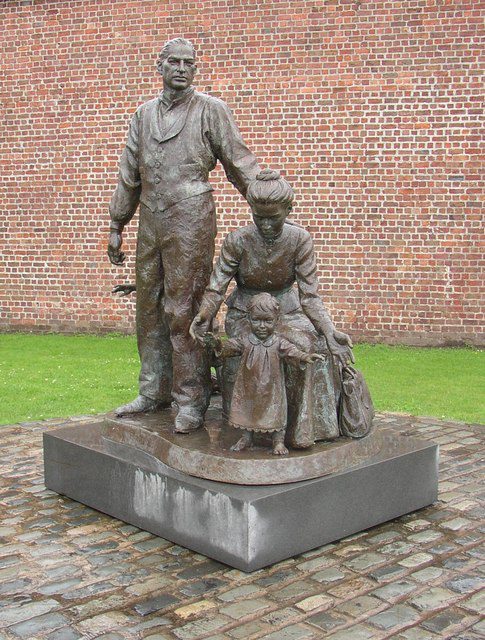
This 2001 bronze statue by Mark De Graffenried, titled “The Emigrants,” stands on the Albert Dock in Liverpool. Given to the people of the city by the Church of Jesus Christ of Latter-day Saints in 2007, it commemorates migration from Liverpool to the New World. It pays tribute to the many families from all over Europe who embarked from Liverpool for a new life in America. The father looks, very seriously, into the distance and the future. The mother tends to their toddler. Almost unseen behind his father, a son, facing the other direction and plainly in his own world, plays with a large crab. (Wikimedia Commons photograph by Humphrey Bolton)
We met up with Kris Frederickson, a member of the Interpreter Foundation board and an organizer and co-host of this Interpreter Church history tour of England and then went to meet our motor coach and our local guide and friend, Peter Fagg, and the rest of our group — save two, who didn’t arrive until dinnertime tonight after flight delays — at the Manchester airport. Thereupon, we drove to the Liverpool Docks, where, walking about the area, we discussed the Beatles, yes, but mostly the Latter-day Saint converts — approximately 85,000 of them — who emigrated to Zion via Liverpool between the start of the Gathering in 1841 or so until it halted in the 1930s.
Liverpool was, for many years, the European headquarters of the Church of Jesus Christ of Latter-day Saints. It was also, by a considerable distance, the principal port of embarkation for members of the Church (and also for nonmembers of the Church, such as my Norwegian Lutheran grandmother) who were departing Northern Europe for North America. Something of the flavor of the Latter-day Saint emigration can be discerned, though, in this eyewitness account that was written from London by an illustrious British novelist:
In June 1863, the passenger ship Amazon set sail from London for America with nearly 900 Latter-day Saint emigrants aboard. However, just before she weighed anchor, many Londoners—including both government officials and clergymen—came to take a look at the “Mormons,” up close and at first hand, as well as at their traveling arrangements. One of these visitors Charles Dickens, the famous author of such works, by that time, as The Pickwick Papers (1837), Oliver Twist (1839), Nicholas Nickleby (1839), The Old Curiosity Shop (1841), Barnaby Rudge (1841), A Christmas Carol (1849), Martin Chuzzlewit (1844), Dombey and Son (1848), David Copperfield (1850), Bleak House (1853), Hard Times (1854), Little Dorrit (1857), A Tale of Two Cities (1859), and Great Expectations (1861). He is generally regarded as one of the greatest novelists of Victorian England and, indeed, in all of English literature.
Dickens spent several hours aboard the Amazon, quietly observing the Saints on the ship and interviewing George Q. Cannon, the English-born member of the Quorum of the Twelve — a native, in fact, of Liverpool — who was serving at the time as the president of the British Mission. (Elder Cannon, who had played a pivotal role in opening the Hawaiian Mission and in translating the Book of Mormon into Hawaiian, would go on to represent Utah as a territorial delegate to Congress and to serve as a counselor in the First Presidency to Brigham Young, John Taylor, Wilford Woodruff, and Lorenzo Snow.)
A month or so after his visit to the Amazon, Dickens published an account of his experience in an essay for the periodical All the Year Round (4 July 1863), titled “The Uncommercial Traveller.” In his essay, he remarked that virtually all of the emigrating Latter-day Saints were tradesmen and craftsmen and their families, people of the working class. He was worried about what these British converts to “Mormonism” might encounter when they actually arrived in Utah. (He was surely familiar with the horror stories going around England at the time – which would continue for the next several generations — about the theocratic “Mormon kingdom” in the remote North American west.) But he was deeply impressed by what he had actually seen. The emigration was thoroughly well-organized, calm, orderly.
“I went on board their ship,” he wrote, “to bear testimony against them if they deserved it, as I fully believed they would; to my great astonishment they did not deserve it; and my predispositions and tendencies must not affect me as an honest witness. I went over the Amazon’s side feeling it impossible to deny that, so far, some remarkable influence had produced a remarkable result, which better known influences have often missed.” Of the Saints themselves, Dickens confessed that, had he not known they were Latter-day Saints, he would have described them as, “in their degree, the pick and flower of England.”

The Liverpool waterfront as it appears today (Wikimedia Commons public domain image)
In the meanwhile, the dying if not altogether dead website of the Interpreter Foundation continues to not change. Here are some of the most recent examples of its complete lack of change:
“Anachronisms: Accidental Evidence in Book of Mormon Criticisms,” Chapter 3, “Metals and Metallurgy,” written by Matthew Roper
[Editor’s Note: We are pleased to present chapter 3 from a book entitled Anachronisms: Accidental Evidence in Book of Mormon Criticisms*. It is presented in serialized form in this volume of* Interpreter: A Journal of Latter-day Saint Faith and Scholarship.]
“Interpreting Interpreter: (Non-)Anachronisms – Metallurgy,” written by Kyler Rasmussen
This post is a summary of the article “Anachronisms: Accidental Evidence in Book of Mormon Criticisms — Chapter 3: Metals and Metallurgy” by Matthew Roper in Volume 65 of Interpreter: A Journal of Latter-day Saint Faith and Scholarship. All of the Interpreting Interpreter articles may be seen at https://interpreterfoundation.org/category/summaries/. An introduction to the Interpreting Interpreter series is available at https://interpreterfoundation.org/interpreting-interpreter-on-abstracting-thought/.
A video introduction to this Interpreter article is now available on all of our social media channels, including on YouTube at https://youtube.com/shorts/SgYKrb52OBE.
The Takeaway: Roper continues his examination of claimed Book of Mormon anachronisms, looking at 16 different items related to metals and metallurgy. He concludes that 50% of these supposed anachronisms have received subsequent confirmation in the archaeological record, with and additional 4 partially confirmed, and 3 items that are yet to trend toward confirmation (iron smelting and steel in the new world, and silver money).
“Joseph Smith Jr. as a Translator: The Book of Abraham as a Case Study,” written by Stephen O. Smoot
Abstract: This paper examines Joseph Smith’s approach to translation, using the Book of Abraham as a case study to explore the interplay between divine revelation and human participation in scriptural production. While the Book of Abraham incorporates both ancient and modern elements, its unique synthesis resists simple categorization as either an unblemished Abrahamic autograph or a purely nineteenth-century pseudepigraphon. Drawing on historical evidence and textual analysis, this paper aims to illuminate Joseph Smith’s role as both translator and revelator, offering insights into how Latter-day Saints might understand the complex process of producing sacred texts.
[Editor’s Note: An earlier version of this paper was delivered at the annual Joseph Smith Papers Conference in Salt Lake City on 26 October 2018.]
“Interpreting Interpreter: Joseph’s Fingerprints in the Book of Abraham,” written by Kyler Rasmussen
This post is a summary of the article “Joseph Smith Jr. as a Translator: The Book of Abraham as a Case Study” by Stephen O. Smoot in Volume 64 of Interpreter: A Journal of Latter-day Saint Faith and Scholarship. All of the “Interpreting Interpreter” articles may be seen at https://interpreterfoundation.org/category/summaries/. An introduction to the “Interpreting Interpreter” series is available at https://interpreterfoundation.org/interpreting-interpreter-on-abstracting-thought/.
A video introduction to this Interpreter article is now available on all of our social media channels, including on YouTube at https://youtube.com/shorts/BZpKypZon0k.
The Takeaway: Smoot argues that various aspects of the Book of Abraham show evidence of Joseph Smith’s influence as a translator, despite the text itself having a number of authentic ancient elements.
The Temple: Plates, Patterns, & Patriarchs: ““Eastward” in Genesis 2-4: An Exercise in Visual Discovery,” written by Rebecca Holt Stay
Part of our book chapter reprint series, this article originally appeared in The Temple: Plates, Patterns, & Patriarchs, edited by Stephen D. Ricks and Jeffrey M. Bradshaw. For more information, go to https://interpreterfoundation.org/books/the-temple-plates-patterns-patriarchs/. For video and audio recording of this conference talk, go to https://interpreterfoundation.org/conferences/2022-temple-on-mount-zion-conference/videos/stay/.
“Genesis 2–4 is one of many Creation stories in the Old Testament. Studying one account deeply and separately from the others may reveal insights lost when we attempt to harmonize them.”
Posted from Preston, Lancashire, England
Travel and Religion
History and Religion
Previous Post

May 15, 2025
Magnificence and Mystery
Next Post

May 17, 2025 "Sweet is the lore which Nature brings"
Recent Comments
"In a meeting today, I learned another important reason why accurate (or at least as ..."
From Serbia’s “White City,” Belgrade
"PL: "Let's hope he doesn't have your address..."I have to frankly confess that a few ..."
From Serbia’s “White City,” Belgrade
"Let's hope he doesn't have your address..."
From Serbia’s “White City,” Belgrade
"PL: "The layers are peeling back."He appears to be suffering under an odd but powerful ..."
From Serbia’s “White City,” Belgrade
Browse Our Archives
Select a Category Uncategorized
Select a Month October 2026 September 2026 August 2026 July 2026 June 2026 May 2026 April 2026 March 2026 February 2026 January 2026 December 2025 November 2025 October 2025 September 2025 August 2025 July 2025 June 2025 May 2025 April 2025 March 2025 February 2025 January 2025 December 2024 November 2024 October 2024 September 2024 August 2024 July 2024 June 2024 May 2024 April 2024 March 2024 February 2024 January 2024 December 2023 November 2023 October 2023 September 2023 August 2023 July 2023 June 2023 May 2023 April 2023 March 2023 February 2023 January 2023 December 2022 November 2022 October 2022 September 2022 August 2022 July 2022 June 2022 May 2022 April 2022 March 2022 February 2022 January 2022 December 2021 November 2021 October 2021 September 2021 August 2021 July 2021 June 2021 May 2021 April 2021 March 2021 February 2021 January 2021 December 2020 November 2020 October 2020 September 2020 August 2020 July 2020 June 2020 May 2020 April 2020 March 2020 February 2020 January 2020 December 2019 November 2019 October 2019 September 2019 August 2019 July 2019 June 2019 May 2019 April 2019 March 2019 February 2019 January 2019 December 2018 November 2018 October 2018 September 2018 August 2018 July 2018 June 2018 May 2018 April 2018 March 2018 February 2018 January 2018 December 2017 November 2017 October 2017 September 2017 August 2017 July 2017 June 2017 May 2017 April 2017 March 2017 February 2017 January 2017 December 2016 November 2016 October 2016 September 2016 August 2016 July 2016 June 2016 May 2016 April 2016 March 2016 February 2016 January 2016 December 2015 November 2015 October 2015 September 2015 August 2015 July 2015 June 2015 May 2015 April 2015 March 2015 February 2015 January 2015 December 2014 November 2014 March 2014 August 2013 February 2012
Follow Us!
TAKE THE
Religious Wisdom Quiz
What does "Jezebel" mean in Hebrew?
Select your answer to see how you score.
Daughter of Baal The Lord reigns Unexalted Queen of the people
Related posts from Sic et Non


Notes on Women, Priesthood, and General Conference

"The Book of Moses as a Temple Text"

TRENDING AT PATHEOS Latter-day Saint

The Sermon on the Mount, Part I: Matthew...
The Sermon on the Mount, Part I (Matthew 4:12-5:12) St. Matthew moves...

What's up from Crossway: Reviewing some of their latest A few weeks...

Janie Learns the Way of the Cross: A...
Teaching children about Jesus' Passion can be challenging. Many parents and educators...

Looking For Good Catholic Writing - October 2026
He alone extends the heavens, and he walks upon the waves of...

In "Irreplaceable," our book on vocation and technology, Trevor Sutton and I...

I was strolling through the top floor of the brand new Parthenon...
view all Latter-day Saint blogs
What Are Your Thoughts?leave a comment
Ad-Free & Subscriber Log-In Subscription Support
- About Us
- 2026 Calendar
- Videos
- Podcasts
- Library of World Religions
- Faith In Media Tracker
- Advertise With Us
- Write for Us
- Privacy Policy
- Terms of Service
- Do Not Sell My Data
- Contact Us
- Radiant Digital
- Manage Newsletter Subscriptions
- Unsubscribe From Notifications
- Sitemap
Copyright 2008-2026, Patheos. All rights reserved.
Subscription Support Ad-Free & Subscriber Log-In
Follow Patheos