
BuddhistCatholicContemplativeEvangelicalGeneral ChristianHinduJewishLatter-day SaintMuslimNew VisionsProgressive Christian
Beliefs
- Buddhist
- Catholic
- Contemplative
- Evangelical
- General Christian
- Hindu
- Jewish
- Latter-day Saint
- More Voices
- Muslim
- New Visions
- Pagan
- Progressive Christian
Topics
- Religion News
- Food and Religion
- Sports and Religion
- Religious Art
- Religious Music and Entertainment
- Religious Events
- History and Religion
- Style and Religion
- Politics and Religion
- Women in Religion
- Recreation Outdoors and Religion
- Business Finance and Religion
- Careers Workplace and Religion
- Education and Religion
- Family Parenting and Religion
- Health Fitness and Religion
- Home and Religion
- Relationships and Religion
- Technology and Religion
- Travel and Religion
Columnists
- Buddhist Columnists
- Business Finance and Religion Columnists
- Careers Workplace and Religion Columnists
- Catholic Columnists
- Contemplative Columnists
- Education and Religion Columnists
- Evangelists Columnists
- Family Parenting and Religion Columnists
- General Christian Columnists
- Health Fitness and Religion Columnists
- Hindu Columnists
- History and Religion Columnists
- Home and Religion Columnists
- Jewish Columnists
- More Voices Columnists
- Latter Day Columnists
- Muslim Columnists
- New Visions Columnists
- Nonreligious Columnists
- Pagan Columnists
- Politics and Religion Columnists
- Progressive Columnists
- Recreation Outdoors and Religion Columnists
- Relationships and Religion Columnists
- Religion News Columnists
- Religious Art Columnists
- Religious Events Columnists
- Religious Music and Entertainment Columnists
- Sports and Religion Columnists
- Style and Religion Columnists
- Technology and Religion Columnists
- Travel and Religion Columnists
- Women in Religion Columnists
Resource Library
- 2026 Calendar
- Library of World Religions
- The 100 Most Holy Places on Earth
- Patheos Answers
- Podcasts
- Videos
- Faith Leaders Database
- Anglican Episcopalian
- Bahai
- Baptist
- Buddhism
- Christianity
- Confucianism
- Eastern Orthodoxy
- Hinduism
- Holiness and Pentecostal
- ISKCON
- Islam
- Judaism
- Lutheran
- Methodist
- The Church of Jesus Christ of Latter-day Saints
- New Age
- Paganism
- Presbytarian and Reformed
- Protestantism
- Religion Behind the Scenes
- Roman Catholic
- Scientology
- Shia Islam
- Sikhism
- Sufism
- Sunni Islam
- Taoism
- Zen
- See all religions
Research Tools
 Ad-Free & Subscriber Log-In Subscription Support
Ad-Free & Subscriber Log-In Subscription Support
Follow Patheos 

- Trending:
- Forgiveness
- |
- Marriage
- |
- Consciousness
- |
- Death Penalty
- |
- Election
- |
- Halloween

- Home
- Latter-day Saint
- History and Religion
- Of Heavenly Councils and Heavenly Books
Of Heavenly Councils and Heavenly Books
Last updated on: May 14, 2025 at 5:08 pm by Dan Peterson
Of Heavenly Councils and Heavenly Books 2025-05-14T17:08:29-06:00 Dan Peterson
Patheos Explore the world's faith through different perspectives on religion and spirituality! Patheos has the views of the prevalent religions and spiritualities of the world.
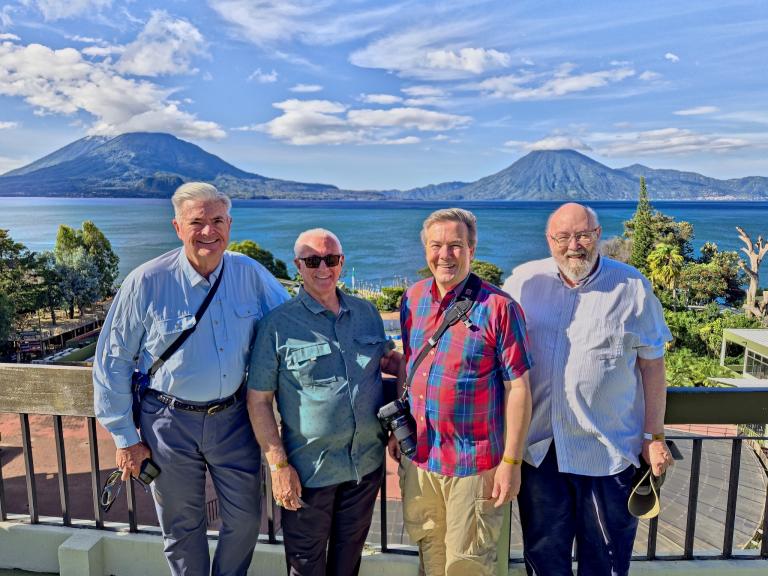
At Lake Atitlán, in Guatemala, which some scholars have identified as the Book of Mormon’s “Waters of Mormon.” From left to right: Larry Ainsworth (a member of Interpreter’s board of directors), Brant Gardner (a noted scholar of the Book of Mormon and now an Interpreter editor), Steve Densley (Interpreter’s executive vice president), and an unidentified vagrant who photobombed the scene and then escaped, running and hopping and laughing maniacally.
New, on the blog of the Interpreter Foundation, where nothing ever changes: “The Heartland Versus Mesoamerica, Part 5: The Narrow Strip of Wilderness,” written by Brant A. Gardner.
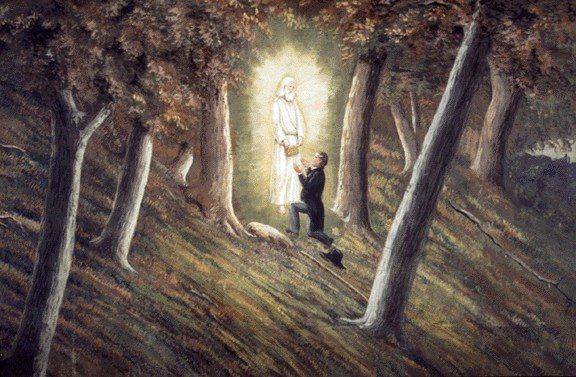
A nineteenth century depiction of Joseph Smith and Moroni on the Hill Cumorah, by C. C. A. Christensen (Wikimedia Commons public domain image)
As a small constituent part of a long-term project that I’m working on, I’ll be extracting notes over the next several weeks or (more likely) months from John W. Welch, ed., Reexploring the Book of Mormon: A Decade of New Research (Salt Lake City and Provo: Deseret Book, 1992), and intermittently sharing them here. They represent the state of the questions as of the early 1990s and, in many cases, they will need to be fleshed out with whatever developments may have occurred over the past thirty-three years. (It’s also possible that, in a few cases, subsequent developments will have negated them altogether.) But that is a task for another time (or times). These are notes — sometimes including bibliographical hints for future reading — that I’m compiling for my own use, but I hope that some of you will find them of interest.
“Lehi’s Council Vision and the Mysteries of God,” by John W. Welch (24-27)
In 1 Nephi 1:8-13, Lehi sees God seated on his throne among the divine council, the heavenly host, and is commissioned with delivering a decree of judgment upon the city and people of Jerusalem. This is consistent with the experiences of several other ancient Israelite prophets, who had visions of participating in a heavenly assembly where they receive the judgments of that council that express God’s will regarding the world and those who live in it. (See, for example, 1 Kings 22:19-22; Isaiah 6:1-10; 40:1-8; Job 1:6-12; 2:1-6; Zechariah 1:8-13; 3:1-7; 6:1-8; and Jeremiah 23:18). The theme was discussed at length by Theodore Mullen, in his The Divine Council in Canaanite and Early Hebrew Literature (Chico, California: Scholars Press, 1980), which is very useful for understanding Lehi’s vision in its preexilic Israelite context.
Jack Welch argues that it is significant that the Hebrew term for the “council” is sôd (סוד), a word that, by association, has also come to refer to “a decree of the council.” It is, simultaneously, a confidential discussion, a secret or plan, a circle of confidants, or a council.
Because the council and its actions were private and intimate, closed to the general public, the decrees emanating from it were secrets. They were known only to the prophets. In fact, access to these secrets was what made a man a prophet. With that understanding in mind, the late Raymond E. Brown – in “The Pre-Christian Semitic Concept of ‘Mystery,”’ Catholic Biblical Quarterly 20 (1958):417-43, especially 421 — concluded that the Semitic background of the concept of the “mysteries” of God resides precisely in the idea of prophets (such as, well, Lehi) having been “introduced into the heavenly assembly and gaining a knowledge of its secret decrees”(compare Amos 3:7).
Accordingly, it’s worth noting that, in the Book of Mormon account, when Nephi described his desire to receive a personal confirmation of the truth of his father’s words, he expressed it by saying that he wanted to “know of the mysteries of God.” Those “mysteries” (sôd) were apparently synonymous, in his mind, with the decrees and knowledge that Lehi had received in the “council” (sôd).
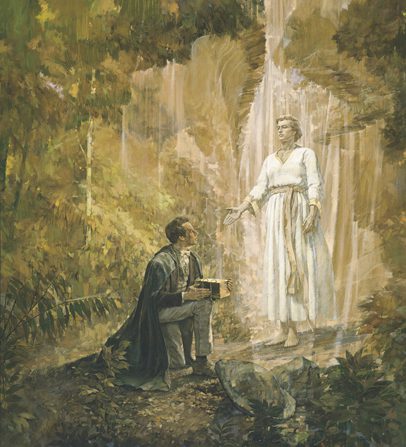
The Angel Moroni gives the golden plates to Joseph Smith
(Painting by Kenneth Riley, from LDS.org)
“The Book of Mormon and the Heavenly Book Motif,” by Brent E. McNeely (26-28)
“He saw One descending out of the midst of heaven, . . . and stood before my father, and gave unto him a book, and bade him that he should read.” (1 Nephi 1:9-11)
The late Sterling McMurrin, a formerly prominent (nominal but unbelieving) Latter-day Saint intellectual, once dismissed the Book of Mormon with the confident assertion that “you don’t get books from angels; . . . it is just that simple.” However, according to the late, great Swedish scholar of comparative religions Geo Widengren, “Few religious ideas in the Ancient East have played a more important role than the notion of the Heavenly Tablets or the Heavenly Books,” which are “handed over [to a mortal] in an interview with a heavenly being.” (See Geo Widengren, Ascension of the Apostle and the Heavenly Book [Leipzig: Harrassowitz, 1950], 7.)
Elements of the “heavenly book motif” occur in the biblical books of Exodus, Jeremiah, Ezekiel, and Revelation, as well as in more than a dozen books of pseudepigraphic literature (nonbiblical writings dating c. 200 B.C. to A.D. 200) and early Christian literature. The motif is also evident in Lehi’s vision (as referenced above), in the story of the coming forth of the Book of Mormon, and, I would argue, in the traditional story of Muhammad and the Qur’an from early seventh-century Arabia. The basic elements of the “heavenly book motif” include these four:
A divine being gives a book to a mortal; (2) the mortal is commanded to read the book; (3) he is then told to copy the book; and (4) he is commanded to preach the book’s message to other mortals.
The brief article on this topic in Reexploring the Book of Mormon examines occurrences of the motif in the Bible, the pseudepigraphic book of 1 Enoch, the early Christian Vision of Hermas, the Book of Mormon and the story of its own coming forth.
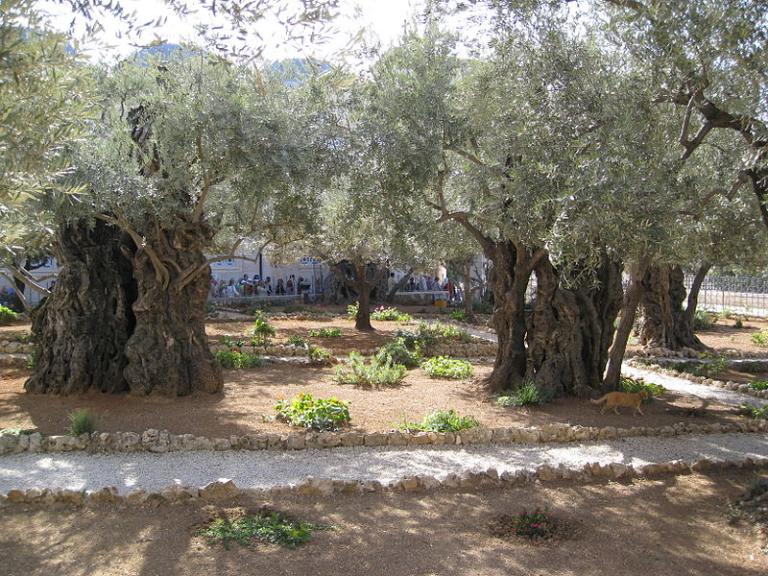
A portion of the Garden of Gethsemane as it appears today, with its ancient olive trees
(Wikimedia Commons public domain image)
I liked this personal recollection from Jamil Srour very much, and I commend it to your attention: “A Latter-day Saint Palestinian remembers the Olive Harvest.” Olive trees and olive cultivation were very important in the ancient eastern Mediterranean and then, later, to the west, in Turkey and Greece, in Italy and the Iberian Peninsula, and, eventually, in California. (See “Book of Mormon Evidence: Botany and Jacob 5 [Overview]”.) At the moment, however, I’m writing this in a place where olives don’t typically grow.
Posted from London, England
History and Religion
Travel and Religion
Previous Post

May 13, 2025
In Londinium
Next Post

May 15, 2025 Magnificence and Mystery
Recent Comments
"DP: “But Mr. Sutherland worries about the fact that our time, when we can communicate ..."
Learning more about a region of ..."
"Another class of memories are of individuals who previously lived. Some of these remembered individuals ..."
"Sutherland's lecture sounds interesting. He seems to restate the Washington consensus that trade brings peace ..."
Learning more about a region of ..."
"In a meeting today, I learned another important reason why accurate (or at least as ..."
From Serbia’s “White City,” Belgrade
Browse Our Archives
Select a Category Uncategorized
Select a Month October 2026 September 2026 August 2026 July 2026 June 2026 May 2026 April 2026 March 2026 February 2026 January 2026 December 2025 November 2025 October 2025 September 2025 August 2025 July 2025 June 2025 May 2025 April 2025 March 2025 February 2025 January 2025 December 2024 November 2024 October 2024 September 2024 August 2024 July 2024 June 2024 May 2024 April 2024 March 2024 February 2024 January 2024 December 2023 November 2023 October 2023 September 2023 August 2023 July 2023 June 2023 May 2023 April 2023 March 2023 February 2023 January 2023 December 2022 November 2022 October 2022 September 2022 August 2022 July 2022 June 2022 May 2022 April 2022 March 2022 February 2022 January 2022 December 2021 November 2021 October 2021 September 2021 August 2021 July 2021 June 2021 May 2021 April 2021 March 2021 February 2021 January 2021 December 2020 November 2020 October 2020 September 2020 August 2020 July 2020 June 2020 May 2020 April 2020 March 2020 February 2020 January 2020 December 2019 November 2019 October 2019 September 2019 August 2019 July 2019 June 2019 May 2019 April 2019 March 2019 February 2019 January 2019 December 2018 November 2018 October 2018 September 2018 August 2018 July 2018 June 2018 May 2018 April 2018 March 2018 February 2018 January 2018 December 2017 November 2017 October 2017 September 2017 August 2017 July 2017 June 2017 May 2017 April 2017 March 2017 February 2017 January 2017 December 2016 November 2016 October 2016 September 2016 August 2016 July 2016 June 2016 May 2016 April 2016 March 2016 February 2016 January 2016 December 2015 November 2015 October 2015 September 2015 August 2015 July 2015 June 2015 May 2015 April 2015 March 2015 February 2015 January 2015 December 2014 November 2014 March 2014 August 2013 February 2012
Follow Us!
TAKE THE
Religious Wisdom Quiz
True or False: Ezekiel was commanded to lie on his left side for 390 days and his right side for 40 days.
Select your answer to see how you score.
TRUE FALSE
Related posts from Sic et Non


Notes on Women, Priesthood, and General Conference

"The Book of Moses as a Temple Text"

TRENDING AT PATHEOS Latter-day Saint

The First Eucharistic Controversy: Christ’s Real Presence
For Catholics, the Eucharist is the source and summit of the Christian...

How to Make a Decision When You Can't...
Main point: It’s much more valuable to stay close to God so...

Archdiocese Hosts Military Marriage Retreat in Germany
RASTATT, Germany — The transient military lifestyle, with its frequent deployments and...

Nearly every morning, I make the drive to Detroit with my high-school-age...

The Real AI Story Is Adoption Without Trust
Artificial intelligence has crossed a political threshold. It is no longer a...

A new article, written by Jeff Lindsay and Gale L. Pooley,...
view all Latter-day Saint blogs
What Are Your Thoughts?leave a comment
Ad-Free & Subscriber Log-In Subscription Support
- About Us
- 2026 Calendar
- Videos
- Podcasts
- Library of World Religions
- Faith In Media Tracker
- Advertise With Us
- Write for Us
- Privacy Policy
- Terms of Service
- Do Not Sell My Data
- Contact Us
- Radiant Digital
- Manage Newsletter Subscriptions
- Unsubscribe From Notifications
- Sitemap
Copyright 2008-2026, Patheos. All rights reserved.
Subscription Support Ad-Free & Subscriber Log-In
Follow Patheos