
BuddhistCatholicContemplativeEvangelicalGeneral ChristianHinduJewishLatter-day SaintMuslimNew VisionsProgressive Christian
Beliefs
- Buddhist
- Catholic
- Contemplative
- Evangelical
- General Christian
- Hindu
- Jewish
- Latter-day Saint
- More Voices
- Muslim
- New Visions
- Pagan
- Progressive Christian
Topics
- Religion News
- Food and Religion
- Sports and Religion
- Religious Art
- Religious Music and Entertainment
- Religious Events
- History and Religion
- Style and Religion
- Politics and Religion
- Women in Religion
- Recreation Outdoors and Religion
- Business Finance and Religion
- Careers Workplace and Religion
- Education and Religion
- Family Parenting and Religion
- Health Fitness and Religion
- Home and Religion
- Relationships and Religion
- Technology and Religion
- Travel and Religion
Columnists
- Buddhist Columnists
- Business Finance and Religion Columnists
- Careers Workplace and Religion Columnists
- Catholic Columnists
- Contemplative Columnists
- Education and Religion Columnists
- Evangelists Columnists
- Family Parenting and Religion Columnists
- General Christian Columnists
- Health Fitness and Religion Columnists
- Hindu Columnists
- History and Religion Columnists
- Home and Religion Columnists
- Jewish Columnists
- More Voices Columnists
- Latter Day Columnists
- Muslim Columnists
- New Visions Columnists
- Nonreligious Columnists
- Pagan Columnists
- Politics and Religion Columnists
- Progressive Columnists
- Recreation Outdoors and Religion Columnists
- Relationships and Religion Columnists
- Religion News Columnists
- Religious Art Columnists
- Religious Events Columnists
- Religious Music and Entertainment Columnists
- Sports and Religion Columnists
- Style and Religion Columnists
- Technology and Religion Columnists
- Travel and Religion Columnists
- Women in Religion Columnists
Resource Library
- 2026 Calendar
- Library of World Religions
- The 100 Most Holy Places on Earth
- Patheos Answers
- Podcasts
- Videos
- Faith Leaders Database
- Anglican Episcopalian
- Bahai
- Baptist
- Buddhism
- Christianity
- Confucianism
- Eastern Orthodoxy
- Hinduism
- Holiness and Pentecostal
- ISKCON
- Islam
- Judaism
- Lutheran
- Methodist
- The Church of Jesus Christ of Latter-day Saints
- New Age
- Paganism
- Presbytarian and Reformed
- Protestantism
- Religion Behind the Scenes
- Roman Catholic
- Scientology
- Shia Islam
- Sikhism
- Sufism
- Sunni Islam
- Taoism
- Zen
- See all religions
Research Tools
 Ad-Free & Subscriber Log-In Subscription Support
Ad-Free & Subscriber Log-In Subscription Support
Follow Patheos 

- Trending:
- Forgiveness
- |
- Marriage
- |
- Consciousness
- |
- Death Penalty
- |
- Election
- |
- Halloween

- Home
- Latter-day Saint
- Travel and Religion
- In Oxford
In Oxford
Last updated on: May 22, 2025 at 4:17 pm by Dan Peterson
In Oxford 2025-05-22T16:17:12-06:00 Dan Peterson
Patheos Explore the world's faith through different perspectives on religion and spirituality! Patheos has the views of the prevalent religions and spiritualities of the world.
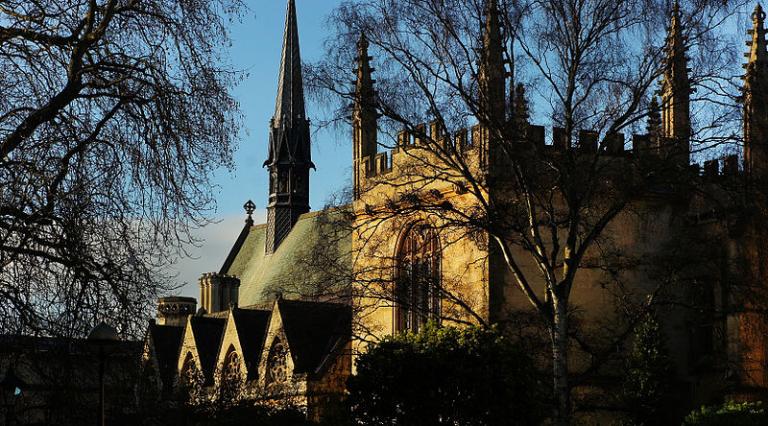
Evening at the University of Oxford (Wikimedia Commons public domain image)
This new item has now gone up on the website of the Interpreter Foundation: The Temple: Plates, Patterns, & Patriarchs: “From Jared to Jacob: The Motif of Divine Ascensus and Descensus in Genesis, the Book of Moses, and the Enochic Tradition,” written by Matthew L. Bowen and Jeffrey M. Bradshaw.
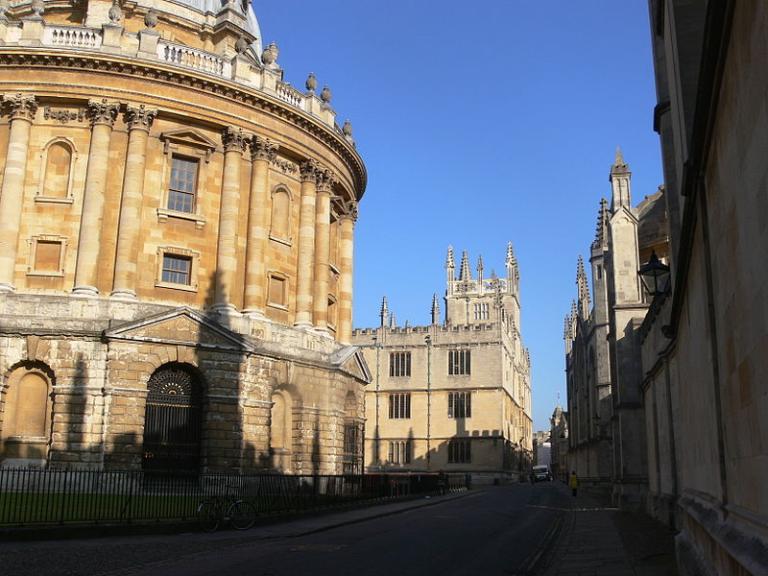
The Bodleian Library at Oxford, from Radcliffe Square
(Wikimedia Commons public domain image)
We left Cardiff this morning to drive to Oxford. En route, Peter Fagg shared some passages from Dylan Thomas’s 1954 BBC radio play Under Milk Wood, an interesting portrayal of life in a fictional Welsh town. He is an exceptionally good voice actor, adept at dialects and distinct personalities. A few days ago, at Dove Cottage in Grasmere, he recited Roald Dahl’s satirical retelling of “Goldilocks and the Three Bears” from memory. It’s really funny, but especially in his recital of it. I’ve heard him do it before; I would love to get him to record the piece. As he pointed out to us, Roald Dahl, was born to Norwegian immigrant parents (as his name might suggest) in Cardiff.
Then Kris Frederickson and I took turns on the microphone, talking about Oxford and, as it turned out, focusing heavily on C. S. Lewis, who is, of course, strongly associated with the University of Oxford, where he studied, taught, and is buried. I’ll share a few of the passages from him that we shared on the motor coach. The first was mine, a favorite of long standing:
“It is a serious thing to live in a society of possible gods and goddesses, to remember that the dullest most uninteresting person you can talk to may one day be a creature which,if you saw it now, you would be strongly tempted to worship, or else a horror and a corruption such as you now meet, if at all, only in a nightmare. All day long we are, in some degree helping each other to one or the other of these destinations. It is in the light of these overwhelming possibilities, it is with the awe and the circumspection proper to them, that we should conduct all of our dealings with one another, all friendships, all loves, all play, all politics. There are no ordinary people. You have never talked to a mere mortal. Nations, cultures, arts, civilizations – these are mortal, and their life is to ours as the life of a gnat. But it is immortals whom we joke with, work with, marry, snub, and exploit – immortal horrors or everlasting splendors.” (The Weight of Glory)
Kris shared a number of her own favorites, including this one:
“To love at all is to be vulnerable. Love anything and your heart will be wrung and possibly broken. If you want to make sure of keeping it intact you must give it to no one, not even an animal. Wrap it carefully round with hobbies and little luxuries; avoid all entanglements. Lock it up safe in the casket or coffin of your selfishness. But in that casket, safe, dark, motionless, airless, it will change. It will not be broken; it will become unbreakable, impenetrable, irredeemable. To love is to be vulnerable.” (The Four Loves)
And this one, which reminds me of the passage from Wordworth’s “Ode: Intimations of Immortality from Recollections of Early Childhood” that I cited here a few days ago:
“If we find ourselves with a desire that nothing in this world can satisfy, the most probable explanation is that we were made for another world.” (Mere Christianity)
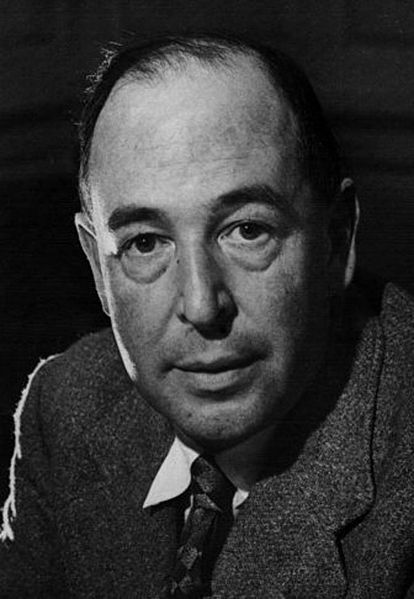
C. S. Lewis at about the age of fifty (Wikimedia Commons public domain image)
And this one:
“We are, not metaphorically but in very truth, a Divine work of art, something that God is making, and therefore something with which he will not be satisfied until it has a certain character. Here again we come up against what I have called the ‘intolerable compliment.’ Over a sketch made idly to amuse a child, an artist may not take much trouble: he may be content to let it go even thought it is not exactly as he meant it to be. But over the great picture of his life—the work which he loves, though in a different fashion, as intensely as a man loves a woman or a mother a child—he will take endless trouble—and would, doubtless, thereby give endless trouble to the picture if it were sentient. One can imagine a sentient picture, after being rubbed and scraped and recommenced for the tenth time, wishing that it were only a thumbnail sketch whose asking was over in a minute. In the same way, it is natural for us to wish that God had designed for us a less glorious and less arduous destiny; but then we are wishing not for more love, but less.” (The Problem of Pain)
Which reminded me of a passage that I didn’t share, but certainly could have:
“Imagine yourself as a living house. God comes in to rebuild that house. At first, perhaps, you can understand what He is doing. He is getting the drains right and stopping the leaks in the roof and so on; you knew that those jobs needed doing and so you are not surprised. But presently He starts knocking the house about in a way that hurts abominably and does not seem to make any sense. What on earth is He up to? The explanation is that He is building quite a different house from the one you thought of – throwing out a new wing here, putting on an extra floor there, running up towers, making courtyards. You thought you were being made into a decent little cottage: but He is building a palace. He intends to come and live in it Himself.” (Mere Christianity)
I did, however, share this one with the unfortunate passengers of the coach, who had nowhere to run:
“I am trying to prevent anyone saying the really foolish thing that people often say about Him: ‘I am ready to accept Jesus as a great moral teacher, but I do not accept His claim to be God.’ That is the one thing we must not say. A man who was merely a man and said the sort of things Jesus said would not be a great moral teacher. He would either be a lunatic–on the level with the man who says he is a poached egg–or else he would be the Devil of Hell. You must make your choice. Either this man was, and is, the Son of God, or else a madman or something worse. You can shut him up for a fool, you can spit at him and kill him as a demon, or you can fall at his feet and call him Lord and God. But let us not come up with any patronizing nonsense about his being a great human teacher. He has not left that open to us. He did not intend to. We are faced, then, with a frightening alternative. This man we are talking about either was (and is) just what He said, or else a lunatic, or something worse. I have to accept the view that He was and is God.” (Mere Christianity)
We did a walking tour in Oxford, walking past several of the colleges; the Sheldonian Theatre and the Radcliffe Camera; the monument commemorating the “Oxford Martyrs” (Bishop Nicholas Ridley, Bishop Hugh Latimer, and Thomas Cranmer, the deposed Archbishop of Canterbury) who were burned at the stake under Queen Mary I (aka “Bloody Mary”); through the courtyard of the Balliol Library; and so forth. Afterwards, we had some time on our own. My wife and I spent ours in the Covered Market and in the University Church of St. Mary the Virgin, where John Wesley preached and where John Henry Newman served as the vicar (before he converted to Catholicism and rose to the rank of cardinal). Among other things, too, the trials of the Oxford Martyrs were held in the church and, in early 1942, C. S. Lewis preached the lay sermon in it that was later published as The Weight of Glory. It’s the essay from which I took my first quotation, above.
Posted from London, England
Travel and Religion
History and Religion
Previous Post
May 21, 2025
In the footsteps of Dan Jones
Next Post

May 23, 2025 Dickensian London and the Fruits of Empire
Recent Comments
"DP: “But Mr. Sutherland worries about the fact that our time, when we can communicate ..."
Learning more about a region of ..."
"Another class of memories are of individuals who previously lived. Some of these remembered individuals ..."
"Sutherland's lecture sounds interesting. He seems to restate the Washington consensus that trade brings peace ..."
Learning more about a region of ..."
"In a meeting today, I learned another important reason why accurate (or at least as ..."
From Serbia’s “White City,” Belgrade
Browse Our Archives
Select a Category Uncategorized
Select a Month October 2026 September 2026 August 2026 July 2026 June 2026 May 2026 April 2026 March 2026 February 2026 January 2026 December 2025 November 2025 October 2025 September 2025 August 2025 July 2025 June 2025 May 2025 April 2025 March 2025 February 2025 January 2025 December 2024 November 2024 October 2024 September 2024 August 2024 July 2024 June 2024 May 2024 April 2024 March 2024 February 2024 January 2024 December 2023 November 2023 October 2023 September 2023 August 2023 July 2023 June 2023 May 2023 April 2023 March 2023 February 2023 January 2023 December 2022 November 2022 October 2022 September 2022 August 2022 July 2022 June 2022 May 2022 April 2022 March 2022 February 2022 January 2022 December 2021 November 2021 October 2021 September 2021 August 2021 July 2021 June 2021 May 2021 April 2021 March 2021 February 2021 January 2021 December 2020 November 2020 October 2020 September 2020 August 2020 July 2020 June 2020 May 2020 April 2020 March 2020 February 2020 January 2020 December 2019 November 2019 October 2019 September 2019 August 2019 July 2019 June 2019 May 2019 April 2019 March 2019 February 2019 January 2019 December 2018 November 2018 October 2018 September 2018 August 2018 July 2018 June 2018 May 2018 April 2018 March 2018 February 2018 January 2018 December 2017 November 2017 October 2017 September 2017 August 2017 July 2017 June 2017 May 2017 April 2017 March 2017 February 2017 January 2017 December 2016 November 2016 October 2016 September 2016 August 2016 July 2016 June 2016 May 2016 April 2016 March 2016 February 2016 January 2016 December 2015 November 2015 October 2015 September 2015 August 2015 July 2015 June 2015 May 2015 April 2015 March 2015 February 2015 January 2015 December 2014 November 2014 March 2014 August 2013 February 2012
Follow Us!
TAKE THE
Religious Wisdom Quiz
What did Jesus say to the storm on the Sea of Galilee?
Select your answer to see how you score.
"Depart from me!" "Be gone!" "Peace, be still!" "Let there be light!"
Related posts from Sic et Non



TRENDING AT PATHEOS Latter-day Saint

Archdiocese Hosts Military Marriage Retreat in Germany
RASTATT, Germany — The transient military lifestyle, with its frequent deployments and...

Nearly every morning, I make the drive to Detroit with my high-school-age...

The Real AI Story Is Adoption Without Trust
Artificial intelligence has crossed a political threshold. It is no longer a...

A new article, written by Jeff Lindsay and Gale L. Pooley,...

Swimfan: Forgotten Aughts Pleasures
This is a recovery effort. In 2002, My Big Fat Greek Wedding...

Top Three Anti-Catholic Lies About Catholicism
This is my initial transcript for the video, "THE 3 WORST...
view all Latter-day Saint blogs
What Are Your Thoughts?leave a comment
Ad-Free & Subscriber Log-In Subscription Support
- About Us
- 2026 Calendar
- Videos
- Podcasts
- Library of World Religions
- Faith In Media Tracker
- Advertise With Us
- Write for Us
- Privacy Policy
- Terms of Service
- Do Not Sell My Data
- Contact Us
- Radiant Digital
- Manage Newsletter Subscriptions
- Unsubscribe From Notifications
- Sitemap
Copyright 2008-2026, Patheos. All rights reserved.
Subscription Support Ad-Free & Subscriber Log-In
Follow Patheos