
BuddhistCatholicContemplativeEvangelicalGeneral ChristianHinduJewishLatter-day SaintMuslimNew VisionsProgressive Christian
Beliefs
- Buddhist
- Catholic
- Contemplative
- Evangelical
- General Christian
- Hindu
- Jewish
- Latter-day Saint
- More Voices
- Muslim
- New Visions
- Pagan
- Progressive Christian
Topics
- Religion News
- Food and Religion
- Sports and Religion
- Religious Art
- Religious Music and Entertainment
- Religious Events
- History and Religion
- Style and Religion
- Politics and Religion
- Women in Religion
- Recreation Outdoors and Religion
- Business Finance and Religion
- Careers Workplace and Religion
- Education and Religion
- Family Parenting and Religion
- Health Fitness and Religion
- Home and Religion
- Relationships and Religion
- Technology and Religion
- Travel and Religion
Columnists
- Buddhist Columnists
- Business Finance and Religion Columnists
- Careers Workplace and Religion Columnists
- Catholic Columnists
- Contemplative Columnists
- Education and Religion Columnists
- Evangelists Columnists
- Family Parenting and Religion Columnists
- General Christian Columnists
- Health Fitness and Religion Columnists
- Hindu Columnists
- History and Religion Columnists
- Home and Religion Columnists
- Jewish Columnists
- More Voices Columnists
- Latter Day Columnists
- Muslim Columnists
- New Visions Columnists
- Nonreligious Columnists
- Pagan Columnists
- Politics and Religion Columnists
- Progressive Columnists
- Recreation Outdoors and Religion Columnists
- Relationships and Religion Columnists
- Religion News Columnists
- Religious Art Columnists
- Religious Events Columnists
- Religious Music and Entertainment Columnists
- Sports and Religion Columnists
- Style and Religion Columnists
- Technology and Religion Columnists
- Travel and Religion Columnists
- Women in Religion Columnists
Resource Library
- 2026 Calendar
- Library of World Religions
- The 100 Most Holy Places on Earth
- Patheos Answers
- Podcasts
- Videos
- Faith Leaders Database
- Anglican Episcopalian
- Bahai
- Baptist
- Buddhism
- Christianity
- Confucianism
- Eastern Orthodoxy
- Hinduism
- Holiness and Pentecostal
- ISKCON
- Islam
- Judaism
- Lutheran
- Methodist
- The Church of Jesus Christ of Latter-day Saints
- New Age
- Paganism
- Presbytarian and Reformed
- Protestantism
- Religion Behind the Scenes
- Roman Catholic
- Scientology
- Shia Islam
- Sikhism
- Sufism
- Sunni Islam
- Taoism
- Zen
- See all religions
Research Tools
 Ad-Free & Subscriber Log-In Subscription Support
Ad-Free & Subscriber Log-In Subscription Support
Follow Patheos 

- Trending:
- Forgiveness
- |
- Marriage
- |
- Consciousness
- |
- Death Penalty
- |
- Election
- |
- Halloween

- Home
- Latter-day Saint
- Travel and Religion
- Frederic, Jane, Henry, and their homes
Frederic, Jane, Henry, and their homes
Last updated on: June 4, 2025 at 6:16 pm by Dan Peterson
Frederic, Jane, Henry, and their homes 2025-06-04T18:16:58-06:00 Dan Peterson
Patheos Explore the world's faith through different perspectives on religion and spirituality! Patheos has the views of the prevalent religions and spiritualities of the world.
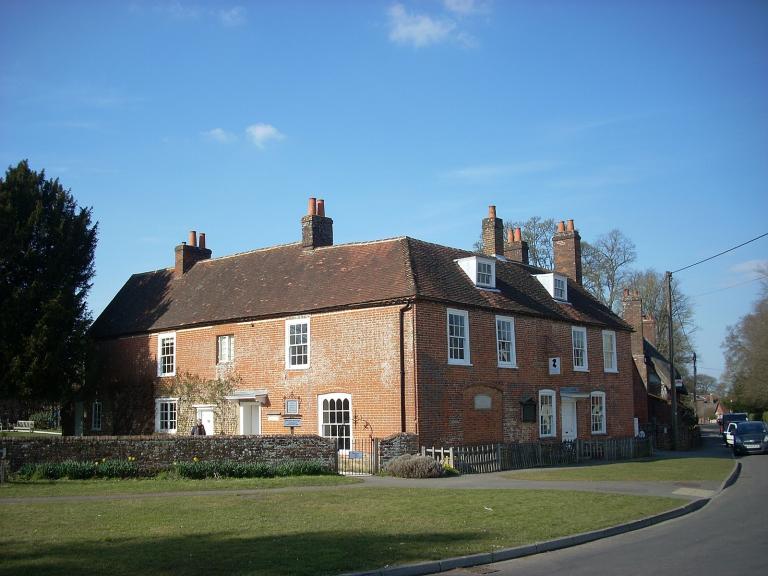
The Austen house in Chawton, Hampshire (Wikimedia Commons public domain image)
We were up early this morning for a brief visit to Winchester Cathedral, where Jane Austen is buried. Then we drove to Chawton, where Jane lived her last eight years. We walked over to Chawton House, one of the estates that belonged to her brother — that’s a slightly strange and complicated story, including his changing his surname from Austen to Knight — and saw there the graves of her mother and her sister, as well as a small but beautiful statue of Jane herself. But we spent most of our time in Jane’s own home, which is often called Chawton Cottage. It’s where she wrote (or, at least, made the final revisions on) all six of her novels, as well as the unpublished fragment Sanditon. I had good conversations with two of the docents in the home, one of whom is actually a descendant of Jane’s brother. (He grew up in Chawton House.)

A wide view of the front of Hampton Court Palace (Wikimedia Commons public domain image)
Then we headed to Hampton Court Palace, where my wife and I spent the entirety of our time in and about Henry VIII’s royal apartments, his great hall, and his chapel royal. Henry VIII is obviously both a repulsive figure and a fascinating one. I’m much less interested in the baroque portions of the palace belonging to William III and in the still later portions pertaining to George II; we’ve seen them on previous visits. Incidentally, we saw Elder Lew Cramer and Senator Jeff Flake walking away from the palace as we were walking toward it. They didn’t see us — or, at least, they pretended not to see us. (I’m beginning to suspect that Senator Flake is stalking me. I mean, really. Istanbul? Then London? Then, the next day, at Hampton Court Palace? And, many years ago, in Provo?)
Our tour ended this evening. Most of our people are headed home tomorrow morning. It’s always a bit of a letdown when a trip like this concludes: We’ve just made a number of new friends, and now they’re gone. But I was extremely pleased with Peter Fagg’s guiding this time around; he seems to become better each time. And our coach driver, Gary, was an unusually pleasant, jovial, friendly, and accommodating fellow. Peter has begun to request him for his tours, and I can certainly see why.
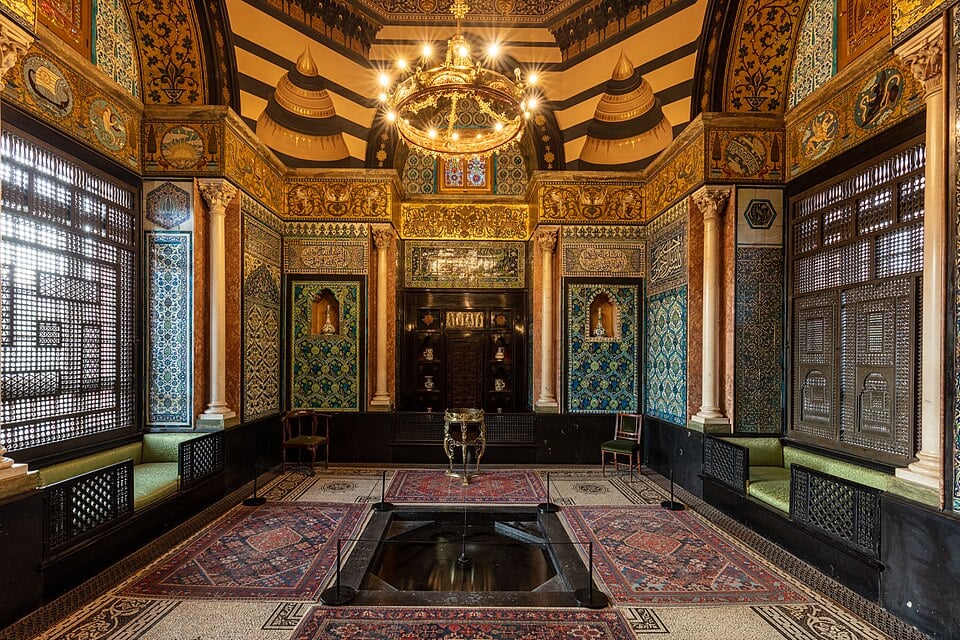
“Arab Hall” in Leighton House (Wikimedia Commons public domain photo)
I realize that I omitted something significant from yesterday’s tour summary. (I was tired and in a hurry. It was late, and we needed to rise early.) I failed to mention our early-morning visit to the Leighton House Museum, the former London home of the Victorian painter Frederic Leighton, 1st Baron Leighton (1830–1896), whose painting I quite like. I had never previously heard of the Leighton House Museum; the visit was Kris Frederickson’s idea. I loved it. It’s a little gem of a place, and the “Arab Hall” is exquisitely beautiful.
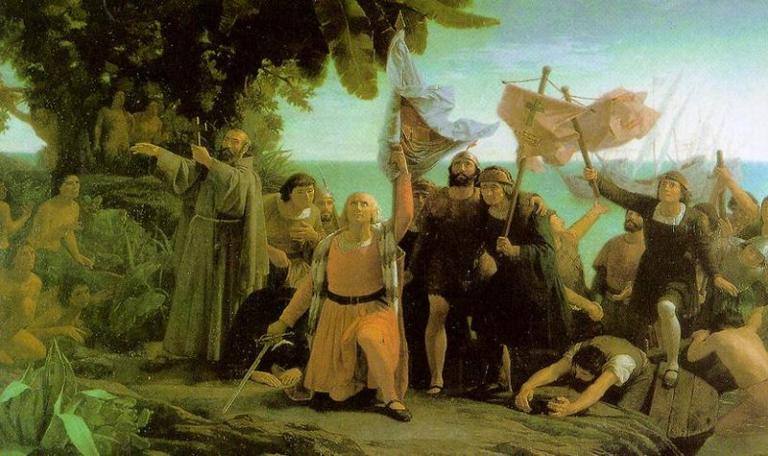
“Primer desembarco de Cristóbal Colón en América” (The First Landing of Christopher Columbus in America), by Dióscoro Teófilo Puebla Tolín (Wikimedia CC public domain image)
As a small constituent part of a long-term project that I’m working on, I’ll be extracting notes over the next several weeks or (more likely) months from John W. Welch, ed., Reexploring the Book of Mormon: A Decade of New Research (Salt Lake City and Provo: Deseret Book, 1992), and intermittently sharing them here. They represent the state of the questions as of the early 1990s and, in many cases, they will need to be fleshed out with whatever developments may have occurred over the past thirty-three years. (It’s also possible that, in a few cases, subsequent developments will have negated them altogether.) But that is a task for another time (or times). These are notes — sometimes including bibliographical hints for future reading — that I’m compiling for my own use, but I hope that some of you will find them of interest.
Tonight, I’m drawing on “Columbus: By Faith or Reason?” by Grant R. Hardy:
“I looked and beheld a man among the Gentiles, . . . and he went forth upon the many waters.” (1 Nephi 13:12)
This verse has long been understood by Latter-day Saints as referring to Columbus. And, assuming that identification to be accurate, the Book of Mormon seems to assert that, whatever else may have been involved, Columbus’s primary reasons for sailing were spiritual.
When I was growing up, though, Columbus appears to have been generally seen as led by science, reason, and restlessness, and, perhaps most importantly, by greed and a lust for conquest. By the early 1990s, however, historian Pauline Watts had taken a new look at his motivations, arguing persuasively that Columbus was in fact deeply influenced by prophecy and revelation. [See especially Pauline Watts, “Prophecy and Discovery: On the Spiritual Origins of Christopher Columbus’s ‘Enterprise of the Indies,”’ American Historical Review (February 1985): 73-102.]
At least some recent scholarship, it seems, has come to agree with the Book of Mormon’s assessment of Columbus.
“In her article, Watts investigates the spiritual origins of Columbus’s voyages. She discusses the inuences of scripture, theology, astrology, apocalypticism, and medieval prophecy. She particularly focuses on a book that Columbus himself was writing but never completed, called Book of Prophecies (the fragments were first edited by Cesare De Lollis in 1894). In this book Columbus set forth views on himself as the fullfiller of biblical prophecies! Columbus saw himself as fullfilling the “islands of the sea” passages from Isaiah and another group of verses concerning the conversion of the heathen. Watts reports that Columbus was preoccupied with “the final conversion of all races on the eve of the end of the world,” paying particular attention to John 10:16: “And other sheep I have, which are not of this fold” (see also 3 Nephi 16:3). He took his mission of spreading the gospel of Christ seriously. “God made me the messenger of the new heaven and the new earth. . . . He showed me the spot where to find it,” Columbus wrote in 1500. [Watts, “Prophecy and Discovery,” 73]
Watts summarizes her argument by stating that “in the final years of his life, . . . Columbus came increasingly to see himself as a divinely inspired fulfiller of prophecy, the one who inaugurated the age of the unum ovile et unus pastor” (“one fold and one shepherd”). [Watts, “Prophecy and Discovery,” 73.] “He came to believe that he was predestined to fulfill a number of prophecies in preparation for the coming of the Anti-Christ and the end of the world” (which also happens to be the context of Nephi’s prophecies in 1 Nephi 13-14). [Watts, “Prophecy and Discovery,” 74]
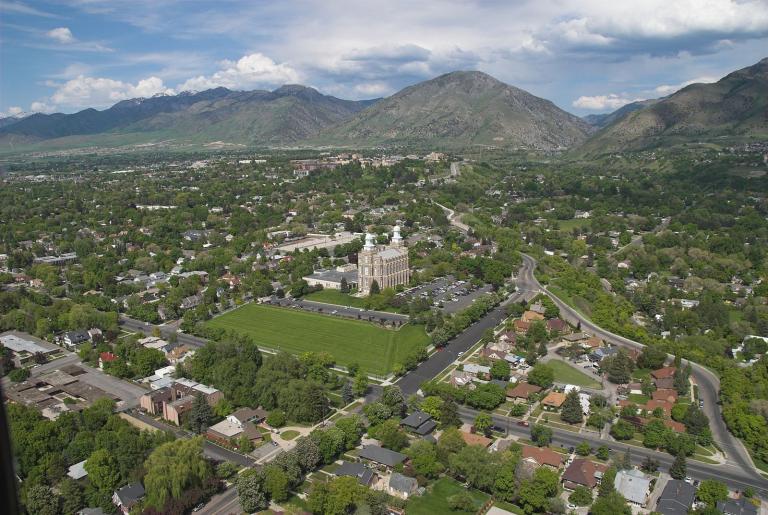
A 2008 view of Logan, Utah, by Michael Gordon, looking over the Logan Utah Temple toward the campus of Utah State University in the distance (Wikimedia Commons public domain image)
Dr. John Johnson and his wife have participated in several of our Interpreter Foundation educational tours. They were on this one, as well. A member of the Utah state senate, he published an interesting article a couple of days ago in the Deseret News; I like the direction that he’s pursuing: “Perspective: The renaissance that American universities need: What’s broken in higher ed isn’t just policy. It’s purpose”
Posted from London, England
Travel and Religion
History and Religion
Previous Post

May 25, 2025
With the Saints in England, both Latter-day Saints and not
Next Post
May 27, 2025 I married a theater major
Recent Comments
"About 10 of the BYU medical school faculty are women. One of tgese women gave ..."
The Iron Gates and the Lion ..."
"The BYU School of medicine alreasy has some female faculty members. Having done a complete ..."
The Iron Gates and the Lion ..."
"“Enough and to Spare”I love their closing statement:“Joseph’s revelations related to the issues of scarcity ..."
"Thanks John. You always have so many interesting facts. I could listen to you read ..."
Browse Our Archives
Select a Category Uncategorized
Select a Month October 2026 September 2026 August 2026 July 2026 June 2026 May 2026 April 2026 March 2026 February 2026 January 2026 December 2025 November 2025 October 2025 September 2025 August 2025 July 2025 June 2025 May 2025 April 2025 March 2025 February 2025 January 2025 December 2024 November 2024 October 2024 September 2024 August 2024 July 2024 June 2024 May 2024 April 2024 March 2024 February 2024 January 2024 December 2023 November 2023 October 2023 September 2023 August 2023 July 2023 June 2023 May 2023 April 2023 March 2023 February 2023 January 2023 December 2022 November 2022 October 2022 September 2022 August 2022 July 2022 June 2022 May 2022 April 2022 March 2022 February 2022 January 2022 December 2021 November 2021 October 2021 September 2021 August 2021 July 2021 June 2021 May 2021 April 2021 March 2021 February 2021 January 2021 December 2020 November 2020 October 2020 September 2020 August 2020 July 2020 June 2020 May 2020 April 2020 March 2020 February 2020 January 2020 December 2019 November 2019 October 2019 September 2019 August 2019 July 2019 June 2019 May 2019 April 2019 March 2019 February 2019 January 2019 December 2018 November 2018 October 2018 September 2018 August 2018 July 2018 June 2018 May 2018 April 2018 March 2018 February 2018 January 2018 December 2017 November 2017 October 2017 September 2017 August 2017 July 2017 June 2017 May 2017 April 2017 March 2017 February 2017 January 2017 December 2016 November 2016 October 2016 September 2016 August 2016 July 2016 June 2016 May 2016 April 2016 March 2016 February 2016 January 2016 December 2015 November 2015 October 2015 September 2015 August 2015 July 2015 June 2015 May 2015 April 2015 March 2015 February 2015 January 2015 December 2014 November 2014 March 2014 August 2013 February 2012
Follow Us!
TAKE THE
Religious Wisdom Quiz
Who dreamed of a ladder reaching to heaven?
Select your answer to see how you score.
Joseph Isaac Jacob Simeon
Related posts from Sic et Non


A monument to the transience of power (and...
Shall we not go on in so great...

Two Plays about Women Being Treated Badly
TRENDING AT PATHEOS Latter-day Saint

Catholic Evangelization: Sharing Your Faith Every Day
Welcome back to the Graceful Awakening mini-series called, “From Faith to Mission.” ...

The Pillar of the Boatmen: the Ancient Monument...
The Pillar of the Boatmen is a Romano-Gaulish sculpture that dates from...

In one sense walking into Westminster Abbey is like walking down the...

'Super Scam Me' Exposes AI Jon Bon Jovi...
Leslie Pickett believed she was in a relationship with Jon Bon Jovi....

The Brazilian Remake of Kendricks' 'Flywheel' Opens in...
“Flywheel,” the story that launched the Kendrick Brothers’ filmmaking career is getting...

The Dangers of Gradual Accommodation (Winking at Sin)
Recently, the “law of gradualness” resurfaced during the opening of a weeklong,...
view all Latter-day Saint blogs
What Are Your Thoughts?leave a comment
Ad-Free & Subscriber Log-In Subscription Support
- About Us
- 2026 Calendar
- Videos
- Podcasts
- Library of World Religions
- Faith In Media Tracker
- Advertise With Us
- Write for Us
- Privacy Policy
- Terms of Service
- Do Not Sell My Data
- Contact Us
- Radiant Digital
- Manage Newsletter Subscriptions
- Unsubscribe From Notifications
- Sitemap
Copyright 2008-2026, Patheos. All rights reserved.
Subscription Support Ad-Free & Subscriber Log-In
Follow Patheos