
BuddhistCatholicContemplativeEvangelicalGeneral ChristianHinduJewishLatter-day SaintMuslimNew VisionsProgressive Christian
Beliefs
- Buddhist
- Catholic
- Contemplative
- Evangelical
- General Christian
- Hindu
- Jewish
- Latter-day Saint
- More Voices
- Muslim
- New Visions
- Pagan
- Progressive Christian
Topics
- Religion News
- Food and Religion
- Sports and Religion
- Religious Art
- Religious Music and Entertainment
- Religious Events
- History and Religion
- Style and Religion
- Politics and Religion
- Women in Religion
- Recreation Outdoors and Religion
- Business Finance and Religion
- Careers Workplace and Religion
- Education and Religion
- Family Parenting and Religion
- Health Fitness and Religion
- Home and Religion
- Relationships and Religion
- Technology and Religion
- Travel and Religion
Columnists
- Buddhist Columnists
- Business Finance and Religion Columnists
- Careers Workplace and Religion Columnists
- Catholic Columnists
- Contemplative Columnists
- Education and Religion Columnists
- Evangelists Columnists
- Family Parenting and Religion Columnists
- General Christian Columnists
- Health Fitness and Religion Columnists
- Hindu Columnists
- History and Religion Columnists
- Home and Religion Columnists
- Jewish Columnists
- More Voices Columnists
- Latter Day Columnists
- Muslim Columnists
- New Visions Columnists
- Nonreligious Columnists
- Pagan Columnists
- Politics and Religion Columnists
- Progressive Columnists
- Recreation Outdoors and Religion Columnists
- Relationships and Religion Columnists
- Religion News Columnists
- Religious Art Columnists
- Religious Events Columnists
- Religious Music and Entertainment Columnists
- Sports and Religion Columnists
- Style and Religion Columnists
- Technology and Religion Columnists
- Travel and Religion Columnists
- Women in Religion Columnists
Resource Library
- 2026 Calendar
- Library of World Religions
- The 100 Most Holy Places on Earth
- Patheos Answers
- Podcasts
- Videos
- Faith Leaders Database
- Anglican Episcopalian
- Bahai
- Baptist
- Buddhism
- Christianity
- Confucianism
- Eastern Orthodoxy
- Hinduism
- Holiness and Pentecostal
- ISKCON
- Islam
- Judaism
- Lutheran
- Methodist
- The Church of Jesus Christ of Latter-day Saints
- New Age
- Paganism
- Presbytarian and Reformed
- Protestantism
- Religion Behind the Scenes
- Roman Catholic
- Scientology
- Shia Islam
- Sikhism
- Sufism
- Sunni Islam
- Taoism
- Zen
- See all religions
Research Tools
 Ad-Free & Subscriber Log-In Subscription Support
Ad-Free & Subscriber Log-In Subscription Support
Follow Patheos 

- Trending:
- Forgiveness
- |
- Marriage
- |
- Consciousness
- |
- Death Penalty
- |
- Election
- |
- Halloween

- Home
- Latter-day Saint
- History and Religion
- “She Took the Veil and Covered Herself”
“She Took the Veil and Covered Herself”
Last updated on: April 10, 2025 at 6:19 pm by Dan Peterson
“She Took the Veil and Covered Herself” 2025-04-10T18:19:16-06:00 Dan Peterson
Patheos Explore the world's faith through different perspectives on religion and spirituality! Patheos has the views of the prevalent religions and spiritualities of the world.

“Rebecca and Eleazar” (1632), by Willem van Nieulandt II (Wikimedia Commons public domain image), accurate in every Middle Eastern detail
This previously-published book chapter was posted today, Thursday, on the website of the Interpreter Foundation: The Temple: Plates, Patterns, & Patriarchs, “She Took the Veil and Covered Herself,” written by T. K. Plant. For those who may still be confused by what is going on — as at least one unfortunate soul has been — we publish journal articles on Friday. On Thursdays, we post electronic versions of book chapters that have already appeared in print. These are two different things, just as Thursdays and Fridays are two different days. (Fridays typically follow Thursdays — though, perplexingly, Thursdays also commonly follow Fridays, albeit at a somewhat greater distance in time.). Anyway, here’s a description of the article by T. K. Plant:
Part of our book chapter reprint series, this article originally appeared in The Temple: Plates, Patterns, & Patriarchs, edited by Stephen D. Ricks and Jeffrey M. Bradshaw. For more information, go to https://interpreterfoundation.org/books/the-temple-plates-patterns-patriarchs/. For video and audio recording of this conference talk, go to https://interpreterfoundation.org/conferences/2022-temple-on-mount-zion-conference/videos/plant/.
“Genesis 24:65 and 38:14 include the recorded actions of Rebekah and Tamar covering themselves with a veil. The Genesis account in the 1611 King James Version (KJV) records that Rebekah and Tamar covered themselves in a “vaile.” Vaile is the translated word in the KJV from the Masoretic Text (MT) for the Hebrew word ( צָעִִָיף ), transliterated as tsa‘īf (see Genesis 24:65; 38:14 MT). To understand the meaning of the veil in these accounts, I have used parallel methodology to compare the biblical record with other ancient Near Eastern texts and images. In the Genesis accounts of their veiling, the phrase translated into English as “covered” has been found in ancient Near Eastern texts as early as the third millennium BC as a likely ancient Mesopotamian idiom that meant the accepted performance of a culturally legitimate marriage or consummation.”
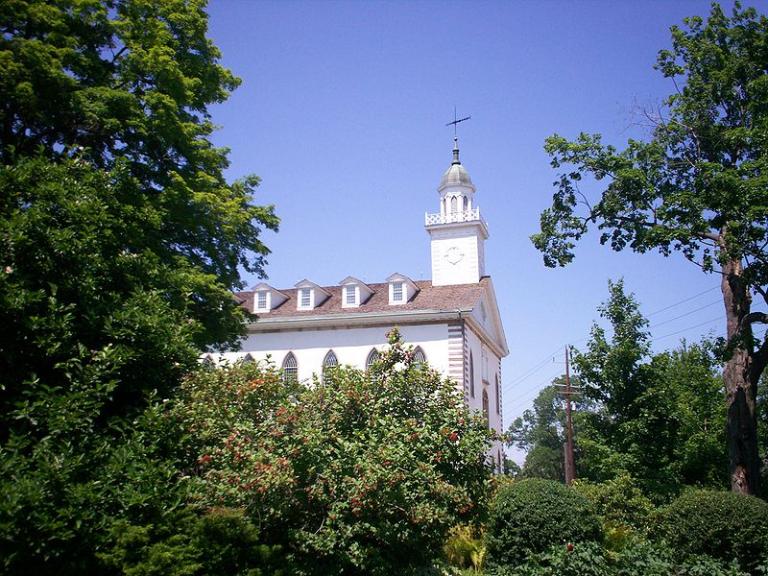
The first Latter-day Saint temple — the first Latter-day Saint building, period — was dedicated in Kirtland, Ohio, in 1836. Owing to apostasy and persecution, the Prophet and the Saints were obliged to abandon Kirtland, and, for nearly two hundred years, the temple was no longer in the hands of the Church of Jesus Christ of Latter-day Saints. Now, though, it has been returned to our custody. But the view today was nowhere near as sunny as shown above. (Wikimedia Commons public domain image)
Today, we filmed in the historic Kirtland Flats area, inside and outside both the Newell K. Whitney Store and the adjacent red brick Johnson Inn. The weather was gray and somewhat rainy, but not too bad, and I think, again, that we got some good material. Basically, now, we have the stuff for ten episodes of our Becoming Brigham series. Obviously, it will take time to get those ten episodes edited into serviceable shape, provided with background music, and so forth, but the filming for them is essentially done.
When we were finished, we were able to work in a tour of the Kirtland Temple. The new temple tours under the auspices of the Church of Jesus Christ of Latter-day Saints are a good blend of historical facts and spiritual significance, far superior to the dry and religiously barren art history tour that I experienced on my first visit to Kirtland many, many, many years ago. Some were worried that the new Latter-day Saint approach would ignore historical fact in favor of hardcore proselytizing but, happily, that hasn’t occurred. After my previous visit to Kirtland, during which a team then affiliated with Scripture Central filmed me and Casey Griffiths in the temple and a pair of then-new missionaries, still mastering their presentation, took us on a tour, I was confident that things would be just fine, and they were.

A 1981 Susan B. Anthony dollar coin (Wikimedia Commons public domain image)
I mentioned the other day that, before our group arrived in upstate New York, my wife and I visited the home and then the grave of Susan B. Anthony. In connection with that, I did just a small bit of reading about her life, and I saw an interesting albeit small and indirect connection to an important part of the history of the Latter-day Saints in Kirtland:
Susan B. Anthony’s father was a Quaker, an abolitionist, and an advocate of temperance. During her very earliest years, he ran his own small cotton factory. When she was six years old, though, her family moved to Battenville, New York, where her father assumed the management of a large cotton mill. At the age of seventeen, she was sent off to a Quaker boarding school in Philadelphia, which she soon came to dislike intensely for what she regarded as its strict and sometimes humiliating atmosphere. But she was forced to end her studies after one term — it doesn’t seen that she would have been very upset about that, at least — because an economic downturn known as the “Panic of 1837” ruined her family financially. They were forced to sell off everything they had at a public auction — although, in the end, they were rescued by her maternal uncle, who bought most of their belongings back and kindly restored them to the family. Anyway, that was the very same “Panic of 1837” that, hundreds of miles away in Ohio, engulfed and destroyed the famous Kirtland Bank (aka the “Kirtland Safety Society”) and contributed powerfully to the eventual abandonment of Kirtland by Joseph Smith and almost all other Latter-day Saints. Some folks are, and were at the time, under the impression that it was Joseph Smith’s personal malfeasance and corruption that led to the failure of the bank, but the causes were much larger than Kirtland and much more complicated than that impression would suggest. An important treatment of the topic is Marvin S. Hill, C. Keith Rooker, and Larry T. Wimmer, “The Kirtland Economy Revisited: A Market Critique of Sectarian Economics,” BYU Studies Quarterly 17/4 (1977): 391 -475.
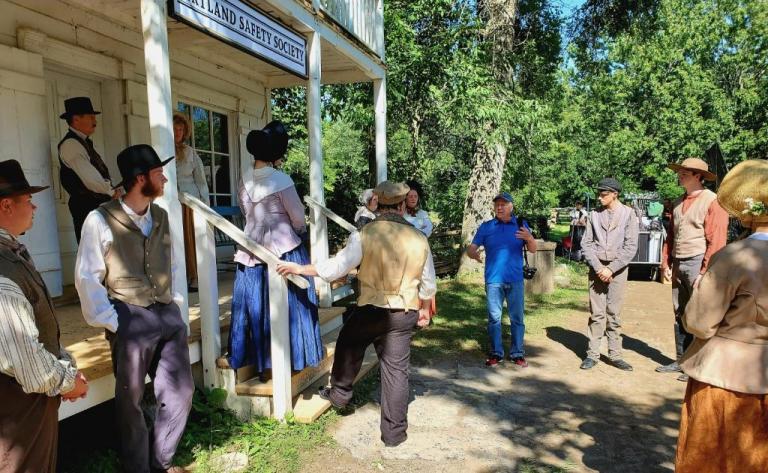
Director Mark Goodman gives instructions to some of the actors in the “Witnesses” project on the movie set in Ontario’s Upper Canada Village. As the store front sign in this photo might suggest, our 2021 “Witnesses” film engaged the tough issues involved in the story. (Photograph courtesy of James Jordan)
Posted from Cleveland, Ohio
History and Religion
Travel and Religion
Previous Post

April 9, 2025
"Ye shall go to the Ohio"
Next Post
April 11, 2025 The Timing of the Death of Jesus Christ
Recent Comments
"I have cpnsidered in my mond if the 4 volume Saints could be made into ..."
From Serbia’s “White City,” Belgrade
"Another class of memories are of individuals who previously lived. Some of these remembered individuals ..."
"Sutherland's lecture sounds interesting. He seems to restate the Washington consensus that trade brings peace ..."
Learning more about a region of ..."
"In a meeting today, I learned another important reason why accurate (or at least as ..."
From Serbia’s “White City,” Belgrade
Browse Our Archives
Select a Category Uncategorized
Select a Month October 2026 September 2026 August 2026 July 2026 June 2026 May 2026 April 2026 March 2026 February 2026 January 2026 December 2025 November 2025 October 2025 September 2025 August 2025 July 2025 June 2025 May 2025 April 2025 March 2025 February 2025 January 2025 December 2024 November 2024 October 2024 September 2024 August 2024 July 2024 June 2024 May 2024 April 2024 March 2024 February 2024 January 2024 December 2023 November 2023 October 2023 September 2023 August 2023 July 2023 June 2023 May 2023 April 2023 March 2023 February 2023 January 2023 December 2022 November 2022 October 2022 September 2022 August 2022 July 2022 June 2022 May 2022 April 2022 March 2022 February 2022 January 2022 December 2021 November 2021 October 2021 September 2021 August 2021 July 2021 June 2021 May 2021 April 2021 March 2021 February 2021 January 2021 December 2020 November 2020 October 2020 September 2020 August 2020 July 2020 June 2020 May 2020 April 2020 March 2020 February 2020 January 2020 December 2019 November 2019 October 2019 September 2019 August 2019 July 2019 June 2019 May 2019 April 2019 March 2019 February 2019 January 2019 December 2018 November 2018 October 2018 September 2018 August 2018 July 2018 June 2018 May 2018 April 2018 March 2018 February 2018 January 2018 December 2017 November 2017 October 2017 September 2017 August 2017 July 2017 June 2017 May 2017 April 2017 March 2017 February 2017 January 2017 December 2016 November 2016 October 2016 September 2016 August 2016 July 2016 June 2016 May 2016 April 2016 March 2016 February 2016 January 2016 December 2015 November 2015 October 2015 September 2015 August 2015 July 2015 June 2015 May 2015 April 2015 March 2015 February 2015 January 2015 December 2014 November 2014 March 2014 August 2013 February 2012
Follow Us!
TAKE THE
Religious Wisdom Quiz
Cast your bread upon the waters and after many days you will find it again. What does this encourage?
Select your answer to see how you score.
Patience Fishing Generosity Sharing
Related posts from Sic et Non


Notes on Women, Priesthood, and General Conference

"The Book of Moses as a Temple Text"

TRENDING AT PATHEOS Latter-day Saint

57th Dove Awards Honor Dolly Parton, Crown New...
On gospel music’s biggest night, the 57th annual GMA Dove Awards honored...

The First Eucharistic Controversy: Christ’s Real Presence
For Catholics, the Eucharist is the source and summit of the Christian...

What a Stop Sign Can Teach Us About...
How to Make a Decision When You Can't Hear God Main point:...

Archdiocese Hosts Military Marriage Retreat in Germany
RASTATT, Germany — The transient military lifestyle, with its frequent deployments and...

Nearly every morning, I make the drive to Detroit with my high-school-age...

The Real AI Story Is Adoption Without Trust
Artificial intelligence has crossed a political threshold. It is no longer a...
view all Latter-day Saint blogs
What Are Your Thoughts?leave a comment
Ad-Free & Subscriber Log-In Subscription Support
- About Us
- 2026 Calendar
- Videos
- Podcasts
- Library of World Religions
- Faith In Media Tracker
- Advertise With Us
- Write for Us
- Privacy Policy
- Terms of Service
- Do Not Sell My Data
- Contact Us
- Radiant Digital
- Manage Newsletter Subscriptions
- Unsubscribe From Notifications
- Sitemap
Copyright 2008-2026, Patheos. All rights reserved.
Subscription Support Ad-Free & Subscriber Log-In
Follow Patheos