
BuddhistCatholicContemplativeEvangelicalGeneral ChristianHinduJewishLatter-day SaintMuslimNew VisionsProgressive Christian
Beliefs
- Buddhist
- Catholic
- Contemplative
- Evangelical
- General Christian
- Hindu
- Jewish
- Latter-day Saint
- More Voices
- Muslim
- New Visions
- Pagan
- Progressive Christian
Topics
- Religion News
- Food and Religion
- Sports and Religion
- Religious Art
- Religious Music and Entertainment
- Religious Events
- History and Religion
- Style and Religion
- Politics and Religion
- Women in Religion
- Recreation Outdoors and Religion
- Business Finance and Religion
- Careers Workplace and Religion
- Education and Religion
- Family Parenting and Religion
- Health Fitness and Religion
- Home and Religion
- Relationships and Religion
- Technology and Religion
- Travel and Religion
Columnists
- Buddhist Columnists
- Business Finance and Religion Columnists
- Careers Workplace and Religion Columnists
- Catholic Columnists
- Contemplative Columnists
- Education and Religion Columnists
- Evangelists Columnists
- Family Parenting and Religion Columnists
- General Christian Columnists
- Health Fitness and Religion Columnists
- Hindu Columnists
- History and Religion Columnists
- Home and Religion Columnists
- Jewish Columnists
- More Voices Columnists
- Latter Day Columnists
- Muslim Columnists
- New Visions Columnists
- Nonreligious Columnists
- Pagan Columnists
- Politics and Religion Columnists
- Progressive Columnists
- Recreation Outdoors and Religion Columnists
- Relationships and Religion Columnists
- Religion News Columnists
- Religious Art Columnists
- Religious Events Columnists
- Religious Music and Entertainment Columnists
- Sports and Religion Columnists
- Style and Religion Columnists
- Technology and Religion Columnists
- Travel and Religion Columnists
- Women in Religion Columnists
Resource Library
- 2026 Calendar
- Library of World Religions
- The 100 Most Holy Places on Earth
- Patheos Answers
- Podcasts
- Videos
- Faith Leaders Database
- Anglican Episcopalian
- Bahai
- Baptist
- Buddhism
- Christianity
- Confucianism
- Eastern Orthodoxy
- Hinduism
- Holiness and Pentecostal
- ISKCON
- Islam
- Judaism
- Lutheran
- Methodist
- The Church of Jesus Christ of Latter-day Saints
- New Age
- Paganism
- Presbytarian and Reformed
- Protestantism
- Religion Behind the Scenes
- Roman Catholic
- Scientology
- Shia Islam
- Sikhism
- Sufism
- Sunni Islam
- Taoism
- Zen
- See all religions
Research Tools
 Ad-Free & Subscriber Log-In Subscription Support
Ad-Free & Subscriber Log-In Subscription Support
Follow Patheos 

- Trending:
- Forgiveness
- |
- Marriage
- |
- Consciousness
- |
- Death Penalty
- |
- Election
- |
- Halloween

- Home
- Latter-day Saint
- Travel and Religion
- On the Silk Road
On the Silk Road
Last updated on: April 29, 2025 at 3:24 am by Dan Peterson
On the Silk Road 2025-04-29T03:24:54-06:00 Dan Peterson
Patheos Explore the world's faith through different perspectives on religion and spirituality! Patheos has the views of the prevalent religions and spiritualities of the world.
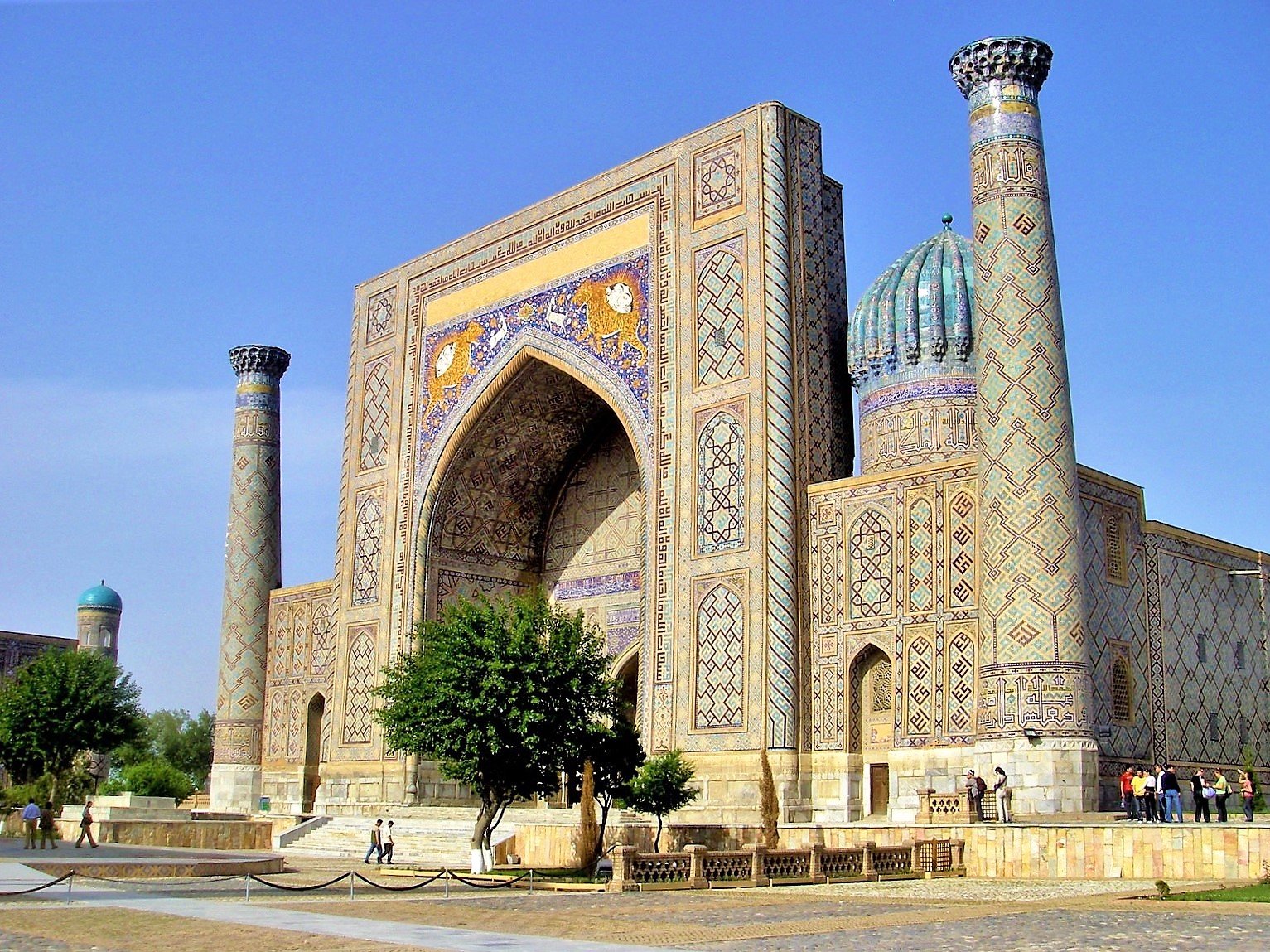
One of the madrasas of the Registan, the center of Samarkand in the late-fourteenth century (Wikimedia Commons public domain image)
It’s difficult to overstate the historical and cultural importance of the place where I’m sitting at this very moment. For one thing, Samarkand is located on what has come to be called, quite famously, the “Silk Road.” The term was originally coined in German, in the nineteenth century, as die Seidenstraße. It entered English and other languages not long thereafter, although some prefer nowadays to term it — a little less attractively, I think — the “Silk Routes.” Why? Because it’s actually not a single road, but a fairly broad assembly of related trade routes. Moreover, few merchants or travelers covered the entire distance, the whole route. Rather, there were lots of middlemen, operating as it were in “relays.”
With that proviso, though, I think that I’ll nonetheless refer to it here as a single entity.
The Silk Road flourished from roughly the second century before Christ until the middle of the fifteenth century. It extended for approximately 4,000 miles (or 6,400 kilometers).
In the West, trade routes joined it from both the north and the south at Palmyra (or Tadmor), in what is today Syria. Depending upon your point of view, depending (in other words) upon which direction goods and people were traveling, I suppose these could be seen as either as tributary roots or as diverging branches.
The northern routes were coming down from Aleppo and, beyond Aleppo, from Constantinople (or, at the end of its story, from Istanbul, which was simply Constantinople after its conquest and renaming by the Turkish Ottoman Empire under Sultan Mehmet II, “the Conqueror”). And Europe, too — especially and most obviously southern Europe — profited indirectly from these pathways of trade.
From the south, the feeder or delivery routes were coming up from Damascus and, beyond Damascus, up from Cairo. And, of course, trade and movement extended on across North Africa and down into East Africa.
At its eastern end, the Silk Route fed and was fed by end stations at Beijing and Huangzhou. The subordinate routes to those cities diverged or came together — again, depending upon the direction in which you were traveling — at what is today called Xi’an but was anciently known as Chang’an.
The Silk Road obviously facilitated trade and economic exchanges between East and West. For example, silk textiles from China were widely sought in Rome, Egypt, Greece, and elsewhere. (Hence, obviously, the name Seidenstraße or “Silk Road.”) But the East also provided such treasured goods as porcelain, tea, dyes, and perfumes. The word tea will serve excellently as an illustration. It is almost universal, with its close cognates, in every language on the planet. There may be exceptions, but I’m unaware of any. Consider this list:
- Spanish: el te
- French: le the
- German: der Tee
- Italian: te
- Portuguese: cha
- Dutch: thee
- Danish: te
- Swedish: te
- Finnish: tee
- Norwegian: te
- Icelandic: te
- Russian: chai
- Greek: tsai
- Japanese: ocha
- Korean: cha
- Chinese (Mandarin): cha (make sure you pronounce the “a” in a rising tone
- Thai: chah
- Hindi: cha
- Arabic: chai or shai
- Armenian: te
- Turkish: cay
- Croatian: caj
- Czech: caj
- Hungarian: tea
- Polish: herbata (notę the final syllable)
- Romanian: ceai
- Ukranian: chaj
- Hebrew: teh
- Somali: shaah
- Zulu: itiye
- Filipino: tsaa
- Vietnamese: tra
- Indonesian: teh
- Chinese (Cantonese): cha
- Sinhalese: the
- Tamil: tea
And all of these cognate words originate, ultimately, in a form of Chinese — that is, in China.
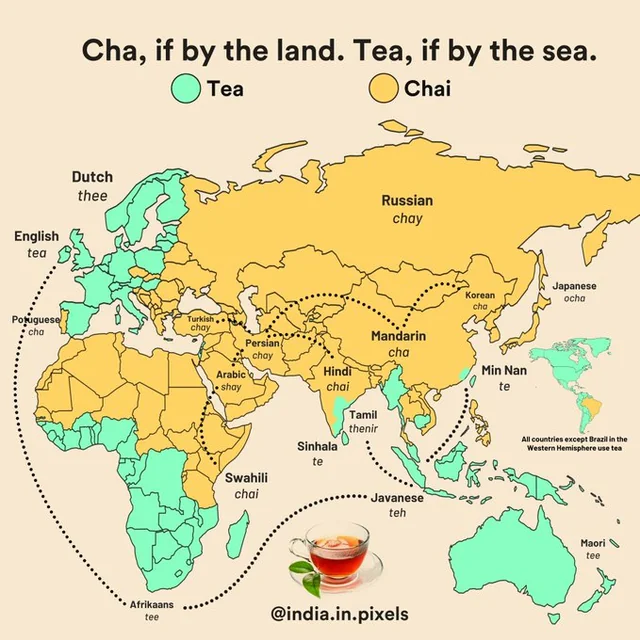
Where does our word for “tea” originate? (Wikimedia Commons public domain image)
In exchange for silk and tea and dyes and perfumes and porcelain, regions at the western end of the Silk Road offered such valued commodities as horses, camels, honey, wine, and gold.
Of course, non-economic exchanges also occurred along the Silk Road. Cultural, political, and religious ideas traveled back and forth along its busy trade routes.
It’s difficult to know exactly how to categorize the transfer of Chinese paper making to the early Islamic world and then on to Europe. (That transfer seems to have happened somewhere near Samarkand. At the very least, near or within what is today Uzbekistan.) The transmission of Chinese paper-making technology was an economic transfer, of course, but, by making the production of books much less expensive than it had previously been, the arrival of paper in the Middle East and then in Europe fostered a cultural revolution that, furthered centuries later by Gutenberg’s application of movable type, transformed the Western world. (Among other things, it enabled the Lutheran Reformation, which rode to a remarkable degree upon Martin Luther’s talents as a popular pamphleteer and, obviously, upon the availability for the first time of relatively affordable Bibles.)
There is a lesson to be learned here, I think, about the venerable age of global markets and the enormous importance of international trade — and the interconnectedness of global civilizations. Having studied history all of my life, I am unrepentantly and inescapably a “globalist.” Civilizations don’t flourish in isolation. They never have. But far be it from me to mention any such lesson in a time when many people appear to imagine that prosperity is somehow magically created by erecting trade barriers.
Admittedly, not everything that traveled over the Silk Road was unequivocally positive — so there’s definitely a case to be made for at least some guidelines and controls. Gunpowder came from China, for instance. It eventually empowered the Ottomans (in Western Asia) and the Safavids (in Persia, or the vicinity of modern Iran) and the Mughals of India to gobble up the fragmented smaller states of the Islamic Middle Periods and to create in the islamic world what the late, great Marshall G. S. Hodgson aptly called the “Age of the Gunpowder Empires.” In Europe, the arrival of gunpowder put an end to the usefulness of castles and to the chivalry of gallant knighthood and, if anything, made wars effortlessly even more terrible and far more destructive than they had been before.
And then there’s the Black Death. That infamous bubonic plague pandemic that raged across Europe from AD 1346 to 1353 may have killed as many as fifty (50) million people — which is to say, perhaps fifty to sixty percent of Europe’s population in the fourteenth century. Where did it come from? It may have started in China or Central Asia and reached first the Middle East and then Europe via the Silk Road.
More to come, in sha’a Allah.
Posted from Samarkand, Uzbekistan
Travel and Religion
History and Religion
Previous Post

April 28, 2025
The first full public day
Next Post
April 30, 2025 Bukhara
Recent Comments
"I have cpnsidered in my mond if the 4 volume Saints could be made into ..."
From Serbia’s “White City,” Belgrade
"DP: “But Mr. Sutherland worries about the fact that our time, when we can communicate ..."
Learning more about a region of ..."
"Another class of memories are of individuals who previously lived. Some of these remembered individuals ..."
"Sutherland's lecture sounds interesting. He seems to restate the Washington consensus that trade brings peace ..."
Learning more about a region of ..."
Browse Our Archives
Select a Category Uncategorized
Select a Month October 2026 September 2026 August 2026 July 2026 June 2026 May 2026 April 2026 March 2026 February 2026 January 2026 December 2025 November 2025 October 2025 September 2025 August 2025 July 2025 June 2025 May 2025 April 2025 March 2025 February 2025 January 2025 December 2024 November 2024 October 2024 September 2024 August 2024 July 2024 June 2024 May 2024 April 2024 March 2024 February 2024 January 2024 December 2023 November 2023 October 2023 September 2023 August 2023 July 2023 June 2023 May 2023 April 2023 March 2023 February 2023 January 2023 December 2022 November 2022 October 2022 September 2022 August 2022 July 2022 June 2022 May 2022 April 2022 March 2022 February 2022 January 2022 December 2021 November 2021 October 2021 September 2021 August 2021 July 2021 June 2021 May 2021 April 2021 March 2021 February 2021 January 2021 December 2020 November 2020 October 2020 September 2020 August 2020 July 2020 June 2020 May 2020 April 2020 March 2020 February 2020 January 2020 December 2019 November 2019 October 2019 September 2019 August 2019 July 2019 June 2019 May 2019 April 2019 March 2019 February 2019 January 2019 December 2018 November 2018 October 2018 September 2018 August 2018 July 2018 June 2018 May 2018 April 2018 March 2018 February 2018 January 2018 December 2017 November 2017 October 2017 September 2017 August 2017 July 2017 June 2017 May 2017 April 2017 March 2017 February 2017 January 2017 December 2016 November 2016 October 2016 September 2016 August 2016 July 2016 June 2016 May 2016 April 2016 March 2016 February 2016 January 2016 December 2015 November 2015 October 2015 September 2015 August 2015 July 2015 June 2015 May 2015 April 2015 March 2015 February 2015 January 2015 December 2014 November 2014 March 2014 August 2013 February 2012
Follow Us!
TAKE THE
Religious Wisdom Quiz
Which book of the Bible contains the "Armor of God" passage?
Select your answer to see how you score.
Romans Ephesians Galatians Colossians
Related posts from Sic et Non
TRENDING AT PATHEOS Latter-day Saint

Methodist Central Hall and Westminster Abbey
Situated on the same square is Methodist Central Hall and Westminster Abbey. ...

57th Dove Awards Honor Dolly Parton, Crown New...
On gospel music’s biggest night, the 57th annual GMA Dove Awards honored...

The First Eucharistic Controversy: Christ’s Real Presence
For Catholics, the Eucharist is the source and summit of the Christian...

What a Stop Sign Can Teach Us About...
How to Make a Decision When You Can't Hear God Main point:...

Archdiocese Hosts Military Marriage Retreat in Germany
RASTATT, Germany — The transient military lifestyle, with its frequent deployments and...

Nearly every morning, I make the drive to Detroit with my high-school-age...
view all Latter-day Saint blogs
What Are Your Thoughts?leave a comment
Ad-Free & Subscriber Log-In Subscription Support
- About Us
- 2026 Calendar
- Videos
- Podcasts
- Library of World Religions
- Faith In Media Tracker
- Advertise With Us
- Write for Us
- Privacy Policy
- Terms of Service
- Do Not Sell My Data
- Contact Us
- Radiant Digital
- Manage Newsletter Subscriptions
- Unsubscribe From Notifications
- Sitemap
Copyright 2008-2026, Patheos. All rights reserved.
Subscription Support Ad-Free & Subscriber Log-In
Follow Patheos