
BuddhistCatholicContemplativeEvangelicalGeneral ChristianHinduJewishLatter-day SaintMuslimNew VisionsProgressive Christian
Beliefs
- Buddhist
- Catholic
- Contemplative
- Evangelical
- General Christian
- Hindu
- Jewish
- Latter-day Saint
- More Voices
- Muslim
- New Visions
- Pagan
- Progressive Christian
Topics
- Religion News
- Food and Religion
- Sports and Religion
- Religious Art
- Religious Music and Entertainment
- Religious Events
- History and Religion
- Style and Religion
- Politics and Religion
- Women in Religion
- Recreation Outdoors and Religion
- Business Finance and Religion
- Careers Workplace and Religion
- Education and Religion
- Family Parenting and Religion
- Health Fitness and Religion
- Home and Religion
- Relationships and Religion
- Technology and Religion
- Travel and Religion
Columnists
- Buddhist Columnists
- Business Finance and Religion Columnists
- Careers Workplace and Religion Columnists
- Catholic Columnists
- Contemplative Columnists
- Education and Religion Columnists
- Evangelists Columnists
- Family Parenting and Religion Columnists
- General Christian Columnists
- Health Fitness and Religion Columnists
- Hindu Columnists
- History and Religion Columnists
- Home and Religion Columnists
- Jewish Columnists
- More Voices Columnists
- Latter Day Columnists
- Muslim Columnists
- New Visions Columnists
- Nonreligious Columnists
- Pagan Columnists
- Politics and Religion Columnists
- Progressive Columnists
- Recreation Outdoors and Religion Columnists
- Relationships and Religion Columnists
- Religion News Columnists
- Religious Art Columnists
- Religious Events Columnists
- Religious Music and Entertainment Columnists
- Sports and Religion Columnists
- Style and Religion Columnists
- Technology and Religion Columnists
- Travel and Religion Columnists
- Women in Religion Columnists
Resource Library
- 2026 Calendar
- Library of World Religions
- The 100 Most Holy Places on Earth
- Patheos Answers
- Podcasts
- Videos
- Faith Leaders Database
- Anglican Episcopalian
- Bahai
- Baptist
- Buddhism
- Christianity
- Confucianism
- Eastern Orthodoxy
- Hinduism
- Holiness and Pentecostal
- ISKCON
- Islam
- Judaism
- Lutheran
- Methodist
- The Church of Jesus Christ of Latter-day Saints
- New Age
- Paganism
- Presbytarian and Reformed
- Protestantism
- Religion Behind the Scenes
- Roman Catholic
- Scientology
- Shia Islam
- Sikhism
- Sufism
- Sunni Islam
- Taoism
- Zen
- See all religions
Research Tools
 Ad-Free & Subscriber Log-In Subscription Support
Ad-Free & Subscriber Log-In Subscription Support
Follow Patheos 

- Trending:
- Forgiveness
- |
- Marriage
- |
- Consciousness
- |
- Death Penalty
- |
- Election
- |
- Halloween

- Home
- Latter-day Saint
- Travel and Religion
- Jeremiah as Prophet and, Again, Calling Conquerors “Great”
Jeremiah as Prophet and, Again, Calling Conquerors “Great”
Last updated on: April 26, 2025 at 10:53 am by Dan Peterson
Jeremiah as Prophet and, Again, Calling Conquerors “Great” 2025-04-26T10:53:41-06:00 Dan Peterson
Patheos Explore the world's faith through different perspectives on religion and spirituality! Patheos has the views of the prevalent religions and spiritualities of the world.
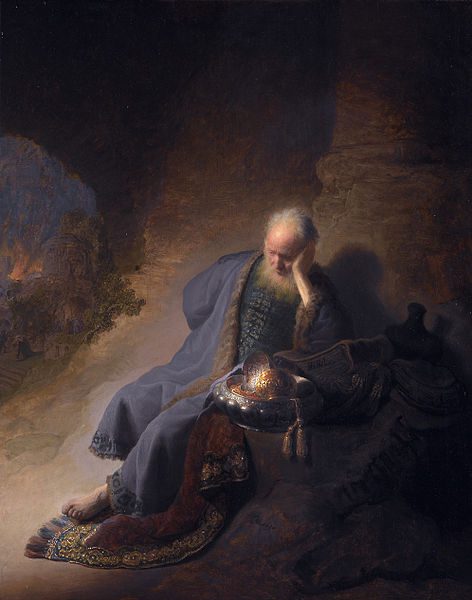
“Jeremiah Lamenting the Destruction of Jerusalem,” by Rembrandt
(Wikimedia Commons public domain image)
I’m eleven hours off of my normal time zone and have been almost completely without internet access for the past couple of days or so. I apologize for being late in calling these new items from the Interpreter Foundation to your notice, but I had little alternative. They went up on Thursday and Friday:
“Jeremiah “the Prophet,”” written by Loren Blake Spendlove
Abstract: This article, which focuses on the role of Jeremiah as a prophet, is based on a study of the Hebrew Bible and the Greek Septuagint. It also analyzes references to Jeremiah in the Book of Mormon and connects those references to current scholarly research on the book of Jeremiah. Consistent with the general consensus among biblical scholars today, as well as Nephi1’s own references to Jeremiah in the Book of Mormon, the author proposes that even though Jeremiah embodied the office of a prophet, he was not recognized as being “among the prophets” during his lifetime. This is a subtle yet significant difference. If this view is correct, it would further substantiate the alignment between the Book of Mormon and contemporary scholarly perspectives on the historical reception of Jeremiah’s identity as a prophet in antiquity.
“Interpreting Interpreter: Jeremiah’s Prophetic Title,” written by Kyler Rasmussen
This post is a summary of the article “Jeremiah ‘the Prophet’” by Loren Spendlove in Volume 64 of Interpreter: A Journal of Latter-day Saint Faith and Scholarship. All of the Interpreting Interpreterarticles may be seen at https://interpreterfoundation.org/category/summaries/. An introduction to the Interpreting Interpreter series is available at https://interpreterfoundation.org/interpreting-interpreter-on-abstracting-thought/.
A video introduction to this Interpreter article is now available on all of our social media channels, including on YouTube at https://youtube.com/shorts/El4SP5Ndlic.
The Takeaway: Spendlove argues, based on evidence from the Septuagint and the Dead Sea Scrolls, that Jeremiah was not initially listed as “among the prophets” by his contemporaries, a fact that’s reflected in how he’s referred to by Nephi in the Book of Mormon.
*The Temple: Plates, Patterns, & Patriarchs: “*The Cosmic Temple of Divine Names: Sapiential, Nomistic, and Numerical Properties,” written by Samuel Zinner:
Part of our book chapter reprint series, this article originally appeared in The Temple: Plates, Patterns, & Patriarchs, edited by Stephen D. Ricks and Jeffrey M. Bradshaw. For more information, go to https://interpreterfoundation.org/books/the-temple-plates-patterns-patriarchs/. For video and audio recording of this conference talk, go to https://interpreterfoundation.org/conferences/2022-temple-on-mount-zion-conference/videos/zinner/.
“As Alexandra Grund documents, the typical ancient Near Eastern creation story tends to end with the establishment of a divine temple, in which the king is crowned as a symbol of bringing cosmic order out of chaos.1 By contrast, Genesis’s first creation story reaches its apex with the establishment of the divine Sabbath.”
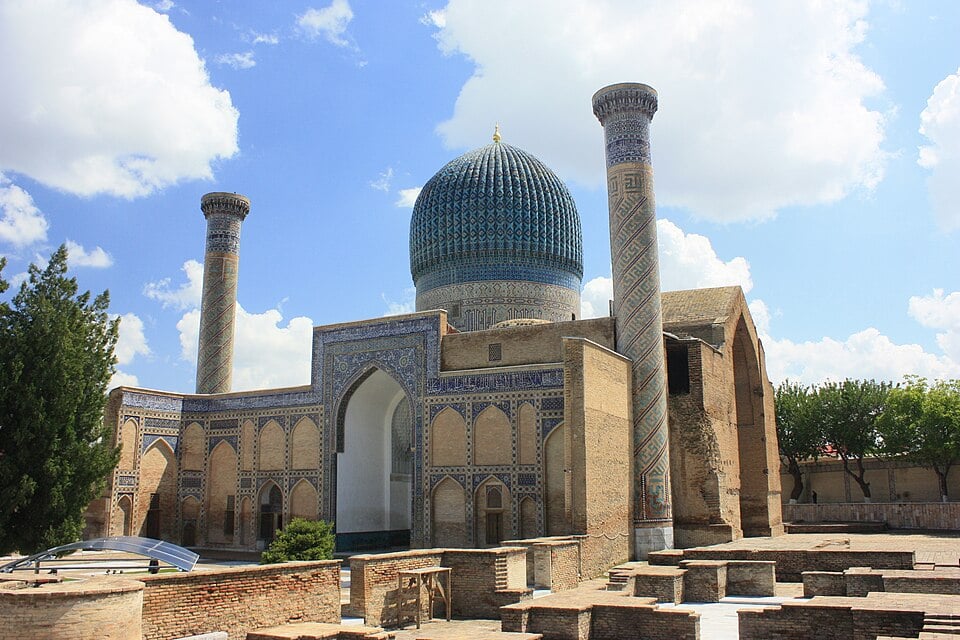
The Gūr-i Amīr in Samarkand (Wikimedia Commons public domain image)
We flew roughly north northeast last night, mostly across Iran, over Bandar Abbas, Kerman, Rafsanjan, and Mashhad. I’m not sure, but we may also have passed over the northwestern corner of Afghanistan. (If so, that would surprise me just a tiny bit.) Then we passed over Bukhara and on to Samarkand, traveling by air a small part of the ancient Silk Road. Unfortunately, all was dark (except, of course, for the occasional lights of urban sprawl).
My first impression of Samarkand — at 4 AM, still pitch black — was of a surprisingly clean and orderly city with well-kept streets and, at frequent intervals, beautiful decorative arrangements of lights along the major boulevard that we mostly followed. Those arrangements were in patterns that were familiar to me from what I know of the regional Islamicate artistic and architectural tradition — which, of course, echoes in multiple elegant but refracted ways the broader design elements of Islamicate art from India to Spain. Literally so: The repeated geometric design on the marble floor of our hotel’s large atrium is a very familiar one that I’ve often pointed out to students as appearing in both the Alhambra in Andalusia and on the grounds of India’s Taj Mahal. It was already fun for me, also, to see elements of Islamicate civilization reflected in the street signs and markers on the way in to the hotel — familiar and yet somewhat unfamiliar. There was, for instance, a sign indicating the direction of the Markaz — an Arabic term for the “(presumably city) center,” but adopted here into Roman letters and Uzbek. And sometimes the Arabic loanwords were rendered in Cyrillic. (Russian is still widely spoken here, after years of Soviet occupation.) There was also a pointer toward Hadarat Kidr, meaning something like “His Excellency the Green [One]” or “His Presence the Green [One],” which is almost certainly a reference, in turn, to something that must be connected with common Islamic legends about the Prophet Elijah. (I need to find out what the specific reference here in Samarkand might be.)
The conference for which I’ve come actually begins tomorrow — some of our people are still on their way here — so we did an afternoon tour of some of the principal sights of Samarkand. I’ve read and even sometimes taught about them for many years, so it was gratifying finally to actually see them.
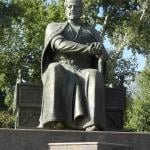
First, we spent a fair amount of time at the Gūr-i Amīr, the mausoleum of the Turkic conqueror Timur (who is often known the West as Tamerlane). I’ve noticed that Timur, who founded the large but relatively short-lived Timurid Empire, is treated as a hero here. (There is, for example, a larger than life-sized statue of an enthrone Timur located in a park within easy walking distance of our hotel.) In my opinion, though, Timur is another of those who are called “x the Great” who don’t really deserve that title. A few weeks ago, I was roundly attacked as a racist and a white supremacist over on the Peterson Obsession Board for having expressed reservations here about applying the title the Great to the Hawaiian king, unifier, and conqueror Kamehameha I, who killed many hundreds pr thousands of people in order make himself ruler over all of the islands. While we were under the dome of the Gūr-i Amīr, listening to our guide praise Timur, one of the Iranian scholars with whom we’re meeting leaned over to me and whispered “He was a horrible person, you know.” I couldn’t agree more. He was a brilliant conqueror, but he was brutal and cruel even by the standards of highly successful ancient and medieval warlords. Pathologically so, in my judgment.
Babur, who founded the Mughal dynasty in India, was a descendent of Timur. Unsurprisingly, in that light, the design of Gūr-i Amīr has plain echoes in the architecture of later Mughal tombs (e.g., the Gardens of Babur, the Tomb of Humayun, and, most famously, Shah Jahan’s incomparable Taj Mahal.
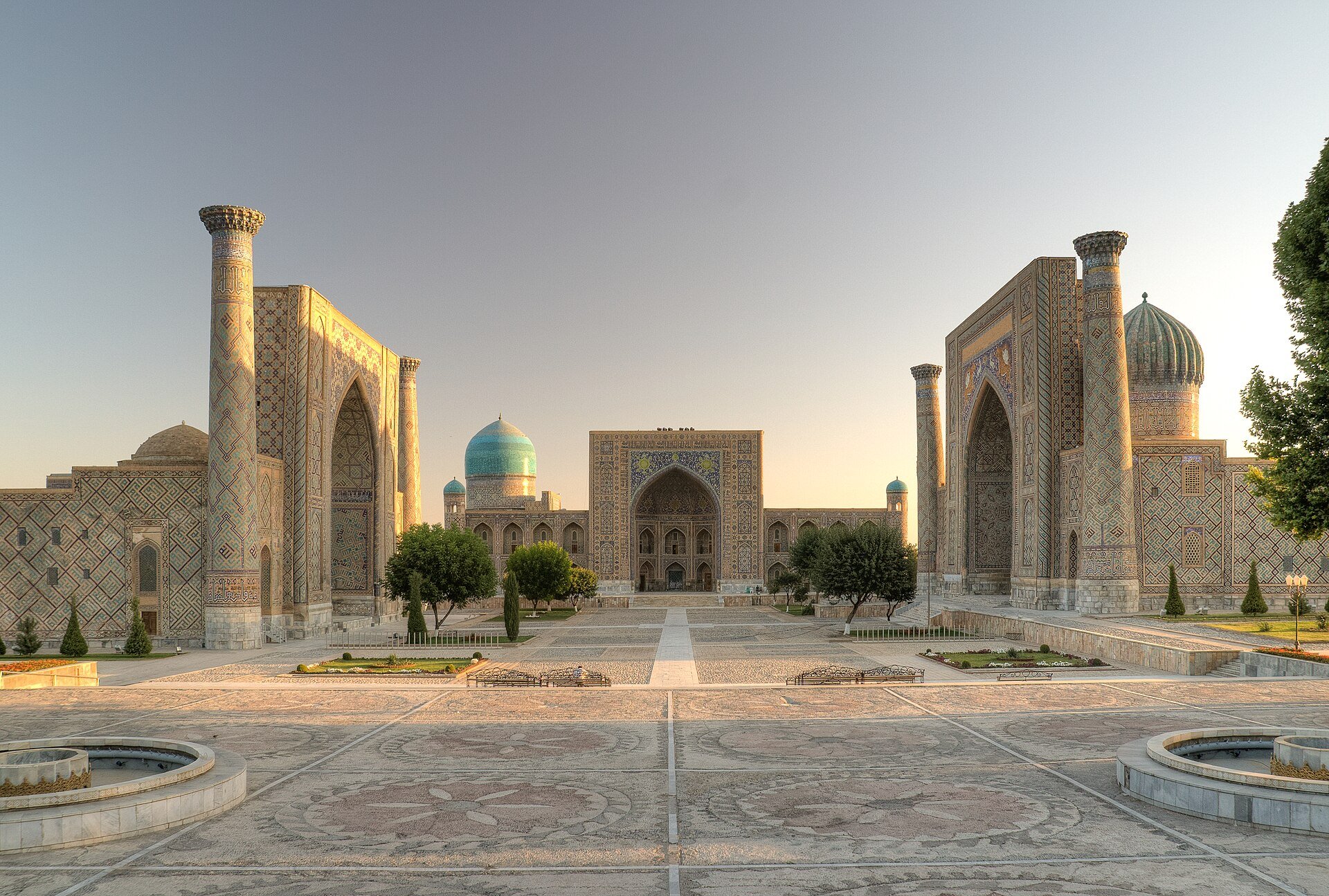
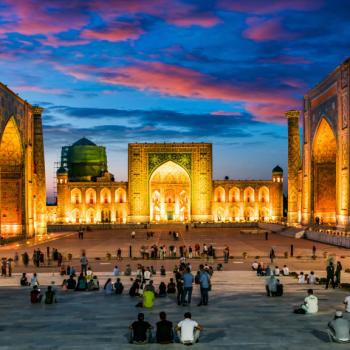
The Registan and its three madrasahs. From left to right: Ulugh Beg Madrasah, Tilya-Kori Madrasah and Sher-Dor Madrasah. (Wikimedia Commons public domain image)
We also went to the Registan, which was the public square for the Timurid capital city. But I may report on that tomorrow. And don’t let me forget to tell you about “the curse of Timur.” Jet lag is affecting me powerfully right now. I can scarcely keep my eyes open. I’ve just returned from having dinner with my friend Randy Paul and some of the Iranian participants in our conference. Good people..
Posted from Samarkand, Uzbekistan
Travel and Religion
History and Religion
Previous Post
April 25, 2025
Greetings from the Persian Gulf!
Next Post
April 27, 2025 Of Goodness and Greatness
Recent Comments
"DP: “But Mr. Sutherland worries about the fact that our time, when we can communicate ..."
Learning more about a region of ..."
"Another class of memories are of individuals who previously lived. Some of these remembered individuals ..."
"Sutherland's lecture sounds interesting. He seems to restate the Washington consensus that trade brings peace ..."
Learning more about a region of ..."
"In a meeting today, I learned another important reason why accurate (or at least as ..."
From Serbia’s “White City,” Belgrade
Browse Our Archives
Select a Category Uncategorized
Select a Month October 2026 September 2026 August 2026 July 2026 June 2026 May 2026 April 2026 March 2026 February 2026 January 2026 December 2025 November 2025 October 2025 September 2025 August 2025 July 2025 June 2025 May 2025 April 2025 March 2025 February 2025 January 2025 December 2024 November 2024 October 2024 September 2024 August 2024 July 2024 June 2024 May 2024 April 2024 March 2024 February 2024 January 2024 December 2023 November 2023 October 2023 September 2023 August 2023 July 2023 June 2023 May 2023 April 2023 March 2023 February 2023 January 2023 December 2022 November 2022 October 2022 September 2022 August 2022 July 2022 June 2022 May 2022 April 2022 March 2022 February 2022 January 2022 December 2021 November 2021 October 2021 September 2021 August 2021 July 2021 June 2021 May 2021 April 2021 March 2021 February 2021 January 2021 December 2020 November 2020 October 2020 September 2020 August 2020 July 2020 June 2020 May 2020 April 2020 March 2020 February 2020 January 2020 December 2019 November 2019 October 2019 September 2019 August 2019 July 2019 June 2019 May 2019 April 2019 March 2019 February 2019 January 2019 December 2018 November 2018 October 2018 September 2018 August 2018 July 2018 June 2018 May 2018 April 2018 March 2018 February 2018 January 2018 December 2017 November 2017 October 2017 September 2017 August 2017 July 2017 June 2017 May 2017 April 2017 March 2017 February 2017 January 2017 December 2016 November 2016 October 2016 September 2016 August 2016 July 2016 June 2016 May 2016 April 2016 March 2016 February 2016 January 2016 December 2015 November 2015 October 2015 September 2015 August 2015 July 2015 June 2015 May 2015 April 2015 March 2015 February 2015 January 2015 December 2014 November 2014 March 2014 August 2013 February 2012
Follow Us!
TAKE THE
Religious Wisdom Quiz
What was the name of the Jewish ruling council in Jesus’ time?
Select your answer to see how you score.
Essenes Sanhedrin Sadducees Pharisees
Related posts from Sic et Non

TRENDING AT PATHEOS Latter-day Saint

How to Make a Decision When You Can't...
Main point: It’s much more valuable to stay close to God so...

Archdiocese Hosts Military Marriage Retreat in Germany
RASTATT, Germany — The transient military lifestyle, with its frequent deployments and...

Nearly every morning, I make the drive to Detroit with my high-school-age...

The Real AI Story Is Adoption Without Trust
Artificial intelligence has crossed a political threshold. It is no longer a...

A new article, written by Jeff Lindsay and Gale L. Pooley,...

Swimfan: Forgotten Aughts Pleasures
This is a recovery effort. In 2002, My Big Fat Greek Wedding...
view all Latter-day Saint blogs
What Are Your Thoughts?leave a comment
Ad-Free & Subscriber Log-In Subscription Support
- About Us
- 2026 Calendar
- Videos
- Podcasts
- Library of World Religions
- Faith In Media Tracker
- Advertise With Us
- Write for Us
- Privacy Policy
- Terms of Service
- Do Not Sell My Data
- Contact Us
- Radiant Digital
- Manage Newsletter Subscriptions
- Unsubscribe From Notifications
- Sitemap
Copyright 2008-2026, Patheos. All rights reserved.
Subscription Support Ad-Free & Subscriber Log-In
Follow Patheos