
BuddhistCatholicContemplativeEvangelicalGeneral ChristianHinduJewishLatter-day SaintMuslimNew VisionsProgressive Christian
Beliefs
- Buddhist
- Catholic
- Contemplative
- Evangelical
- General Christian
- Hindu
- Jewish
- Latter-day Saint
- More Voices
- Muslim
- New Visions
- Pagan
- Progressive Christian
Topics
- Religion News
- Food and Religion
- Sports and Religion
- Religious Art
- Religious Music and Entertainment
- Religious Events
- History and Religion
- Style and Religion
- Politics and Religion
- Women in Religion
- Recreation Outdoors and Religion
- Business Finance and Religion
- Careers Workplace and Religion
- Education and Religion
- Family Parenting and Religion
- Health Fitness and Religion
- Home and Religion
- Relationships and Religion
- Technology and Religion
- Travel and Religion
Columnists
- Buddhist Columnists
- Business Finance and Religion Columnists
- Careers Workplace and Religion Columnists
- Catholic Columnists
- Contemplative Columnists
- Education and Religion Columnists
- Evangelists Columnists
- Family Parenting and Religion Columnists
- General Christian Columnists
- Health Fitness and Religion Columnists
- Hindu Columnists
- History and Religion Columnists
- Home and Religion Columnists
- Jewish Columnists
- More Voices Columnists
- Latter Day Columnists
- Muslim Columnists
- New Visions Columnists
- Nonreligious Columnists
- Pagan Columnists
- Politics and Religion Columnists
- Progressive Columnists
- Recreation Outdoors and Religion Columnists
- Relationships and Religion Columnists
- Religion News Columnists
- Religious Art Columnists
- Religious Events Columnists
- Religious Music and Entertainment Columnists
- Sports and Religion Columnists
- Style and Religion Columnists
- Technology and Religion Columnists
- Travel and Religion Columnists
- Women in Religion Columnists
Resource Library
- 2026 Calendar
- Library of World Religions
- The 100 Most Holy Places on Earth
- Patheos Answers
- Podcasts
- Videos
- Faith Leaders Database
- Anglican Episcopalian
- Bahai
- Baptist
- Buddhism
- Christianity
- Confucianism
- Eastern Orthodoxy
- Hinduism
- Holiness and Pentecostal
- ISKCON
- Islam
- Judaism
- Lutheran
- Methodist
- The Church of Jesus Christ of Latter-day Saints
- New Age
- Paganism
- Presbytarian and Reformed
- Protestantism
- Religion Behind the Scenes
- Roman Catholic
- Scientology
- Shia Islam
- Sikhism
- Sufism
- Sunni Islam
- Taoism
- Zen
- See all religions
Research Tools
 Ad-Free & Subscriber Log-In Subscription Support
Ad-Free & Subscriber Log-In Subscription Support
Follow Patheos 

- Trending:
- Forgiveness
- |
- Marriage
- |
- Consciousness
- |
- Death Penalty
- |
- Election
- |
- Halloween

- Home
- Latter-day Saint
- History and Religion
- Wisdom begins with wonder
Wisdom begins with wonder
Last updated on: March 23, 2025 at 3:22 am by Dan Peterson
Wisdom begins with wonder 2025-03-23T03:22:13-06:00 Dan Peterson
Patheos Explore the world's faith through different perspectives on religion and spirituality! Patheos has the views of the prevalent religions and spiritualities of the world.

Along the Na Pali coast of Kaua’i (Wikimedia Commons public domain image)
We spent much of Saturday out on the ocean, traveling from Port Allen, in Eleele on the south coast of Kaua’i, around to the end of the famous and spectacular Na Pali cliffs on the northwest side of the island, and back again. The weather was perfect. (Sunnier than in the image above.) We cruised among scores and scores of spinner dolphins and past a honu, a sea turtle. Snorkeling not far from Port Allen itself, we saw lots of fish — several beautiful, bright Yellow Tang, for example — over the coral reef, as well as a monk seal and a honu. While watching three hikers cautiously easing their way down the aptly-named Crawler’s Ledge at Na Pali, we also saw two or three feral goats, who seemed quite a bit more sure-footed than the humans did. After the cruise (which we did through “Capt. Andy’s,” which I can highly recommend), we drove up along Waimea Canyon for a very different view from the summit of Na Pali.

Waimea Canyon, on the island of Kaua’i (Wikimedia Commons public domain image)
I don’t apologize for posting a blog entry that some will dismiss as a mere exercise in”Gee whiz!” “It is through wonder [thaumazein],” said Aristotle, “that men now begin and originally began to philosophize” (Aristotle, Metaphysics Α, 982b11-12). And Plato represents Socrates as saying that “wonder is the feeling of a philosopher, and philosophy begins in wonder” (Plato, Theatatus, 155d).
On the flight over to Hawaii the other day, I read Taking Leave of Darwin: A Longtime Agnostic Discovers the Case for Design, by Neil Thomas. Professor Thomas is impressed by a physician and writer named James Le Fanu, and, in turn, I was impressed by what he wrote in response:
Every day, writes Le Fanu, we are the unwitting beneficiaries of an incalculable number of invisible natural wonders, such as the purifying function of the liver (which is able to perform more functions than the largest chemical refinery), or the autonomous functioning of the heart, whose diminutive size belies its enormous pumping power (artificial heart machines, being the size of a chest of drawers, have to be hauled around on trolley wheels and can only be used for a number of hours as a stop-gap before transplant), or our physiological capacity for bodily self-repair: think (I might add) of a bicycle puncture mending itself automatically or the implication of the April Fools ad put out by BMW some decades ago to the effect that the special paints applied to the company’s cars were self-cleaning. What seems amusingly preposterous in the case of human manufacture is perfectly practicable in human physiology via the cleansing function of the liver.
We might also usefully ponder the fact that there exists a diminutive universe in each of our individual cells which went all unsuspected for millennia before mid-twentieth century advances in electron microscope technology. Or what about that bodily system we all refer to glibly (but uncomprehendingly) as the immune system — how many people know how that works? No, I didn’t either. This is what Linda Hamlin says about its well-nigh preternatural complexity, and keep in mind that the excerpt below only scratches the surface of the immune system’s complexity:
Faced with the onslaught of microbes, how does the normal human body defend itself and stay healthy? To begin with, it keeps out as many potential pathogens as possible with barriers such as the skin and other non-specific defenses. The skin, which is waterproof, is impenetrable to most invaders, and it provides fatty acids that many microorganisms find toxic. Areas not covered by the skin, such as the eyes, mouth, lungs, and digestive tract, are more vulnerable, but they have alternative defenses. Tears, saliva, urine and other body secretions contain lysozyme, an enzyme that can kill certain types of bacteria by splitting the molecules found in their cell walls. Mucus in the nose and airwaves engulfs bacteria and stops them penetrating the membranes. Cilia — tiny beating “hairs” — then push the mucus out of the airways into the throat, where it is swallowed. In the stomach, acid kills most of the microorganisms in food, as well as starting the process of digestion.
Needless to say, our bodily organs are quite beyond the ability of human bio-engineers to reproduce. To give a prime example, experiments in the United States to introduce artificial hearts to patients had to be withdrawn some decades ago when the fatalities topped 200 with no realistic hope of medical experts being able to improve their technology. Forty years of research and development and forty billion dollars went down the drain. If such gargantuan efforts and expense could not fashion a functioning heart-substitute, it becomes all the more difficult to imagine a heart being constructed by the serendipity of random mutations and natural selection. (111-113)
Continuing, Thomas writes:
We should . . . be more appreciative of nature’s ingenuity and the sheer ease with which we see, hear, talk , eat, drink, make love and reproduce our kind. Such should be the central core of school biology lessons, promoting a sense of wonder in the young mind at the very fact of existence. The reason that it does not form that core is that scientists and the educational establishment subscribe to the materialistic-mechanistic model of human functioning , and therefore tend not to “do” wonder.
As a footnote to Le Fanu’s argument, I would add that we also betray collectively some element of false entitlement about our innumerable boons: we feel hungry, eat, and by some magical alchemy of which we know little — and couldn’t care less about — our bodies transform the food into the very substance of our physical frames. We take it for granted that we are born with hinged bones to provide low-friction articulations, eye-protectors (eyelids), tears secreted by the lachrymal glands to lubricate the eyes so that they don’t feel scratchy, and an optic nerve to transmit electrical impulses to the brain to decode visual cues so that we can know where we are. We shrug off as unremarkable the fact that broken bones will, unlike broken vases, mend, or the fact that minor wounds will heal by the process to which medical people refer with a complacent lack of affect as “bodily regeneration.”
As far as external nature is concerned, we are the beneficiaries of plants’ photosynthesis, the process by which plants convert light energy into chemical energy and produce oxygen, yet we give little thought to this bedrock of our existence. (Nobody, by the way, has the first idea about how photosynthesis might have evolved.) The same goes for the sun’s warming rays and all those cosmological constants described above. As for that huge symbiosis by which all life is connected productively in a web of interrelated functions (rainwater for crops, grazing animals fertilizing the soil with dung, worms aerating the soil so that crops can grow, and on and on), this is just another part of what we see as our entitlement, assuming we even bother to think about such things at all. The list could be extended practically without limit. (113-114)
A newly married couple standing in front of the Laie Hawaii Temple (LDS Media Library)

A new Gospel Topics essay appeared from the Church a couple of days ago on “Race and The Church of Jesus Christ of Latter-day Saints.” Race-related issues have troubled more than a few members of the Church for a long time, so I hope that this essay will be helpful to them and to others who might be concerned with the subject.
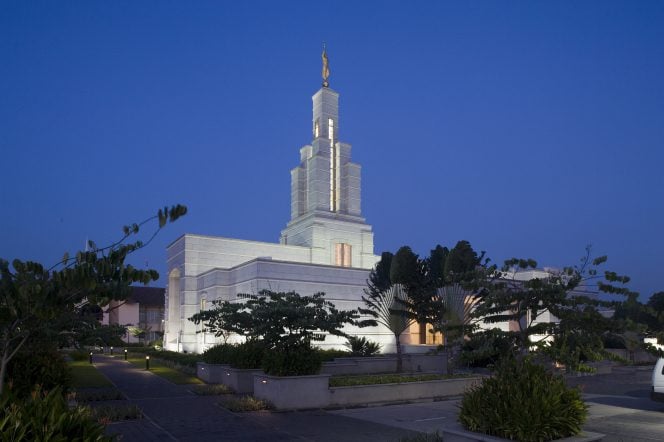
The Accra Ghana Temple by night (LDS Media Library)
Before I close, though, I want to share with you some gruesome gleanings from the Christopher Hitchens Memorial “How Religion Poisons Everything” File™. Theism is a global blight, and there’s a segment of my readership that desperately wants and needs to be kept informed about its latest horrors. I don’t want to let them down:
Posted from Poʻipū, Kauaʻi, Hawaiʻi
History and Religion
Travel and Religion
Previous Post
March 21, 2025
"Anchoring Nephi’s Account in the Real World"
Next Post

March 24, 2025 "Realer than Real"
Recent Comments
"DP: “But Mr. Sutherland worries about the fact that our time, when we can communicate ..."
Learning more about a region of ..."
"Another class of memories are of individuals who previously lived. Some of these remembered individuals ..."
"Sutherland's lecture sounds interesting. He seems to restate the Washington consensus that trade brings peace ..."
Learning more about a region of ..."
"In a meeting today, I learned another important reason why accurate (or at least as ..."
From Serbia’s “White City,” Belgrade
Browse Our Archives
Select a Category Uncategorized
Select a Month October 2026 September 2026 August 2026 July 2026 June 2026 May 2026 April 2026 March 2026 February 2026 January 2026 December 2025 November 2025 October 2025 September 2025 August 2025 July 2025 June 2025 May 2025 April 2025 March 2025 February 2025 January 2025 December 2024 November 2024 October 2024 September 2024 August 2024 July 2024 June 2024 May 2024 April 2024 March 2024 February 2024 January 2024 December 2023 November 2023 October 2023 September 2023 August 2023 July 2023 June 2023 May 2023 April 2023 March 2023 February 2023 January 2023 December 2022 November 2022 October 2022 September 2022 August 2022 July 2022 June 2022 May 2022 April 2022 March 2022 February 2022 January 2022 December 2021 November 2021 October 2021 September 2021 August 2021 July 2021 June 2021 May 2021 April 2021 March 2021 February 2021 January 2021 December 2020 November 2020 October 2020 September 2020 August 2020 July 2020 June 2020 May 2020 April 2020 March 2020 February 2020 January 2020 December 2019 November 2019 October 2019 September 2019 August 2019 July 2019 June 2019 May 2019 April 2019 March 2019 February 2019 January 2019 December 2018 November 2018 October 2018 September 2018 August 2018 July 2018 June 2018 May 2018 April 2018 March 2018 February 2018 January 2018 December 2017 November 2017 October 2017 September 2017 August 2017 July 2017 June 2017 May 2017 April 2017 March 2017 February 2017 January 2017 December 2016 November 2016 October 2016 September 2016 August 2016 July 2016 June 2016 May 2016 April 2016 March 2016 February 2016 January 2016 December 2015 November 2015 October 2015 September 2015 August 2015 July 2015 June 2015 May 2015 April 2015 March 2015 February 2015 January 2015 December 2014 November 2014 March 2014 August 2013 February 2012
Follow Us!
TAKE THE
Religious Wisdom Quiz
What animal is mentioned in Proverbs as having little strength but great wisdom?
Select your answer to see how you score.
Ant Ox Bear Lion
Related posts from Sic et Non


Notes on Women, Priesthood, and General Conference

"The Book of Moses as a Temple Text"

TRENDING AT PATHEOS Latter-day Saint

Nearly every morning, I make the drive to Detroit with my high-school-age...

The Real AI Story Is Adoption Without Trust
Artificial intelligence has crossed a political threshold. It is no longer a...

A new article, written by Jeff Lindsay and Gale L. Pooley,...

Swimfan: Forgotten Aughts Pleasures
This is a recovery effort. In 2002, My Big Fat Greek Wedding...

Top Three Anti-Catholic Lies About Catholicism
This is my initial transcript for the video, "THE 3 WORST...

Pope Leo Celebrates Mass for Nurses & Docs...
I don't have any idea how he did it, but Pope Leo...
view all Latter-day Saint blogs
What Are Your Thoughts?leave a comment
Ad-Free & Subscriber Log-In Subscription Support
- About Us
- 2026 Calendar
- Videos
- Podcasts
- Library of World Religions
- Faith In Media Tracker
- Advertise With Us
- Write for Us
- Privacy Policy
- Terms of Service
- Do Not Sell My Data
- Contact Us
- Radiant Digital
- Manage Newsletter Subscriptions
- Unsubscribe From Notifications
- Sitemap
Copyright 2008-2026, Patheos. All rights reserved.
Subscription Support Ad-Free & Subscriber Log-In
Follow Patheos