
BuddhistCatholicContemplativeEvangelicalGeneral ChristianHinduJewishLatter-day SaintMuslimNew VisionsProgressive Christian
Beliefs
- Buddhist
- Catholic
- Contemplative
- Evangelical
- General Christian
- Hindu
- Jewish
- Latter-day Saint
- More Voices
- Muslim
- New Visions
- Pagan
- Progressive Christian
Topics
- Religion News
- Food and Religion
- Sports and Religion
- Religious Art
- Religious Music and Entertainment
- Religious Events
- History and Religion
- Style and Religion
- Politics and Religion
- Women in Religion
- Recreation Outdoors and Religion
- Business Finance and Religion
- Careers Workplace and Religion
- Education and Religion
- Family Parenting and Religion
- Health Fitness and Religion
- Home and Religion
- Relationships and Religion
- Technology and Religion
- Travel and Religion
Columnists
- Buddhist Columnists
- Business Finance and Religion Columnists
- Careers Workplace and Religion Columnists
- Catholic Columnists
- Contemplative Columnists
- Education and Religion Columnists
- Evangelists Columnists
- Family Parenting and Religion Columnists
- General Christian Columnists
- Health Fitness and Religion Columnists
- Hindu Columnists
- History and Religion Columnists
- Home and Religion Columnists
- Jewish Columnists
- More Voices Columnists
- Latter Day Columnists
- Muslim Columnists
- New Visions Columnists
- Nonreligious Columnists
- Pagan Columnists
- Politics and Religion Columnists
- Progressive Columnists
- Recreation Outdoors and Religion Columnists
- Relationships and Religion Columnists
- Religion News Columnists
- Religious Art Columnists
- Religious Events Columnists
- Religious Music and Entertainment Columnists
- Sports and Religion Columnists
- Style and Religion Columnists
- Technology and Religion Columnists
- Travel and Religion Columnists
- Women in Religion Columnists
Resource Library
- 2026 Calendar
- Library of World Religions
- The 100 Most Holy Places on Earth
- Patheos Answers
- Podcasts
- Videos
- Faith Leaders Database
- Anglican Episcopalian
- Bahai
- Baptist
- Buddhism
- Christianity
- Confucianism
- Eastern Orthodoxy
- Hinduism
- Holiness and Pentecostal
- ISKCON
- Islam
- Judaism
- Lutheran
- Methodist
- The Church of Jesus Christ of Latter-day Saints
- New Age
- Paganism
- Presbytarian and Reformed
- Protestantism
- Religion Behind the Scenes
- Roman Catholic
- Scientology
- Shia Islam
- Sikhism
- Sufism
- Sunni Islam
- Taoism
- Zen
- See all religions
Research Tools
 Ad-Free & Subscriber Log-In Subscription Support
Ad-Free & Subscriber Log-In Subscription Support
Follow Patheos 

- Trending:
- Forgiveness
- |
- Marriage
- |
- Consciousness
- |
- Death Penalty
- |
- Election
- |
- Halloween

- Home
- Latter-day Saint
- Travel and Religion
- “Anchoring Nephi’s Account in the Real World”
“Anchoring Nephi’s Account in the Real World”
Last updated on: March 22, 2025 at 1:29 am by Dan Peterson
“Anchoring Nephi’s Account in the Real World” 2025-03-22T01:29:18-06:00 Dan Peterson
Patheos Explore the world's faith through different perspectives on religion and spirituality! Patheos has the views of the prevalent religions and spiritualities of the world.
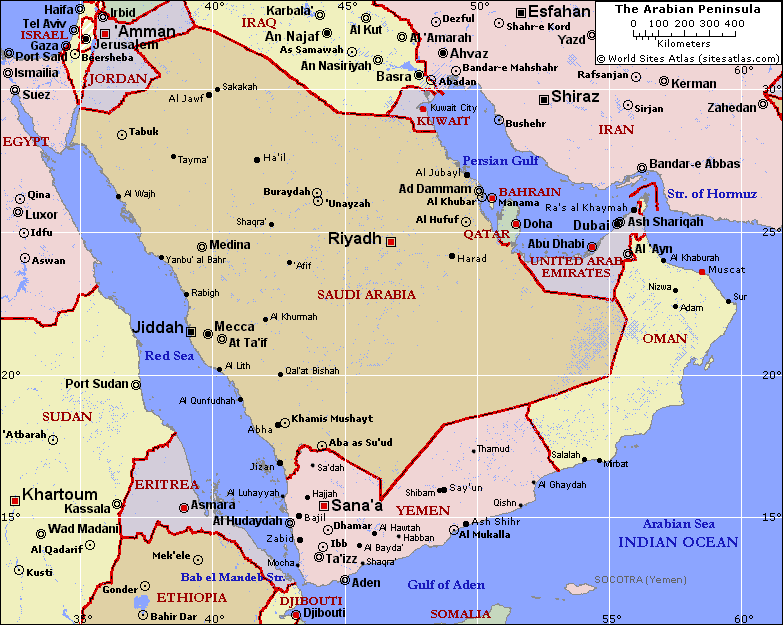
A political map of the modern Arabian Peninsula (Wikimedia Commons public domain image)
As happens several times each week, something new has appeared on the website of the nearly-dead and never-changing website of the Interpreter Foundation. It’s a new review essay in Interpreter: A Journal of Latter-day Saint Faith and Scholarship: “Wonder No More: A Review of Into Arabia,” written by Brant A. Gardner:
Review of Warren P. Aston, Godfrey J. Ellis, and Neal Rappleye, Into Arabia: Anchoring Nephi’s Account in the Real World (Orem, UT: The Interpreter Foundation; Salt Lake City: Eborn Books, 2024). 298 pages. $44.99 (hardback), $39.99 (paperback).
Abstract: Into Arabia is a collected reprint of six articles. The first chapter reprints an article that first appeared in BYU Studies*. The other five appeared in* Interpreter*. Both* BYU Studies and Interpreter are peer-reviewed academic journals, which means that all these articles were examined and reviewed prior to publication. Thus, my review is more of a synopsis of the importance of each chapter rather than a detailed critique.
This is a book that I wish I had written. You can read more about Warren P. Aston, Godfrey J. Ellis, and Neal Rappleye, Into Arabia: Anchoring Nephi’s Account in the Real World here. And you can order it here.
Incidentally, today marks the six-hundred-and-sixty-first (661st) consecutive Friday of publication for Interpreter: A Journal of Latter-day Saint Faith and Scholarship since its founding 662.5 weeks ago. At least one article has appeared each Friday, without interruption, since we launched the journal back in August of 2012, and sometimes two or even three articles have been published on the same Friday. (Along with the blog entries and reprints and etc. that appear on other days of the week.) It seems undeniably obvious — doesn’t it? — that the Interpreter Foundation is on its deathbed, as hath long been confidently prophesied. However, I begin to despair of ever being able to help some of Interpreter’s more unhinged critics to understand this. They confuse our Thursday reprints with our Friday journal articles, imagine that we’re trying to substitute reprints for new articles, arbitrarily decide that review essays don’t count as articles, accuse me (on the basis of their own willful confusion and misunderstanding) of attempting to deceive them, and, just generally, remind me of one of the famous corollaries to Murphy’s Law: “It’s impossible to make anything foolproof, because fools are so ingenious.”

A landscape near Hanalei, not far from Princeville on Kaua’i’s northern shore
(Wikimedia Commons public domain image)
So far as I can recall, I have never been a young-earth creationist. Not even when I was a child. (I played with dinosaurs and I loved going to the La Brea Tar Pits and to natural history museums in Los Angeles and elsewhere where I could learn about prehistoric animals. I always knew that they lived millions of years before the present.)
I’ve also never denied the reality of organic evolution, for which the evidence seems to me overwhelming. Barring some inconceivable scientific upheaval, I don’t believe that a religious viewpoint that altogether rejects the idea of substantial biological change over time or that denies the evidence for a very old Earth can be intellectually sustained. One of the early articles that we published in Interpreter was Gregory L. Smith’s ““Endless Forms Most Beautiful”: The uses and abuses of evolutionary biology in six works.” Since then, I myself have written affirmatively about an important book reflecting on evolution (“How Can We Make Sense of Evolution?: A Latter-day Saint Perspective”) and have conducted two friendly video interviews with Latter-day Saint scholars for the Interpreter Foundation that plainly presuppose belief in evolutionary theory. (See “Interviews with Ben Spackman and Samuel T. Wilkinson.”)
That said, my views on the subject are not firmly settled. Nor am I in any particular hurry to settle them; in most regards, I don’t consider the issue to be of primary importance.
One of the things that I read on the way over to Kaua’i on Wednesday was Taking Leave of Darwin: A Longtime Agnostic Discovers the Case for Design, by Neil Thomas.
Let it be acknowledged right up front that Neil Thomas is not an evolutionary biologist. He is, rather, a Reader Emeritus in the German section of the School of European Languages and Literatures at the University of Durham, England. Trained the universities of Oxford, Munich, and Cardiff, his teaching at Durham covered a broad spectrum of subjects, including Germanic philology, medieval literature, the literature and philosophy of the Enlightenment, and modern German history and literature. He sometimes focused on the propagandist use of the German language employed both by the Nazis and by the functionaries of the old German Democratic Republic. Notably, too, he was a longtime member of the British Rationalist Association and, even now, he describes himself as committed to “no revealed religion.”
Although not a biologist, Thomas has plainly read widely and deeply on the subject of evolutionary thought. He is a first-class intellectual historian, and I found his book impressively learned and deeply interesting. I recommend it to anybody who is really concerned with the topic of the origin and development of Darwinism and, yes, in the leaps of logic and the evidentiary gaps that, Thomas argues, continue to exist in it and to cast grave doubt upon it. I will almost certainly be drawing upon Taking Leave of Darwin for future blog entries here.
Among the major problems still faced by evolutionary theory is the question of the origin of terrestrial life. It is one thing, say, for the Darwinian mechanism of natural selection to work on existing organisms, but where and how did organic life originate in the first place? Charles Darwin couldn’t answer that question, and neither can the science of our day. Certainly not definitively, though there has been no shortage of effort devoted to it and although there has been no lack of hypotheses.
My attention was caught this morning by an article on the CNN website, “Iguanas floated 5,000 miles from North America to Fiji on vegetation rafts, new study finds.” Genetic evidence suggests that the ancestors of today’s Fijian iguanas came originally from what is today the southwestern United States and northwestern Mexico, arriving in Fiji between 34 million and 30 million years ago. The Fijian archipelago is a volcanic formation that was originally barren of either botanical or zoological life. In this regard as in others, of course, Hawaii is a parallel case. The Hawaiian Islands originally emerged from the sea as sterile volcanic rock. How did flora and fauna arrive here?
But the largest parallel, obviously, is Earth itself. How did life arise on our planet? The problem of the origin of terrestrial life has proven so intractable, thus far — although, by and large, devotees of abiogenesis continue to hold to the promissory faith that a solution to that problem will shortly be found — that some over recent decades have proposed that the explanation lies in the notion of panspermia (from ancient Greek πᾶν [pan] ‘all‘ and σπέρμα [sperma] ‘seed‘). This idea is the hypothesis that life exists throughout the universe, and that it is distributed by space dust, meteoroids, asteroids, comets, and/or planetoids, and even perhaps by alien spacecraft carrying unintended contamination by microorganisms. In fact, some have gone so far as to suggest “directed panspermia,” which holds that the seeding of Earth was deliberately undertaken by advanced extraterrestrial beings of some sort. (Given my own religious views, I’m open to the possibility of something like that being actually true.)
But the theory that life did not originate on Earth, having instead evolved somewhere else and having thereafter seeded life as we know it, goes no distance at all toward solving the problem of life’s origin. It merely kicks that problem down the road.
Posted from Poʻipū, Kauaʻi, Hawaiʻi
Travel and Religion
History and Religion
Previous Post

March 20, 2025
Thoughts, even in Poʻipū
Next Post

March 23, 2025 Wisdom begins with wonder
Recent Comments
"DP: “But Mr. Sutherland worries about the fact that our time, when we can communicate ..."
Learning more about a region of ..."
"Another class of memories are of individuals who previously lived. Some of these remembered individuals ..."
"Sutherland's lecture sounds interesting. He seems to restate the Washington consensus that trade brings peace ..."
Learning more about a region of ..."
"In a meeting today, I learned another important reason why accurate (or at least as ..."
From Serbia’s “White City,” Belgrade
Browse Our Archives
Select a Category Uncategorized
Select a Month October 2026 September 2026 August 2026 July 2026 June 2026 May 2026 April 2026 March 2026 February 2026 January 2026 December 2025 November 2025 October 2025 September 2025 August 2025 July 2025 June 2025 May 2025 April 2025 March 2025 February 2025 January 2025 December 2024 November 2024 October 2024 September 2024 August 2024 July 2024 June 2024 May 2024 April 2024 March 2024 February 2024 January 2024 December 2023 November 2023 October 2023 September 2023 August 2023 July 2023 June 2023 May 2023 April 2023 March 2023 February 2023 January 2023 December 2022 November 2022 October 2022 September 2022 August 2022 July 2022 June 2022 May 2022 April 2022 March 2022 February 2022 January 2022 December 2021 November 2021 October 2021 September 2021 August 2021 July 2021 June 2021 May 2021 April 2021 March 2021 February 2021 January 2021 December 2020 November 2020 October 2020 September 2020 August 2020 July 2020 June 2020 May 2020 April 2020 March 2020 February 2020 January 2020 December 2019 November 2019 October 2019 September 2019 August 2019 July 2019 June 2019 May 2019 April 2019 March 2019 February 2019 January 2019 December 2018 November 2018 October 2018 September 2018 August 2018 July 2018 June 2018 May 2018 April 2018 March 2018 February 2018 January 2018 December 2017 November 2017 October 2017 September 2017 August 2017 July 2017 June 2017 May 2017 April 2017 March 2017 February 2017 January 2017 December 2016 November 2016 October 2016 September 2016 August 2016 July 2016 June 2016 May 2016 April 2016 March 2016 February 2016 January 2016 December 2015 November 2015 October 2015 September 2015 August 2015 July 2015 June 2015 May 2015 April 2015 March 2015 February 2015 January 2015 December 2014 November 2014 March 2014 August 2013 February 2012
Follow Us!
TAKE THE
Religious Wisdom Quiz
True or False: The apostles drew lots to choose Matthias to replace Judas.
Select your answer to see how you score.
FALSE TRUE
Related posts from Sic et Non


Some notes on the archaeology of the Bible


TRENDING AT PATHEOS Latter-day Saint

Swimfan: Forgotten Aughts Pleasures
This is a recovery effort. In 2002, My Big Fat Greek Wedding...

Top Three Anti-Catholic Lies About Catholicism
This is my initial transcript for the video, "THE 3 WORST...

Pope Leo Celebrates Mass for Nurses & Docs...
I don't have any idea how he did it, but Pope Leo...

The Sermon on the Mount, Part I: Matthew...
The Sermon on the Mount, Part I (Matthew 4:12-5:12) St. Matthew moves...

What's up from Crossway: Reviewing some of their latest A few weeks...

Janie Learns the Way of the Cross: A...
Teaching children about Jesus' Passion can be challenging. Many parents and educators...
view all Latter-day Saint blogs
What Are Your Thoughts?leave a comment
Ad-Free & Subscriber Log-In Subscription Support
- About Us
- 2026 Calendar
- Videos
- Podcasts
- Library of World Religions
- Faith In Media Tracker
- Advertise With Us
- Write for Us
- Privacy Policy
- Terms of Service
- Do Not Sell My Data
- Contact Us
- Radiant Digital
- Manage Newsletter Subscriptions
- Unsubscribe From Notifications
- Sitemap
Copyright 2008-2026, Patheos. All rights reserved.
Subscription Support Ad-Free & Subscriber Log-In
Follow Patheos