
BuddhistCatholicContemplativeEvangelicalGeneral ChristianHinduJewishLatter-day SaintMuslimNew VisionsProgressive Christian
Beliefs
- Buddhist
- Catholic
- Contemplative
- Evangelical
- General Christian
- Hindu
- Jewish
- Latter-day Saint
- More Voices
- Muslim
- New Visions
- Pagan
- Progressive Christian
Topics
- Religion News
- Food and Religion
- Sports and Religion
- Religious Art
- Religious Music and Entertainment
- Religious Events
- History and Religion
- Style and Religion
- Politics and Religion
- Women in Religion
- Recreation Outdoors and Religion
- Business Finance and Religion
- Careers Workplace and Religion
- Education and Religion
- Family Parenting and Religion
- Health Fitness and Religion
- Home and Religion
- Relationships and Religion
- Technology and Religion
- Travel and Religion
Columnists
- Buddhist Columnists
- Business Finance and Religion Columnists
- Careers Workplace and Religion Columnists
- Catholic Columnists
- Contemplative Columnists
- Education and Religion Columnists
- Evangelists Columnists
- Family Parenting and Religion Columnists
- General Christian Columnists
- Health Fitness and Religion Columnists
- Hindu Columnists
- History and Religion Columnists
- Home and Religion Columnists
- Jewish Columnists
- More Voices Columnists
- Latter Day Columnists
- Muslim Columnists
- New Visions Columnists
- Nonreligious Columnists
- Pagan Columnists
- Politics and Religion Columnists
- Progressive Columnists
- Recreation Outdoors and Religion Columnists
- Relationships and Religion Columnists
- Religion News Columnists
- Religious Art Columnists
- Religious Events Columnists
- Religious Music and Entertainment Columnists
- Sports and Religion Columnists
- Style and Religion Columnists
- Technology and Religion Columnists
- Travel and Religion Columnists
- Women in Religion Columnists
Resource Library
- 2026 Calendar
- Library of World Religions
- The 100 Most Holy Places on Earth
- Patheos Answers
- Podcasts
- Videos
- Faith Leaders Database
- Anglican Episcopalian
- Bahai
- Baptist
- Buddhism
- Christianity
- Confucianism
- Eastern Orthodoxy
- Hinduism
- Holiness and Pentecostal
- ISKCON
- Islam
- Judaism
- Lutheran
- Methodist
- The Church of Jesus Christ of Latter-day Saints
- New Age
- Paganism
- Presbytarian and Reformed
- Protestantism
- Religion Behind the Scenes
- Roman Catholic
- Scientology
- Shia Islam
- Sikhism
- Sufism
- Sunni Islam
- Taoism
- Zen
- See all religions
Research Tools
 Ad-Free & Subscriber Log-In Subscription Support
Ad-Free & Subscriber Log-In Subscription Support
Follow Patheos 

- Trending:
- Forgiveness
- |
- Marriage
- |
- Consciousness
- |
- Death Penalty
- |
- Election
- |
- Halloween

- Home
- Latter-day Saint
- Travel and Religion
- “Upon Thy Belly Shalt Thou Go”
“Upon Thy Belly Shalt Thou Go”
Last updated on: January 24, 2025 at 5:14 pm by Dan Peterson
“Upon Thy Belly Shalt Thou Go” 2025-01-24T17:14:10-07:00 Dan Peterson
Patheos Explore the world's faith through different perspectives on religion and spirituality! Patheos has the views of the prevalent religions and spiritualities of the world.
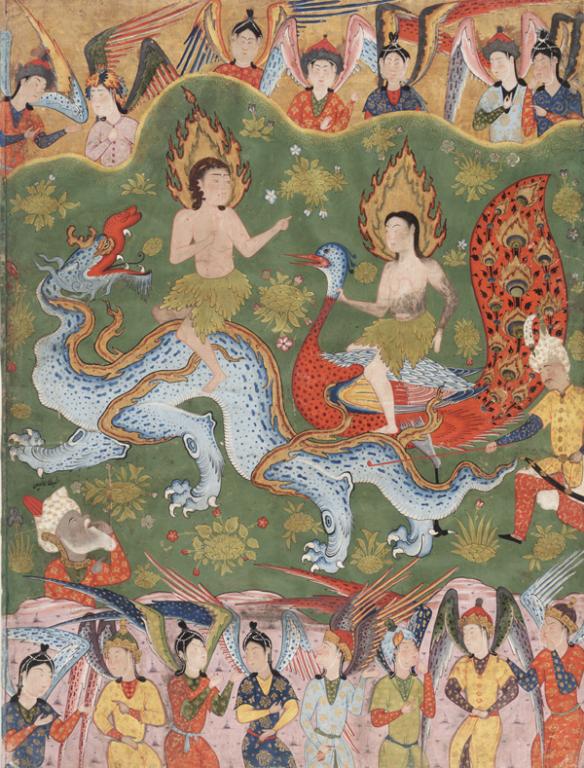
Adam and Eve and the Serpent in the Garden of Eden, as shown in a 16th-century Safavid manuscript of the “Falnameh” or “Book of Omens,” ascribed to the Shi‘i imam Ja‘far al-Sadiq (Wikimedia Commons public domain image)
Two new articles went up today on the website of the Interpreter Foundation. The first of these was ““Upon Thy Belly Shalt Thou Go”: The Garden of Eden Serpent Symbology Based on the Concept of Seraphim,” written by Noel Hudson:
Abstract: The concept of the serpentine seraphim from biblical iconography is discussed in the context of biblical serpent symbology. The association of the seraphim with Ancient Near Eastern kings, deities, and temples is noted. The concept of the seraphim as members of the Council of God is explored, and the possibility of the seraph as a symbol of Christ is discussed. These concepts are applied to the story of the snake in the Garden of Eden, and the additional explanatory power of the seraph symbol in connection with the snake is explored. Specific serpentine attributes are discussed in the context of the seed motif. The article concludes with a brief discussion of the application of this topic to the modern reader.
The second of them was “Interpreting Interpreter: Serpentine Seraphs,” written by Kyler Rasmussen:
This post is a summary of the article “‘Upon Thy Belly Shalt Thou Go’: The Garden of Eden Serpent Symbology Based on the Concept of Seraphim” by Noel Hudson in Volume 63 of Interpreter: A Journal of Latter-day Saint Faith and Scholarship. All of the Interpreting Interpreter articles may be seen at https://interpreterfoundation.org/category/summaries/. An introduction to the Interpreting Interpreter series is available at https://interpreterfoundation.org/interpreting-interpreter-on-abstracting-thought/.
A video introduction to this Interpreter article is now available on all of our social media channels, including on YouTube at https://youtube.com/shorts/Qw21qqtJo1E.
The Takeaway: Hudson works to unify the potentially conflicting religious symbolism of the serpent, which has been applied to both Lucifer and Christ. He proposes that the symbol, used in biblical contexts to describe angels, identifies them both as seraphic members of the divine council, with Lucifer as a fallen seraph and Christ as their divine head.
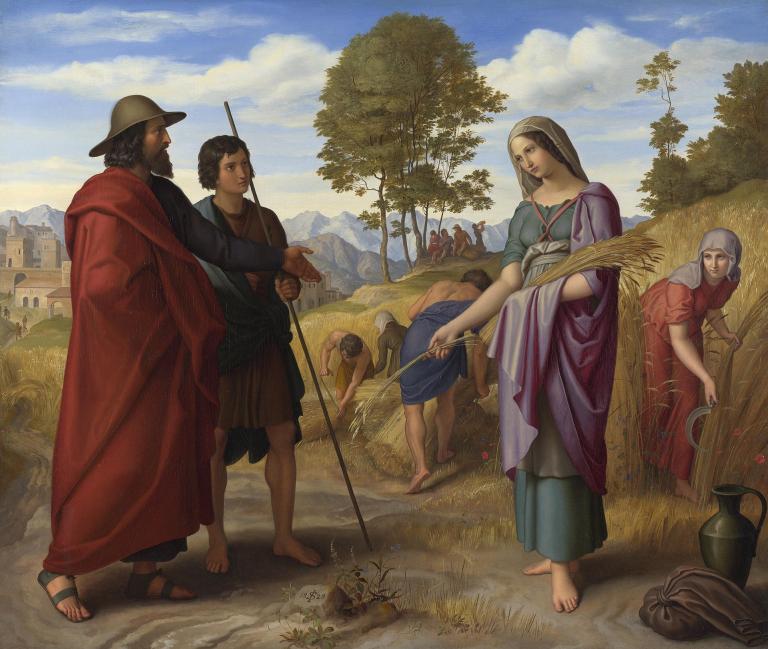
Julius Schnorr von Carolsfeld, “Ruth im Feld des Boaz” (1828, Ruth in the Feld of Boaz”)
Wikimedia Commons public domain image
This article from a previously-published Interpreter Foundation volume went up online yesterday, while I was busy elsewhere: The Temple: Past, Present and Future: “Ruth: An Allegorical Reading,” written by Mack Stirling. We hope that you’ll enjoy it:
Part of our book chapter reprint series, this article originally appeared in The Temple: Past, Present and Future, edited by Stephen D. Ricks and Jeffrey M. Bradshaw. For more information, go to https://interpreterfoundation.org/books/the-temple-past-present-and-future/. For video and audio recording of this conference talk, go to https://interpreterfoundation.org/conferences/2020-temple-on-mount-zion-conference/videos/stirling/.
“The book of Ruth easily lends itself to an allegorical interpretation, which corresponds in many ways to the endowment. Ruth, typifying any individual or Israel as a whole, undertakes and completes a journey to the Lord, typified by Boaz, the kinsman-redeemer. Ruth goes from emptiness/famine and the bitterness of family death to fulness and renewed family. As Ruth demonstrates obedience, initiative, and creativity, her ever strengthening relationship with Boaz (kinsman-redeemer) is betokened by intermittent gifts of food/grain (word of God, spiritual nourishment) from Boaz, which go beyond the requirements of the law. Finally, after washing, anointing, and putting on special clothing and under the cover of a night-veil Ruth achieves union with Boaz, the kinsman-redeemer. Afterwards, Boaz makes sure there is no legal claim to prevent his marriage to Ruth, Ruth brings forth a son, and she is acclaimed a mother in Israel.”
The older David Whitmer speaking with a reporter, in a scene from the Interpreter Foundation’s 2021 dramatic film “Witnesses.” (Still photograph by James Jordan, kindly furnished by Mark Goodman)

In time for this year’s Come, Follow Me discussions, we at the Interpreter Foundation are calling attention to the series of short video features that we created in connection with the overall Witnesses film project. Here are two of them:
Witnesses of the Book of Mormon—Insights Episode 12: In 1838, in reaction to persecution, some members of the Church formed a vigilante group known as the Danites. Much has been made of this group in folklore and anti-LDS propaganda. What do we actually know about this group? This is Episode 12 of a series compiled from the many interviews conducted during the course of the Witnesses film project.
Episode 13: Plural Marriage – Part 1
Witnesses of the Book of Mormon—Insights Episode 13: What do we know about the practice of plural marriage in the early Church? Who was Fanny Alger? This is Episode 13 of a series compiled from the many interviews conducted during the course of the Witnesses film project.
These additional resources are hosted by Camrey Bagley Fox, who played Emma Smith in Witnesses, as she introduces and visits with a variety of experts. These individuals answer questions or address accusations against the witnesses, also helping viewers understand the context of the times in which the witnesses lived. For these two episodes, we feature Gerrit Dirkmaat, Associate Professor of Church History and Doctrine at Brigham Young University. For more information, go to https://witnessesofthebookofmormon.org/. Learn about the documentary movie Undaunted—Witnesses of the Book of Mormon at https://witnessesundaunted.com/.
And, incidentally, Undaunted is now available for free streaming at The Witnesses Initiative. We hope that you’ll enjoy it and benefit from it and that, if you do, you’ll call it to the attention of others.

An illustration from an objective, scholarly, nineteenth-century study of Latter-day Saint theology and practice
(Wikimedia Commons public domain image)
Some of my habitual critics have mocked my expressions of concern about the current hit Netflix miniseries American Primeval. They’ve lampooned me (in a revealingly rather sexist image) as a pearl-clutching hysteric, reminded me that it’s “only fiction,” and sometimes written as if I’m the only one who sees anything problematic and even potentially dangerous in the image of Latter-day Saints that it’s fostering around the globe. I’ve provided a large number of links that demonstrate the contrary, of course, but here’s another, from Barbara Jones Brown, who speaks with some authority on the subject. The Oxford University Press book that she and Rick Turley recently co-wrote — Vengeance is Mine: The Mountain Meadows Massacre and Its Aftermath — has just received its fourth award, the Westerners International Best Book in Western American History. Here are some of her thoughts on the Netflix miniseries: “‘American Primeval’ left this historian confused and frustrated. Here’s why. The depiction of the Shoshone, Paiute, Ute, Latter-day Saint settlers, Arkansas emigrants and U.S. Army soldiers were far from reality in the Netflix miniseries, she writes”
And here, just published, is an official statement from the Church of Jesus Christ of Latter-day Saints that, without explicitly identifying the miniseries, comments upon American Primeval: “Depictions that Deceive: When Historical Fiction Does Harm”
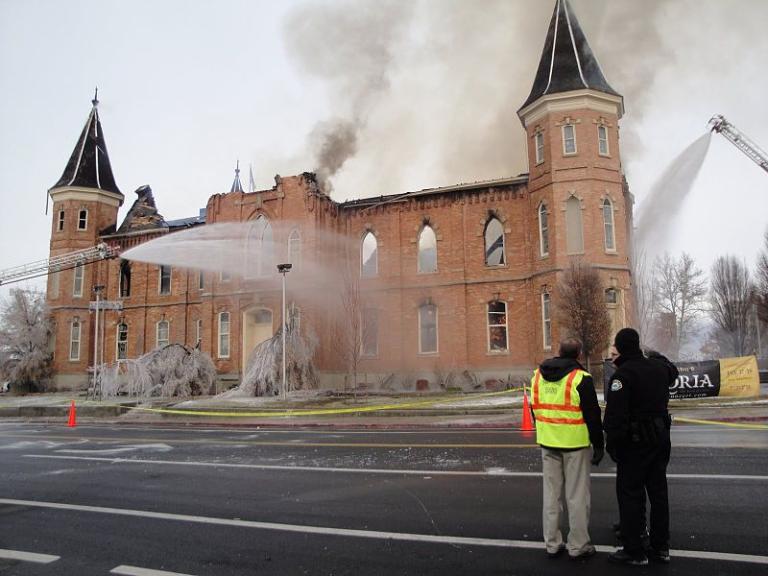
In the wake of the December 2010 fire that destroyed the Provo Tabernacle (which has now been reconstructed as the Provo City Center Temple). Wikimedia Commons public domain photo

The Provo Tabernacle in December 2010. (from a Provo mayoral website)
We attended a session yesterday afternoon in the Provo City Center Temple with our longtime friends Stephen and Shirley Ricks. Shirley currently serves as a member of the board of the Interpreter Foundation. Stephen was one of my companions in the Switzerland Zürich Mission and, for many years, a colleague of mine in the Department of Asian and Near Eastern Languages at Brigham Young University. After our session, we met up with our longtime friends Ed and Eileen Snow for dinner at Los Hermanos, which is located very near to the temple. Ed was also a missionary in Switzerland; for a time, he and I overlapped in the Bern missionary district. At the present time, having retired from LDS Philanthropies, he serves as the principal fundraiser for the Interpreter Foundation.
While sitting in the temple, which entered into December 2010 as the Provo Tabernacle and then emerged from a catastrophic fire to become something much more grand, my thoughts quite naturally turned to the concept and the hope of resurrection. The temple is far more beautiful now than it ever was as a tabernacle. It has been expanded underground. Its interior has been redesigned in a nineteenth-century Victorian style that its original builders might have used had they been creating a temple, albeit with modern improvements. (Take a look at photographs of the temple’s interior to see what I mean.) And, thus, I began to think of the famous and delightful epitaph that Benjamin Franklin once wrote for himself:
The Body
of
BENJAMIN FRANKLIN,
Printer,
(Like the cover of an old book its contents torn out
And stript of its lettering and gilding)
Lies here food for worms;
Yet the work itself shall not be lost,
For it will (as he believed) appear once more
In a new and more beautiful edition,
Corrected and amended by
The Author.
Travel and Religion
History and Religion
Previous Post

January 23, 2025
As political a blog entry as you'll see here
Next Post

January 25, 2025 A Life Lived in Crescendo
Recent Comments
"I have cpnsidered in my mond if the 4 volume Saints could be made into ..."
From Serbia’s “White City,” Belgrade
"DP: “But Mr. Sutherland worries about the fact that our time, when we can communicate ..."
Learning more about a region of ..."
"Another class of memories are of individuals who previously lived. Some of these remembered individuals ..."
"Sutherland's lecture sounds interesting. He seems to restate the Washington consensus that trade brings peace ..."
Learning more about a region of ..."
Browse Our Archives
Select a Category Uncategorized
Select a Month October 2026 September 2026 August 2026 July 2026 June 2026 May 2026 April 2026 March 2026 February 2026 January 2026 December 2025 November 2025 October 2025 September 2025 August 2025 July 2025 June 2025 May 2025 April 2025 March 2025 February 2025 January 2025 December 2024 November 2024 October 2024 September 2024 August 2024 July 2024 June 2024 May 2024 April 2024 March 2024 February 2024 January 2024 December 2023 November 2023 October 2023 September 2023 August 2023 July 2023 June 2023 May 2023 April 2023 March 2023 February 2023 January 2023 December 2022 November 2022 October 2022 September 2022 August 2022 July 2022 June 2022 May 2022 April 2022 March 2022 February 2022 January 2022 December 2021 November 2021 October 2021 September 2021 August 2021 July 2021 June 2021 May 2021 April 2021 March 2021 February 2021 January 2021 December 2020 November 2020 October 2020 September 2020 August 2020 July 2020 June 2020 May 2020 April 2020 March 2020 February 2020 January 2020 December 2019 November 2019 October 2019 September 2019 August 2019 July 2019 June 2019 May 2019 April 2019 March 2019 February 2019 January 2019 December 2018 November 2018 October 2018 September 2018 August 2018 July 2018 June 2018 May 2018 April 2018 March 2018 February 2018 January 2018 December 2017 November 2017 October 2017 September 2017 August 2017 July 2017 June 2017 May 2017 April 2017 March 2017 February 2017 January 2017 December 2016 November 2016 October 2016 September 2016 August 2016 July 2016 June 2016 May 2016 April 2016 March 2016 February 2016 January 2016 December 2015 November 2015 October 2015 September 2015 August 2015 July 2015 June 2015 May 2015 April 2015 March 2015 February 2015 January 2015 December 2014 November 2014 March 2014 August 2013 February 2012
Follow Us!
TAKE THE
Religious Wisdom Quiz
Which city did Paul describe as "a city filled with idols"?
Select your answer to see how you score.
Corinth Rome Athens Jerusalem
Related posts from Sic et Non


Notes on Women, Priesthood, and General Conference

"The Book of Moses as a Temple Text"

TRENDING AT PATHEOS Latter-day Saint

Letters on Living the Faith by C.S. Lewis
Most of us met C.S. Lewis as a public intellectual. Mere Christianity....

When Halloween Unmasks Married Hearts
Written by Dr. David K. Ewen from Eternal Truth Bible College Behind...

Aristotle. He’s been called the father of logic, the father of the...

Methodist Central Hall and Westminster Abbey
Situated on the same square is Methodist Central Hall and Westminster Abbey. ...

57th Dove Awards Honor Dolly Parton, Crown New...
On gospel music’s biggest night, the 57th annual GMA Dove Awards honored...

The First Eucharistic Controversy: Christ’s Real Presence
For Catholics, the Eucharist is the source and summit of the Christian...
view all Latter-day Saint blogs
What Are Your Thoughts?leave a comment
Ad-Free & Subscriber Log-In Subscription Support
- About Us
- 2026 Calendar
- Videos
- Podcasts
- Library of World Religions
- Faith In Media Tracker
- Advertise With Us
- Write for Us
- Privacy Policy
- Terms of Service
- Do Not Sell My Data
- Contact Us
- Radiant Digital
- Manage Newsletter Subscriptions
- Unsubscribe From Notifications
- Sitemap
Copyright 2008-2026, Patheos. All rights reserved.
Subscription Support Ad-Free & Subscriber Log-In
Follow Patheos