
BuddhistCatholicContemplativeEvangelicalGeneral ChristianHinduJewishLatter-day SaintMuslimNew VisionsProgressive Christian
Beliefs
- Buddhist
- Catholic
- Contemplative
- Evangelical
- General Christian
- Hindu
- Jewish
- Latter-day Saint
- More Voices
- Muslim
- New Visions
- Pagan
- Progressive Christian
Topics
- Religion News
- Food and Religion
- Sports and Religion
- Religious Art
- Religious Music and Entertainment
- Religious Events
- History and Religion
- Style and Religion
- Politics and Religion
- Women in Religion
- Recreation Outdoors and Religion
- Business Finance and Religion
- Careers Workplace and Religion
- Education and Religion
- Family Parenting and Religion
- Health Fitness and Religion
- Home and Religion
- Relationships and Religion
- Technology and Religion
- Travel and Religion
Columnists
- Buddhist Columnists
- Business Finance and Religion Columnists
- Careers Workplace and Religion Columnists
- Catholic Columnists
- Contemplative Columnists
- Education and Religion Columnists
- Evangelists Columnists
- Family Parenting and Religion Columnists
- General Christian Columnists
- Health Fitness and Religion Columnists
- Hindu Columnists
- History and Religion Columnists
- Home and Religion Columnists
- Jewish Columnists
- More Voices Columnists
- Latter Day Columnists
- Muslim Columnists
- New Visions Columnists
- Nonreligious Columnists
- Pagan Columnists
- Politics and Religion Columnists
- Progressive Columnists
- Recreation Outdoors and Religion Columnists
- Relationships and Religion Columnists
- Religion News Columnists
- Religious Art Columnists
- Religious Events Columnists
- Religious Music and Entertainment Columnists
- Sports and Religion Columnists
- Style and Religion Columnists
- Technology and Religion Columnists
- Travel and Religion Columnists
- Women in Religion Columnists
Resource Library
- 2026 Calendar
- Library of World Religions
- The 100 Most Holy Places on Earth
- Patheos Answers
- Podcasts
- Videos
- Faith Leaders Database
- Anglican Episcopalian
- Bahai
- Baptist
- Buddhism
- Christianity
- Confucianism
- Eastern Orthodoxy
- Hinduism
- Holiness and Pentecostal
- ISKCON
- Islam
- Judaism
- Lutheran
- Methodist
- The Church of Jesus Christ of Latter-day Saints
- New Age
- Paganism
- Presbytarian and Reformed
- Protestantism
- Religion Behind the Scenes
- Roman Catholic
- Scientology
- Shia Islam
- Sikhism
- Sufism
- Sunni Islam
- Taoism
- Zen
- See all religions
Research Tools
 Ad-Free & Subscriber Log-In Subscription Support
Ad-Free & Subscriber Log-In Subscription Support
Follow Patheos 

- Trending:
- Forgiveness
- |
- Marriage
- |
- Consciousness
- |
- Death Penalty
- |
- Election
- |
- Halloween

- Home
- Latter-day Saint
- Travel and Religion
- Until we meet again
Until we meet again
Last updated on: January 17, 2025 at 11:48 pm by Dan Peterson
Until we meet again 2025-01-17T23:48:56-07:00 Dan Peterson
Patheos Explore the world's faith through different perspectives on religion and spirituality! Patheos has the views of the prevalent religions and spiritualities of the world.
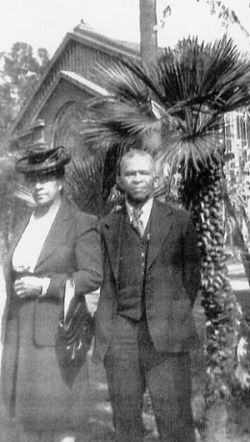
Abner Leonard Howell (1877-1966)
(public domain photograph)
A new article appeared earlier today in Interpreter: A Journal of Latter-day Saint Faith and Scholarship: “Small Hinges, Great Doorways: How Some Descendants of an Enslaved Youth Unexpectedly Became Prominent Utah Citizens,” written by Jeffrey M. Bradshaw
Abstract: A vivid illustration of how “the doorways of history turn on small hinges” is found in the Howell family tradition about Wilford Woodruff’s short stay at the home of slaveholders in the South, where it appears he may have taught a 14-year-old enslaved boy named Jackson Howell. Decades later, Jackson’s son Paul C. Howell would migrate to Utah and become a prominent citizen of Salt Lake City. Later, Paul’s son, Abner, would serve a unique mission and would continue to speak and serve in the Church. Several Church leaders played a key role in the story of the Howell family throughout the years when priesthood and temple restrictions remained in place.
Dr. Bradshaw’s article was accompanied online by “Interpreting Interpreter: A Hinge for the Howells,” which was written by Kyler Rasmussen:
This post is a summary of the article “Small Hinges, Great Doorways: How Some Descendants of an Enslaved Youth Unexpectedly Became Prominent Utah Citizens” by Jeffrey M. Bradshaw in Volume 63 of Interpreter: A Journal of Latter-day Saint Faith and Scholarship. All of the Interpreting Interpreter articles may be seen at https://interpreterfoundation.org/category/summaries/. An introduction to the Interpreting Interpreter series is available at https://interpreterfoundation.org/interpreting-interpreter-on-abstracting-thought/.
A video introduction to this Interpreter article is now available on all of our social media channels, including on YouTube at The Takeaway
Bradshaw tells the story of Abner Howell, a prominent African American Latter-day Saint in the early 20th century. Bradshaw proposes that Abner’s grandfather may have been a slave boy that Wilford Woodruff recorded teaching in Arkansas in 1835, and presents new records that shed light on Abner’s mission to reactivate Black members in various parts of the U.S.
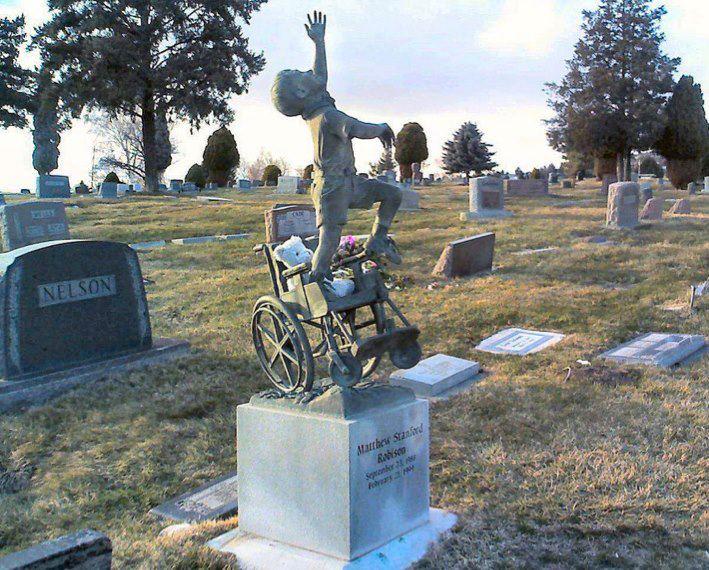
The grave monument of Matthew Stanford Robison (1988-1999) in the Salt Lake City Cemetery
We said our final farewell to my wife’s ninety-eight year-old father today. It was a wonderful funeral, full of tears and humor. As I’ve said many times before, the funeral of a good person can be one of the best, most inspiring, and most humbling meetings that we have — and my father-in-law was a remarkably good man in every respect.
The only thing that went awry was that one of his sons, who had flown over from his home in the Washington suburbs of Portland to be with his clearly dying father and then to assist with funeral preparations, became very ill last night and was unable even to attend his father’s services today. That seems to me deeply sad. What it meant was that his wife had to read his remarks today and that, in his stead, it was I who dedicated and consecrated the grave in the Salt Lake Cemetery.
Only a few feet to the east from where the burial took place today, which was amidst the graves of other members of my wife’s family, is the unostentatious marker of Harold B. Lee, eleventh president of the Church of Jesus Christ of Latter-day Saints. And maybe about a hundred feet further eastward from President Lee’s grave is the small but moving monument shown above. Here’s some background on my interest in it:
Back in 2013, I was moved by the obituary notice for Matthew Stanford Robison that appeared in the Deseret News: https://www.deseretnews.com/article/682084/Obituary-Matthew-Stanford-Robison.html I saw that notice at just about the time that a national atheist organization — in what was plainly intended as an in-your-face jab at the benighted Latter-day Saints — was very publicly planning to hold its national convention in Salt Lake City, and I commented on it in a blog post, as follows:
I know the arguments against theism reasonably well, and I don’t discount their force. By natural temperament, as it happens, I’m more inclined to skepticism than to faith. There are legitimate reasons for disbelief, though I ultimately find the reasons for belief more persuasive and find belief itself far more satisfying. What I’ve never understood, though, is how some people can seriously claim that atheism represents good news. I can understand coming sadly to the conclusion that life is purposeless, that the cosmos doesn’t care, and that, at death, we and our loved ones cease to exist. I simply can’t grasp why anybody would find this a message to be enthusiastic about.
I simply cannot imagine a more glorious, joyous message than the one that is implicit in the grave monument shown above. Certainly the message that we’re here briefly, pointlessly, and then rot, that all human relationships end in death if they haven’t already ended before, doesn’t quite compare. And almost every other message or fact seems trivial nonsense by contrast.
I can’t help but think of my father-in-law’s passing as a liberation. He had become very deaf, and his vision became poor. And, in his last months, his mind was noticeably less clear. He has now burst through those limitations.
But back to today’s funeral. At the conclusion of her remarks, my wife read a poem that has been credited to Henry Van Dyke. Many of you will, no doubt, be familiar with it. It expresses very well my own view of the subject:
I am standing upon the seashore.
A ship at my side spreads her white
sails to the morning breeze and starts
for the blue ocean.She is an object of beauty and strength.
I stand and watch her until at length
she hangs like a speck of white cloud
just where the sea and sky come
to mingle with each other.Then, someone at my side says;
“There, she is gone!”“Gone where?”
Gone from my sight. That is all.
She is just as large in mast and hull
and spar as she was when she left my side
and she is just as able to bear her
load of living freight to her destined port.
Her diminished size is in me, not in her.And just at the moment when someone
at my side says, “There, she is gone!”
There are other eyes watching her coming,
and other voices ready to take up the glad shout;
“Here she comes!”
And that is dying.
We had a service at the graveside, following the funeral at the mortuary chapel. My father-in-law enlisted in the Navy in 1945, when he was eighteen. But his service was cut short by, among other things, the surrender of Germany and the capitulation of the Empire of Japan. Accordingly, he was never particularly proud of his military career. However, his family requested a military honor guard, and I must say that I was impressed by it. (It was a Navy group, but one of his granddaughters is an active-duty Air Force officer currently stationed near Washington DC and, happily, she was allowed to participate with the honor guard, in uniform.) I wish that we had done the same for my own father’s graveside service. He was already serving in the Army when Pearl Harbor was attacked, and he remained enlisted ’til the conflict was o’er — that is, until the end of the Second World War, by which time he was attached to the Eleventh Armored Division of General George S. Patton’s Third Army.
The chaplain of the Naval Honor Guard recited a poem that I had never heard before. However, I was able to track it down online, and I found that it was written in May 1942 by one Sherman Walgren, who was (along with the future stage and screen actor Jason Robards) a sailor aboard the cruiser USS Northampton, which was sunk by Japanese torpedoes on 30 November of that same year at the Battle of Tassafaronga. Here is the poem that was recited early this afternoon:
What is it the billowing waves impart,
and repeat and repeat with each dash
What is the pounding in my heart?
I’m sailing home, at last.The salt spray stings on the naked cheek,
and the wind sings in the mast,
but it only sings because it knows,
I’m sailing home, at last.Was it centuries since we sailed away
Out of the harbor there,
or was it only yesterday
I don’t know, nor care.For gone are the lonely nights and the days
mid tropical isles alone
and gone is the hunger countenanced there,
At last I’m sailing home.And tho the sailor sails the seas
and in distant places roam
There is no “call” that’s quite so sweet
as the call “I’m Sailing Home”
My father-in-law has gone home. We will sorely miss him. If, however, there was ever an honorable return, his was one. May his memory be a blessing.
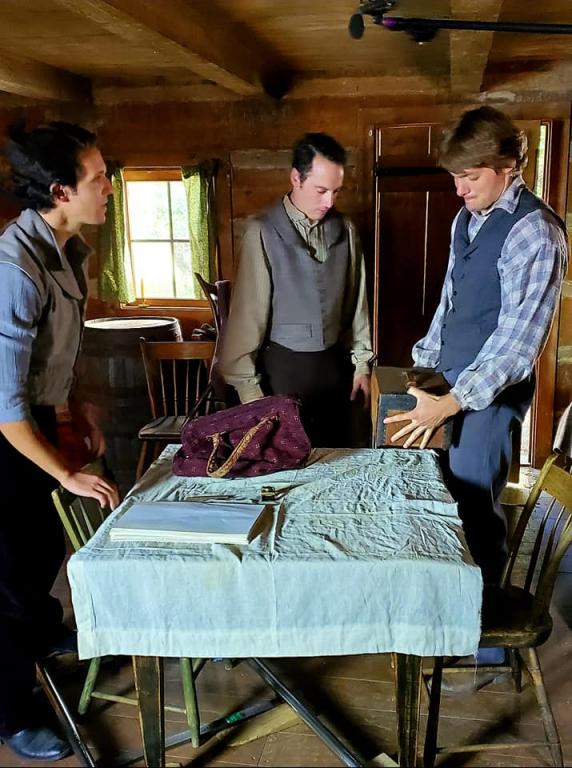
From left to right, in a still photograph by James Jordan from the set of the Interpreter Foundation’s 2021 film “Witnesses”: Oliver Cowdery, David Whitmer, and Joseph Smith (who has the plates in a box)
“Episode 8: What was the Cost of Being a Witness?”
Once again, in a bid to support teachers and students of the 2025 Come, Follow Me curriculum, which turns shortly to the translation of publication of the Book of Mormon, the Interpreter Foundation is making materials from its Witnesses film project as available as possible to the public. Here, for example, is a short-video feature that we think some of you might find interesting. And we encourage you to share it further:
Witnesses of the Book of Mormon—Insights: What price did the witnesses pay for being witnesses—and for never denying their testimonies of the Book of Mormon? This is Episode 8 of a series compiled from the many interviews conducted during the course of the Witnesses film project. . . . These additional resources are hosted by Camrey Bagley Fox, who played Emma Smith in Witnesses, as she introduces and visits with a variety of experts. These individuals answer questions or address accusations against the witnesses, also helping viewers understand the context of the times in which the witnesses lived. This week we feature Gerrit Dirkmaat, Associate Professor of Church History and Doctrine at Brigham Young University. For more information, go to https://witnessesofthebookofmormon.org/. Learn about the documentary movie Undaunted—Witnesses of the Book of Mormon at https://witnessesundaunted.com/.
Posted from Bountiful, Utah
Travel and Religion
History and Religion
Previous Post

January 16, 2025
Strolling on the ice floes of the Galilee?
Next Post
January 18, 2025 Songs of the Heart
Recent Comments
"Sutherland's lecture sounds interesting. He seems to restate the Washington consensus that trade brings peace ..."
Learning more about a region of ..."
"In a meeting today, I learned another important reason why accurate (or at least as ..."
From Serbia’s “White City,” Belgrade
"I've been watching a lot of video interviews of NDErs and researchers. I think in ..."
"PL: "Let's hope he doesn't have your address..."I have to frankly confess that a few ..."
From Serbia’s “White City,” Belgrade
Browse Our Archives
Select a Category Uncategorized
Select a Month October 2026 September 2026 August 2026 July 2026 June 2026 May 2026 April 2026 March 2026 February 2026 January 2026 December 2025 November 2025 October 2025 September 2025 August 2025 July 2025 June 2025 May 2025 April 2025 March 2025 February 2025 January 2025 December 2024 November 2024 October 2024 September 2024 August 2024 July 2024 June 2024 May 2024 April 2024 March 2024 February 2024 January 2024 December 2023 November 2023 October 2023 September 2023 August 2023 July 2023 June 2023 May 2023 April 2023 March 2023 February 2023 January 2023 December 2022 November 2022 October 2022 September 2022 August 2022 July 2022 June 2022 May 2022 April 2022 March 2022 February 2022 January 2022 December 2021 November 2021 October 2021 September 2021 August 2021 July 2021 June 2021 May 2021 April 2021 March 2021 February 2021 January 2021 December 2020 November 2020 October 2020 September 2020 August 2020 July 2020 June 2020 May 2020 April 2020 March 2020 February 2020 January 2020 December 2019 November 2019 October 2019 September 2019 August 2019 July 2019 June 2019 May 2019 April 2019 March 2019 February 2019 January 2019 December 2018 November 2018 October 2018 September 2018 August 2018 July 2018 June 2018 May 2018 April 2018 March 2018 February 2018 January 2018 December 2017 November 2017 October 2017 September 2017 August 2017 July 2017 June 2017 May 2017 April 2017 March 2017 February 2017 January 2017 December 2016 November 2016 October 2016 September 2016 August 2016 July 2016 June 2016 May 2016 April 2016 March 2016 February 2016 January 2016 December 2015 November 2015 October 2015 September 2015 August 2015 July 2015 June 2015 May 2015 April 2015 March 2015 February 2015 January 2015 December 2014 November 2014 March 2014 August 2013 February 2012
Follow Us!
TAKE THE
Religious Wisdom Quiz
What is the correct order of the seven churches addressed in Revelation?
Select your answer to see how you score.
Ephesus, Pergamum, Smyrna, Sardis, Thyatira, Laodicea, Philadelphia Laodicea, Philadelphia, Sardis, Thyatira, Pergamum, Smyrna, Ephesus Ephesus, Smyrna, Pergamum, Thyatira, Sardis, Philadelphia, Laodicea Smyrna, Ephesus, Thyatira, Pergamum, Philadelphia, Sardis, Laodicea
Related posts from Sic et Non


Some notes on the archaeology of the Bible


TRENDING AT PATHEOS Latter-day Saint

I was strolling through the top floor of the brand new Parthenon...

What Does Gêvâh Mean For Kimberley Guifoyle &...
This week, a lot of the news is focused on Kimberly Guilfoyle....

INNER CIRCLE: Profound Mystery (Of Christ In All...
Ephesians 5:31-32 “For this reason, a man will leave his father and...

Do Not Rejoice When Your Enemy Falls: The...
Turning an execution into a public spectacle is a disturbing expression of...

'The Chosen' S6 Trailer: The Passion Gets Very...
Not many watching 'The Chosen' worry about spoilers, but just because they...

The purpose-driven labor priest
A labor activist reads Rick Warren and it gets me wondering about...
view all Latter-day Saint blogs
What Are Your Thoughts?leave a comment
Ad-Free & Subscriber Log-In Subscription Support
- About Us
- 2026 Calendar
- Videos
- Podcasts
- Library of World Religions
- Faith In Media Tracker
- Advertise With Us
- Write for Us
- Privacy Policy
- Terms of Service
- Do Not Sell My Data
- Contact Us
- Radiant Digital
- Manage Newsletter Subscriptions
- Unsubscribe From Notifications
- Sitemap
Copyright 2008-2026, Patheos. All rights reserved.
Subscription Support Ad-Free & Subscriber Log-In
Follow Patheos