
BuddhistCatholicContemplativeEvangelicalGeneral ChristianHinduJewishLatter-day SaintMuslimNew VisionsProgressive Christian
Beliefs
- Buddhist
- Catholic
- Contemplative
- Evangelical
- General Christian
- Hindu
- Jewish
- Latter-day Saint
- More Voices
- Muslim
- New Visions
- Pagan
- Progressive Christian
Topics
- Religion News
- Food and Religion
- Sports and Religion
- Religious Art
- Religious Music and Entertainment
- Religious Events
- History and Religion
- Style and Religion
- Politics and Religion
- Women in Religion
- Recreation Outdoors and Religion
- Business Finance and Religion
- Careers Workplace and Religion
- Education and Religion
- Family Parenting and Religion
- Health Fitness and Religion
- Home and Religion
- Relationships and Religion
- Technology and Religion
- Travel and Religion
Columnists
- Buddhist Columnists
- Business Finance and Religion Columnists
- Careers Workplace and Religion Columnists
- Catholic Columnists
- Contemplative Columnists
- Education and Religion Columnists
- Evangelists Columnists
- Family Parenting and Religion Columnists
- General Christian Columnists
- Health Fitness and Religion Columnists
- Hindu Columnists
- History and Religion Columnists
- Home and Religion Columnists
- Jewish Columnists
- More Voices Columnists
- Latter Day Columnists
- Muslim Columnists
- New Visions Columnists
- Nonreligious Columnists
- Pagan Columnists
- Politics and Religion Columnists
- Progressive Columnists
- Recreation Outdoors and Religion Columnists
- Relationships and Religion Columnists
- Religion News Columnists
- Religious Art Columnists
- Religious Events Columnists
- Religious Music and Entertainment Columnists
- Sports and Religion Columnists
- Style and Religion Columnists
- Technology and Religion Columnists
- Travel and Religion Columnists
- Women in Religion Columnists
Resource Library
- 2026 Calendar
- Library of World Religions
- The 100 Most Holy Places on Earth
- Patheos Answers
- Podcasts
- Videos
- Faith Leaders Database
- Anglican Episcopalian
- Bahai
- Baptist
- Buddhism
- Christianity
- Confucianism
- Eastern Orthodoxy
- Hinduism
- Holiness and Pentecostal
- ISKCON
- Islam
- Judaism
- Lutheran
- Methodist
- The Church of Jesus Christ of Latter-day Saints
- New Age
- Paganism
- Presbytarian and Reformed
- Protestantism
- Religion Behind the Scenes
- Roman Catholic
- Scientology
- Shia Islam
- Sikhism
- Sufism
- Sunni Islam
- Taoism
- Zen
- See all religions
Research Tools
 Ad-Free & Subscriber Log-In Subscription Support
Ad-Free & Subscriber Log-In Subscription Support
Follow Patheos 

- Trending:
- Forgiveness
- |
- Marriage
- |
- Consciousness
- |
- Death Penalty
- |
- Election
- |
- Halloween

- Home
- Latter-day Saint
- Happy Thanksgiving!
Happy Thanksgiving!
Last updated on: November 28, 2024 at 10:57 am by Dan Peterson
Happy Thanksgiving! 2024-11-28T10:57:56-07:00 Dan Peterson
Patheos Explore the world's faith through different perspectives on religion and spirituality! Patheos has the views of the prevalent religions and spiritualities of the world.
I wish a Happy Thanksgiving to all of my fellow Americanos out there. And — why not? — I hope that all of you non-Americans have a good day, too!
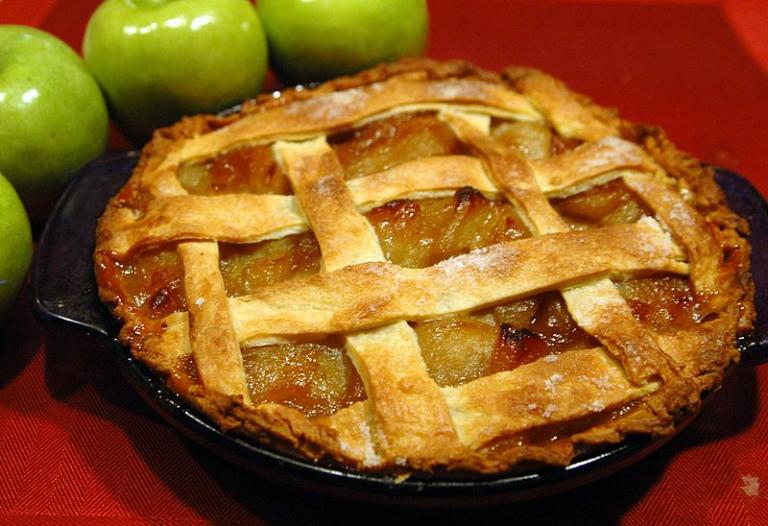
Are you familiar with the saying “As cosmic as apple pie”? Neither am I. (Wikimedia Commons public domain image)
I published this article, entitled “The miracle of Thanksgiving pies,” in the 23 November 2017 issue of the Deseret News:
“If you wish to make an apple pie from scratch,” the late American astronomer and science popularizer Carl Sagan once quipped, “you must first invent the universe.”
As Americans enjoy their Thanksgiving dinners today, many of those dinners will include apple pie. But any other food would serve to make Sagan’s important point.
Unless we ourselves grew the apples and grains and other ingredients vital to our apple pie, we can’t really claim to have made it from scratch. After all, those components came to us via complex and varied trade networks, from widely scattered farms.
Moreover, the hardworking farmers who grew our apples and the grains for our pie crusts didn’t create them out of nothing. They came from pre-existing seeds.
Lest this column rapidly grow far too complicated, though, we’ll concentrate only on the apples:
The Rev. William Blaxton planted the first apple orchard in North America in Boston, in 1625. But apples had already been grown in Asia and Europe for millennia. In fact, the apple tree, which originated in Central Asia, may have been the earliest tree ever cultivated.
Where do apple trees come from, ultimately? The origin of life on Earth as a whole remains a mystery; science doesn’t know how or whence it arose. But apples are very far from simple or primitive organisms. The apple genome, its genetic material, may contain more genes than any other plant genome yet analyzed, and perhaps even more than the human genome does. But even a single gene is a remarkable thing. Unlike the machines that humans create, DNA — the hereditary material in cells — has the capacity to reproduce itself. Planting a Porsche or a hammer doesn’t yield new craftsman’s tools or sports cars. Apple trees, though, produce seeds that, in their turn, yield new apple trees.
This would all be irrelevant, of course, had chemical and biological processes not created soil in which to plant apple seeds. Moreover, according to some current science, that soil wouldn’t have contained key ingredients for the chemistry of life— elements such as hydrogen, oxygen, nitrogen, phosphorus and sulfur — if they weren’t regularly replenished by the constant movements of the tectonic plates that cover Earth’s surface. (In other words, you may owe your apple pie to the same forces that cause earthquakes.)
There would be no soil, though, no tectonic plates and neither apples nor apple pie if there were no Earth. Where did it come from? Our solar system formed roughly 4.6 billion years ago and, shortly thereafter, the Earth began to coalesce.
Ultimately, of course, the genesis of apples is to be found in the Big Bang, which occurred (for reasons that may lie forever beyond the reach of science) about 13.7 billion years ago.
But the path from the Big Bang to the appearance of life (and apple pies) on Earth is paved with remarkable facts. Somehow, only a fraction of a second after that unimaginable explosion, nature’s fundamental forces were established — in ways that make life possible.
If, for example, gravity differed even slightly — making you weigh a billionth of a gram more or less than you do — or if the universe’s expansion rate were even slightly slower or faster, or if the overall density of the cosmos varied by as little as 0.0000000000001 percent — roughly the same precision required for a blindfolded man to choose a single predesignated coin from a pile of pennies sufficient to pay off the national debt of the United States — either a “Big Crunch” would shortly have followed the Big Bang or, alternatively, atoms would have scattered so widely that neither galaxies, stars, planets nor apples could have formed.
Sir Fred Hoyle (d. 2001), an illustrious astronomer and a vocal atheist, conducted pathbreaking research into the indispensable role that stars played in the synthesis of all the chemical elements heavier than helium — including carbon — without which life (and apple pie) would be impossible. What he found shocked him deeply:
“A commonsense interpretation of the facts,” he commented, “suggests that a superintellect has monkeyed with physics, as well as with chemistry and biology, and that there are no blind forces worth speaking about in nature. The numbers one calculates from the facts seem to me so overwhelming as to put this conclusion almost beyond question.”
Making apple pie absolutely from scratch is plainly more difficult than most of us have imagined. Downright mysterious, in fact. Praise God, from whom all blessings flow.
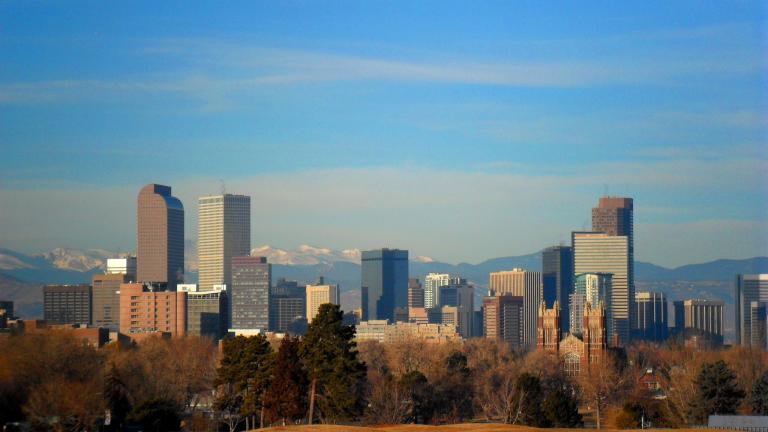
The Denver, Colorado, skyline (Wikimedia Commons public domain image)
This next column, regarding the debt that we owe to God and our predecessors, had already appeared in the Deseret News on 22 November 2012:
William Ernest Henley’s famous Victorian-era poem “Invictus” provided the title and the theme for Clint Eastwood’s inspiring 2009 film about Nelson Mandela. It also provided the memorable claim, “I am the master of my fate: I am the captain of my soul.”
It’s a stirring assertion, and, in a very real sense, true. A great proportion of what we are and do rests upon our own decisions.
But not everything, and perhaps not the most important things. Henley’s claim is also false and misleading.
As I write, a friend and neighbor is recuperating from a catastrophic fall that lacerated his face, took out most of his teeth, broke major bones everywhere in his body, and very nearly killed him. As he plunged toward the ground, he certainly wasn’t the master of his fate, and he’s scarcely more so as he lies in a hospital bed. Those who’ve surveyed the spot where he landed regard his survival as a miracle, and he himself, speaking with difficulty, testifies to it.
“I thank whatever gods may be,” says Henley, “for my unconquerable soul.”
Thirty years ago, my wife and I traveled with our infant son from Southern California to her parents’ house in Denver, where the whole extended family were gathering for a Christmas trip to Florida. We participated in a “Messiah” sing-along and then went home to prepare for our flight to Orlando the next morning.
But then came what’s been called “the Christmas Eve blizzard of 1982.” Stapleton International Airport closed at 9:30 a.m. on Dec. 24, remained closed for fully 33 hours, and then, for several days thereafter, was open only for severely limited operations.
Ten-foot-high snowdrifts were left throughout greater Denver, highways into and out of the city were shut down, power outages darkened large portions of the metropolitan area, roofs collapsed, supermarkets closed because their employees couldn’t get to work, hospitals were reduced to minimal staff on emergency power and snowmobiles dominated suburban streets.
It was astounding to me, and revealing, to realize how easily simple snowfall could shut down a major modern city quite accustomed to seeing it.
We’re plainly not entirely the masters of our fates, the captains of our souls. Rather, as Elder Orson F. Whitney (d. 1931) of the Quorum of the Twelve Apostles put it in “The Soul’s Captain,” his response to “Invictus,” “Men are as bubbles on the wave, as leaves upon the tree.”
We’re fragile creatures. A few days without food, even fewer without water, a few minutes without oxygen and we’re gone.
If our hearts miss just a few beats, none of our plans, ambitions, schemes or careful investments will mean a thing. And, in the end, no matter how we fight it, we’ll die.
Our comfort and survival in the meantime depend upon cycles of evaporation and precipitation that few of us really understand, and we rely upon complex networks of exchange and transportation that very few of us could begin to explain.
The ground on which most of us live and where our food is grown was cleared of rocks, trees and stumps by millions of hardworking people whose names we’ve forgotten.
Our cities — big and small — feature large buildings erected by generations of construction workers to whom we’ve probably never given the slightest thought.
We owe a debt of gratitude that we can never repay.
“For behold, are we not all beggars? Do we not all depend upon … God, for all the substance which we have, for both food and raiment, and for gold, and for silver, and for all the riches which we have of every kind?” (Mosiah 4:19).
The Book of Mormon’s Amulek wisely counsels us that we should “humble ourselves even to the dust, and worship God, in whatsoever place we may be in, in spirit and in truth; and that we live in thanksgiving daily, for the many mercies and blessings which he doth bestow upon us” (paraphrased slightly from Alma 34:38).
In the United States, where many of us are gathering together as families and friends for the Thanksgiving holiday, this is an exceptionally appropriate day for us to remember the debt that we owe to those who’ve preceded us and to God, “in whom we live, and move, and have our being” (Acts 17:28).
Christmas Eve blizzard of 1982
Previous Post
November 27, 2024
Thinking and Thanking
Next Post

November 29, 2024 "A Book of Mormon Mystery"?
Recent Comments
"DP: “But Mr. Sutherland worries about the fact that our time, when we can communicate ..."
Learning more about a region of ..."
"Another class of memories are of individuals who previously lived. Some of these remembered individuals ..."
"Sutherland's lecture sounds interesting. He seems to restate the Washington consensus that trade brings peace ..."
Learning more about a region of ..."
"In a meeting today, I learned another important reason why accurate (or at least as ..."
From Serbia’s “White City,” Belgrade
Browse Our Archives
Select a Category Uncategorized
Select a Month October 2026 September 2026 August 2026 July 2026 June 2026 May 2026 April 2026 March 2026 February 2026 January 2026 December 2025 November 2025 October 2025 September 2025 August 2025 July 2025 June 2025 May 2025 April 2025 March 2025 February 2025 January 2025 December 2024 November 2024 October 2024 September 2024 August 2024 July 2024 June 2024 May 2024 April 2024 March 2024 February 2024 January 2024 December 2023 November 2023 October 2023 September 2023 August 2023 July 2023 June 2023 May 2023 April 2023 March 2023 February 2023 January 2023 December 2022 November 2022 October 2022 September 2022 August 2022 July 2022 June 2022 May 2022 April 2022 March 2022 February 2022 January 2022 December 2021 November 2021 October 2021 September 2021 August 2021 July 2021 June 2021 May 2021 April 2021 March 2021 February 2021 January 2021 December 2020 November 2020 October 2020 September 2020 August 2020 July 2020 June 2020 May 2020 April 2020 March 2020 February 2020 January 2020 December 2019 November 2019 October 2019 September 2019 August 2019 July 2019 June 2019 May 2019 April 2019 March 2019 February 2019 January 2019 December 2018 November 2018 October 2018 September 2018 August 2018 July 2018 June 2018 May 2018 April 2018 March 2018 February 2018 January 2018 December 2017 November 2017 October 2017 September 2017 August 2017 July 2017 June 2017 May 2017 April 2017 March 2017 February 2017 January 2017 December 2016 November 2016 October 2016 September 2016 August 2016 July 2016 June 2016 May 2016 April 2016 March 2016 February 2016 January 2016 December 2015 November 2015 October 2015 September 2015 August 2015 July 2015 June 2015 May 2015 April 2015 March 2015 February 2015 January 2015 December 2014 November 2014 March 2014 August 2013 February 2012
Follow Us!
TAKE THE
Religious Wisdom Quiz
What does "Jezebel" mean in Hebrew?
Select your answer to see how you score.
Daughter of Baal Queen of the people Unexalted The Lord reigns
Related posts from Sic et Non


A really, really long post for the eve...
As easy a way to do good as...
TRENDING AT PATHEOS Latter-day Saint

How to Make a Decision When You Can't...
Main point: It’s much more valuable to stay close to God so...

Archdiocese Hosts Military Marriage Retreat in Germany
RASTATT, Germany — The transient military lifestyle, with its frequent deployments and...

Nearly every morning, I make the drive to Detroit with my high-school-age...

The Real AI Story Is Adoption Without Trust
Artificial intelligence has crossed a political threshold. It is no longer a...

A new article, written by Jeff Lindsay and Gale L. Pooley,...

Swimfan: Forgotten Aughts Pleasures
This is a recovery effort. In 2002, My Big Fat Greek Wedding...
view all Latter-day Saint blogs
What Are Your Thoughts?leave a comment
Ad-Free & Subscriber Log-In Subscription Support
- About Us
- 2026 Calendar
- Videos
- Podcasts
- Library of World Religions
- Faith In Media Tracker
- Advertise With Us
- Write for Us
- Privacy Policy
- Terms of Service
- Do Not Sell My Data
- Contact Us
- Radiant Digital
- Manage Newsletter Subscriptions
- Unsubscribe From Notifications
- Sitemap
Copyright 2008-2026, Patheos. All rights reserved.
Subscription Support Ad-Free & Subscriber Log-In
Follow Patheos